By Jean Baptiste Ndabananiye

We are convinced that the Apostle Paul’s Letter to the Romans is familiar to most people. Its verses reverberate across sermons, studies, centuries and continents—cited, cherished, and often supposed to be well comprehended. But pause for a moment: do we truly know who these Romans are? Was Paul the Apostle writing to the vast population of the powerful Roman Empire—millions spread across continents, cultures, and classes? Or was his message designed for a far more specific, perhaps surprising audience?
These questions have intrigued us, not merely out of historical curiosity, but because the answer affects how we read one of the most influential texts in the Holy Bible. If we misunderstand the initial recipients, we risk misreading the message itself.
So, who, really, were the Romans Paul addressed—and why does it matter more than we might think?
These Romans were not all the inhabitants of the Roman Empire
When the Apostle Paul wrote the Epistle to the Romans, he was communicating to Christians living in the city of Rome, not all the inhabitants of the entire Roman Empire. These Romans formed a mix of Jews and Gentiles [non-Jews] who had come to believe in Jesus Christ.
The Roman Empire stood vast—extending across Europe, North Africa, and some parts of Asia. Most people living in it were not Christians, spoke different languages and adhered to different religions. Paul’s letter, in this regard, is similar to writing a letter to Parisians. That doesn’t mean that you’re writing to all Europeans—just people living in Paris— the capital of France.
“Letter of Paul to the Romans, sixth book of the New Testament and the longest and doctrinally most significant of St. Paul the Apostle’s writings. It was probably composed at Corinth in about 57 ce [Common Era/Current Era/Christian Era]. The epistle was addressed to the Christian church at Rome, whose congregation Paul hoped to visit for the first time on his way to Spain. The letter has been intensely studied since early Christian times and was the basis of Martin Luther’s teaching on justification by faith alone,” Britannica states.
The Milwaukee Public Museum forms a natural and human history museum situated in the Westown neighborhood of Downtown Milwaukee, Wisconsin in the United States of America. In its undated piece entitled “The Roman Empire: A Brief History”, it reports “Rome was founded around 625 BC in the areas of ancient Italy known as Etruria and Latium. It is thought that the city-state of Rome was initially formed by Latium villagers joining together with settlers from the surrounding hills in response to an Etruscan invasion. It is unclear whether they came together in defense or as a result of being brought under Etruscan rule. Archaeological evidence indicates that a great deal of change and unification took place around 600 BC which likely led to the establishment of Rome as a true city.”

Insight for Living constitutes a global Christian teaching organization founded by the Pastor Charles R. Swindoll. It focuses on helping people to understand and use the Bible in everyday life in a practical and relatable way. This religious organization says “The apostle Paul wrote to the Romans from the Greek city of Corinth in AD 57, just three years after the 16-year-old Nero had ascended to the throne as Emperor of Rome.
The political situation in the capital had not yet deteriorated for the Roman Christians, as Nero wouldn’t begin his persecution of them until he made them scapegoats after the great Roman fire in AD 64. Therefore, Paul wrote to a church that was experiencing a time of relative peace, but a church that he felt needed a strong dose of basic gospel doctrine.”
Paul was a Jew and Roman citizen and we will come back to him in detail in an article which will explain how he also oppressed Christians, before being converted. For example, Vatican News in its dateless story entitled “Saint Paul, Apostle of the City of Rome” reports “He never met Jesus while Our Lord was on Earth, and was among the first to persecute Christians, whom he considered a dangerous sect to be overthrown. In the Scriptures he is mentioned for the first time in the narrative of the stoning of St. Stephen – the first Christian martyr – in Jerusalem. A proud advocate of Jewish tradition, Saul, ‘sought to destroy the Church: he went into the houses, took men and women, and put them in prison’ (Acts 8: 3). The disciples feared him, and to escape the persecution, some fled to various cities, including Damascus.”
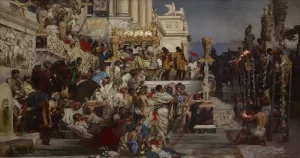
Global Christian Relief, with its 23 December 2024 story entitled “Why did the Romans persecute Christians?”, reports “One of the most infamous episodes of early Christian persecution in Rome occurred during the reign of Emperor Nero. In AD 64, a massive fire—later called the Great Fire—swept through Rome, destroying much of the city. To deflect blame, Nero accused Christians of starting the fire. This marked a significant moment for the heightened persecution of Christians in the Roman Empire.”
Though the Emperor Nero imputed this extremely tragic fire to the Christian Community in Rome, it is alleged that it was he who himself turned the capital city into ashes, for reasons explained by PBS [Public Broadcasting Service— an American public broadcaster]. “Though the infamous emperor Nero ruled Rome for less than two decades, his reign witnessed tremendous changes to the empire’s capital city.
One of his grandest plans was to tear down a third of Rome so that he could build an elaborate series of palaces that would be known as Neropolis. The senate, however, objected ardently to this proposal. Exactly what happened next has remained a mystery for nearly 2,000 years.”
PBS adds “On the night of July 19, 64 A.D. [Anno Domini literally meaning ‘in the year of the Lord Jesus Christ— the years counted after his birth], a fire broke out among the shops lining the Circus Maximus, Rome’s mammoth chariot stadium. In a city of two million, there was nothing unusual about such a fire — the sweltering summer heat kindled conflagrations around Rome on a regular basis, particularly in the slums that covered much of the city.
Knowing this, Nero himself was miles away in the cooler coastal resort of Antium. Yet this was no ordinary fire. The flames raged for six days before coming under control; then the fire reignited and burned for another three. When the smoke cleared, 10 of Rome’s 14 districts were in ruin. The 800-year-old Temple of Jupiter Stator and the Atrium Vestae, the hearth of the Vestal Virgins, were gone. Two thirds of Rome had been destroyed.”
This American broadcaster reports that Nero set Rome on the fire, so as for him to procure justifiable grounds to have his rejected ambition smoothly implemented. The broadcaster also mentions some evidence which suggests that this Roman ruler must have razed the city with the conflagration intentionally. “History has blamed Nero for the disaster, implying that he started the fire so that he could bypass the senate and rebuild Rome to his liking. Much of what is known about the great fire of Rome comes from the aristocrat and historian Tacitus, who claimed that Nero watched Rome burn while merrily playing his fiddle.
Gangs of thugs prevented citizens from fighting the fire with threats of torture, Tacitus wrote. There is some support for the theory that Nero leveled the city on purpose: the Domus Aurea, Nero’s majestic series of villas and pavilions set upon a landscaped park and a man-made lake, was built in the wake of the fire.”
The fact that Nero charged the Christian community in Rome with burning the city to that extent unquestionably substantiates that the Romans to whom the Apostle gave the epistle were the city’s inhabitants. This is corroborated by Eye Witness to History in its dateless piece titled “Nero Persecutes The Christians, 64 A.D.” It echoes PBS, saying “A generation after the death of Christ, Christianity had reached Rome in the form of an obscure offshoot of Judaism popular among the city’s poor and destitute. In the summer of 64, Rome suffered a terrible fire that burned for six days and seven nights consuming almost three quarters of the city.
The people accused the Emperor Nero for the devastation claiming he set the fire for his own amusement. In order to deflect these accusations and placate the people, Nero laid blame for the fire on the Christians. The emperor ordered the arrest of a few members of the sect who, under torture, accused others until the entire Christian populace was implicated and became fair game for retribution.”

Eye Witness to History cites Tacitus as saying “Therefore, to stop the rumor [that he had set Rome on fire], he [Emperor Nero] falsely charged with guilt, and punished with the most fearful tortures, the persons commonly called Christians, who were [generally] hated for their enormities.”
PBS specifies that the above quote has been extracted from Tacitus’ book “Annals” published a few years after the event. “Tacitus was a young boy living in Rome during the time of the persecutions.”
How the church in Rome started and what happened to it
The most acknowledged statement is that Jews from Rome were in Jerusalem on the Day of Pentecost, and were converted by Peter’s preaching. They then returned to Rome and created the first Christian communities within local synagogues. For more on this, you can read the Acts of Apostles— Chapter 2.
Another accepted reason behind the church in Rome “Romans” is traveling believers. As believers arrived in the center of the Roman empire, Rome, from Jerusalem, Antioch, and Corinth; they naturally disseminated the gospel, propagating the faith to the capital. Biblical Hermeneutics Stack Exchange, with its almost 8-year-old piece entitled “Who planted the assembly in Rome to whom Paul wrote ‘Romans’?” elaborates on it. The unnamed writer of the piece has said “Catholic tradition says that Peter established the assembly but there does not appear to be any evidence to that effect. In fact, Peter is not even mentioned in chapter 16 where Paul sends his various personal greetings.
The most useful suggestion I have found so far is from a post on another forum. I would suggest that the Church in Rome was planted by those ‘visitors’ from Rome who were in Jerusalem on the Day of Pentecost and were witnesses to the outpouring of the Holy Spirit upon the apostles and those who were gathered with them. Reading Acts 2:7-11 we can note that verse 10 includes the words ‘… strangers from Rome …’”
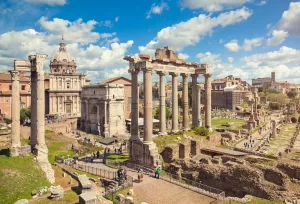
The author reiterates “Therefore I would suggest that the Church in Rome was the result of those Roman visitors who accepted Christ as their Savior—being either among the 3,000 men that day or the additional 5,000 a few days later—who then returned to Rome and brought with them the gospel which they shared in obedience to Christ.
No doubt evangelists went to Rome from the early Church in Jerusalem, as well. Possibly even an apostle. But when Paul ended his letter to the Church at Rome (written from Corinth during the winter of 57-58 A.D.) he named over two dozen individual Christians in Rome and not one of the apostles was mentioned.”
The website— Bible Hub, in its undated article titled “The Church in Rome”— echoes it too. “The origins of the Roman church are not explicitly detailed in the New Testament, but it is widely believed that the church was established by Jewish Christians who were present in Jerusalem during Pentecost (Acts 2:10) and later returned to Rome.”
We strongly believe that the “Romans” addressed by Paul the Apostle in his epistle haven’t disappeared as a community—they have instead been assimilated into the society in ways that have molded much of the modern world.
So, whom have the Romans become?
First, they continued as the early Church in Rome. That community, instead of vanishing despite indescribable persecution, grew, endured the persecution, and changed into one of the most influential centers of Christianity. Over time, this community finally developed into what we now know as the Catholic Church, with Rome as its historic heart.
After Paul the Apostle wrote his letter to the believers in Rome, the young Christian community there faced a period of mounting tension and uncertainty. Even before the reign of Nero, Christians were often seen with suspicion, partly because they came from Jewish roots and partly because they refused to participate in the religious practices that expressed loyalty to the Roman state. Earlier, under the Emperor Claudius, disturbances among the Jewish population had resulted in expulsions from Rome, likely affecting Jewish Christians and leaving the church increasingly shaped by Gentile believers.
The situation culminated in a dramatic turn in 64 CE with the outbreak of the Great Fire of Rome. As already explained, Nero sought to divert suspicion by placing blame on the Christians, a small and already unpopular group. What followed was a brutal wave of persecution, remembered as the first significant state action against Christians. According to the historian Tacitus, believers were subjected to horrendous punishments—some were burned alive, others were torn apart by wild animals, and many were publicly executed in spectacles meant to entertain and intimidate. We will come exclusively back to this topic of persecution of the believers in one of our upcoming articles.
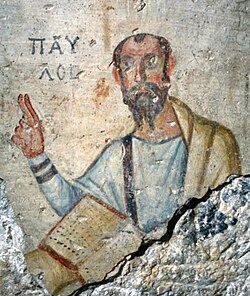
It was during this period, according to long-standing Christian tradition, that two of the most prominent leaders of the early church met their deaths in Rome. Peter the Apostle is believed to have been crucified, while Paul the Apostle, as a Roman citizen, was likely decapitated. Their martyrdom left a profound mark on the Roman Christian community, transforming the city into a place of both suffering and sacred memory.
Yet the church in Rome was not ruined under this pressure. Instead, it adapted and endured. Believers assembled more discreetly, often in homes or hidden spaces, forming tighter and more resilient communities. The experience of persecution just deepened their sense of identity and commitment, and the stories of those who suffered acted as a powerful source of inspiration.
In a stunning paradox, the attempt to defeat Christianity only conduced to its growth and consolidation. Over time, the same city that experienced such intense persecution would become one of the most significant hubs of the Christian faith, bearing lasting witness to a community that survived—and was reinforced by—the fires meant to annihilate it.
Secondly, the ‘Romans’ lived through the collapse of the Roman Empire. When the Western Roman Empire disintegrated in 476 A.D, the people of Rome including the Christians didn’t disappear. Political power shifted, but the population remained—gradually becoming part of medieval European societies. The city of Rome remained inhabited continuously, advancing culturally and linguistically (from Latin to Italian), and religiously.

Finally, the ‘Romans’ spiritual legacy has outlived their political environment. Ironically, while the empire which constituted the source of their name faded, the community Paul wrote to expanded globally. The teachings in Romans have become foundational for Christian theology across continents and centuries.
In essence, the Romans Paul wrote to didn’t vanish—they instead transformed.
They went from a small, diverse house-church in imperial Rome
to part of a global spiritual movement and the ancestry of modern Europeans.
Bible Hub says “Persecution and Growth. The church in Rome faced significant persecution, particularly under Emperor Nero, who blamed Christians for the Great Fire of Rome in A.D. 64. Despite such trials, the church continued to grow and became a central hub for Christian thought and leadership. The steadfastness of Roman Christians in the face of persecution is a testament to their faith and commitment to the gospel.
Tradition holds that both Peter and Paul were martyred in Rome, further cementing the city’s importance in Christian history. The presence of these apostles in Rome contributed to the church’s authority and influence. Peter’s association with Rome is particularly significant, as he is often considered the first bishop of the city, a role that later evolved into the papacy.”

Church Life Journal, in its 10 November 2023 piece of writing entitled “City of Echoes: The Rise of Christian Rome”, says “By the late fourth century, the tomb of Saint Peter was sheltered by an imposing basilica dedicated to his name. In the footsteps of Peter’s early, ignoble devotees came some of the noblest persons of the city. By 384, the triumph of Christianity among the noble and ruling classes was becoming a fact.
Even in the mid-second century, the philosopher who would come to be known as Justin Martyr claimed—with some credibility—that in his time ‘more Christians were ex-pagans than ex-Jews.’ But just twenty years earlier the emperor himself had tried to turn the tide against the Church. From the moment he took the throne in 361, Julian I (361–3)—known as Julian the Apostate—worked to cleanse the powerful of Christian influence.”
The journal adds “If he could only restore the traditional religion of Rome he believed that he could restore the glories of Rome itself. Julian did not have long. Ultimately, he would fail. On the night of 26 June 363, less than two years into his reign, he lay dying from a stab wound that had pierced his rib cage and liver.
It is a tradition and somewhat of an irony that Julian dedicated his final labored breath not to pray to his own gods but to that of the Christians. Addressing Jesus directly he is said to have conceded: You have won, Galilean.”
According to this journal, the regime of the Roman Emperor, Constantine, had demolished the buildings of his enemies and erased some pagan places of piety. “Now he had swept away the humble roots of the Church of Rome to dig the foundations of what would become a triumphantly Christian city. Principally, however, it was tales of martyrdom that underpinned his basilicas dedicated to Peter, John the Baptist, and Christ himself. Such stories, particularly that of Peter, would remain the surest foundations for this new Christian Rome for many centuries to come.
Christian Rome, later papal Rome, would never be realized in Constantine’s lifetime. Yet its institutional shape and strength were born with his decrees. This included the elevation of the Bishop of Rome, which would facilitate his emergence as pope of the entire Western Church. For Constantine established the hierarchy that still defines the Catholic Church and, at one time, shaped huge swathes of religious, political, and social life across the Western world.”
Church Life Journal offers a striking glimpse into how the office of the Bishop of Rome gradually evolved into one of the most influential institutions. “At the top of this pyramid, beneath the emperor himself, sat the Bishop of Rome, also known as ‘God’s consul.’ It was he who would take the seat of the judge in the apse of the Lateran Basilica, and it was he who was consecrated to the office in the cavernous nave of Saint Peter’s Basilica. At that time, the Bishop of Rome would be named by a cluster of priests and, acting below them, deacons.
The choice could then be ratified by neighboring bishops, such as the bishop of the nearby coastal see of Ostia. The election of a new bishop could also be confirmed or denied formally or informally by the will of the people. This was a process that had begun to emerge before Constantine. With the actions of that emperor, it was cemented, as the significance of the identity and actions of the Bishop of Rome influenced the lives of an ever-growing number of Christians.”
The ‘Romans’ matters considerably even today
Insight for Living further states “Why is Romans so important? The letter to the Romans stands as the clearest and most systematic presentation of Christian doctrine in all the Scriptures. Paul began by discussing that which is most easily observable in the world—the sinfulness of all humanity. All people have been condemned due to our rebellion against God. However, God in His grace offers us justification by faith in His Son, Jesus.
When we are justified by God, we receive redemption, or salvation, because Christ’s blood covers our sin. But Paul made it clear that the believer’s pursuit of God doesn’t stop with salvation; it continues as each of us is sanctified—made holy—as we persist in following Him. Paul’s treatment of these issues offers a logical and complete presentation of how a person can be saved from the penalty and power of his or her sin.”
Bible Hub explains “The Church in Rome holds a significant place in early Christian history, being one of the earliest and most influential Christian communities.”
Bible Hub additionally explains that the Church in Rome has left a profound impact. “The theological contributions of the Roman church are profound, with the Epistle to the Romans being a cornerstone of Christian doctrine. The letter’s exploration of themes such as the sovereignty of God, the nature of sin, and the transformative power of the Holy Spirit has shaped Christian theology for centuries.
The legacy of the Church in Rome is enduring, influencing both the development of early Christian doctrine and the structure of the church. Its role as a center of theological thought and its perseverance through persecution have left an indelible mark on the history of Christianity. The Roman church’s commitment to the teachings of Christ and the apostles continues to inspire believers around the world.”