By Editorial Staff
Patience constitutes a silent force behind unbelievable achievements and changes. This value will continue in this way. There lived people who implemented acts of unparalleled patience, so that there are optimal lessons which we can learn from these individuals. One of those amazing people is a South Vietnamese Buddhist monk, Thich Quang Duc, who immolated himself in 1963. I implore you to pause—truly pause—and contemplate the searing image of Duc seated in unflinching stillness amid flames, and then dare to fathom what magnitude of disciplined conviction must lie latent within a human soul to endure such extremity without a cry. If such immeasurable resolve could reside within one frail body, what unimaginable giant of courage, purpose, and transformative power might be lying dormant within us, awaiting only the ignition of unwavering patience?
According to the Cambridge Dictionary, patience means the capacity to wait, to continue working despite difficulties, or to endure suffering without complaint or anger. In fact, it constitutes a form of stoicism—the quiet acceptance of delay, hardship, or frustration while remaining steadfast in purpose. Patience, at its deepest register, does not mean mere waiting. It signifies the disciplined endurance of suffering without surrendering the clarity of purpose. It means the mastery of impulse, the refusal to let pain dictate reaction. In this sense, patience is not passive—it is controlled intensity stretched across time.

As we promised in our first piece on this theme, we are starting to explore real cases of unparalleled patience and lessons that we can acquire from them.
Duc’s self-immolation
Council on Foreign Relations (CFR), established in 1921, is an American “independent, nonpartisan member organization” think-tank and publisher boosting the understanding of international relations and foreign policy. In its 12 June 2012 story titled “TWE Remembers: Thich Quang Duc’s Self-Immolation, it says “The New York Times, the Washington Post, and the BBC all ran stories in June 2012 about Tibetan monks who have set themselves on fire to protest against the Chinese government.
The stories provoked little reaction in Washington. That was not the case when a sixty-six year-old Buddhist monk named Thich Quang Duc set himself on fire on June 11, 1963 on the streets of Saigon, the capital of South Vietnam.”
CFR continues “On June 11, 1963, Thich Quang Duc and more than 300 other monks and nuns marched in a procession down one of Saigon’s major boulevards. Wearing a saffron robe, he sat down in the lotus position on a cushion in the middle of the street. Two other monks emptied a five-gallon can of gasoline on him. Quang Duc then took a match, struck it, and dropped it on himself.”
According to the same source, the journalist David Halberstam, who was witnessing the event described what occurred next in the following words. “Flames were coming from a human being; his body was slowly withering and shriveling up, his head blackening and charring. In the air was the smell of burning flesh; human beings burn surprisingly quickly.
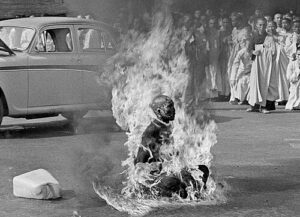
Behind me I could hear the sobbing of the Vietnamese who were now gathering. I was too shocked to cry, too confused to take notes or ask questions, too bewildered even to think… As he burned, he never moved a muscle, never uttered a sound, his outward composure in sharp contrast to the wailing people around him.”
The publisher adds “A fire engine raced to extinguish the blaze, but several monks blocked its path. The flames eventually burned out, and the monks placed Quang Duc’s body in a coffin and carried him away.”

When the monk set himself alight, his composure did not constitute an improvisation of the moment. It was the visible summit of a long interior discipline. The stillness described by Halberstam—the absence of a cry or yelling, the refusal to move—was not simply courage; it amounted to the culmination of cultivated endurance. Only a mind extremely long trained to withstand suffering without agitation could remain sovereign over the body as it was being seared.
In this light, self-immolation can be understood not as the negation of patience, but as its extreme transfiguration. Patience ordinarily stretches suffering across time; here, it condensed suffering into a single, irrevocable act. The same discipline that allows one to endure insult, hardship, or injustice quietly over years may, when all avenues of redress are exhausted, manifest as a final, controlled offering of the self. The act shocks the world precisely because it reveals a will so steady that even agony cannot shake it.
Thus, while patience and martyrdom are not identical, they share a common root: mastery over reaction. Patience endures; sacrifice declares. Yet both depend on the same interior sovereignty—the power to remain unruffled where instinct would rebel. In that sense, the flame that consumed the body illuminated something forged long before the match was struck: an endurance so complete that even fire could not provoke protest from it.
History, with its 27 May 2025 short piece of writing entitled “Buddhist immolates himself in protest” explains the reason behind the self-sacrifice. “Buddhist monk Thich Quang Duc publicly burns himself to death in a plea for President Ngo Dinh Diem to show ‘charity and compassion’ to all religions.

Diem, a Catholic who had been oppressing the Buddhist majority, remained stubborn despite continued Buddhist protests and repeated U.S. requests to liberalize his government’s policies. More Buddhist monks immolated themselves during ensuing weeks. Madame Nhu, the president’s sister-in-law, referred to the burnings as ‘barbecues’ and offered to supply matches.”
CFR echoes “Seven other monks soon followed Quang Duc’s example and set themselves afire to protest Diem’s rule. Convinced of his own rectitude, Diem did nothing to appease the growing anger being directed his way. His sister-in-law, Madame Nhu, however, added to it. She likened Quang Duc’s suicide to a ‘barbecue.’ ‘Let them burn,’ she said, ‘and we shall clap our hands.’”
Impact of the self-immolation and its reason
CFR reports “Malcolm Brown, an Associated Press photographer, caught the self-immolation on film. His photograph won the award for World Press Photo of the Year, and it remains among the most famous (and haunting) images from the Vietnam War. It certainly stunned millions of people around the world who saw it in June 1963. As a U.S. embassy official put it, the photo ‘had a shock effect of incalculable value to the Buddhist cause, becoming a symbol of the state of things in Vietnam.’”

This event was not a blessing for the Vietnamese president. According to History, “In November 1963, South Vietnamese military officers assassinated Diem and his brother during a coup.” Council on Foreign Relations also affirms it. “President John F. Kennedy said of Browne’s photo that ‘no news picture in history has generated so much emotion around the world as that one.’ The so-called Buddhist Crisis incident certainly helped sour Kennedy on Diem. Five months later, Kennedy looked the other way as a group of South Vietnamese Army generals overthrew and executed Diem.” Meanwhile, “Kennedy himself was assassinated three weeks later in Dallas.”
CFR provides the backdrop around his ascent into this highest office, clarifying why the US president intervened for the Vietnamese chief of state to be toppled and killed. “To understand Quang Duc’s story it is essential to know the story of Ngo Dinh Diem, the U.S.-backed president of South Vietnam. He came to power in 1955 in the aftermath of the Geneva Accords, which ended French colonial rule and split Vietnam along the 17th parallel. He had gained national fame when he quit a critical job working for the French colonial government before World War II and then refused to cooperate with the Japanese occupiers during it.”
“But he was hardly the ideal choice to lead the new South Vietnam. He was a French-educated Catholic in a Buddhist majority country, and he had spent much of the decade after World War II living in the United States rather than building a political organization in South Vietnam. And he was hardly a democrat. When he ran in a ‘national’ referendum in October 1955, he arranged it so that he won more than 98 percent of the vote.”
CFR highlights “Not surprisingly, the Vietnamese public’s support for Diem soon faded. He repressed his opponents and favored his friends and family. His policies to counter the growing strength of the Viet Cong had the opposite effect; they alienated many South Vietnamese against his government. By the spring of 1963, public unrest reached a crisis point. On May 8, residents of Hue, the imperial capital of old Vietnam, organized a rally to protest a ban on flying the Buddhist flag. Police fired on the crowd, killing nine and wounding fourteen. Hunger strikes and more protests followed.”
Core lessons
The act of Duc was not hotheaded. It was the conspicuous summit of long spiritual discipline. His motionlessness in the face of unbearable pain revealed extraordinary mastery over instinct and fear. The composure he exuded was not accidental—it had been developed. It reflected a mind trained to remain sovereign even while the body was facing extreme assault.
The photograph captured by Browne, later termed by Kennedy as one of the most emotionally powerful images in history, did more than document an event. It disclosed the depth of human endurance. What stunned the world was not purely the flames—it was the stillness observed within them.
Core lesson 1 — the hidden power of human endurance
If a human being can remain calm while enduring the most extreme physical pain, what does that emphasize about our own ability? It reveals that we boast far greater tolerance for hardship than we assume.
Duc’s visible serenity, despite the excruciating suffering, acts as a testament that suffering does not automatically defeat us. Pain is powerful—but the disciplined mind can be far more powerful than you deem. Instinct demands escape; fear demands movement; agony demands reaction. Yet he remained still. That means suffering, however maximally intense, does not always control the will.
This does not include encouraging extreme acts. It only involves understanding what the act proves about human potential.
If a person can tolerate flames without panic, why can’t we tolerate criticism without collapsing? Why can’t we endure temporary failure without surrendering? Why can’t we withstand uncertainty without losing clarity? Why can faint, faced with discouragements? Why can we feel paralyzed by adversities into which life throws us unexpectedly? Why can’t we summon all our energy until we even exhaust all its repository, to overcome them? Won’t we really rise above them? If we do, we certainly will.
Most hurdles which we experience—poverty, professional setbacks, emotional disappointment, academic difficulty, divorce, business failures, just to name very few—stand intensely severe, but they are not a fire consuming the body. They feel torturous, only because the mind resists them. However, this resistance cannot permit you to beat them. Consider these hardships a tempest in an ocean or sea. Attacked by the tempest, the only weapon you possess involves not fighting back. You only have to accept to go where it takes you, till it is appeased and then lets you free to carry your journey on.
The deeper lesson is this: hardship defeats us less by its intensity than by our reaction to it. Patience, then, is not passive waiting. It forms disciplined endurance. It amounts to the refusal to let pain dictate our identity. It is controlled intensity stretched across time. The incident demonstrates that human beings carry within themselves an astonishing reserve of strength. When that strength is steeled—through unswerving discipline, clarity of purpose, and self-mastery, among others—it becomes almost incomparable.
In that sense, the flame did not only burn; it established a principle. It revealed that suffering can be endured. And if suffering can be endured, then adversity—how torturous it appears—can be faced, mastered, and ultimately overcome.
Core lesson 2—patience turns hardship into unimaginable achievement

The self-immolation of Duc shows that extreme patience and the disciplined tolerance of suffering can produce results far beyond what seems possible. By remaining calm, and unwavering in the face of insufferable pain, he created an impact that resonated worldwide—an effect no immediate action or forceful struggle could have matched.
This teaches a universal truth: when we fully accept our adversities and endure them with clarity and unshakable resolution, we harness a power that will certainly lead to outcomes we never imagined. Challenges that seem overwhelming, even insurmountable, are—through patient endurance— transformed into moments of monumental achievement.
In essence, tolerating and mastering suffering is not submission; it is the engine of extraordinary success. What feels like endurance in the present, in the long run, becomes the catalyst for accomplishments beyond ordinary expectation, as other compelling examples of exceptional patience we will provide reveal it.
Comprehensive lesson — humans ooze astonishing, untapped capabilities
The life and act of Duc confront us with a truth that is both unsettling and empowering: we, as human beings, ooze capacities far beyond what we ordinarily permit ourselves to access. His composure within flames was not the product of impulse, nor of recklessness—it was the visible crest of invisible discipline. What the world witnessed was not merely a body enduring fire, but a mind reigning sovereign over instinct, fear, and agony. That sovereignty is not exclusive to saints or martyrs; it is a human faculty.
The photograph captured by Browne did more than freeze a historical moment—it exposed the architecture of human potential. And when Kennedy later described it as one of the most emotionally powerful images in history, the reaction was not solely to the spectacle of flames, but to the stillness within them. That stillness shattered a common illusion: that pain automatically governs behavior. It proved instead that the disciplined will can eclipse suffering.
From this emerges a sweeping lesson: human beings possess deeper reservoirs of endurance, courage, and clarity than we habitually acknowledge. We collapse under criticism, tremble before uncertainty, and surrender to temporary failure—not because the hardship is unconquerable, but because we underestimate our internal architecture. Poverty, professional setbacks, heartbreak, academic struggle, or business collapse may feel torrential, yet they are not flames consuming the body. They are storms of circumstance. And storms, however violent, exhaust themselves.
The true battleground is not the adversity—it is our reaction to it. Hardship defeats us less through intensity than through impatience. When we resist suffering with panic, we amplify it. When we meet it with disciplined acceptance, we weaken its grip. Patience, therefore, is not resignation. It is mastery stretched across time. It is controlled intensity refusing to fracture. It is the deliberate choice to remain internally stable while externally pressured.
To say that humans ooze capabilities is not poetic exaggeration; it is empirical observation. History repeatedly demonstrates that when clarity of purpose is fused with disciplined endurance, individuals produce impact far beyond ordinary expectation. The flame, in this sense, did not only burn—it illuminated. It revealed that suffering can be endured without relinquishing identity. And if suffering can be endured, then adversity—how intimidating it were—can be faced, absorbed, and transcended.
Thus, the ultimate lesson is neither about extremity nor imitation. It instead includes recognition. Recognition that within each of us lies an unexhausted repository of steadiness, resilience, and transformative strength. When cultivated through self-mastery and unwavering purpose, that reserve becomes formidable. What appears unbearable becomes manageable. What appears insurmountable becomes navigable. And what appears devastating becomes, in time, the very forge that shapes unimaginable achievement.