By Jean Baptiste Ndabananiye
The specter of World War III looms darker than ever as tensions between nuclear powers escalate to dangerous new heights. Russia’s most recent stark warning to the United States and its allies—delivered with the chilling rhetoric of a conflict that could engulf not only Europe but the entire globe—underscores the fragile state of international peace. Moscow’s caution comes amid Ukraine’s most significant drone assault on the Russian capital to date, targeting Moscow’s financial district and military infrastructure. As the conflict intensifies, the world stands on the precipice of a war with unparalleled consequences. The war in Ukraine, now extending beyond its borders into the heart of Russia, has ignited fears that what began as a regional conflict could spiral into a global calamity. Ukraine’s drone strike on Moscow, the largest since the war began, signals an escalation that has rattled the Kremlin and emboldened calls for harsher retaliation. Russian officials, including long-serving Foreign Minister Sergei Lavrov, have cast the ongoing crisis as more than just a geopolitical struggle, warning that Western support for Ukraine—particularly in enabling such bold attacks—risks triggering the worst-case scenario: nuclear war.
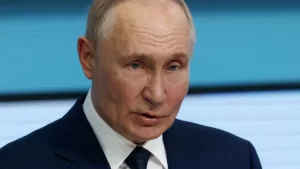
Lavrov’s reminder that World War III would not be confined to Europe but would unleash devastation on an unprecedented scale serves as a grim warning of how quickly the situation could escalate. With world powers increasingly drawn into the conflict, and each new assault pushing the boundaries of restraint, the potential for a devastating miscalculation grows. The largest drone attack on Moscow is not just a military act; it’s a signal of the deteriorating stakes in a war that threatens to culminate into a global catastrophe. Each day brings the world closer to the unthinkable—a war that would not only redefine global power structures but also threaten the survival of humanity itself. Meanwhile, Ukraine’s Zelenskyy has always actively called upon the NATO allies to cancel restrictions on Western-supplied arms, to strike deep inside Russia. Russia’s President, Vladimir Putin has now warned that Russia will enter a war with NATO, if Ukraine long-range missile restrictions are removed. However, the NATO alliance- leading nation, US, alludes to permitting Ukraine to hit deep inside Russia, infuriating Putin.
Reuters ran an article headlined “Russia warns the United States of the risks of World War Three” on 27 August 2024. According to this news organization, Russia declared that the West was playing with fire by considering allowing Ukraine to strike deep into Russia with Western missiles. This nation additionally warned the United States that World War Three would not be restricted to Europe.
“Ukraine attacked Russia’s western Kursk region on Aug. 6 and has carved out a slice of territory in the biggest foreign attack on Russia since World War Two. President Vladimir Putin said there would be a worthy response from Russia to the attack,” reports Reuters.
This organization that constitutes one of the largest and most well-known news agencies in the world adds that Sergei Lavrov said that the West was seeking to escalate the Ukraine war. Lavrov who has been working as Putin’s foreign minister for more than 20 years underlined that the West was asking for trouble by considering Ukrainian requests to lessen restrictions on using foreign–supplied weapons.
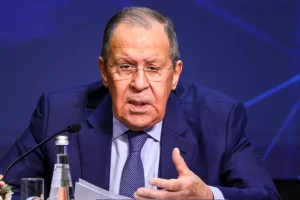
Lavrov told reporters in Moscow “We are now confirming once again that playing with fire – and they are like small children playing with matches – is a very dangerous thing for grown-up uncles and aunts who are entrusted with nuclear weapons in one or another Western country.
Americans unequivocally associate conversations about Third World War as something that, God forbid, if it happens, will affect Europe exclusively.” He additionally pointed out that Russia was clarifying its nuclear doctrine.
Russia’s 2020 nuclear doctrine explains when this country’s president would consider employing a nuclear weapon. It elucidates that the use of the weapon occurs in a response to an attack using nuclear or other weapons of mass destruction or conventional weapons “when the very existence of the state is put under threat.”
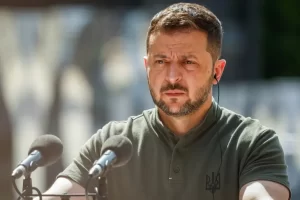
Ukrainia’s President Volodymyr Zelenskyy has recently said that the assault on Russia’s Kursk region revealed that Kremlin threats of retaliation were a bluff. He has underlined that his country has assaulted Russia, to take the war back to its origin. He then scornfully ridiculed Russia’s Vladimir Putin as “a sick old man from Red Square who constantly threatens everyone with the red button [nuclear weapon rhetoric] will not dictate any of his red lines to us.”
At the end of last August Zelenskyy maintained that Ukraine could not utilize the weapons at its disposal to strike some Russian military targets, because of the restrictions determined by its allies. He therefore seized an opportunity to re-appeal to the allies to be bolder in their decisions about how to help Kyiv in the war.
Nonetheless, Russia says that Ukraine has employed Western weaponry such as British tanks and U.S. rocket systems in Kursk. “Kyiv has confirmed using U.S. HIMARS missiles to take out bridges in Kursk.
Washington says it was not informed about Ukraine’s plans ahead of the surprise incursion into Kursk. The United States has also said it did not take any part in the operation,” says Reuters.
Nevertheless, Putin’s foreign intelligence chief, Sergei Naryshkin, said that Moscow did not believe Western assertions that it wasn’t connected with the Kursk attack. Russian Deputy Foreign Minister Sergei Ryabkov affirmed that the involvement of the United States was “an obvious fact”.
In the meantime, The New York Times said that the United States and Britain gave Ukraine satellite imagery and other information about the Kursk region, after the Ukrainian attack. The Times stated that this intelligence was intended to assist Ukraine to maintain better track of Russian reinforcements.
“How close are we to World War Three?”: The Week’s article headline
The Week released the story on 9 September 2024. The Week says “Trump issues warning as British army chief says West facing ‘axis of upheaval’ led by Russia, China, Iran and North Korea.” Quoting USA Today, The Week reports that Donald Trump has said that the world has never “been closer to World War III than we are now.”
USA Today clarifies that Trump was addressing a crowd of National Guard officers in Detroit last week, pointing out that the world is experiencing unprecedented dangers as he “positioned himself as uniquely capable” of addressing these threats.
Dominic Waghorn, Sky News’ international affairs editor has said that if Putin ultimately vanquishes Ukraine, he will “almost certainly try his luck” in the Baltics, “because he will assume the alliance is too spineless to stop him”. During a debate with Harris this week, Trump said “I want the war to stop.”
The following words probably contain a response to how Trump would stop the potential third world war. “That view [alliance too weak to stop Putin] would likely be reinforced if Donald Trump were to carry through with his threats to pull America out of Nato if he wins the US presidential election in November. His words came after the new head of the British Army, General Sir Roly Walker, warned that Britain must be ready to fight a war in three years’ time in the face of growing threats from an ‘axis of upheaval’ led by Russia, China, Iran and North Korea,” says The Week.
According to the latter one, it is a “deliberately stark judgment”, said The Guardian, “based on China’s hostility towards Taiwan, Iran’s nuclear ambitions and Russia’s militarisation as demonstrated by its invasion of Ukraine”.
Military historian Richard Overy in The Telegraph said that it is all part of a “dangerous new chapter” for the world. The “growing division between the democratic West and the arc of authoritarian states across Eurasia” could culminate into World War Three. Putin has always contended that he does not to engage in a war with the U.S.-led NATO organization. He has however frequently warned of the risk of a much larger war involving the world’s biggest nuclear powers, since attacking Ukraine in 2022. Various mega news organizations wrote today on 13 September 2024 about his statement that lifting the long-range missile restrictions for Ukraine by the West automatically signifies Russia war with NATO.
“This would in a significant way change the very nature of the conflict. It would mean that NATO countries, the US, European countries, are at war with Russia,” Putin told Russian state TV on Thursday, according to Al Jazeera. “And if this is the case, then, bearing in mind the change in the essence of the conflict, we will make appropriate decisions in response to the threats that will be posed to us,” he additionally told reporters, as reported by CNN.
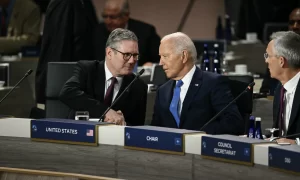
Al Jazeera says “His comments come ahead of a meeting in Washington, DC, on Friday between British Prime Minister Keir Starmer and US President Joe Biden, who are expected to discuss giving Ukraine the go-ahead to strike targets inside Russia amid mounting concerns over its losses on the battlefield.” On the way to the US, according to British media reports, Starmer said “Russia started this conflict. Russia illegally invaded Ukraine. Russia can end this conflict straight away. Ukraine has the right to self-defence.”
The Week indicates that the Ukraine-Russia war doesn’t constitute the only red flashpoint which could beget the global war. It alerts that the Middle East, China, and North Korea in addition to Russia all represent red flashpoints likely to trigger the most horrible calamity that this world has even faced.
Western powers have recommended Iran to avoid attacking Israel, fearing that they could be drawn into a wider war in the Middle East that would pit them against Russia and China. There prevail concerns that Iran could retaliate for the July assassinations of Hezbollah commander Fuad Shukr and Hamas political chief Ismail Haniyeh. With Israel engaged in Gaza, retaliation by Iran or Hezbollah could escalate into a regional war, potentially involving the US.
European nations have warned citizens to leave Lebanon, anticipating Hezbollah’s key role in any conflict. Israel has heightened military readiness, while the US has moved naval forces into the region, bracing for an expected Iranian response. According to The Week, Politico reported fears of an “imminent” Iranian attack on Israel in retaliation for the assassination of Shukr and Haniyeh.
In China, tensions over Taiwan have grown, with US military support intensifying. Beijing’s focus on a potential invasion by 2027 is viewed as a major flashpoint, risking catastrophic global economic fallout and possibly sparking a major war.
North Korea has increased hostilities since 2019, abandoning reconciliation with South Korea and engaging in psychological warfare. The US has conducted military drills with Seoul as tensions along the Korean peninsula continue to escalate.
Henry Kissinger about how to shun World War Three
With regard to foreign policy, the Senior Henry Kissinger who turned 100 on 27 May 2023 is respected as one of the key voices in the US, according to The Economist. He served as a national security adviser for years. He also worked as secretary of state under presidents Richard Nixon and Gerald Ford. “In the early 1970s, he masterminded the US-China rapprochement to isolate and weaken the then Soviet Union. Kissinger is not a softy. He was directly involved in the 1973 coup in Chile and also in the extremely brutal war in Vietnam,” says The Economist.
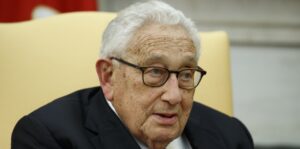
In a recent interview with The Economist, on one hand Kissinger first expressed his profound concern over the escalating tensions between the US and China, fearing a possible confrontation between the two superpowers. He believes that both nations view each other as existential threats. Beijing sees the US as intent on keeping it down, while Washington fears China aims to replace it as the global leader. Kissinger warns that this rivalry, particularly in technology and artificial intelligence (AI), could engender disastrous consequences, likening the current situation to pre-World War I conditions.
He points out “Both sides have convinced themselves that the other represents a strategic danger. We’re in the classic pre-world war one situation where neither side has much margin of political concession and in which any disturbance of the equilibrium can lead to catastrophic consequences.”
Regarding Ukraine, Kissinger calls Russia’s invasion a “catastrophic mistake of judgement by Putin” but also criticizes the West’s approach to NATO expansion. “I thought that the decision to leave open the membership of Ukraine in NATO was very wrong.” The Economist adds “That was destabilising. There was a promise of Nato protection but no plan to realise it. Ukraine was therefore vulnerable while Russia had been infuriated.”
On the other hand, although Kissinger is worried about mutually assured destruction in any conflict, he remains hopeful, suggesting that diplomacy can help the US and China to coexist without war. He advocates for negotiations based on shared values and warns against forcing regime change in China, which could destabilize the country and lead to global chaos.
The Economist says “His rich experience tells him that determined diplomacy is the only way to avoid ruinous conflict. Ideally, this is done on the basis of shared values. He thinks it is still possible for China and the United States to coexist without the threat of all-out war with each other, albeit that success is not guaranteed.
He is convinced that a world order can be created based on rules that Europe, China and India could endorse. Negotiations between the two superpowers can help build mutual trust. That trust will then lead to restraint on both sides.” In his own words, he states “If you then rely entirely on what you can achieve through power, you’re likely to destroy the world.”
In terms of Ukraine, he suggests China’s peace proposal for Ukraine could form a serious diplomatic opportunity. Though he criticizes the fact the NATO has opened the door for Ukraine, he has told The Economist that he advocates for Ukraine joining NATO, yet reasons for his change of mind are not provided. But he also advises Europe to engage Russia diplomatically to ensure long-term stability.
About the US and China, he stresses that AI, with its potential military applications, amplifies the urgency of resolving these tensions, estimating only five to ten years to find a diplomatic solution. The Economist says “The fate of humanity depends on the US and China getting along. And there is not much time. Given the rapid advancement of AI and its potential military applications, he says we only have five to 10 years to find a way of coming to terms with each other.”
Kissinger identifies two areas where diplomacy is crucial: Taiwan and AI. He criticizes the US’s incitement over Taiwan, fearing that a war there could devastate the global economy. He also emphasizes the need for early discussions on AI, drawing parallels to Cold War-era arms control efforts. Lastly, Kissinger criticizes today’s polarized political climate, particularly in the US, noting that the country urgently needs strategic and long-term leadership to avoid disastrous outcomes.
What is the most devastating effect of World War III, if Kissinger’s advice is unheeded?
As always underlined, the most devastating effect of a potential World War III would likely be nuclear annihilation, resulting in catastrophic loss of life and widespread destruction. Given the nuclear capabilities of modern superpowers, a global conflict could trigger the use of nuclear weapons, causing massive civilian casualties, environmental devastation, long-term radiation exposure, and the collapse of infrastructure and society on an unprecedented scale. This could also lead to a nuclear winter, where the planet’s climate is drastically altered, rendering it difficult for life to survive.
Think China is a Singapore-based online platform that provides insights, analysis, and commentary on China’s developments, policies, and its global influence. It acts as a resource for policymakers, scholars, business leaders, and the general public, offering in-depth reports, interviews, and expert opinions.
Think China warns “According to calculations, based on the atomic bombs dropped on Hiroshima and Nagasaki, 100 atomic bombs could destroy about 2 billion lives. According to the 2023 UN State of World Population report, the current world population is 8 billion – detonating about 400 atomic bombs would wipe out humanity, and there would be no life on earth for a long time.”
“According to UN estimates, more than 2,000 nuclear tests have been conducted all over the world, with around 22,000 nuclear weapons globally – enough to destroy humanity and other biological organisms on earth 55 times over.”
Nuclear winter refers to the severe and prolonged global climatic cooling effect predicted to occur after widespread firestorms caused by a large-scale nuclear war. It includes numerous characteristics such as drastic temperature drops, global cooling, reduced sunlight, agricultural collapse, and human suffering, among others.
Science constitutes a platform said to publish the very best in research across sciences, with articles which are consistently placed among the most cited in the world. In its 15 August 2022 article titled “Nuclear war would cause yearslong global famine” it reports “Billions of people could starve to death after even a regional conflict, latest nuclear winter modeling indicates. A nuclear war would disrupt the global climate so badly that billions of people could starve to death, according to what experts are calling the most expansive modeling to date of so-called nuclear winter.
Although the exact effects remain uncertain, the findings underscore the dangers of nuclear war and offer vital insights about how to prepare for other global disasters, researchers say.” Alliance for Science says “The price of nuclear escalation is planetary suicide, with no winners at all.”
3rd war !!!