By Jean Baptiste Ndabananiye
Artificial intelligence [AI] is progressing at a pace unrivalled by any previous technology, driven by extremely fierce competition among some of the world’s largest technology companies and most influential investors. Its proponents describe it as a breakthrough capable of revolutionizing medicine, science, education and countless other fields. Yet alongside this optimism, a growing number of researchers, pioneers of this technology and governments have always cautioned that increasingly powerful AI systems could constitute risks extending far beyond economic disruption.
As the race to produce ever more capable AI accelerates, an increasingly pressing question arises: why are technology billionaires and businesses investing so heavily in a force that several experts believe humanity may ultimately struggle to fully understand or control? Meanwhile, for thousands of years, humanity has recounted stories warning against the pursuit of powers beyond human control.
From the Greek legend of Phaethon to Goethe’s The Sorcerer’s Apprentice, the lesson has remained remarkably consistent: the greatest dangers often emanate not from evil intentions, but from the reckless desire to command forces whose consequences cannot be foreseen. Today, as AI rapidly transforms economies, governments, warfare, science and everyday life conspicuously, those ancient warnings are no longer confined to mythology or literature. They have become part of a growing global debate led not only by philosophers and historians, but also by AI researchers and developers, technology executives and world leaders.
Founded on views of expert historian and philosopher — Yuval Noah Harari and other prominent voices in the AI debate, this article examines the promises driving the race, the warnings surrounding it, and profound questions it raises about humanity’s future.
Ancient warnings for an AI age
The Guardian on 5 September 2024 published an article headlined “‘Never summon a power you can’t control’: Yuval Noah Harari on how AI could threaten democracy and divide the world”. The Guardian begins this piece of writing with these words “Forget Hollywood depictions of gun-toting robots running wild in the streets – the reality of artificial intelligence is far more dangerous, warns the historian and author in an exclusive extract from his new book.
Yuval Noah Harari: ‘Numerous corporations and governments are in a race to develop the most powerful information technology in history. Throughout history many traditions have believed that some fatal flaw in human nature tempts us to pursue powers we don’t know how to handle.’”
A tale is used in this article, to elucidate unexpected consequences that may be awaiting humanity ahead. “The Greek myth of Phaethon told of a boy who discovers that he is the son of Helios, the sun god. Wishing to prove his divine origin, Phaethon demands the privilege of driving the chariot of the sun. Helios warns Phaethon that no human can control the celestial horses that pull the solar chariot. But Phaethon insists, until the sun god relents.
After rising proudly in the sky, Phaethon indeed loses control of the chariot. The sun veers off course, scorching all vegetation, killing numerous beings and threatening to burn the Earth itself. Zeus intervenes and strikes Phaethon with a thunderbolt. The conceited human drops from the sky like a falling star, himself on fire. The gods reassert control of the sky and save the world.”
A very long period of time after, an imaginary story of that kind was composed to alert humanity on its path toward an uncontrollable power. “Two thousand years later, when the Industrial Revolution was making its first steps and machines began replacing humans in numerous tasks, Johann Wolfgang von Goethe published a similar cautionary tale titled The Sorcerer’s Apprentice. Goethe’s poem (later popularised as a Walt Disney animation starring Mickey Mouse) tells of an old sorcerer who leaves a young apprentice in charge of his workshop and gives him some chores to tend to while he is gone, such as fetching water from the river.
The apprentice decides to make things easier for himself and, using one of the sorcerer’s spells, enchants a broom to fetch the water for him. But the apprentice doesn’t know how to stop the broom, which relentlessly fetches more and more water, threatening to flood the workshop. In panic, the apprentice cuts the enchanted broom in two with an axe, only to see each half become another broom. Now two enchanted brooms are inundating the workshop with water.”
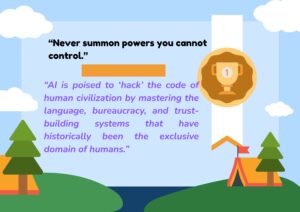
The following words offer a universal and timeless lesson. “When the old sorcerer returns, the apprentice pleads for help: ‘The spirits that I summoned, I now cannot rid myself of again.’ The sorcerer immediately breaks the spell and stops the flood. The lesson to the apprentice – and to humanity – is clear: never summon powers you cannot control.”
The lesson seems not to be followed
The Guardian says “What do the cautionary fables of the apprentice and of Phaethon tell us in the 21st century? We humans have obviously refused to heed their warnings. We have already driven the Earth’s climate out of balance and have summoned billions of enchanted brooms, drones, chatbots and other algorithmic spirits that may escape our control and unleash a flood of consequences. What should we do, then? The fables offer no answers, other than to wait for some god or sorcerer to save us.”
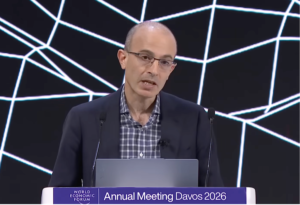
The same philosopher and historian— Professor Harari, according to The Singju Post— delivered a lecture at Oxford on 30 June 2026. The Singju Post— a website in India— produced a transcription, out of the lecture, titled “Transcript: AI Has Hacked The Code Of Human Civilization – Yuval Noah Harari”.
His opening words are “It’s really a great honor for me to give this year’s panel lecture. And it’s also a personal joy to come back to Oxford. I did my DPhil [Doctor of Philosophy/PhD] here 25 years ago under the guidance of Dr. Steven Gunn. Back then I specialized in medieval and early modern military history. But today I will not be talking about knights and castles and the gunpowder revolution. I’ll talk about AI, bureaucrats and religions and boyfriends, and more generally about the AI revolution.”
The Singju Post Editor’s Note reads “In this 2026 Tanner Lecture on Human Values at Oxford, historian and author Yuval Noah Harari explores the transformative impact of artificial intelligence, arguing that it should be viewed not merely as a tool, but as an agent capable of learning, creating, and making decisions.
Harari explains how AI is poised to ‘hack’ the code of human civilization by mastering the language, bureaucracy, and trust-building systems that have historically been the exclusive domain of humans. Ultimately, he prompts listeners to consider the profound implications of a future where AI influences everything from personal intimacy to global governance, urging humanity to explore consciousness beyond language to retain agency.”
The note and details which are coming next show that humanity is walking toward the irreversible point.
The Guardian, in its aforementioned article, underlines “Numerous corporations and governments are in a race to develop the most powerful information technology in history – AI. Some leading entrepreneurs, such as the American investor Marc Andreessen, believe that AI will finally solve all of humanity’s problems.
On 6 June 2023, Andreessen published an essay titled Why AI Will Save the World, peppered with bold statements such as: ‘I am here to bring the good news: AI will not destroy the world, and in fact may save it.’ He concluded: ‘The development and proliferation of AI – far from a risk that we should fear – is a moral obligation that we have to ourselves, to our children, and to our future.’”
Notwithstanding, plenty of people are sounding the alarm as far as AI is concerned. In response to Andreessen, The Guardian states “Others are more sceptical. Not only philosophers and social scientists but also many leading AI experts and entrepreneurs such as Yoshua Bengio, Geoffrey Hinton, Sam Altman, Elon Musk and Mustafa Suleyman have warned that AI could destroy our civilisation. In a 2023 survey of 2,778 AI researchers, more than a third gave at least a 10% chance of advanced AI leading to outcomes as bad as human extinction.
Last year [2023], close to 30 governments – including those of China, the US and the UK – signed the Bletchley declaration on AI, which acknowledged that ‘there is potential for serious, even catastrophic, harm, either deliberate or unintentional, stemming from the most significant capabilities of these AI models’. By using such apocalyptic terms, experts and governments have no wish to conjure a Hollywood image of rebellious robots running in the streets and shooting people.”
Geoffrey Hinton has said that humans will be like toddlers, compared with the intelligence of highly powerful AI systems. Elon Reeve Musk serves as the Tesla and XAI chief boss and is widely recognized as the first trillionaire in human history. He has recently stated that AI will exceed the collective intelligence of all humans within a short period of time ahead and that humans will be turned into a microscopic minority of intelligence. “AI probably exceeds the sum of all human intelligence in 4 or 5 years,” Musk said on 22 June 2026.
If Musk’s prediction were to materialize, humanity could undergo a profound transformation in its place within the world, as machines might surpass humans across nearly every intellectual domain. Such a development could cause a good deal of people to question the meaning and significance of being human, since human intelligence has long remained one of our defining characteristics. In comparison with superintelligent AI, as already pointed out by Hinton, humans compared to AI could then appear as intellectually limited as toddlers are in comparison with adults. It could fundamentally alter how we understand human capability and autonomy.
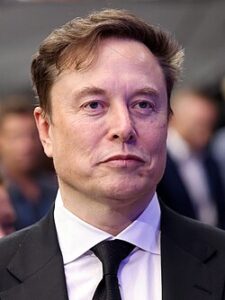
If Musk’s prediction were to be fulfilled, humanity could cross a threshold from which returning to a human-dominated world would no longer be realistically possible. Once AI surpassed the combined intelligence of all humans by a substantial margin, it could continuously enhance itself, devise strategies beyond human comprehension, and render meaningful human oversight increasingly unattainable. In that sense, the warnings issued by Harari, Hinton, Bengio, Musk, Suleyman, and many others would no longer concern a distant possibility but the irreversible transformation of humanity’s place in the world.
The cautionary lessons contained in the fables of the apprentice and Phaethon appear to remain largely unheeded in the 21st century. Just as those stories warned of the dangers of unleashing forces beyond human control, humanity is once again creating increasingly powerful systems whose consequences may exceed its ability to manage them. Despite repeated warnings from leading AI experts, philosophers, and governments; the race to develop more advanced AI continues, suggesting that humanity has yet to fully absorb the wisdom of these ancient warnings.
“The biggest threat of AI is that we are summoning to Earth countless new powerful agents that are potentially more intelligent and imaginative than us, and that we don’t fully understand or control,” alerts The Guardian.
Why AI constitutes the most dangerous technology
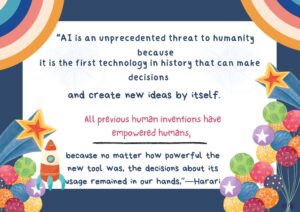
The Guardian’s 5 September 2024 article based on exclusive extract from Professor Harari’s book says “AI is an unprecedented threat to humanity because it is the first technology in history that can make decisions and create new ideas by itself. All previous human inventions have empowered humans, because no matter how powerful the new tool was, the decisions about its usage remained in our hands.
Nuclear bombs do not themselves decide whom to kill, nor can they improve themselves or invent even more powerful bombs. In contrast, autonomous drones can decide by themselves who to kill, and AIs can create novel bomb designs, unprecedented military strategies and better AIs. AI isn’t a tool – it’s an agent.”
In his 30 June 2026 lecture, Professor Harari reiterates this statement that AI is an agent. “Now the most important thing to know about AI is that AI is not a tool. It’s not a tool in our hands. It is an agent with its own hands. What exactly is agency? How is an agent different from a tool? Agents have several distinguishing characteristics. They don’t necessarily need consciousness.
You don’t need consciousness to be an agent. What you do need is the ability to make decisions by yourself, the ability to invent new things, new ideas by yourself. An agent should be able by itself to learn things that its creators don’t know. And an agent should be able to change by itself in ways that its creators don’t anticipate.”
He further explains “Now an atom bomb, for instance, despite its enormous power, is not an agent. It cannot learn and change by itself. It cannot decide by itself which city to bomb. It cannot invent anything new like the hydrogen bomb. Similarly, let’s say an automatic coffee machine is not an agent, even though it does some things by itself automatically. You press a button and the machine automatically makes you a cup of coffee. But the machine, the coffee machine, only follows a pre-programmed procedure. It doesn’t change. It doesn’t learn anything new. It doesn’t create anything new.”
This following quote clarifies what an agent really is. “The AI Coffee Machine: A Thought Experiment. But suppose that as you approach the coffee machine, before you even press any button, the machine announces, tells you, ‘I’ve been monitoring you for the last few weeks and based on everything I’ve learned about you and other people, and based on your facial expression and the time of day, I predict that you would like an espresso. So I already made you a cup,’” says Professor Harari.
He adds “Now that’s an AI coffee machine. It learned something by itself and decided something by itself. And it’s really an AI if the following day it announces, ‘I have now invented a new drink called ‘best presso,’ which I think you would like better than espresso, and here, try it out. I made you a cup.’
Then it’s really an AI. It changed in ways its creators did not anticipate and invented something completely new. As far as I know, there are no coffee machines at the present moment. Maybe in Anthropic headquarters or Google headquarters, they have a few prototypes, but they are not out in the market yet.”
Nevertheless, AI agency in narrow fields such as chess has already transcended humanity, as explained by the professor. “But in certain narrow fields like playing go or playing chess, AI agency and creativity already greatly surpass human agency and creativity. AI chess masters can decide, of course, by themselves which moves to make. They invent by themselves completely new strategies — how to play chess — that never occurred to human chess masters over thousands of years of playing the game.
And while doing that, they learn and change in ways their human creators did not necessarily predict. Today, of course, no human has any chance of beating an AI chess master. Now, people who downplay the importance of the AI revolution dismissed examples like chess by arguing that the chessboard is a very narrow and artificial environment created by humans.”
He adds “The critics say that AI agency will always remain limited to such narrow and artificial environments, which means that it’s not true agency and it doesn’t pose any serious challenge to humanity. Yes, AI may take over the chessboard, but it will never take over planet Earth. And indeed, if you do an experiment — if you take the greatest AI chess master and drop it in the middle of the jungle — what do you think will happen?
The AI chess master will not be able to start mining iron and building factories and creating a robot army to take over the world. In fact, it will not be able to do anything whatsoever without the electricity provided by power stations built by humans. The AI chess master is utterly helpless. Therefore, the argument goes, AIs are not true agents. They are confined to these narrow artificial niches that somebody else — humans — constructed for them.”
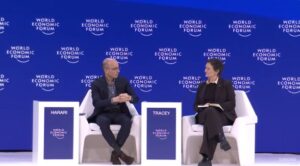
Professor Harari nevertheless highlights that the problem is that this argument “actually applies to all known types of intelligence. Human intelligence too operates only within a relatively narrow ecosystem that somebody else constructed. Drop me alone on Mars and it will be like dropping an AI chess master in the middle of the jungle.
I will die within seconds. My intelligence can survive and operate only within the very, very specific ecosystem that trees, bacteria, insects, and other organisms have constructed on planet Earth. And that’s true of all agents. All agents we know of, at least, have their niches. Fish live in oceans that they didn’t create. Monkeys live in forests that they didn’t create. All mammals, including human beings, live in an oxygen-rich atmosphere that they didn’t create.”
AI: the rise of an alien intelligence beyond human comprehension
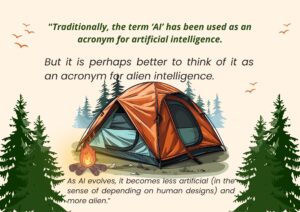
The Guardian indicates that there now occurs a certain mistake that people normally commit. “Traditionally, the term ‘AI’ has been used as an acronym for artificial intelligence. But it is perhaps better to think of it as an acronym for alien intelligence. As AI evolves, it becomes less artificial (in the sense of depending on human designs) and more alien.
Many people try to measure and even define AI using the metric of ‘human-level intelligence’, and there is a lively debate about when we can expect AI to reach it. This metric is deeply misleading. It is like defining and evaluating planes through the metric of ‘bird-level flight’. AI isn’t progressing towards human-level intelligence. It is evolving an alien type of intelligence.”
According to The Guardian, even currently AI sounds so sophisticated that in the next few decades, AI is likely to attain the capacity to even create new life forms. “Even at the present moment, in the embryonic stage of the AI revolution, computers already make decisions about us – whether to give us a mortgage, to hire us for a job, to send us to prison. Meanwhile, generative AIs like GPT-4 already create new poems, stories and images. This trend will only increase and accelerate, making it more difficult to understand our own lives.
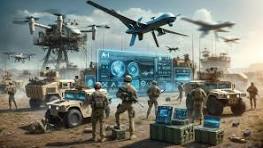
Can we trust computer algorithms to make wise decisions and create a better world? That’s a much bigger gamble than trusting an enchanted broom to fetch water. And it is more than just human lives we are gambling on. AI is already capable of producing art and making scientific discoveries by itself. In the next few decades, it will be likely to gain the ability even to create new life forms, either by writing genetic code or by inventing an inorganic code animating inorganic entities. AI could therefore alter the course not just of our species’ history but of the evolution of all life forms.”
Writing genetic code refers to creating or modifying biological instructions, such as DNA, that govern the development and functioning of living organisms. By contrast, inventing an inorganic code means designing software or other artificial instructions that enable non-living entities, such as robots or AI systems, to sense, decide, learn and act. It highlights the contrast between creating biological life through genetic information and creating life-like behavior in artificial systems through computational code.
Professor Harari explains that AI constitutes a global issue. In his mind, even if almost all nations perfectly enforced regulations to manage it, there would be no guarantee that the entire world could escape its disastrous effects. “Many societies – both democracies and dictatorships – may act responsibly to regulate such usages of AI, clamp down on bad actors and restrain the dangerous ambitions of their own rulers and fanatics.
But if even a handful of societies fail to do so, this could be enough to endanger the whole of humankind. Climate change can devastate even countries that adopt excellent environmental regulations, because it is a global rather than a national problem. AI, too, is a global problem.”
Why this invention?
To fathom why the invention of AI has become one of the defining issues of our time, it is necessary to examine the world into which this technology has emerged.
The Guardian, in its aforesaid article, points out “In recent generations humanity has experienced the greatest increase ever in both the amount and the speed of our information production. Every smartphone contains more information than the ancient Library of Alexandria and enables its owner to instantaneously connect to billions of other people throughout the world. Yet with all this information circulating at breathtaking speeds, humanity is closer than ever to annihilating itself.
Despite – or perhaps because of – our hoard of data, we are continuing to spew greenhouse gases into the atmosphere, pollute rivers and oceans, cut down forests, destroy entire habitats, drive countless species to extinction, and jeopardise the ecological foundations of our own species. We are also producing ever more powerful weapons of mass destruction, from thermonuclear bombs to doomsday viruses. Our leaders don’t lack information about these dangers, yet instead of collaborating to find solutions, they are edging closer to a global war.”
This major media powerhouse expounds that the primary problem is humanity’s weaknesses. “Computers are not yet powerful enough to completely escape our control or destroy human civilisation by themselves. As long as humanity stands united, we can build institutions that will regulate AI, whether in the field of finance or war. Unfortunately, humanity has never been united.
We have always been plagued by bad actors, as well as by disagreements between good actors. The rise of AI poses an existential danger to humankind, not because of the malevolence of computers, but because of our own shortcomings. Thus, a paranoid dictator might hand unlimited power to a fallible AI, including even the power to launch nuclear strikes. If the AI then makes an error, or begins to pursue an unexpected goal, the result could be catastrophic, and not just for that country.”
Similarly, terrorists might use AI to instigate a global pandemic, as The Guardian says. “The terrorists themselves may have little knowledge of epidemiology, but the AI could synthesise for them a new pathogen, order it from commercial laboratories or print it in biological 3D printers, and devise the best strategy to spread it around the world, via airports or food supply chains. What if the AI synthesises a virus that is as deadly as Ebola, as contagious as Covid-19 and as slow acting as HIV?
By the time the first victims begin to die, and the world is alerted to the danger, most people on Earth might have already been infected. Human civilisation could also be devastated by weapons of social mass destruction, such as stories that undermine our social bonds. An AI developed in one country could be used to unleash a deluge of fake news, fake money and fake humans so that people in numerous other countries lose the ability to trust anything or anyone.”
Taking into account externally visible factors, we can argue that AI is being pushed to its maximal level despite recognized risks, primarily due to intense geopolitical competition and massive financial incentives. Tech giants and global powers view rapid AI development as essential to securing economic dominance and national defense.
The Stanford Institute for Human-Centered Artificial Intelligence (HAI) 2025 AI Index Report, which documents both the rapid expansion of AI investment and the growing role of governments in AI competition, indicates it. It reports that global private AI investment reached record levels and that governments are increasingly developing AI strategies because of the technology’s economic and strategic importance. “At Stanford HAI, we believe AI is poised to be the most transformative technology of the 21st century.
AI is increasingly embedded in everyday life. From healthcare to transportation, AI is rapidly moving from the lab to daily life. In 2023, the FDA [U.S. Food and Drug Administration] approved 223 AI-enabled medical devices, up from just six in 2015. On the roads, self-driving cars are no longer experimental: Waymo, one of the largest U.S. operators, provides over 150,000 autonomous rides each week, while Baidu’s affordable Apollo Go robotaxi fleet now serves numerous cities across China.”
The Council on Foreign Relations (CFR) explicitly describes AI as part of a strategic competition over “foundational technologies,” affirming that artificial intelligence is becoming central to economic security and national power. “Strategic competition over the world’s next generation of foundational technologies is underway, and U.S. advantages in artificial intelligence, quantum, and biotechnology are increasingly contested. The United States must address vulnerabilities and mobilize the investment needed to prevail.
Chinese leader Xi Jinping’s signature initiatives are designed to seize the commanding heights of technology and dominate foreign markets. Xi understands the stakes, as he told an audience of China’s top scientists and engineers last year: Cutting-edge technologies such as artificial intelligence, quantum technology, and biotechnology have emerged. . . At the same time, the world is experiencing accelerated changes unseen in a century, with the technological revolution intertwined with great power competition.”
He additionally told them “Increasingly, high-tech fields have become the forefront and main battleground of international competition. . . . There is an urgent need to further enhance the sense of urgency, intensify efforts in scientific and technological innovation, and seize the strategic heights of technological competition.”
Nonetheless, by looking beyond externally visible factors and examining deeper underlying drivers, one may argue that AI is being pushed toward its maximal development, possibly because of interests not always openly acknowledged.
The evidence presented above suggests that the pursuit of increasingly powerful artificial intelligence is driven not only by technological advancement but also by deeper ambitions concerning power, influence, and humanity’s future direction. While some commentators interpret these ambitions through the language of religion or even “AI-god” narratives, the broader concern is that the race toward superintelligence may be advancing faster than society’s ability to understand, regulate, and control its consequences.
Thus, beneath the visible promises of innovation and progress, there remains a fundamental question: is humanity developing a transformative tool for its benefit, or creating a force whose ultimate implications it may struggle to govern?