By Paulin Nsengiyumva
Global employee engagement, for the first time in four years, is in free fall — and the world is paying a $438 billion price. Behind this downturn lies a deeper crisis: the burnout and breakdown of managers caught in a crossfire of executive pressure and frontline frustration.
Gallup’s report, the State of the Global Workplace: 2025 Report, delivers a stark warning — manager engagement has plummeted more than any other group, dragging teams down, morale, and productivity with it. The consequences are seismic: this doesn’t just concern unhappy employees — it’s about economic risk on a global scale. Gallup is a global analytics and advisory company best known for its public opinion polls and research into workplace trends, human behavior, and organizational performance.

Are we witnessing the unraveling of the workplace as we know it? In this article, we unpack the scope and signs of this disengagement spiral and explore what renders the current trend so alarming. In one of our next articles, we’ll turn to what can be done —practical steps that leaders must take to reverse the course before the collapse becomes irreversible. These steps are what the report calls “the most promising solutions”. The next article will also show how the world’s regions compare.
State of the crisis
“Is the Global Workplace at a Breaking Point?” Gallup asks itself, before adding “Last year, global employee engagement fell, costing the world economy US$438 billion in lost productivity.The primary cause was a drop in manager engagement. Since the pandemic [COVID-19], managers have been asked to square the circle of new executive demands and employee expectations. We are starting to see the toll.
But, it is not going to stop with managers. Manager engagement affects team engagement, which affects productivity. Business performance — and ultimately GDP [Gross Domestic Product] growth — is at risk if executive leaders do not address manager breakdown.”
Gallup says that the survey is typically administered annually face to face or by telephone, covering more than 160 countries and areas since its inception. It clarifies that the total number of global employed respondents included in the full trend of data for this report (2009 through 2024) equals 5,490,517. For the 2024 data, the total is 227,347; 2024 data included in this report were obtained from April 2024 to December 2024, according to Gallup.
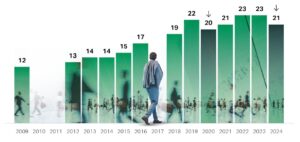
The survey’s report indicates that the global percentage of engaged employees decreased from 23% to 21% in 2024 and that engagement has only declined twice in the past 12 years, in 2020 and 2024. “Last year’s two-point drop in engagement was equal to the decline during the year of COVID-19 lockdowns and shelter-in-place orders.”
This drop is more than just a data point — it reflects a broader trend that’s visualized in the chart below, which is designed to illustrate the trajectory of global employee engagement over more than a decade. The chart serves as a visual warning: the rare decline seen in 2024 mirrors the shock of a global pandemic, signaling that something profound is unfolding in workplaces worldwide.
“If managers are disengaged, their teams are, too. This relationship is so strong that it shows up in country-level data: countries with less engaged managers are more likely to have less engaged individual contributors. Every year, Gallup asks the world’s workers how their lives are going. After several years of steady improvement, global employee life evaluations fell to 33% in the last two years.”
“Which employees experienced the largest decrease in well-being? Managers. Older managers saw a five-percentage-point decline in wellbeing in the past year, and female managers saw a seven-percentage-point drop. At the same time, individual contributor life evaluations improved slightly.
Manager engagement fell from 30% to 27%.Individual contributor engagement remained flat at 18%. No other worker category — male or female, young or old — experienced as significant a decline. However, two types of managers were particularly affected: Young (under 35) manager engagement fell by five percentage points; female manager engagement dropped by seven points.”
According to the report, half of employees who are engaged at work are thriving in life overall, while only a third of employees who are not engaged are experiencing overall wellbeing. “Engaged employees are also less likely to report experiencing daily negative emotions, including stress.”
Causes of the decline
The report shows that organizations across the globe have faced continuous and significant changes that have affected every part of how they operate — from leadership and workforce to finances, technology, and customer relations.
Post-pandemic retirements and turnover are some of the challenges. Several employees left the workforce due to retirement (especially older workers) or changed jobs frequently, creating instability in staffing. A hiring boom and bust—after the pandemic, there was a rush to hire — a “boom” — followed by a slowdown or mass layoffs — a “bust” — as economic conditions changed.

Rapidly restructured teams and departments—organizations had to quickly reorganize how teams work — combining roles, shifting responsibilities, or changing reporting lines — to adapt to new demands. The latter ones include, for example, the ability to work remotely (fully or partially) or flexible hours that accommodate personal life. Other challenges involve shrinking budgets and the end of stimulus programs, and new customer expectations, among others. Together, this list emphasizes how organizations haven’t just been dealing with one challenge — they’ve been navigating a storm of changes, all at once, reshaping the modern workplace from top to bottom.
The report reads “In an era where executives and employees seem farther apart than they have been in years, managers are handed an almost impossible task of making it all work in the real world. Here’s how managers around the world describe their jobs.”
“Difficult decisions put pressure on me psychologically, such as hiring. And sometimes there aren’t many resources. And there are also disputes between employees, facing problems, new systems, and so on,” Abu M, Marketing Manager in Saudi Arabia told Gallup. Wonseon K, Maintenance Technician in South Korea said “Since [our leaders] don’t stay long and move to other departments before we can fully get to know them, it’s hard to develop trust.” Andile V, Field Operating Manager in South Africa reported “We should have [a] team of six people. There’s only two of us. I think that is very stressful.”
Picture a building slowly cracking from its foundation—this is today’s workplace, where burned-out managers and disengaged employees are chipping away at its core. The warning signs are clear, and the cost is existential. The report reads “When we consider the decline in both manager life evaluations and employee engagement, a deteriorating workplace environment is the common denominator.
As with engagement, the consequences are existential for a business. Manager burnout eventually leads to declining performance, increased absenteeism and increased turnover — impacting the people they lead and the organization itself.”
The global workplace stands at a crossroads—one path leads deeper into disengagement and decline, the other toward an unprecedented surge in human potential. Gallup’s findings reveal that the difference between the two is a staggering $9.6 trillion in untapped productivity. “Gallup’s data show that the world’s workplace is not headed in the right direction.
However, the data also show a productivity boom opportunity if executive leaders seize the moment. Gallup estimates that if the world’s workplace was fully engaged, US$9.6 trillion in productivity could be added to the global economy, the equivalent of 9% in global GDP.”
A wake-up call for leadership across the globe

What we are witnessing does not just constitute a dip in engagement metrics—it forms a loud, persistent signal that the very framework of the modern workplace is under threat. The disengagement of managers, once the pivotal force holding teams together, is now actively eroding team spirit, performance, and overall well-being. Gallup’s report doesn’t just highlight a problem; it unveils a chain reaction that starts with managerial burnout and ends with billions of dollars in lost productivity—and potentially, a crumbling global economy.
The figures tell a compelling story: a decline in manager engagement from 30% to 27%, and a drop in global employee engagement from 23% to 21%. These numbers may appear modest, but they mirror the psychological and emotional toll of an overstretched workforce navigating constant change without adequate support. Particularly affected are young and female managers, whose sharp declines in engagement signal that specific demographic groups are bearing the brunt of this crisis.
The contributing factors are as complex as they are urgent—rapid restructuring, budget cuts, evolving customer expectations, and the aftershocks of the pandemic have left no aspect of the workplace untouched. Managers, caught in a precarious balance between upper management directives and employee needs, are breaking under pressure.
This moment demands decisive, compassionate leadership. The stakes are not only about improving employee satisfaction—they’re about unlocking up to $9.6 trillion in global productivity and safeguarding the future of work. As the cracks deepen across industries and nations, the need for systemic change becomes non-negotiable.
The data are sobering but also illuminating. We know where the fault lines lie. What remains is the willingness of leaders to act—to genuinely listen, invest in their people, and redesign workplaces where both managers and teams can thrive. The silent collapse can be reversed, but only if we move swiftly and with purpose.
Good https://lc.cx/xjXBQT
Thank you! We’re glad you judge it good — we appreciate your feedback!
Awesome https://is.gd/N1ikS2
Thanks a lot! Glad you’ve judged it awesome.
Awesome https://is.gd/N1ikS2
We actually rejoice over your inspirational feedback.