By Eph Mur.
Social health means the well-being of an individual in relation to their ability to form and preserve healthy, positive, and meaningful relationships with others. It encompasses various aspects of social interaction, including the ability to communicate effectively, build and maintain friendships, and engage in social activities. Social health is a crucial component of overall health and well-being, as strong social connections furnish emotional support, decrease stress, and upgrade mental health. Social health is influenced by various factors like social skills, social networks, and the quality of relationships.
The illustrative case below from Rwanda elucidates the great importance of social health for an individual and a family, while suggesting its huge importance for even a nation. The case involves a legal couple of Jacqueline Murekatete and Jean de Dieu Habiyambere whom I interviewed in 2015 in Tabagwe Sector in Nyagatare District in the Eastern Province of Rwanda. It was within the framework of the Promoting Peace Project funded by the USAID and implemented by Landesa and Search For Common Ground, among other key project implementing partners. The project was executed from 2013 to 2016 in Kayonza and Nyagatare Districts. This couple had experienced a prolonged and unbearable land property-related dispute.
“We couldn’t believe our 8 year-dispute could end,” said Murekatete. Their violent conflict started in 2006 and ended peacefully in 2014. “The only reason was that my husband used to disregard and infringe my land and property rights, like other men saying that women don’t have rights to land and other household invaluable possessions.”
Murekatete said that her husband wished to sell property as he pleased. She added they suddenly started fighting when she complained. She specified they’d spent 2 years clashing because of ‘wasting our jointly owned property’. He once sold a piece of land for 150 000 Rwandan francs (then around 187.5 US Dollars), according to Murekatete who added that the land value then actually equaled about 600 000 Rwandan francs (750 US Dollars then) and ‘this was the trigger of the escalation of the conflict.’
Negative Consequences
As explained by Murekatete, this dispute was disastrous. “We were living between death and life, my husband was once on the point of dying because of drinking poison to commit suicide and he was healed in a health center. It’s because of the violent conflict that he decided to kill himself, accusing me of depriving him of peace and security at home for the mere reason that I opposed his wish to continue selling our property.” “After the 2 years of physical violence at home, my husband moved to his family where he spent 2 years. He was eventually tired of such life and decided to move to Toro in Uganda to evade the situation and he spent there 4 years.”
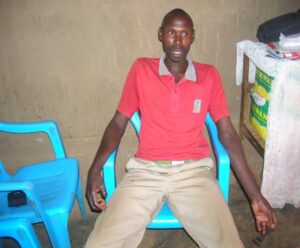
When Habiyambere, seen on the photo also on the right, compared his family to others in the region, he acknowledged the family faced a huge loss. “We’ve suffered an intolerable loss because we could now own at least a four-wheel vehicle of more than 10 000 000 (around 12 500 USD) Rwandan francs and other possessions since we possessed a strong shop worth more than 2 000 000 (nearly 2500 USD) in 2005.”
“I know a man, who was then nearly at the same level as me, who now owns a 6 000 000 (nearly 7500 USD) Rwandan franc vehicle and a lorry worth 28 000 000 (about 35 000 USD that time) Rwandan francs and over 10 hectares of land as well as other things we don’t know since he has moved to another sector, while I don’t even possess a bicycle of 30 000 (37.5 USD) Rwandan francs.”
A shop of about a 2 500USD value in 2005 actually was very strong. A piece of land/plot in an advanced/urban place which then cost then around 200 USD can now cost around 10 000USD.
Techniques used for the dispute to be peacefully resolved
Murekatete said that their dispute was resolved, thanks to the project’s Common Ground Approach. “Oh, God. Thanks for the project’s Community Resource Person (CRP), Anna Batesi and a group of women who accompanied her to assist us in getting out of the violent conflict. They performed a fabulous achievement.”
The Tabagwe CRP, like other 25 CRPs in Kayonza and Nyagatare Districts covered by the project, had been trained by SFCG on Conflict Transformation. Murekatete explained that the women approached her to talk to her about the dispute. She added the women helped her to understand she’d also perpetrated some mistakes though she was right to some extent as she was striving to defend her rights.
The women clarified to her that she claimed her rights aggressively, instead of peacefully or non-violently. “The woman, Batesi and the other women managed to show me that the conflict wouldn’t have escalated into violence if I had used constructive and peaceful dialogue to defend my rights; they emphasized that the conflict was actually aggravated by the destructive approach I applied.” “I was convinced I’d not been humble towards my husband, because I couldn’t fear that we even beat each other and I felt I was right.”

The women advised her to go to Uganda to initiate a peaceful interaction with her husband, and request him to come back. “After elucidating me that I have to show respect/ honor to my husband and clearly explaining the mistakes I committed, the women suggested that I should ask my husband for pardon and that he should also request me for pardon.” “Consequently I immediately decided to meet him in Uganda while I neither knew where he was nor possessed money to use to reach there since I was then cultivating people’s land for food; I didn’t have any other source of income.”
According to Murekatete, for her to be able to get to Uganda, she requested Urwego Opportunity Bank for a loan. She also requested a neighbor to lend her a phone so as to try to speak to his husband. “I called him and asked where he was and he replied he was in Toro and to reach there I had to spend 40 000 (around 50 USD); and the bank gave me the money.” “So I told him that I wanted us to amicably settle our dispute and he accepted. I begged him for pardon and he begged me for pardon.”
The man actually recognized the mistake he had committed. “I asked her for the pardon; I’d wasted our jointly owned property and you’ve learnt the huge loss we’ve experienced because of my behavior. So, I sincerely begged her for pardon for that.”
Benefits of peaceful resolution of the dispute
Murekatete and Habiyambere affirmed that they immediately started reaping good fruits from the end of their violent conflict. It was then only around one year after Batesi and the group of women peacefully transformed their dispute. However, they said they’d been able to have two houses constructed during this period only. They had additionally cemented all of their rooms. “We’ve even got a shop, we’re paying school fees for our 6 children and we get them all necessary needs like clothes while two of the children had failed to pursue courses since they irregularly studied so that they dropped out of school,” says Murekatete before adding “Currently here reigns a peaceful atmosphere and the children are always joyful.”
Habiyambere then believed that they were ready to exploit the peaceful environment to recover things they’d lost. “I nourish great hope that we’ll have accomplished a lot of achievements by two years from now, if things continue in this way. I strongly believe that we’ll have acquired some motorcycles.”
Benefits to the Community
Furthermore, Murekate confirmed that she had recorded a very important accomplishment, owing to the peaceful resolution of their violent conflict. “I now provide testimonies about our violent conflict and how it has been peacefully resolved so that the testimonies are helping a lot of people. Thanks to this, I’ve been elected the President of the Parents’ Evening Forum in our village.”

Murekate, holding sheets of paper where she’d recorded cases peacefully handled, said that on 8th March 2015 on the International Women’s Day she was the only woman, from the whole sector of Tabagwe, given an opportunity for speech. Her testimonies healed numerous people- both women and men, as she said. “I now have 9 disputes I’ve peacefully resolved; 4 of them are land-related while the others are relationship-based.” “Allow me to praise the Lord thanks to this marvelous project employing the Common Ground Approach, it has been my redemption and is being redemption for other people I’m helping because of it.”
Moreover Murekatete had succeeded in accomplishing what most women really fail to do in Rwanda, owing to the peaceful resolution of the dispute. “After we were assisted in peacefully transforming the conflict whereby we both recognized our mistakes; I accepted the children that my husband procreated with a concubine; they are here, they’re my children, I’m treating them the same as my own children and they’re learning like my own children.”
Based on the dispute, Habiyambere went beyond to prioritize projects and programs related to the Peaceful Conflict Resolution Field over projects and programs situated in other fields like education, health, agriculture and infrastructures usually more valued thanks to their nature of delivering tangible results or impacts. “People saying or thinking that projects, dealing with intangible things shouldn’t be attached value, deceive themselves considerably; they are totally wrong. This project has been designed to peacefully resolve/transform land-related conflicts and it has managed to successfully transform our dispute peacefully while even local government leaders had failed. During the time when the violent conflict was still existing, we never knew peace- we stagnated in the war, a fighting environment; therefore, our children were no longer eating well and sometimes lacked food, some of the children had dropped out of school, the violent conflict forced me to even move from the country to Uganda, I once attempted to perpetrate suicide of myself because of the dispute”.

“Our neighbors- who haven’t encountered a dispute but who were at the same level as us- are enjoying well-being; some of them possess a lot of property while I don’t even have even a bicycle of 30 000 RWF. However, for only 7 months after your project succeeded in peacefully handling our conflict, we have achieved tremendous accomplishments since we’ve got a shop, we’ve constructed two houses-one that we occupy and the other one that we rent to people for money. All of the children have returned to school, they’re well dressed and fed. They’re not right, those people only defending projects designed for tangible products like schools; but, where can they find students to join their schools, if the parents are stagnating in the war and fighting environment as we used to be?”
This recommendation of proper communication and resolving disputes through conversation reminds me of the couple of Bibiana Uwitonze and Michael Nkurunziza living in Cyuve Sector in Musanze District in Rwanda’s Northern Province. They have spent 11 years in extremely harsh violent conflict. It’s a local organization, Haguruka, that has recently helped them peacefully handle the dispute. The key reason for the dispute was the lack of right communication and family functions. “One day, I was going to kill him; he came home, inebriated and I took a hoe so as to smash his head but I renounced it when I thought that I could make my children orphans and that I could be jailed. His behavior had emboldened me not to fear anything because he wasted all money he got and we often lacked food,” said Uwitonze. “In fact the major reason was an inappropriate language; when a wife addresses an issue without anger or insults, you really listen to her, but when she confronts you, you immediately engage in the competing style.”
Haguruka has taught them to use appropriate communication and language to foster collaboration to reach consensus.
Can you be more specific about the content of your article? After reading it, I still have some doubts. Hope you can help me.
Your article helped me a lot, is there any more related content? Thanks!
Thanks for sharing. I read many of your blog posts, cool, your blog is very good.
Can you be more specific about the content of your article? After reading it, I still have some doubts. Hope you can help me.
Your article helped me a lot, is there any more related content? Thanks!
Your point of view caught my eye and was very interesting. Thanks. I have a question for you.
Feel free to surf to my page … https://cryptolake.online/crypto2
Your article helped me a lot, is there any more related content? Thanks!
Your comment is really appreciated and related content is always published.
Your point of view caught my eye and was very interesting. Thanks. I have a question for you.
Thank you for your sharing. I am worried that I lack creative ideas. It is your article that makes me full of hope. Thank you. But, I have a question, can you help me?
Thank you so much for your heartfelt comment. The fact that you feel at a loss for words to express your appreciation actually speaks volumes—and it’s incredibly touching. Sometimes, it’s not about lacking creative ideas but simply being moved beyond expression. We’re truly honored that the article could resonate with you in such a deep way. Your words, however modest they may seem to you, mean a great deal to us. Thank you for reading and connecting with it.
Thank you for your sharing. I am worried that I lack creative ideas. It is your article that makes me full of hope. Thank you. But, I have a question, can you help me? https://accounts.binance.com/hu/register-person?ref=FIHEGIZ8
Thank you sincerely for your touching message. We’re truly glad the article gave you a sense of hope and encouragement. Please feel free to ask your question—we’ll do our best to help you.
Your article helped me a lot, is there any more related content? Thanks!
We are pleased with your encouraging feedback, and the website contains more related content.
Thanks for sharing. I read many of your blog posts, cool, your blog is very good.
Thank you so much for this galvanizing feeedback.
Can you be more specific about the content of your article? After reading it, I still have some doubts. Hope you can help me.
Thank you for your engagement with the article. Please, clarify where you are experiencing doubts, so we can respond to them.
Your article helped me a lot, is there any more related content? Thanks! https://www.binance.com/ro/register?ref=V3MG69RO
We thank you a lot. Yes, there is more related content.
Thanks for sharing. I read many of your blog posts, cool, your blog is very good.
Thank you so much indeed.
I don’t think the title of your article matches the content lol. Just kidding, mainly because I had some doubts after reading the article.
Even though you are kidding, we would like you to enlighten us on the doubts.
Can you be more specific about the content of your article? After reading it, I still have some doubts. Hope you can help me.
Thank you for reaching out and sharing your feedback. We appreciate your interest in our article. Could you please let us know which parts you’d like us to clarify? We’ll be glad to provide more details and address any doubts you may entertain.
Your point of view caught my eye and was very interesting. Thanks. I have a question for you.
We’re delighted to know our point of view caught your attention — thank you for your kind words! We truly appreciate your engagement. Please feel free to share your question; we’ll be glad to help.
Your article helped me a lot, is there any more related content? Thanks!
Yes, the website features more related pieces. We thank you very much for the feedback.
I don’t think the title of your article matches the content lol. Just kidding, mainly because I had some doubts after reading the article.
Thank you for the playful feedback. We concur that the title might have raised certain expectations, and we’d love to clarify any points that have left you with doubts. Could you share which sections you’d like us to expound on? Your input will help us to make the article clearer and more aligned with its focus.
Your point of view caught my eye and was very interesting. Thanks. I have a question for you. https://www.binance.info/en-ZA/register?ref=B4EPR6J0
Thank you indeed for your motivating words— we’re really gladdened that the perspective has caught your attention and sparked your interest.
Please feel free to share your question. We’d be more than happy to explore it with you and provide any clarifications you need. Your engagement is truly appreciated.
Can you be more specific about the content of your article? After reading it, I still have some doubts. Hope you can help me.
Thank you for your feedback— you’re 100% entitled to ask for more clarity, and we’re happy to help address your doubts. If you can share the specific part that felt unclear or raised doubts, we can respond more precisely and break it down further. Your questions help us to improve the clarity and usefulness of the work, so we truly appreciate them.
Your point of view caught my eye and was very interesting. Thanks. I have a question for you.
Thank you very much indeed.
Your point of view caught my eye and was very interesting. Thanks. I have a question for you. https://www.binance.com/register?ref=JW3W4Y3A
Please, ask it. We are happy to learn that the view caught your eye and was very interesting.
Your point of view caught my eye and was very interesting. Thanks. I have a question for you.
Thank you very much. Please, raise the question.
Thanks for sharing. I read many of your blog posts, cool, your blog is very good.
Thank you very much for your feedback.
Can you be more specific about the content of your article? After reading it, I still have some doubts. Hope you can help me.
Please, clarify to us your doubts so we can get an opportunity to address them.
Can you be more specific about the content of your article? After reading it, I still have some doubts. Hope you can help me.
Clarify your doubts so we can respond to them.
Can you be more specific about the content of your article? After reading it, I still have some doubts. Hope you can help me. https://www.binance.bh/register?ref=JW3W4Y3A
Please elucidate your doubts, so it can pave the way for us to address them.
Thanks for sharing. I read many of your blog posts, cool, your blog is very good.
Thank you very much indeed!