By Life In Humanity Analysis Desk
The modern world often speaks as if science and the Holy Bible stood on opposite sides of reality. Yet, again and again, researchers attain discoveries eerily echoing the biblical record. Few examples illustrate this more strikingly than the ongoing discussion surrounding the destruction of Sodom. Researchers now advance a catastrophic inferno, a sudden annihilation marked by extreme heat and devastation so strange that some have suggested a meteor-like airburst as the cause. In other words, the destruction itself no longer constitutes the primary controversy. The real controversy is its meaning.

This is where the discussion gets intellectually unavoidable. The Holy Bible does not merely claim that the cities vanished; it states that they were judged by God. Yet several modern interpretations try to preserve the event while evading its theological significance—as though identifying a physical mechanism somehow eliminates divine agency.
But that assumption quietly collapses under scrutiny. Saying that a meteorite has brought the destruction does not logically prove that God was not involved. It merely describes a possible means through which the destruction materialized. Throughout the Scripture, divine judgment is frequently implemented through physical phenomena: floods, earthquakes, plagues, invading armies, and fire from heaven. The presence of a natural process has never, in itself, disproved the possibility of divine intervention.
The deeper issue, therefore, is not archaeology alone, but worldview. If evidence increasingly aligns with the biblical account, why does there exist such resistance to the Bible’s own explanation of that evidence? Is the rejection truly based on the facts themselves, or on a prior commitment to exclude any conclusion that concurs on God’s intervention in history? These questions deserve more than casual dismissal, because at stake is not merely the fate of an ancient city, but whether modern humanity is willing to follow evidence even when it points beyond materialism.
Forbes’ story on the destruction of Sodom
Forbes, on 23 September 2021, released a story entitled “A Massive Meteor May Have Destroyed The Biblical City Of Sodom”. It reads “ Recent archeological findings published in Nature by researchers of the Comet Research Group indicate that a large meteor may have destroyed the ancient city of Tall el-Hammam, and that this destruction may have gone on to form the basis of the Biblical story of the destruction of Sodom.”
The story goes on, explaining “Walking through the excavation of Tall el-Hammam is a fascinating, yet haunting, voyage. Puzzling findings indicate that the city was destroyed rapidly in a scorching fireball which is hard to explain. Pottery and mudbricks were melted. People were ripped limb from limb, and their bones are found smashed and scattered, buried in layers of ash, charcoal, and pulverized mudbricks. As archeologists dig through the ancient rock, they uncover a tell-tale blackened layer, where the rocks themselves tell the story of intense and widespread fires.”
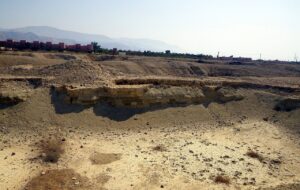
Archaeologists have found thousands of shaft tombs on the site, several containing pottery, tools, and burial offerings. The nearby settlement appears to have been a fortified urban center that was eventually destroyed by fire, after which it was largely forsaken. Because of this destruction layer and its location in the southern Dead Sea plain, Bab edh-Dhra has turned into one of numerous sites eliciting debates around possible locations for the five biblical cities of the plain, including Sodom and Gomorrah—though there occurs no scholarly consensus connecting it definitively to those cities. The close urban settlement must be the one shown on this next photo below.
“The story of the destruction of Sodom is detailed in both the Bible and the Koran. The destruction was rapid and intense. Three layers within the archeological dig indicate that something drastic happened here. The bottom layer is made of pulverized bricks, melted roof clay, charcoal, burned seeds, and scraps of burnt clothing. Above this is a windblown layer of small bits of plaster, charcoal, and limestone spherules. Topping it off is a dark, almost black, layer of ash and charcoal.”
The Collins Dictionary defines a limestone as a whitish-colored rock which is employed to build and produce cement. In geological contexts like extreme-heat events, these spherules are formed when a limestone or carbonate-rich material is intensely heated, prompting it to melt, vaporize, or partially melt. The spherules then rapidly cool in mid-air —they are solidified while still suspended in the atmosphere, before getting to the ground.
Forbes’ story continues “Perhaps most puzzling are the melted objects found in the ruins of Tall el-Hammam. Melted pottery shards, which melt at temperatures above 1500C. Mudbricks, that melt above 1400C. A host of melted elements and minerals, such as platinum, iridium, and quartz. There are also clues at the microscopic level. Archeologists also found carbon, likely originating from wood or plants, shocked to form structures like microscopic diamonds.
Almost as if it is peaking out of a layer of ancient pulverized mudbricks, the top of a skull emerges from the rock. It’s buried up to the bridge of its nose – the rest is embedded within a matrix of melted mudbricks. Stained with ash, it now has a brick-red tinge. The right eye socket has been crushed. Around it is a constellation of tiny bone fragments, which show the scar of high temperatures. Most of them are smaller than a penny.”
Forbes’ account does not end there. It states “There is more. Archeologists found that the massively thick walls of the city were sheared off [broken]. Millions of the mudbricks that made the city simply disappeared, potentially pulverized to microscopic pieces. Another piece of the puzzle – debris, whether it be shards of pottery or melted bricks, always seemed to point to the northeast. The spherules, tiny sand-sized balls of melted material, are particularly interesting. Some of these consist of calcium carbonate.”
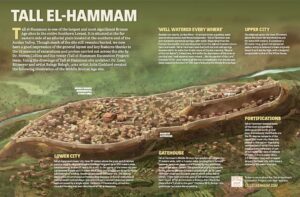
Here, calcium carbonate spherules are being cited as indicators of an exceptionally intense, rapid destruction event involving limestone-rich material, which some researchers link to a possible airburst scenario. The spherules suggest extreme, short-lived heat at city scale, and violent disruption of building materials, among others.
Forbes quotes Dr. Christopher Moore, a scientist at the Savannah River Archaeological Research Program at the South Carolina Institute of Archaeology and Anthropology and author on the study, as explaining “Extreme high temperatures (>1500 C) melted limestone plaster applied to the walls (mainly in the Palace area). Vaporized limestone plaster then quickly cooled in the air to form the numerous calcium carbonate spherules.” Other spherules found, according to Forbes, were formed of iron or silica. The Cambridge Dictionary defines “silica” as a mineral that exists in various forms, including sand, quartz, and flint, used to make glass and cement.
An extraordinary fire is acknowledged as the reason
Forbes says “3,600 years ago, the city of Tall el-Hammam was a bustling metropolis. With a population of about 8,000 people, it was the largest city in the region. But around 1650 B.C.E, that came to an end. The researchers of the study looked at several things that could account for the destruction. Warfare seemed unlikely, as there was no other archeological evidence of spearpoints or other weapons.
Tornadoes are rare in the area, and it would be difficult to imagine how a tornado could cause the extent of damage seen in human bones. Earthquakes could have led to fires, but could not explain the high-temperature melting of minerals. The authors looked at all sorts of natural disasters, from widespread city fires to volcanism to lightning. Of the 17 types of observations they made, there was only one event that fit all the data – a meteor.”

This media organization stresses “This meteor could have hit the city itself or nearby, or could have exploded in the air, like the Tunguska meteor in 1908 over Siberia. Either one could cause the level of destruction seen. The authors used the online Impact Calculator to simulate a meteor approaching Tall el-Hammam. This meteor likely would have been between 60 and 75 m across, putting it at potentially larger than the bolide that exploded in the Tunguska event.”
Forbes states that the destruction of Tall el-Hammam constituted the historical basis that became Sodom’s story. “Surely, the destruction of Tall el-Hammam would have been memorable. For the unlucky people who lived within the city, it is likely that no one survived.” Malcolm A. LeCompte, a researcher on the study from the Center of Excellence in Remote Sensing Education and Research, is cited as pointing out that tribesmen, women, and shepherds in nearby fields may have lived to recount the story, although “they may have been blinded or deafened by the explosion. In addition, there may have been some survivors within Jericho.”
According to Forbes, Tall el-Hammam was not the only city to be destroyed on that day. “22 km to the west lay the city of Jericho. This city was destroyed on a similar timescale as Tall el-Hammam. The city walls, along with buildings, tumbled, and the city burnt to the ground. Storerooms caught fire, causing pottery to burst. Human bones were found shattered and mixed in with the ruin. The main fortification of the city, in the direction of Tall el-Hammam, collapsed. However, no evidence of extremely high temperatures (>1200C), like melted pottery or mudbricks, was found.”
Forbes adds that the timing of the story of Sodom and the destruction of Tall el-Hammam seem to agree, citing Dr. Phil Silvia. “We can say with a high degree of confidence that the simultaneous destruction of Tall el-Hammam and every other city, town, and village in the Kikkar occurred ca 1650 BCE +/- 30 years,” says this author on the study from Trinity Southwest University, “which is the time of Abraham and Lot.”
Are Tall el-Hammam and Sodom the same place?
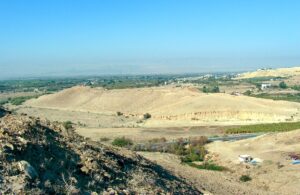
The idea that Tall el-Hammam was Sodom is situated in the 18th or 19th centuries, according to Forbes. This suggestion had been rejected, but it is slowly gaining traction today. Dr. Silvia was the one who hypothesized in 2018 that a meteor may have been the culprit of the demolition. “The Bible mentions only one eyewitness—Abraham,” Silvia explained to Forbes.
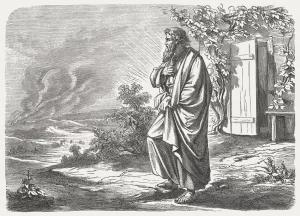
“He went up [to the top] and looked down upon Sodom and saw smoke rising from the whole plain like smoke from a furnace…. he probably saw the flash of the airburst the evening before, but it was to [too] dangerous to venture out at night, so he waited until the next morning to investigate.”
The exact location of Sodom has never been established with absolute certainty, yet most scholars place it near the southern region of the Dead Sea, in the area between present-day Israel and Jordan. The Bible doesn’t locate Sodom so conspicuously that you can easily know where Sodom can be situated today. In fact, the Bible does provide geographical clues about Sodom, but it does not situate the city so clearly that modern readers can identify its exact position with exactitude today.
Yet, Dr. Steven Collins seems to challenge this. Armstrong Institute of Bible Archaeology cites him as saying “Genesis 13 is the verbal map. It is specifically written, consciously by the author to take the reader to the site of Sodom.” This implies that you can use this Scripture, verbal map, to precisely locate the place.
In fact, the text places Sodom somewhere in the plain of Jordan, associates it with the Vale of Siddim, and connects that region with the Salt Sea now known as the Dead Sea. However, the Scriptures never supply precise coordinates, exact distances, or enduring landmarks that would allow historians and archaeologists to pinpoint one undisputed site. As a result, several competing theories have emerged over time, with some researchers equating Sodom with Tall el-Hammam and others placing it near the southern basin of the Dead Sea.
If the biblical text had described the city with modern geographical precision, there would likely occur little or no debate today. Instead, the location must be inferred from broad regional descriptions, ancient terminology, and archaeological interpretation; which is why the precise site of Sodom remains uncertain and contentious.
As already indicated by Forbes’ story, the event which happened to Tall el-Hammam matches the event described by the Holy Bible. That is why the story states that the Biblical Sodom is today’s Tall el-Hammam.
Tall el-Hammam constitutes an archaeological site in Jordan. The name “Tall el-Hammam” did not exist in the time when Sodom existed. Tall el-Hammam is a modern Arabic name. “Tall or Tell” means an archaeological mound — a hill formed by the accumulated ruins of ancient settlements built one on top of another over centuries. “El-Hammam” refers to the local area and is Arabic in origin.
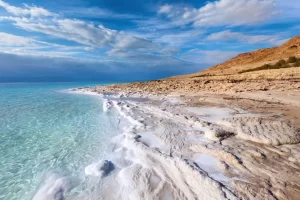
It is possible that the ancient city beneath Tall el-Hammam was known in its own time as Sodom, while the name “Tall el-Hammam” is a much later Arabic designation for the archaeological mound that now marks its remains. As already explained, the word “Tall” signifies an artificial hill or mound created by layers of ancient settlements constructed over several centuries.
“El-Hammam” is a local Arabic place name often associated with baths or warm water. Armstrong Institute of Biblical Archaeology, in its article —headlined “Uncovering the Biblical City of Sodom”, from the January-February 2025 Let the Stones Speak Magazine Issue — says “It [Tall el-Hammam] had, quite literally, hot and cold running water, derived from two springs—one warm and one cold—located inside the city. (The site’s Arabic name means ‘Mound of the Hot Baths.’”
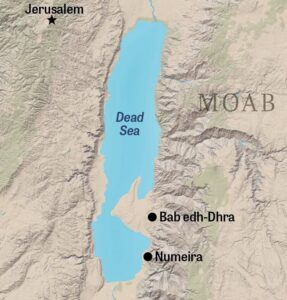
Britannica highlights “Har Sedom (Arabic: Jabal Usdum), or Mount Sodom, at the southwestern end of the sea, reflects Sodom’s name. The present-day industrial site of Sedom, Israel, on the Dead Sea shore, is located near the presumed site of Sodom and Gomorrah.”
If the identification is correct, then Sodom was the city’s original ancient name recorded in the biblical tradition, while Tall el-Hammam reflects the later language and geography of the region after the city’s destruction and abandonment. Over time, as populations changed and memory of the original name faded, the site possibly ceased to be called by its Bronze Age designation. Today, most archaeologists use the modern name “Tall el–Hammam” rather than Sodom.
Armstrong Institute of Biblical Archaeology says “A sensational discovery made international headlines in 2021: At the biblical site of Sodom—Tall el-Hammam—jaw-dropping evidence had been uncovered of some sort of fiery holocaust event that wiped out the city instantaneously, killing all inhabitants within half a second. What was the cause? The researchers ascribed it to an ‘airburst event,’ something like the mystery explosion in Tunguska, Russia, in 1908—when a meteor entering Earth’s atmosphere exploded above ground.
There was no crater, but everything below was flattened and incinerated by a yield equivalent to hundreds of atomic bombs—something that could justifiably be described as ‘brimstone and fire from the Lord out of heaven,’ to use biblical language (Genesis 19:24). The discovery of some sort of fiery cataclysm at Tall el-Hammam was not without its detractors, however. Ironically, some of the most heated criticism came from scholars in the religious community itself, who argued that Tall el-Hammam could not be Sodom.”
This institute adds “Death [ in Tall el-Hammam] would have been instantaneous, killing all living things in the area within a split second. Sudden destruction—and even this is reflected in the biblical account. Lamentations 4:6 states that Sodom was ‘overthrown as in a moment’—in the blink of an eye.”
NASA is the National Aeronautics and Space Administration— an independent agency of the U.S. federal government in charge of the United States’ civil space program and research in aeronautics and space. Its 30 June 2023 article titled “115 Years Ago: The Tunguska Asteroid Impact Event”, explains why the Tunguska meteor explosion didn’t turn into a cataclysm comparable to Sodom’s.
“At about 7:15 am local time on June 30, 1908, when Tsar Nicholas II ruled Russia, in one of the remotest areas of Siberia, a most unusual event occurred. An asteroid plunged into Earth’s atmosphere and exploded in the skies over Siberia. Local eyewitnesses in the sparsely populated region reported seeing a fireball and hearing a large explosion.
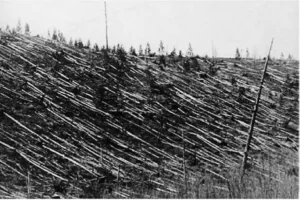
They also reported massive forest fires, and trees blown over for miles. Because of the remoteness of the site, the event garnered only brief attention even within Tsarist Russia and much less outside. The first scientific expedition did not reach the area until 1927, but still found ample evidence that eventually led to our understanding that an aerial explosion of an asteroid caused the destruction.”
This agency adds “Fortunately, because of the low population density, very few human casualties resulted, though there were reports of herds of reindeer perishing. Later aerial and ground surveys and additional fieldwork by professional scientists and voluntary researchers in the 1950s and 1960s eventually outlined a butterfly-shaped area of destruction of 830 square miles extending nine to 22 miles from the epicenter with millions of trees knocked over.
For a while, there was debate about whether the Tunguska explosion might have been caused by a comet, but most scientists today believe it was an asteroid that rained destruction on Siberia on that June day in 1908. In 2016, the United Nations proclaimed June 30 as International Asteroid Day to raise awareness about asteroids and efforts at planetary defense.”
Location of Lot’s wife pillar of salt
For centuries, the story of Sodom has been anchored not only in the catastrophic devastation of the city itself, but also in one unforgettable image: Lot’s wife turned into a pillar of salt when the judgment occurred to the plain. That shocking detail has long stood as one of the narrative’s most striking points. The existence of the pillar can constitute another powerful and tangible testament that the event was not merely symbolic legend, but something rooted in real history. The detail can also serve as a key undoubted mark, left by the destruction, dramatic enough to echo across millennia.
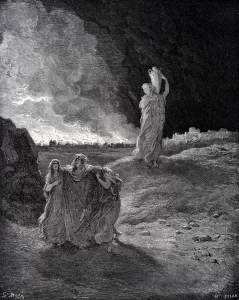
“If you are driving along the shores of the Dead Sea today, you can see the formation that bears her [Lot’s wife] name. The ‘pillar’ is located on the eastern flank of Mount Sodom, at the southern end of the Dead Sea basin. It stands prominently above Highway 90, the main artery running through the Jordan Rift Valley, approximately 12 miles (20 kilometers) south of the Masada fortress. What does it look like? Rising roughly 20 meters (65 feet) high, the formation is a tall, slender column of rock salt and limestone,” says Dekel Tours—a travel company in Israel.
This company further says “From certain angles, particularly when viewed from the road below, the pillar remarkably resembles the shrouded figure of a woman looking back toward the north, the direction traditionally associated with the destroyed cities of the plain. The surrounding environment of Mount Sodom is a ‘salt diapir’ essentially a mountain made of salt that has been pushed up through the earth’s crust.
This creates a landscape of white, crystalline ridges and deep, narrow crevices that look like something from another planet. If you are exploring the region on one of our Dead Sea and Masada Private Tours, your guide will lead you to the best vantage points where the ‘human’ silhouette of the pillar is most striking.”
Other cities of the plain which were annihilated by the event include Gomorrah, Admah and Zeboyim. Deuteronomy 29: 23 clarifies it in these words. “The whole land [Israel] will be a burning waste of salt and sulfur—nothing planted, nothing sprouting, no vegetation growing on it. It will be like the destruction of Sodom and Gomorrah, Admah and Zeboyim, which the Lord overthrew in fierce anger.”
Dekel Tours adds that some people say that the salt pillar amounts to a natural geological wonder. “While the biblical narrative attributes the pillar’s creation to a miraculous judgment, geologists offer a fascinating look at the natural forces at play in this volatile region. Mount Sodom is unique because it is composed almost entirely of rock salt (halite). Because salt is less dense than the sedimentary rocks above it, tectonic pressure over thousands of years has pushed the salt upward, much like toothpaste being squeezed from a tube.”
It adds “The identification of a specific salt formation as Lot’s wife is not a modern tourist invention. It has been a staple of Mediterranean lore for two thousand years. The Jewish historian Flavius Josephus, writing in the 1st century CE, claimed to have seen the pillar himself, noting: ‘I have seen it, and it remains at this day.’ Early Christian pilgrims of the Byzantine era also recorded sightings of the salt statue, often describing it as having miraculous properties (such as ‘healing itself’ if a limb was broken off).
It is important to note that throughout history, different formations on Mount Sodom have likely been identified as ‘the’ pillar. As one column erodes and collapses, another emerges through the shifting topography of the salt mountain, ensuring that every generation has a ‘Lot’s Wife’ to look upon.”
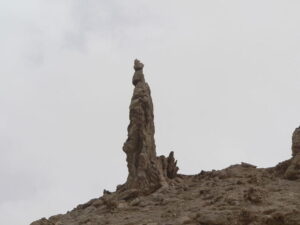
The Times of Israel is an Israeli multi-language online newspaper launched in 2012. It is widely acknowledged as the most extensively-read online paper in Israel. Sharona Margolin Halickman wrote a piece of writing headlined “Is Lot’s wife still standing near the Dead Sea?”, published on The Times of Israel on 5 November 2017. What she first stated supports Dekel Tours. “Yesterday, I was driving along the Dead Sea and saw a sign that said ‘Lot’s wife.’ The sign points to a rock formation that looks like a woman.”
Nevertheless, her following words raise suspicion. “The chances that this rock is actually Lot’s wife are very slim considering that the rock is much bigger than an actual person. Also, over thousands of years the shape of the rock would have probably changed. However, we know that she was turned into a pillar of salt in that vicinity, we just don’t know exactly where. The sign reminds us that the story took place in that area and the Dead Sea was formed by the destruction of Sdom and Amora and that is why to this day nothing will grow there.”
There generally exist two opposing interpretive approaches to the question of the pillar of Lot’s wife. One position affirms, at least within traditional and faith-based frameworks, that the formation near the Dead Sea maintains a physical reminder of the biblical narrative. The other position rejects any such association, arguing that the rock purely constitutes a natural geological formation whose resemblance and naming are coincidental and socially constructed.
From the tension between these two approaches, however, it emerges that what is genuinely striking about the formation is not easily dismissed: the presence of a tall, upright salt structure whose contours, from certain perspectives, appear to resemble a human silhouette—sometimes even interpreted as feminine in shape. Is such a convergence of form, location, and long-standing tradition merely coincidental, or does it invite a more open-ended interpretation than strict dismissal allows?

Back to Halickman’s account, her reasoning rests heavily on physical comparison and gradual natural change—specifically, the size of the formation and the likelihood that erosion should have modified its shape over millennia.
In fact, if one begins with the assumption that only what is measurable and empirically traceable can be meaningfully real, then anything outside that frame is automatically dismissed—not because it has been disproven, but because it has been reclassified into a category that cannot include it. Besides, in the case of the pillar, the formation exhibits physical characteristics that invite interpretation, particularly its striking vertical structure and its unusual resemblance from certain angles.
On one hand, it is reasonable for Halickman to ask why such a formation appears so prominent and how its size and structure came to be as it now stands. On the other hand, it is also rational to query why a natural formation should resemble a human figure, and in some perspectives even a female form; which corresponds to the biblical narrative of Lot’s wife. Moreover, the formation is located in a region traditionally associated with the biblical account; which is why it is continuing to draw interpretive significance.
In that sense, the argument by Dekel Tours and Halickman does not decisively refute the possibility. Moreover, divine action is not constrained by the same expectations which govern ordinary physical processes, and it is therefore not inherently unusual for the pillar to remain intact or be higher and larger than expected, especially if it is understood within a framework of divine causation rather than purely natural forces. The Holy Bible’s Old Testament (NKJV) states “All the inhabitants of the earth are reputed as nothing; He does according to His will in the army of heaven And among the inhabitants of the earth. No one can restrain His hand Or say to Him, ‘What have You done?’”
These words suggest that if God has determined the pillar to be larger than expected and to remain intact, no opposing force or natural limitation can ultimately frustrate His will. In that sense, any perceived persistence or scale of the formation can be understood as consistent with divine sovereignty rather than constrained by ordinary physical expectations.
Furthermore, according to Zephaniah 2:9 [NKJV], “Says the LORD of hosts, the God of Israel, ‘Surely Moab [a nation] shall be like Sodom, and the people of Ammon like Gomorrah— Overrun with weeds and saltpits, and a perpetual desolation.”
The plains associated with Sodom and Gomorrah are largely barren, infertile salt flats today. While the Jordan Valley once formed an agriculturally rich region, a combination of sudden catastrophic destruction and progressive soil salinity transformed the landscape into a desolate wasteland.

Phillip J. Silvia, Steven Collins and Malcolm A. LeCompte et al. Modeling how a Powerful Airburst destroyed Tall el-Hammam, a Middle Bronze Age city near the Dead Sea. Airbursts and Cratering Impacts. 2024. Vol. 2(1). DOI: 10.14293/ACI.2024.0005,”— Armstrong Institute of Biblical Archaeology.
In April 1994, Springer Nature Link released an article, titled “Sodom, Gomorrah and the other lost cities of the plain – a climatic perspective”, whose abstract reads “Certain aspects of the biblical story of the Cities of the Plain have in recent years become widely accepted. Among them is the placing of those cities in the southern basin of the Dead Sea, The Bible emphasizes the agricultural richness of the Jordan plain prior to the upheaval of Sodom and Gomorrah and its catastrophic transformation into a wasteland.
Thus, stripped of ethical and religious overtones, the scenario is that of a rapid climatic change that converted a densely inhabited and richly watered area into an infertile salt playa. The region northeast and southeast of Jericho, which today is quite barren as a result of the upward movement of salty ground water but which contains some of the World’s earliest known agricultural settlements, fits such a picture.”
Armstrong Institute of Biblical Archaeology confirms this detail. “The inhospitable wastelands of the southern Dead Sea region are a picture of desolation. And embedded throughout the aggregate strata of the southwestern Dead Sea region are numerous miniature sulfur balls that can be pulled out of the sandy marl cliffs and even set on fire, for many calling to mind the picture of ‘fire and brimstone’ that destroyed Sodom and Gomorrah.”
Nevertheless, this region was once immensely fertile. Genesis 13:10 in the Old Testament [NKJV], points out “And Lot lifted his eyes and saw all the plain of Jordan, that it was well watered everywhere (before the Lord destroyed Sodom and Gomorrah) like the garden of the Lord, like the land of Egypt as you go toward Zoar.”
Britannica also validates it. “Archaeological evidence indicates that the area was once fertile, in the Middle Bronze Age (c. 2000–c. 1550 bce), with fresh water flowing into the Dead Sea in sufficient amounts to sustain agriculture. Because of the fertile land, Lot selected the area of the cities of the Valley of Siddim (the Salt Sea, or Dead Sea) to graze his flocks.”
There are people who will raise objection immediately after you refer to the Holy Bible. Numerous scholars assume that biblical narratives are mythological from the outset; which creates immediate resistance before archaeological evidence is even discussed or evaluated.

But, in his article entitled “Has Archaeology Gone Overboard in Throwing Out the Bible?” published on ASOR [ American Schools of Oriental Research] Blog, Dr. Collins recommends “Be open to cause-and-effect relationships between biblical and ancient history when reasonable observations from numerous data sets—including the biblical text—converge. When levels of correspondence rise to statistically meaningful levels, do not ignore them merely because they contradict previously accepted ideas.”
Back to the region’s fertility, doesn’t this subject of former fertility in the region and its subsequent barrenness constitute another field which invites more serious reflection on the biblical account around Sodom, Gomorrah and the other cities, rather than its casual dismissal?
Does thus science refute the Holy Bible or it instead confirms it?
“Is Sodom Mentioned Only in the Bible? One argument against the historicity of Sodom and its destruction is that it is a city known only from the biblical text,” states Armstrong Institute of Bible Archaeology, before citing Dr. Collins as saying in his 2024 Cosmic Summit lecture “People have been asking me for 20 years, If Sodom was such a big deal, and this event was such a big deal, how come we never hear of it from the other ancient records outside the Bible?” “Never say never,” he said before boldly announcing “We have found Sodom in the Egyptian records.”
Armstrong Institute of Biblical Archaeology points out “Not only is Tall el-Hammam the largest site in the Jordan Valley; the site turned out to be the largest continuously occupied Bronze Age city in the entire southern Levant. And for Collins, this was a perfect fit; he had already proposed, based on the biblical account alone, that Sodom must have been ‘the largest Bronze Age city north and east of the Dead Sea.’”
Collins believes that such doubts and questions about the identity of the site should be laid to rest. “This [Tall el-Hammam] is Sodom,” he asserts. “If it isn’t, then by all means, biblically, tell us what it is.”
The modern discussion of Sodom’s destruction increasingly demonstrates that scientific investigation and the biblical narrative do not necessarily oppose each other, but often describe the same event through different lenses. Researchers examining Tall el-Hammam have proposed that the city experienced a sudden, extreme-temperature catastrophe consistent with a meteoric airburst, producing extreme heat, widespread destruction, and unusual material residues.
Even in this interpretation, the physical mechanism of destruction does not contest the possibility of divine work in the biblical sense, since the Holy Bible frequently describes judgment through natural events — like fire, floods, and earthquakes.
From a strictly evidential and scholarly perspective, the current scientific and archaeological data do reveal notable points of convergence with the biblical account of Sodom. Excavations at Tall el-Hammam have uncovered proofs of an unexpected, extreme-temperature destructive event consistent with an airburst calamity — involving fused pottery, shocked minerals, carbonized remains, and widespread urban devastation occurring around the period traditionally connected with Abraham and Lot.
Researchers have also observed that the region encircling the Dead Sea appears to have undergone severe environmental decline after antiquity, agreeing in broad terms with biblical descriptions of desolation, sulfur, and salt. At the same time, no scholarly consensus presently exists establishing with certainty that Tall el-Hammam was the historical Sodom. Nor does archaeological evidence possess the capacity to empirically prove theological claims concerning divine judgment with absolute certainty or beyond doubt. However, it is important to note that — as already underlined — archaeological evidence has, in numerous instances, corroborated historical and geographical details contained in the biblical record.
What the evidence presently demonstrates is that several physical and historical features described in the biblical narrative do not stand incompatible with known archaeological and geological findings. Therefore, in a rigorous scholarly sense, science does not presently disprove the biblical account. Rather, it supplies data that some researchers — as well as people in general — interpret as consistent with aspects of the scriptural tradition.