BY Editorial Staff
Imagine a reality where the ultimate finality of death is nothing but an illusion, a mirage crafted by our limited perception. Picture a world where hell does not constitute a myth, but an unspeakably terrifying, tangible place awaiting beyond this life. What if everything we think we know about existence, the afterlife, and our own mortality is fundamentally wrong?

This isn’t just a question of philosophy or religion—it instead represents a challenge to the very core of our understanding of reality. What if the boundaries between life and death, heaven and hell, are far thinner than we ever imagined? As we attempt to expose the layers of these unsettling possibilities, we invite you to rethink everything you’ve ever believed about life, death, and the realms that might lie beyond.
This is the second article in the “Mystery” sub-beat of this platform—a sub-beat designed to explore mysterious phenomena, especially those surrounding death and eternity. The primary reason why we have created the “Mystery” sub-category within the Spiritual Health beat is to thoroughly and scientifically explore enigmatic subjects. Those particularly include those concerning the nature of death, the afterlife, and the concepts of hell and heaven. This intriguing point has led Life In Humanity to create a dedicated program around the concept of ‘death,’ which some regard as an ‘illusion.’ The program is titled “Beyond the Veil: Rethinking Life and Death.” In the first article, Stephane Allix— after 15 years of research— states “Death does not exist.”
Context
These—death, afterlife and the concepts of hell and heaven— are maximally mysterious things which don’t unfortunately carry tangible proofs on which one can be based, to confirm or reject them. There are people who maintain that death is only an illusion, that hell certainly exists. A plethora of studies suggests that death could be more a transition or continuation of consciousness in another form rather than an absolute end. Other people contend that death signifies the definitive end of life in any form.
On one hand, these people affirming that when you die, your life ends so that no chances for consciousness stand bear reasonable grounds. A human is material, like other different creatures. When a person passes away, we bury their physical or tangible body. How can it happen that a dead person changes and then continues living in another form?
On the other hand, one of the most brilliant geniuses of all time-Blaise Pascal challenging his atheist counterpart stated “I have a choice: either first I believe God exists or second I do not believe God exists. First, if I believe God exists, and God in fact does exist, then I will gain infinite happiness. However, if I believe God exists, and God in fact does not exist, then I will have no payoff.
Second, if I do not believe God exists, and God in fact does exist, then I will gain infinite pain. However, if I believe God does not exist, and God in fact does not exist, then I will have no payoff. Thus, I have everything to gain and nothing to lose by believing in God, and I have everything to lose and nothing to gain by not believing in God. On these grounds, one would be foolish not to believe.”
Life In Humanity reiterates the question “what if Hell exists and Death is an illusion?” Even in the distant past there were things which people generally opposed, but these things eventually emerged true.

BBVA Open Mind in its 24 February 2016 article, it says “Galileo was condemned for his theory that the Earth revolved around the Sun, and not the contrary, an idea that on 24 February 1616 the Inquisition of the Catholic Church declared ‘formally heretical’ as well as ‘foolish and absurd in philosophy.’
Heliocentrism had become a matter of theological discussion following Galileo’s work Sidereus Nuncius (Sidereal Messenger) published in 1610. In the work the astronomer brought his telescopic observations to support the heliocentric hypothesis; however, this idea had already been circulating in the celestial treatises for nearly a century.”
NASA Earth Observatory with its July 7, 2009 article entitled “Planetary Motion: The History of an Idea That Launched the Scientific Revolution” echoes the point. “When Galileo pointed his telescope into the night sky in 1610, he saw for the first time in human history that moons orbited Jupiter. If Aristotle were right about all things orbiting Earth, then these moons could not exist.
Galileo also observed the phases of Venus, which proved that the planet orbits the Sun. While Galileo did not share Bruno’s fate, he was tried for heresy under the Roman Inquisition and placed under house arrest for life.”
Giordano Bruno faced a tragic fate for just affirming that the Earth is round and refusing to recant his true statement which was however regarded as a heresy.
Organiser Weekly in its Aug 26, 2023 article reports “Today, India stands on the verge of making history on the Moon, drawing the hopeful eyes of the world toward its endeavors. Both India and the global community have made strides in the realms of of science and space exploration. However, there was a time when a man voiced the simple truth that the Earth is round, only to be met with a tragic fate – he was burned alive. This stark reality reflects a darker aspect of our society.
In July 2023, the Catholic Church in Rome released a statement to the world, seeking forgiveness for historical transgressions that left an indelible stain of blood on the hands of both religion and the Church. This apology is also rooted in an incident that occurred nearly 400 years ago when the Church’s actions led to the demise of an individual who dared to speak a fundamental truth: the Earth is round.”
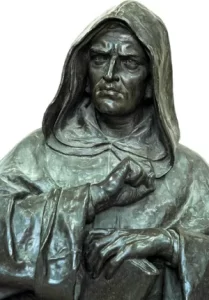
Britannica also confirms that he was burned alive. “Bruno finally declared that he had nothing to retract and that he did not even know what he was expected to retract. At that point, Pope Clement VIII ordered that he be sentenced as an impenitent and pertinacious heretic.
On February 8, 1600, when the death sentence was formally read to him, he addressed his judges, saying: ‘Perhaps your fear in passing judgment on me is greater than mine in receiving it.’ Not long after, he was taken to the Campo de’ Fiori, his tongue in a gag, and burned alive.”
A gag, according to the Collins Dictionary, is a thing like a piece of cloth that is tied around or inserted inside someone’s mouth so as to prevent them from speaking. “If someone gags you, they tie a piece of cloth around your mouth or put a cloth inside it in order to stop you from speaking or shouting.”
Life In Humanity has judged it necessary to first furnish this context in efforts to invite people to avoid instantaneous skepticism, so they may be awakened to some extent, paying attention to the question “What if Hell exists and Death is an illusion?”
This platform therefore grabs this opportunity, to request you seriously consider this subject and express your comments on it since the platform is determined to scientifically and thoroughly address this provocative field. Your comments and questions figure among things which will enable Life In Humanity to deal with it in full neutrality.
Different personalities besides Stephane and institutions on death or afterlife
Cleveland Clinic is a nonprofit academic medical center based in Cleveland, Ohio. It is renowned for its high-quality patient care, cutting-edge medical research, and education programs. This clinic is said to have stood at the forefront of modern medicine when it was first structured as a multi-specialty group practice in 1921.
This healthcare organ said to have grown to become the world’s first integrated international health system, with more than 65,000 caregivers worldwide, says “Death marks the moment when your vital organs stop working to keep you alive. The actual moment of death is often just one part of a more involved process (dying) where your body slowly shuts down. Knowing what to expect before death, at the moment of death and even afterward can help you face the experience when the time comes.”
Cleveland Clinic adds “Dying is a natural process that unites us all. Still, it’s normal to fear death because of the unknowns. You may wonder what dying will feel like for yourself or a loved one. You may wonder if there’ll be pain or how much time it takes to go from your first labored breath to your last.
These questions don’t have straightforward answers. But having a clearer understanding of what dying looks like can help you face your own death or the death of a loved one when the time comes. And having an idea of what’s to come can make you a more capable caregiver as you comfort a loved one who’s dying.”

The point raised in the latter quote matches the key reason which has caused Allix to investigate death; which has shown him that death doesn’t really exist. “What happens when we die? What does our consciousness become? Does it survive brain death?” These are profound questions that challenged Allix at the time of his brother’s death. He has since employed all his skills and instincts as a journalist, to try to unravel the mystery of consciousness.
“I began investigating the subject after the accidental death of my brother Thomas in 2001, while we were both on a mission in Afghanistan for the French Explorers Society. The shock was immense. This moment marked a major turning point in my life. Where did my brother go? It was then that death became a subject of constant inquiry for me. Since then, I have continually used my experience and investigative tools to try to scientifically understand what we know about this moment, laden with fear and mystery,” he narrated to the Catholic daily paper based in France, La Croix, on 30 December 2023.
“I have particularly questioned neuroscience and other disciplines, to try to uncover the nature of consciousness. I have interviewed numerous researchers around the world, as well as witnesses, especially those who have gone through near-death experiences. This is how I slowly became convinced that the continuation of some form of life after death is a rational hypothesis, supported by both science and countless testimonies. For years, I sought the ultimate proof that death does not exist, and it was science that brought me closer to this understanding, through a multidisciplinary approach combined with personal exploration and the study of ancient knowledge. Science and spirituality have proven to be extraordinarily complementary path.”
Time Magazine published an article headlined “Beyond Death: The Science of the Afterlife” on 20 April 2014. It was written by Lisa Miller. The article begins stating that certain people have claimed to have actually visited the place that, Saint Paul promised, “no eye has seen … and no human mind has conceived.” The article highlights that their stories very often follow the same narrative arc.
It suggests that the stories shared by people claiming to have visited the extraordinary place described by Saint Paul often follow a similar pattern or structure. Despite the different personal experiences, the essential elements of their narratives—how they describe their journey, what they encountered, and the outcomes—are alike, indicating a shared thematic experience in their storytelling.
Miller wrote “A skeptic, a rogue or an innocent suffers hardship or injury: he is hit on the head, he suffers a stroke, he sustains damage in a car crash or on the operating table. A feeling of disconnection comes over him, a sense of being ‘outside’ himself. Perhaps he encounters an opening: a gate, a door, a tunnel. And then, all at once, he is being guided through other worlds that look and feel to him more ‘real’ than the world in which he once existed.
These realms are both familiar and strange, containing music that doesn’t sound like music and light brighter than any light, and creatures that may or may not be angels, and the familiar faces of loved ones lost as well as figures from history and sometimes—depending on the narrator—even Jesus himself. The tourist is agape. Words fail. He leaves reluctantly to reoccupy his body and this earth. But the experience changes him forever. Convinced as he is of a wholly different reality, he is calmer, more self-assured, determined to persuade the world of heaven’s truth. He tells his story to the masses. ‘Heaven is real!’ he proclaims.”
Miller said that according to a Gallup poll, approximately 8 million Americans claimed to have gone through a near-death experience (NDE), and several of them regarded this experience as proof of an afterlife—“a parallel, spiritual realm, more real, many say, than this one.”
Miller further says that Raymond Moody, who wrote Life After Life in 1975, “one of the first popular books about NDEs”, told CNN in 2013 that among people who had faced such experiences, conviction about an afterlife transcended the particulars of religion. “A lot of people talk about encountering a being of light,” he said. “Christians call it Christ. Jewish people say it’s an angel. I’ve gone to different continents, and you can hear the same thing in China, India and Japan about meeting a being of complete love and compassion.”
Moody was one of the founders of the International Association for Near-Death Studies, an institution dedicated to building global understanding of such experiences.
“Ninety Minutes in Heaven (2004), about a Christian pastor who ascended to God after a car wreck; Heaven Is for Real (2010), about a child who sees heaven during surgery; and Proof of Heaven, by a Duke-trained neurosurgeon who traveled to heaven in 2012, have all been bestsellers, all following the same storyline,” said Miller before adding “The neurosurgeon, Eben Alexander, said in Newsweek in 2012 that his experience convinced him that his consciousness (the soul, or the self) exists somehow separate from or outside the mind and can travel to other dimensions on its own.”
“This world of consciousness beyond the body,” Alexander wrote, “is the true new frontier, not just of science but of humankind itself, and it is my profound hope that what happened to me will bring the world one step closer to accepting it.”
Conclusion
Life In Humanity presents this inquiry into the nature of death and the afterlife not as a mere philosophical exercise but as a challenge to our fundamental understanding of reality. The historical examples of Galileo and Giordano Bruno remind us of the courage required to question prevailing beliefs and the eventual rewards of seeking deeper truths.
As we explore the possibility that death might be an illusion and that hell might be more real than we imagine, we invite you to engage with this provocative subject. We seek your comments and questions to further our exploration of these profound ideas. Together, let us embrace the opportunity to expand our understanding and approach this mystery with open minds and rigorous inquiry.