By Jean Baptiste Ndabananiye
The Olympic Games, a symbol of global unity and athletic excellence, leave behind a significant environmental footprint. A recent study by some researchers from the University of South Florida provides fresh insights into how the Olympics generate carbon dioxide (CO2) emissions on a global scale.

The study reveals that host nations experience a substantial rise in CO2 emissions in years paving the way for and during the event, before returning to baseline levels afterward. As climate concerns grow, the findings spark urgent discussions on how to make future Olympic Games more sustainable. This piece is divided into these major parts:
- Studies link Olympic Games to temporary surge in CO2 emissions
- How do sporting mega-events cause gas emissions polluting the atmosphere?
- What does the study on Science Direct suggest and are there feasible and innovative solutions?
Studies link Olympic Games to temporary surge in CO2 emissions and environmental destruction
Three authors from the University of South Florida in the USA conducted a study titled “Do the Olympics impact CO2 emissions? A cross-national analysis”. Science Direct accepted and published it online on 29 and 30 October 2024 respectively. The report of the study reads “In recent decades scholars and practitioners have grown concerned about the sustainability of mega sporting events, such as the Olympics.
While there has been much debate concerning the carbon footprint of the Olympics, and attempts to manage CO2 emissions of the event in the future, there is little empirical research to our knowledge that puts the Olympics events in a cross-national context, which would enable us to assess how the Olympics, over time and compared to other countries, has impacted CO2 emissions cross-nationally, rather than as an isolated event.”

It further says “This is important because emissions from the Olympics are not just bound to the hosting nation but are more diffuse given the level of travel and trade customary to the event.
Moreover, a cross-national quantitative approach can help us understand the overall impact of hosting the Olympics on CO2 emissions, which may provide a larger and longer perspective from which to critique and amend guidelines and principles surrounding such events. To do so, we use two-way fixed effects regression analysis for a sample of 131 nations from 1991 to 2019 to assess how the Olympics impacts CO2 emissions cross-nationally.”
The hosting of the Olympics often brings a surge of activity and investment which leads to significant environmental consequences. The recent analysis reveals a striking correlation between Olympic events and increased CO2 emissions in the host nation, prompting a closer examination of the event’s short-lived impact on the environment.
The authors state “We find that both in the two years preceding an Olympics event and in the year of the event CO2 emissions of the hosting nation are significantly increased, even while controlling for relevant factors such as GDP, population, trade, agriculture, and manufacturing.
This impact is consistent across countries and across time. However, we also find that CO2 emissions do not remain increased once the event is finished. Our analysis shows that emissions in a nation return to pre-Olympics levels in the year following the event.”
The authors highlight “One of the most significant negative impacts of the Olympic Games is the environmental damage caused by climate change, deforestation and water pollution. As an example, the 2022 Beijing Olympics face criticism for destroying native vegetation. However, while the environmental degradation and emissions of Olympics events is well documented, the Olympic games produce fewer emissions than comparable sporting mega-events.”
Bournemouth University’s study also underscores “While sporting mega-events attract large audiences (Varrel & Kennedy, 2011), they also impose substantial negative impacts (Collins et al., 2009). From the environment viewpoint, the latest World Cup in Brazil generated about 2.7 million tonnes of GHG emissions which is disproportionally high for a short-lived event (FIFA, 2014). For comparison, this is almost the amount of carbon footprint generated by the entire nation of Malta in 2014 (GCP, 2015).
In terms of sectoral contribution, the GHG emissions of the World Cup 2014 in Brazil were produced by transportation (83.7%), sporting venues (9.65%), tourist accommodation (5.7%) and various destination-based tourist activities (0.95%) (FIFA, 2014). Within the largest contributing sector, i.e. transportation, most carbon footprint arose from international (60.5%), long-haul domestic (35.2%) and short-haul domestic / local travel (4.3%) (FIFA, 2014). This demonstrates that the transportation element of sporting mega-events represents a key carbon offender whose urgent mitigation is necessary.”
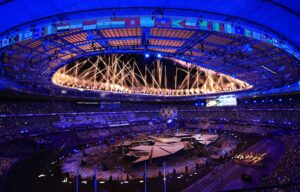
In its survey published on 20 July 2024, Statista explains “During the Tokyo 2021 Olympics, carbon emissions from proceedings were estimated to be around 1.9 million tonnes of carbon dioxide. This was nearly half of the previous Olympics, which were held in Rio de Janeiro in 2016. The Paris 2024 Olympics were forecast to continue this trend of reducing the Games’ carbon footprint, with an estimated 1.75 million tonnes expected from that year’s edition of the competition.”
The target has however been slightly reduced, enabling Paris to accomplish its ambition that it had been pursuing for 10 years before. Olympics in its 20 December 2024 story titled“Paris 2024 Report confirms over 50% carbon emissions reduction” says “The Olympic and Paralympic Games Paris 2024 achieved an unprecedented 54.6% reduction in carbon emissions compared to previous editions, as detailed in the newly published Paris 2024 Sustainability and Legacy Report.
The first Games to fully embrace Olympic Agenda 2020 – the IOC’s strategic roadmap which aims to make the Games more sustainable – Paris 2024 drove unparalleled progress in sustainability and delivered lasting and tangible benefits for local communities that will resonate for generations to come. Paris 2024 emitted a total of 1.59 million tonnes of CO2 equivalent, reducing emissions by 54.6% compared to the average emissions of London 2012 and Rio 2016.”
How do sporting mega-events cause gas emissions polluting the atmosphere?
Sporting mega-events, such as the Olympics or World Cup, contribute significantly to gas emissions and atmospheric pollution through various mechanisms— such as increased construction activity, transportation, energy consumption, tourism and economic activity, waste generation and long-term urbanization effects.
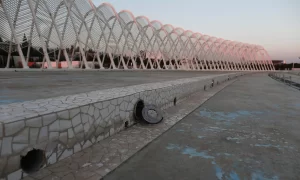
Climate Impacts Tracker Asia with its 4 July 2024 story “The Olympics’ Environmental Impact: Improving Sustainability” reports “ The Olympics demand vast amounts of materials, water and energy. For example, the Rio 2016 Olympics required significant infrastructure development, including the construction of 17 new venues.
The Olympic Village alone required 430,000 cubic metres of concrete and 43 tonnes of steel. Cement and concrete production accounts for up to 8% of global emissions and is a hard-to-decarbonise sector.”
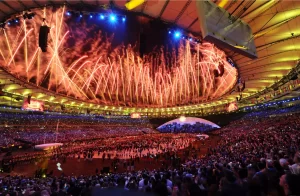
“Waste generation. Significant waste is produced before, during and after the Olympic Games. The Rio 2016 Olympics generated 17,000 tonnes of waste. This is equivalent to the annual waste generation of over 20,000 homes in the U.S. – one of the world’s highest per capita waste-generating countries.”
Increased construction activity
- Infrastructure development— building stadiums, transportation systems, and facilities often requires extensive construction which generates emissions from machinery and materials (for example, cement production).
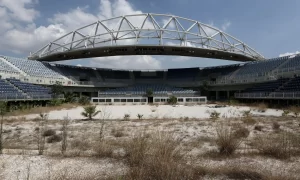
Abandoned Athens Olympic 2004 stadium. The Guardian’s image. - Temporary venues— several mega-events utilize temporary structures that also contribute to emissions during their construction and dismantling. “Specially-designed, temporary festive spaces designed to accommodate spectators and visitors have become commonplace when hosting major and mega sporting events,” said David McGillivray in a paper “Sport events, space and the ‘Live City’” which appeared in Science Direct in February 2019.
Transportation emissions
- Visitor travel— millions of spectators, athletes, and officials travel to the event, leading to increased air, road, and rail transport emissions.
- Local traffic congestion— events cause traffic congestion, resulting in higher emissions from idling vehicles and increased fuel consumption.
Energy consumption
- Event operations— large-scale events require significant energy for lighting, heating, cooling, and powering facilities, often sourced from fossil fuels.
- Broadcasting and media coverage—extensive media presence and technology used to broadcast the events also consume considerable energy.
Tourism and economic activity
- Increased tourism—the influx of tourists produces higher emissions from hospitality services, local transport, and leisure activities.
- Commercial activities— increased demand for goods and services in the area raises emissions from production, distribution, and waste generation.
Waste Generation
Event waste— mega-events generate large amounts of waste, including food, plastic, and construction rubbish which, if not properly managed, can lead to methane emissions from landfills.
Long-term urbanization effects
Post-event development— infrastructure developed for the event may lead to long-term urbanization, increasing emissions over time due to higher population density and industrial activity.
Moreover, these events generate infrastructures that are not used again after they end, resulting in wasted resources and further environmental degradation. This cycle of temporary construction and subsequent abandonment underscores the environmental cost of urban expansion driven by such mega-events.
Smithsonian Magazine’s February 16, 2018 story headlined “In a World Striving To Cut Carbon Emissions, Do the Olympics Make Sense?” reads “Staging the Olympics comes with a huge environmental footprint. Flying an estimated 28,500 athletes and staff to Brazil for the 2016 Summer Olympics in Rio generated more than 2,000 kilotonnes (kt) of greenhouse gases (GHG) — not to mention the 2,500 kt of GHGs associated with bringing in about half a million spectators.

What’s worse is that the investments made for the Olympics often end up being wasted. After the 2004 Summer Olympics in Athens, training fields and pools, a beach volleyball court and a hockey stadium were all left to rot, and the Rio facilities look to be on the same track.”

Overall, while sporting mega-events provide economic benefits which might be short-term, their environmental impact— particularly in terms of increased greenhouse gas emissions— raises important concerns about sustainability and the need for greener practices in future events.
What does the study on Science Direct suggest and are there feasible and innovative solutions?
The study’s authors recommend “We encourage future research to focus on how to create environmental benefits (as opposed to detriments) to nations of hosting the Olympic games and how we can create avenues through which everyone can benefit from using the excitement and economic power of the Olympic games to create positive long-term environmental legacies.”
Life In Humanity has imagined certain approaches as mechanisms to address the issue. Can therefore the following mechanisms intervene as feasible and innovative solutions to reshape the Olympics into a truly low-carbon or even carbon-neutral event?
Permanent Olympics – one fixed location to cut emissions
Instead of rotating host cities every four years, which leads to massive infrastructure emissions, one permanent Olympic city could be designated. Greece, as the birthplace of the Olympic Games, has been suggested, but other neutral, climate-friendly locations could also be explored. This would eliminate the need for constant new construction and massive international processes that drive emissions.
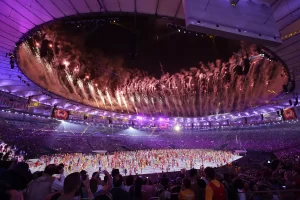
(Robert Gauthier / Los Angeles Times)
The idea of establishing a single permanent location for the Olympics could drastically reduce the need for constant construction and infrastructure emissions. This approach would minimize the environmental costs associated with building new venues and the carbon footprint linked to international travel.
A distributed Olympics model – multiple host cities
Hosting events across multiple existing stadiums in different countries can lower the carbon emissions by reducing the need for new construction and allowing fans to attend events closer to home. This model also spreads the economic benefits more equitably across different nations.
Instead of one country bearing the entire burden, events could be spread across several pre-existing stadiums in different countries or continents. This way, no country needs to build new stadiums, and fans can attend events closer to home, reducing travel-related emissions. For example, the 2026 FIFA World Cup will be hosted across the USA, Canada, and Mexico, showcasing this model in action.
The low-carbon athlete– Olympic participation based on eco-friendliness
This involves introducing sustainability ranking for athletes and delegations—favoring teams that travel via low-carbon means, use eco-friendly gear, and offset their carbon footprint. This could be an incentive for sports teams and federations to invest in greener practices.
Introducing this sustainability ranking for athletes could incentivize greener practices within sports teams and federations. This encourages eco-friendly travel and the use of sustainable gear, promoting a culture of sustainability within the sporting community.
A carbon-neutral spectator experience – can the Olympics go fully virtual?
Leveraging technology for a virtual spectator experience can reduce the carbon footprint associated with travel to and from events. This could transform the way fans engage with the Olympics, making it accessible to a global audience while minimizing emissions.
The Olympics already rely on massive global broadcasting. What if VR, AI, and interactive streaming allowed fans to experience the games without physically traveling? Digital attendance could come with interactive features like virtual fan zones, reducing flights and accommodations that drive emissions.
Sustainable construction – the 100% recyclable stadium
Emphasizing modular, recyclable construction methods for stadiums can mitigate waste and environmental impact. Using sustainable materials and ensuring that venues can be repurposed post-Games aligns with a circular economy approach.
Instead of concrete-heavy stadiums, use modular, recyclable stadiums that can be disassembled and repurposed post-Games. The Paris 2024 Olympics incorporated wooden, reusable, and modular venues, but could this model become a permanent requirement?

Olympics in its 1 July 2024 story “Paris 2024 models a new sustainable urban vision” reports “ As the first Olympic Games to be fully aligned with Olympic Agenda 2020 requirements, Paris 2024 is using 95 per cent existing venues, which have been upgraded and modernised – not just for the Games, but to ensure long-term opportunities for local communities to practise sport. In addition, thanks to the momentum created by the Games, the French government has pledged to build 5,000 proximity sports grounds across the country, ensuring easier access to sport for everyone, closer to their homes.
The ‘reduce, repurpose and re-use’ approach for venues is set to provide a springboard for the decarbonisation of France’s construction industry. The country hopes to cut carbon in the building sector as the European Union aims to reduce the bloc’s overall emissions by 55 per cent by 2030.”

The website, Corfix, in its 24 July 2024 story headlined “Paris Construction Techniques for the Olympics” echoes the point, saying “Many of the new constructions, including the Olympic and Paralympic Village and the Aquatic Centre, incorporate a high percentage of recycled and bio-based materials. For example, wood and bio-sourced materials like hemp and straw are prominently used in these buildings. The Aquatic Centre features a timber frame and a roof equipped with photovoltaic panels, making it one of the largest urban solar farms in France.
Spectators at the Games will sit on chairs made from recycled plastic collected from local bins, showcasing the circular economy in action. This initiative not only reduces waste but also highlights innovative uses for recycled materials. Buildings and venues are designed with energy efficiency in mind, featuring triple glazing, cooling floors, and geothermal energy systems.”
Overall, these proposed solutions not only aim to address the environmental challenges associated with the Olympics but also highlight the potential for innovation and collaboration in the sporting industry to create a more sustainable future. It’s an exciting time for the discussion on how mega-events can evolve to better respect our planet while still delivering the thrill and unity that sports provide.