By Jean Baptiste Ndabananiye
What if Africa’s journey—from food self-sufficiency to food abundancy able to nourish the world—depends on agricultural investment which places this sector’s primary stakeholders, farmers, at its epicenter?
The Green Gicumbi Project has transformed steep and eroded hills — in Rwanda’s Northern Province —into productive farmland through radical terracing, among others. What once symbolized scarcity is now generating measurable prosperity for rural households, owing to this a 6-year intervention implemented by Rwanda Green Fund and expected to end soon. The $32 million project has been financed by the Green Climate Fund [GCF].
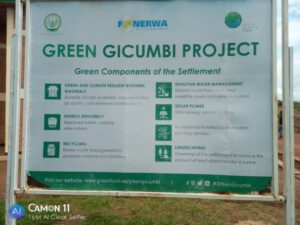
This transformation raises a deeper question about Africa’s struggling agricultural systems, where vast resources often coexist with low productivity. If land can be rebuilt in one context and productivity multiplied, what explains the persistent stagnation elsewhere on the continent? It is within this tension between possibility and reality that Rwanda’s experience through the project becomes more than a national success story—it becomes a continental question.
Agriculture across Africa stands at a crossroads between vast potential and persistent underperformance. While the continent holds abundant land, water resources, and youthful population, productivity remains constrained by erosion, weak investment, and fragile farming systems. Yet in Gicumbi, a quieter transformation is unfolding on steep hillsides once considered unsuitable for farming.
Through radical terracing, degraded slopes have been rebuilt into structured, fertile, and highly productive farmland. This experience offers a powerful lens into what may be the hidden key to Africa’s food revolution: lessons drawn directly from Rwanda’s terraced landscapes. In examining this model, we begin to see how reengineered land can reshape not only yields, but the broader future of African agriculture.
Transformation in Cyumba Sector
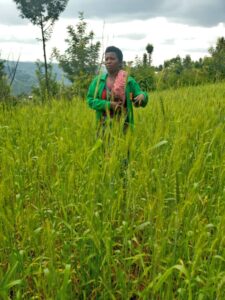
Vestine Nyiransekuye lives in Nyaruka Cell in Cyumba Sector, Gicumbi District in Rwanda’s Northern Province. The Green Gicumbi is locally known as Green Green Gicumbi, but it is officially dubbed “Strengthening Climate Resilience of Rural Communities in Northern Rwanda”. This project has established radical terraces—across 20 hectares in this sector— which are changing the lives of the beneficiaries. Among the several beneficiaries features Nyiransekuye.
After creating the radical terraces, the project provided seeds to plant in the developed land. “Before the project, we used to mix different crops on the same land at the same time; for example, here we could be growing dwarf beans, peas and sweat potatoes concurrently. But they educated us on how to cultivate better. They [Green Gicumbi Project] first gave us Irish potato seeds, then wheat, and eventually beans. We rotate the crops,” she tells us. It is on 3 June 2025.
She actually recounts her story with great satisfaction, feeling genuinely dignified. “Before, I shopped food products. But today, I no longer do so. The value of the place where I lived before can rarely amount to 2 000 000 Rwandan francs (RWF [around $1300]). Before, I never provided food for the market, I produced food which didn’t even succeed in satisfying my household since I was obliged to buy food from shops. Before, I could not exceed two sacks of beans each weighing 100 kilograms, and you could not sell any beans from just these two sacks. I now produce 1 ton or 1.5 tons of beans, depending of the size of land I have cultivated and fertilizers that I have used.
I can say that I hardly produced any Irish potatoes, since what I grew never reached 100 kilos. I have recently gotten 1.5 tons, and I expect to obtain around 2.5 tons in the next harvest. Before, I produced not beyond 100 kilos of wheat; nevertheless today, the smallest quantity is around 700 kilograms of wheat from the same land. The key reasons behind this immense success are these terraces and teaching how to better grow crops. For instance; before, we never employed fertilizers. When I invest 500 000RWF to pay workers and buy fertilizers— both chemical ones and compost, I earn the profit of 1 000 000RWF or more than 1 500 000RWF.”
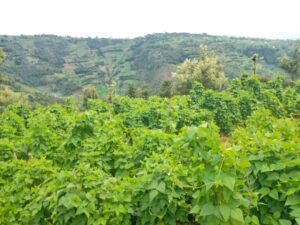
Continuing to provide testimony on her transformation, she says “Before the project, I was facing extreme poverty and lived in a high-risk zone that could imperil my life at any time. But now, my life has changed dramatically. When I cultivate beans, I cannot gain less than 1 000 000 RWF which I earn from beans that I sell per season, while I have left some others to eat at home. I go to save that money on my bank account. However, before the project’s intervention, I never saved money because of my poverty.
Thanks to the radical terraces, my land has brought me wealth. I now own a house and land worth no less than 15,000,000 Rwandan francs [RWF], and I’m about to buy a car. My son is currently learning to drive and preparing for his driving license test. As soon as he passes, I’ll purchase the car. Even now, I possess over 5,000,000 RWF in my bank account,” she says.
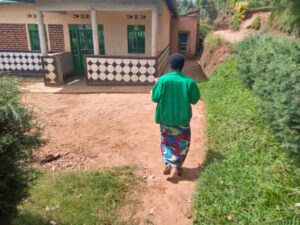
Surprised by her testimony, I challenge her “Are you sure you’re not exaggerating?” She responds without hesitation. “If you think I’m lying, come—so that I may show you my house.” And, indeed, as we’re walking toward her building, you can see her in the photo whereby the house you see before her is exactly her own. She concludes with a powerful statement. “If the project had not intervened, I couldn’t possess this house today. Perhaps, I’d just be thinking about constructing it now.”
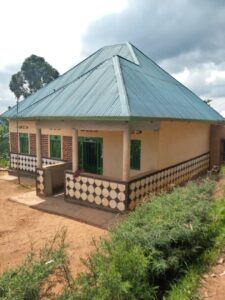
The project’s package has allowed Nyiransekuye to increase her agricultural production considerably— it has not just doubled the production, it has even raised it more than seven times. Other different farmers have told us that their production has increased not less than fourfold. This is due to the fact that terraces help to retain everything added to the soil—from crops to fertilizers—ensuring better yields. This is even highlighted in Farmers’ Potato Academy in Rwanda has significantly enhanced the yield of Irish Potatoes.
In this article, Marie Chantal Nyirasafari dwelling in Nyabihu District in Rwanda’s Western Province says “As members of the cooperative [COAPTIKA-Abajyinama], we have completely eradicated hunger and achieved significant prosperity, thanks to Imbaraga (IFO [Imbaraga Farmers Organization]) and Agriterra and the cultivating technique that they have introduced.”
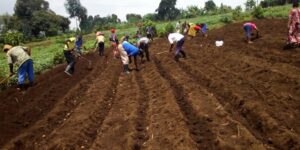
The cultivation technique includes farming Irish potatoes in horizontal lines on mountainsides or slanting places. Cultivating in horizontal lines, often referred to as contour farming or contour plowing, constitutes an agricultural practice where crops are planted in rows that follow the contours or lines of the landscape. The rows are aligned horizontally across a sloped area.
All farmers featured in this article affirm that the yield of a hectare has risen threefold. They specify that a hectare is producing between 28 and 32 tons, while it only generated between 10 and 12 tons of Irish potatoes before. As suggested by Nyirasafari, this stunning increase in production has permitted the farmers to register marvelous progress for a short period of time in relation to their status before.
In fact, this technique helps to decrease soil erosion by slowing down water runoff and allows water to be absorbed more effectively into the soil. This stands particularly beneficial in preventing soil degradation in sloping areas, representing an important method in sustainable farming.
This is why terraces become indispensable. Not only do they stabilize steep land for farming, but they also amplify the advantages of contour farming by creating stair-like platforms that minimize erosion, maximize moisture retention, and support nutrient-rich soil layers. Together, these techniques have transformed once-challenging terrain into a powerhouse of agricultural productivity.
A similar in Bwisige Sector in Gicumbi
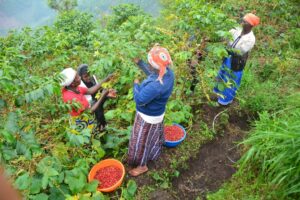
A coffee plantation and a greenhouse constitute some of other successful initiatives of the Green Gicumbi project.
The 40 hectare-coffee plantation belongs to Dutubure Kawa [Let’s Multiply Coffee] Gihuke Cooperative in Gihuke Cell. This plantation has been created by the project for this cooperative that consists of 137 members.
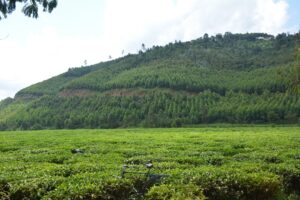
The coffee plantation lies on a steep, once-barren mountain in Gihuke Cell, where farming stood nearly impossible due to its severe slope. For years, this land failed to keep fertilizers or support any meaningful crop production. But everything was reversed when the Green Gicumbi project intervened, stabilizing the mountain through soil conservation and terracing techniques. Now, this formerly unproductive hillside contains a thriving 40-hectare coffee plantation. What was once wasted land now generates more than 80 million RWF annually, marking a remarkable transformation.
Standing atop the now-terraced mountain, you can feel the cool breeze drifting through neat rows of coffee trees where once only dry, eroded soil lay exposed to the sun. Farmers walk the paths between the plots with pride—hands stained with the earth that now rewards their labor, no longer carries it away. For the 137 cooperative members, this mountain no longer forms a symbol of struggle, but a testament to hope, resilience, and renewed dignity.
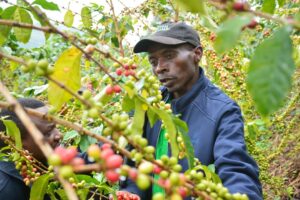
“This land used to be barren—no crop we planted here was productive. But today, coffee grows here and generates no less than 80 million RWF to the cooperative,” says Diogène Habyarimana, president of the cooperative.
Marie Thérèrese Uwingabire—a member of the cooperative—echoes “When we cultivated sweet potatoes here, they yielded no production at all. When we farmed the cassava crop, it never grew successfully, producing no harvest — the land produced zero or extremely poor output. Before the plantation, I was facing poverty; however, my family’s living conditions have improved significantly. My two children are studying smoothly since I obtain them school fees and materials. I have renovated my house, elevating it to the value of 7,000,000 RWF from 500,000 RWF.”
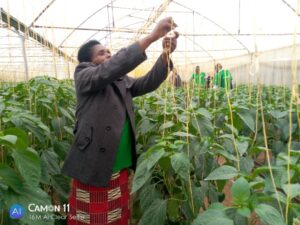
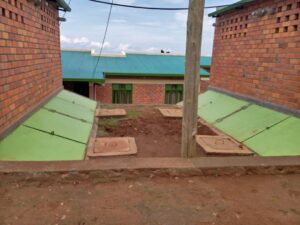
In Murambi Village, Mukono Cell in Bwisige you find a greenhouse measuring 14 meters in width and 36 meters in length. It has been constructed by the project at the cost of 25 million RWF for Tuza [Calm Down] Bwisige Cooperative. The cooperative grows the vegetables—tomatoes, green beans, and bell peppers. “Since 2023 when we started using this greenhouse, it has transformed our lives. For example, I have entrusted 4 cows to other people who are raising them for me, and we share profits. The cows’ value ranges between 400 000RWF and 600 000RWF each. Besides, I pay mutual health insurance fees for some of my vulnerable neighbors. Without this greenhouse, I could not have achieved all that,” says Drocelle Mukandahiro, the cooperative’s president. By June 2025, 12 greenhouses had already been completed while 8 more were expected to be constructed, before the project ends.
The project’s focus areas involve climate-resilient agriculture, ecosystem restoration, sustainable forest management and sustainable energy, and green and climate resilient settlements. As reported by Rwanda Green Fund, the project has accomplished a lot of achievements.
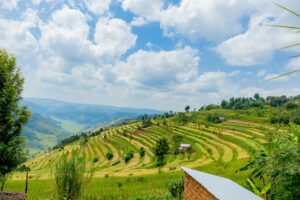
In terms of watershed protection and climate resilient agriculture, 850 hectares of progressive terraces have been established, 600 hectares of radical terraces have been engineered and 99,000 green jobs have been created: 52% women versus 48% men.
As for sustainable forest management and sustainable energy, 2,200 of hectares of degraded forests have been rehabilitated. 31,000 improved cookstoves have been distributed and 10 domestic biogas units constructed as pilot. 10,000 hectares of agricultural land planted with agroforestry. 214,000 greenhouse gas emissions have been reduced as a result of “our interventions”. 3,500,000 high quality seedlings have been raised in time and planted.
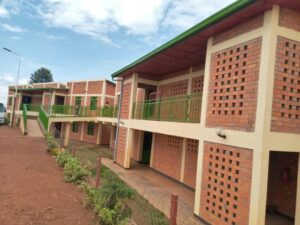
In response to climate resilient settlement, the following accomplishments have been realized. 16,000 check-dams have been constructed in gullies. 16,900 infiltration ditches have been established. 100 climate resilient dwelling units have been erected and occupied by vulnerable families relocated from high-risk areas. 8,700 cubic meters (m3) of water are harvested.
About knowledge transfer and mainstreaming, the following has been performed. 25,000 beneficiaries have been trained on climate resilience. 154,000 direct beneficiaries have been impacted. 464,000 indirect beneficiaries have reaped the wards of the project.
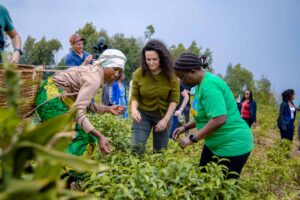
In her courtesy visit to the project on 7 September 2023, the GCF’s Executive Director— Mafalda Duarte— stated “This has shown us the impact our resources have brought to your community, to your lives. This is really what we want to see. This is why we are doing this work. We want to impact the lives of people and create a significant improvement in the quality of their lives, bring new opportunities, new hope, and dignity.”
The GCF is one of Rwanda’s major partners in supporting the country’s efforts toward building a climate-resilient and sustainable economy. The Green Gicumbi project has become a model already replicated by some other projects in some other places in Rwanda.
Don’t such stories act as a wakeup call for entire Africa?
Rwanda’s experience with radical terracing and land protection, combined with farmer empowerment, offers more than a local success story— it constitutes a validated agricultural transformation model already proven under real conditions. These outcomes are not isolated exceptions, but empirical demonstrations of what becomes possible when land is properly engineered, invested in, and managed with empowered farmers at the core.
While such success stories abound across the continent, they now serve a more important function than illustration: they act as tested models that can inform broader structural change. In other words, the significance of these results does not therefore stand symbolic but structural: they substantiate that agricultural stagnation in similar ecological zones is not a constraint of nature, but of approach, coordination, and extension.
In this sense, Rwanda does not merely contribute a case study to African agriculture—it provides a replicable scheme of land restoration and productivity intensification that can be adapted not only across similar geographies on the continent but also in any part of the world where land is underperforming not because of its nature, but because of how it is managed, invested in, and valued.
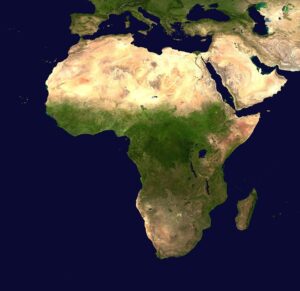
The central question, now, is thus no longer whether such transformation is possible and can even generate colossal production, but why systems that already exist and function effectively remain localized rather than developed into national and continental strategies. It is within this shift—from isolated success to transferable model—that Rwanda’s terraced and protected landscapes as well as farmer support become a reference point for rethinking African agricultural systems at large.
Across Africa, the same questions of investment, policy direction, and farming systems degenerate into structural challenges that shape entire economies. At the global level, however, nations such as China demonstrate how deliberate agricultural reform, sustained investment, and technological modernization can turn farming into a foundation for economic ascent.
Oxfam underlines that agriculture represents a crucial sector for Africa as “most rural communities depend on it for food and income and it employs roughly 53% of the labour force. Yet despite its enormous social and economic potential, the sector has become a poverty trap. A big cause of that is African governments massively underinvesting in agriculture.”
Yet, the African Union [AU] states “African governments are expected to increased investment level in agriculture by allocating at least 10% of national budgets to agriculture and rural development, and to achieve agricultural growth rates of at least 6% per annum.”
However, in response to such statements, Oxfam says “Commitments are made – but never realised. African Union member states committed to spend at least 10% of the government’s budget on agriculture: yet In 2021, the average spending on agriculture in Africa was just 4.1%. And whether any of this low spending even reached small-scale farmers is another question.
And the World Bank and IMF [International Monetary Fund] have not helped, insisting through conditions on their lending that agricultural markets be fully liberalised, promoting export crops and cash crops over food crops. African governments have been denied policy tools that are regularly used by richer nations to support their farmers, such as subsidies or public interventions to guarantee prices.”
“Fully liberalizing agricultural markets” in this context means diminishing government control over agricultural markets, so they operate more freely under market forces like supply and demand. Institutions such as the World Bank and International Monetary Fund promote this by encouraging policies like removing subsidies, eliminating price controls, and unlocking markets to global trade. As a result, farming often shifts toward export-oriented cash crops rather than locally consumed food crops.
In the same context, the word “fully” intensifies the idea of liberalization by implying that almost all or all forms of government control are abolished, not just a few. It suggests a complete or near-complete shift to a free-market system where prices, production, and trade are determined by market forces rather than state intervention.
The AU indicates that bold visions or ambitious plans have long been adopted, though their implementation is questioned by sources such as Oxfam. The AU explains “Over the years, African leaders have committed to prioritize food security, a commitment reinforced through the development of Africa’s Common Position on Food Systems, to help deliver on targets of the African Union’s Agenda 2063 which seeks to end hunger, achieve food security and improved nutrition and promote sustainable agriculture.”
There are countries which have comprehended agriculture’s immense potential and immediately embarked on the work to revolutionize this sphere. China is one of them.
China has funded the revolution of its agricultural sector by moving from taxing farmers to heavily subsidizing, investing in, and modernizing agriculture. This transformation is driven by public and private funding focused on technology, high-yield seeds, and mechanization, aiming to feed 20% of the world’s population with only 7% of its arable land.
“China is the world’s largest agricultural producer, with the country’s total agricultural output amounting to RMB 9.33 trillion (US$1.29 trillion), accounting for 6.7 percent of GDP [gross domestic product],” explains China Briefing.
A chapter- titled “The Role of Agriculture in China’s Development: Past Failures; Present Successes and Future Challenges” published by Columbus University underlines that nations which disregarded agriculture encountered colossal development difficulties. “Unfortunately, countries that took this path seriously soon found out that while such a strategy may work in the initial years of development, in the longer run it slowed development and often ended up in failure (Timmer, 1998). Neglect of agriculture meant that a large part of the population was left out of the development process.
It was found that in many cases, production in agriculture fell and food prices rose. Many households fell into isolated subsistence. When this happened, of course, the stability that is required for growth disappears and development stagnates and can even go into reverse. There are many examples of countries that encountered these difficulties, such as, Argentina, Mexico, Nigeria and even to some extent the Former Soviet Union.”
It additionally highlights “In contrast, during the last century nations that grew fast and entered the ranks of developed nations—for example, Japan and Korea—frequently found that heavy investment in agriculture was an integral part of their development strategy. Today, modern development economists mostly agree that the role of agriculture and rural development is absolutely an integral part to process of nation building and healthy development (Johnston and Mellor, 1961; Johnston, 1970).”
For more on problems battering Africa’s agriculture, you read What will really rescue Africa’s farming sector?
From isolated success to continental transformation
Across Africa, the evidence of the continent’s capacity to revolutionize its agriculture is no longer abstract. It is written on terraced hillsides that were once eroded and now produce abundancy; in cooperatives that once struggled for survival and now generate millions; and in households that have moved from subsistence to surplus. Rwanda’s experience, like similar successes elsewhere on the continent, establishes that agricultural transformation does not represent a theoretical aspiration—it constitutes a practical reality when land, investment, and farmers are brought into alignment.
The real question, therefore, is no longer whether Africa can transform its agriculture, but why proven models remain fragmented, under-scaled, and too often confined to isolated projects. If radical terracing, climate-smart farming, and structured farmer support can multiply yields several times over in one setting, then their absence elsewhere is not a technical gap—it is a policy and implementation choice.
Africa stands at a decisive moment. The continent can continue to treat agricultural success as scattered exceptions, or it can elevate them into coordinated national and continental strategies that position farmers at the center of investment, innovation, and policy design. This requires more than declarations and targets; it demands execution, sustained financing, and a shift from fragmented interventions to systemic transformation.
The path forward is therefore clear: scale up what works, fund what delivers, and institutionalize what has already been proven. Anything less is not a lack of knowledge, but a delay in responsibility.