By Jean Baptiste Ndabananiye
Rwanda Environment Management Authority [REMA] conducted three major activities on 30 May 2026, all constituting efforts to protect the environment and develop community resilience to mitigate and adapt to climate change. REMA officially closed the Green Amayaga Project—Phase I and formally launched the Green Amayaga Project— Phase II. Different personalities who spoke lauded the concluded phase, explaining that this project immensely transformed its geographical scope. REMA also ceremonially launched the Environment Week in the context of the World Environment Day to be celebrated on 5 June 2026.
Beyond the ceremonial aspect of the day’s activities, the event provided an opportunity to reflect on the impact of the Green Amayaga Project—Phase I and the way forward. Officials emphasized the tangible changes brought by the project, ranging from environmental restoration and job creation to improved agricultural productivity and living conditions. Their reflections also highlighted why stakeholders remain determined to build on these achievements through Green Amayaga Phase II and broader climate-action initiatives.
From 100,000 beneficiaries to national leadership
The Green Amayaga Project—Phase I has transformed both biodiversity and livelihoods not only in Gisagara District but also in other districts covered by the project. These districts are now prepared for a deeper climate resilience push.
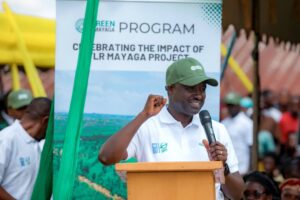
Jerome Rutaburingoga is Gisagara’s Mayor. He shared “The Green Amayaga Project (Phase I) has been vital for us, and the next phase will be far more important. We thus express our gratitude to REMA and its partners — UNDP [ United Nations Development Program] and GEF [Global Environment Facility]. The project has benefitted 100 000 people, women and youth accounting for 60%. It has created 5 000 jobs.”
In Gisagara, like other districts —namely Kamonyi, Ruhango and Nyanza where the project has been implemented — the project has executed different interventions. The latter ones are divided into two broad and closely connected categories: efforts to increase communities’ resilience to climate change by investing in nature-based solutions, and community livelihoods development.
The latter field has allowed Gisagara District to surpass all other 29 districts of Rwanda in the production of avocadoes. “The project has planted 53 895 fruit trees; it’s we who possess the most avocado trees in the country, contributing 30% of avocado production countrywide. Therefore, an avocado-processing factory is going to be constructed in our district,” said Rutaburingoga.
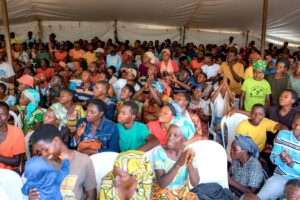
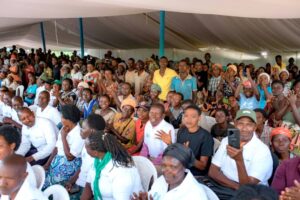
Motivated by achievements in Phase I, he encouraged Gisagara residents— who will benefit from Phase II— to be also attached to this new phase. “Gisagara residents, remain committed to these projects. Exploiting opportunities provided by these projects-Phase I and Phase II, we will certainly improve our living conditions. In fact, the opportunities stand so great that for any person failing to capitalize upon them and remaining poor, it would be their vice.
Let’s develop good conduct to properly manage cash that we will get both from the advantages furnished by these specific projects and other potential sources of income. You have observed the significant progress realized, owing to Phase I. We held the 1st, 2nd and again 1st positions in the accomplishment of performance contracts — Imihigo—, because the Green Amayaga has played a substantial role.”
In the 2022-2023 fiscal year, Gisagara occupied the 1st rank in performance contracts. It garnered the 4th one in the 2023-2024 fiscal year. It was ranked the 2nd in the 2024-2025 fiscal year. However, the combination of the rankings in these three years made this district the first in the same 2024-2025 fiscal year. Performance contracts in Rwanda, known as Imihigo, form annual agreements—between local government authorities [districts] and the central government—which establish specific development targets to be attained within a year. They are used to improve accountability and measure performance in delivering services and development goals. Every year, results are evaluated and ranked to encourage competition and efficiency among districts.
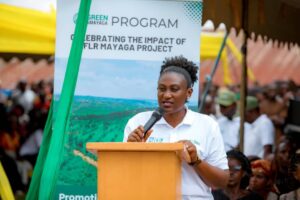
The Southern Province Governor, Alice Kayitesi, explained that the Green Amayaga Project—Phase I— exceptionally reinvented its geographical scope. “The project has proved that things deemed impossible are challenged and transformed into extraordinary accomplishments. Places which were desert have now been rendered green. The project has even exceeded the targets. What the mayor of Gisagara has said perfectly mirrors the reality in all the other districts.”
Different people—from Kamonyi, Ruhango, Nyanza and Gisagara including direct beneficiaries— who have recently talked to Life In Humanity agree with Kayitesi and Gisagara’s Mayor on significant changes brought by Phase I. The following are views that some of the beneficiaries have recently expressed.
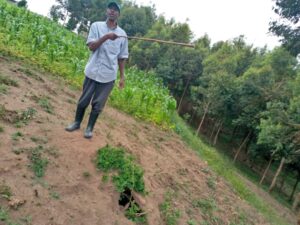
Elie Ntabwoba living in Mikamba Village, Mbati Cell in Mugina, Kamonyi has said “Before the project, all this place was a desert. It was naked, but it has turned green. You are feeling the he gentle breeze; if it were before, you couldn’t experience it.”
Valens Mihigo in Kidoma Village, Mwendo Cell in Mbuye Sector in Ruhango has shared “ Before this project, all this area formed a desert, but now the situation has changed since the area bears trees- grevilleas on the hills and bamboos along the river bank. Sand which descended from our pieces of land on the hills abounded here at the river bank, but you can spot none because the grevillea trees are keeping our field soils from moving away. The bamboos have strengthened the land along the river bank so that the latter one is safeguarded too.”
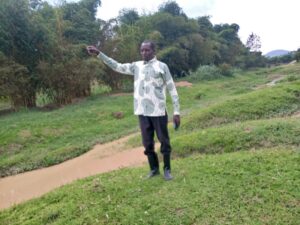
“The project stands very important for the residents of this community. No soils are carried away from our fields by erosion. It is the grevilleas which prevent erosion on our pieces of land; the reason why you cannot see any sand here since the sand used to emanate from our fields on the hills. Eh, if the project had not come, all this place you see could have become a desert! Fields on the hills had been extremely degraded. This part around the river banks could now not be cultivated.”
Bernadette Niyonagira in Buremera Village, in Mbuye Cell, Mbuye Sector echoes “When the project had not been implemented here yet, we were living in a desert. When the river inundated, it washed our crops and field soils away. Owing to the trees, we enjoy a gentle breeze while, before, we suffered extremely harsh solar heat. Today, the community members have comprehended the mammoth importance of trees so that when a person cuts a mature tree down, they plant another one. We cannot talk exhaustively about the project; it goes beyond our understanding!”
Emmanuel Byiringiro who works as the Director of Agriculture and Natural Resources in Ruhango District has said “The project began at the time when biodiversity in Ruhango sectors: Ruhango, Kinazi, Mbuye and Ntongwe had been degraded. This part was going to become a desert. River banks were not protected at all. But they are now safeguarded with bamboos. The sectors possessed very few trees, but they are now all covered.”
Lydvine Mukandayisenga dwelling in Kamudogo Village, Mamba Cell in Mamba Sector, Gisagara has said “Eh, owing to the fact that the project has awakened us to grasp the undeniable and critical importance of trees, plus the project’s component of social support which has elevated our living conditions, we are wholeheartedly committed to protecting achievements accomplished by the project.
For example, personally, I am resolved to furnish my unreserved contribution for trees planted to be maintained. As I did in the past for a person who harmed his trees combined with crops, by felling them while they were one month-old, I will remain vigilant. Like this person who I advised to stop doing so and has abandoned this practice, I will never cease to intervene against such behavior.”
For more on such testimonies on Phase I, click on this article.
New project and expression of gratitude to the stakeholders of the closed one
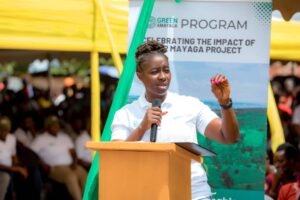
Dr. Fatmata Lovetta Sesay is Acting Resident Representative of UNDP/Rwanda. She also participated in the event. The closed project’s achievements drove her to say “Today is important because we are celebrating, and at the same time we are marking a new beginning — a new beginning of a dynamic project implemented in four districts and today we are adding two more districts: Huye and Muhanga. After celebrating the achievements, we officially launch Green Amayaga II. After celebrating the achievements of Green Amayaga I, we are also officially launching Green Amayaga II. I think it’s exceptional.”
The Minister of the Environment, Dr. Bernadette Arakwiye— who was the guest of honor, while addressing the beneficiaries of the new phase— said “Now the new journey is starting, the new project which we formally start today has to be for us a source of solutions to problems which are affecting us, especially land degradation, climate change and the reduction of agricultural yield. All of those are some of issues that this project seeks to overcome, since it will generate changes in this Amayaga Region both through the enhancement of land management in effort to raise farming productivity, increase land areas which are covered by forests, create jobs and exert more effort in initiatives meant for upgrading communities’ living conditions.
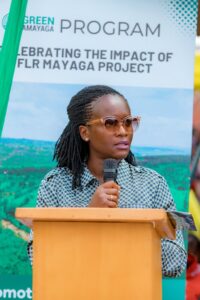
Yet again, the success of this new phase will demand the collaboration of all of us, especially the residents of the sectors where the project is going to be performed. Let’s maintain the same momentum and cooperation, to build climate resilience and restore degraded biodiversity; accomplishing it for both ourselves and our descendants. I thank the districts of Kamonyi, Nyanza, Ruhango and Gisagara in which this completed project has been implemented. I additionally convey gratitude to all the partners particularly community members who have fulfilled a big role in the execution of this project.”
Dr. Fatmata explained that this phase is expected to build on the success already attained, to deal with climate change. She stated “Climate change is real and it is one of the biggest development challenges we have to face today. But, the next phase of the project reflects something even bigger, as I learn that we are deepening what we started; where have now fruits that we are now harvesting, we want to process those fruits, and as we process them, we increase employment. So, it’s no longer about just having fruits, it’s about having fruits that have economic value.”
She added that the aim of the new phase is not to enable the production of fruits to just sell in the market for money. “It’s about processing them for that money—adding value. Rwanda adding value and exporting that value is very important for the stability of communities. This is why for us in UNDP, we remain fully committed to supporting Rwanda in advancing real resilience and inclusive development.”
The declaration “We remain fully committed to supporting Rwanda in advancing real resilience and inclusive development” was not issued without reasons behind—it reflects clear underlying factors and substantive considerations. This is revealed by the following words of appreciation for the concluded project.
Dr. Fatmata said “Let me say that on behalf of my colleagues in UNDP we want to sincerely congratulate the Government of Rwanda through the Rwanda Environment Management Authority and all national and local institutions for the strong leadership you’ve shown in the success of this project. Rwandans, as I look at the financing for the project where we only had about 7 million from GEF, about three times and half times of the grant, was from the financing from Rwanda. That is exceptional.” The entire amount of the project is approximately $32 million. The Government of Rwanda has co-financed it, providing more than $ 25 million including, among others, in-kind contributions which were necessary for the successful completion of the project.
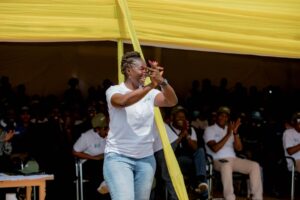
Dr. Fatmata also commended the role of community members in the project’s success. “I also wish to recognize the communities from the four districts: Kamonyi, Ruhango, Nyanza and Gisagara. The achievements we celebrate today are really the achievements of the communities; it’s not from REMA, it’s not from UNDP, it’s achievements from community members— each and everyone of you who are here. Because you have translated what looks like activities on spreadsheet into concrete results and achievements. So, the celebration is for you, because you have shown that real change is possible.”
She added that the “significant” work, carried out with Green Amayaga Project I, constitutes the linkage between “environmental restoration and livelihood improvement. We have shown that we can increase our livelihoods and still protect our environment. So, UNDP is particularly proud that this project has strengthened local ownership—cooperatives, youth groups, women’s groups and local communities, institutional capacity at all levels from the central [level] to local level.”
Emphasizing the value of sustained collaboration, Dr. Fatmata underscored that the Green Amayaga initiative stands as a model of long-term partnership and institutional growth. “The project has truly shown the importance of long-term partnership. And that’s why I am happy because we are here celebrating six years of a project that is ending, but also inaugurating a new project for another six years, meaning for 12 years we will be working together. There is nothing more sustainable than really entrenching the ownership, the institutional building. We have only worked with you for six years and you are left to go on your own [?]— a child that is supposed to be sitting cannot crawl. A child that is crawling cannot walk. A child that is walking may not be able to run.
In this project we have sat together, we are crawling, we are walking, and we are running and in the next six years making it 12 years of working together; I think that’s significant. We want to thank the Global Environment Facility for the support, we deeply value the collaboration with RFMA as well as the Ministry of Environment, district authorities, civil society, etc.”
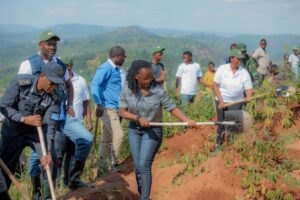
The Minister of the Environment- Dr. Bernadette Arakwiye said “The achievements we are celebrating today are impressive and impactful. Thousands of hectares have been restored through afforestation, agroforestry and progressive terraces. Millions of seedlings have been planted, riverbanks protected, and clean cooking technologies introduced to households and schools. Beyond environmental restoration, this project has improved the livelihoods of communities through climate-smart agriculture, livestock support and income-generating activities.
It has really empowered women and youth with knowledge and skills, while strengthening food security and resilience among vulnerable households. These achievements align well with Rwanda’s national priorities including the National Strategy for Transformation, the Green Growth and Climate Resilience Strategy and our commitment under international environment and climate frameworks, all of which are translated into action on the ground through Rwanda’s Sustainable Land Management Approach.”
She added “The Government of Rwanda recognizes that investing in ecosystem restoration is investing in the future of our people. Healthy ecosystems are essential for water security, agriculture productivity, biodiversity conservation, disaster risk reduction and climate resilience. Therefore, on behalf of the Government of Rwanda, I would like to express sincere appreciation to the Global Environment Facility and you, UNDP, for your continued partnership and support to Rwanda’s efforts to protect the environment and build climate resilience.”
Other details on the project
The Green Amayaga Project, Phase I, distributed and planted more than 243 830 fruit trees including avocado, mango, orange and macadamia trees. It protected 93.5 hectares of river buffer zones, employing bamboo plantations. It restored 1 838 hectares through afforestation woodlots with water retention ditches, roadside afforestation, buffer zone protection and the establishment of a live fence around Kibirizi-Muyira Natural Forest. It established over 35 924 hectares, including 13 886 hectares under agroforestry as well as radical and progressive terraces, contributing to improved soil conservation and productivity.
It supported 21 000 households with improved cookstoves and 20 schools with 20 full kits of giant liquefied petroleum gas (LPG) storage tanks to 20 schools, for clean cooking. It avoided over 625 989 tCO2eq emissions over the past six years through the project’s interventions. “625,989 tCO₂eq emissions” means a total of 625,989 tons of greenhouse gases avoided [not allowed into the atmosphere], expressed in carbon dioxide equivalent.
The project provided 14 000 vulnerable households with livestock including pigs, goats and cows. It trained more than 6500 community members on climate change, climate-smart agriculture, land husbandry, and forest restoration. It financed community-driven development sub-projects worth more than 94 million Rwandan francs in areas like beekeeping, cassava, maize, vegetable and sugarcane production, to promote green income-generating activities and improve community livelihoods. 415 960 beneficiaries (women and youth comprising over 60% ) in all the districts benefitted from the project. It created 100 000 green jobs.
From community work [Umuganda] to volleyball courts
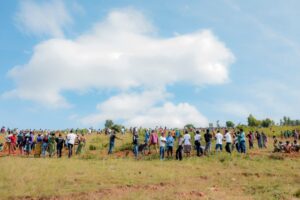
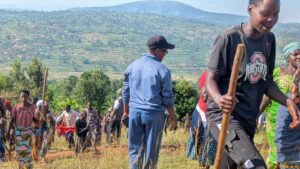
Gisagara opened the Environment Week with community action and then climate awareness campaigns. The Environment Week was started in Gisagara District— at the national level— with community work [Umuganda] which saw massive participation. Around 3 000 people participated in it. The community work was performed in Rwatano Village in Mbogo Cell, Gikonko Sector. This community work brought together residents of Gikonko, Musha and Mamba Sectors.
The community work [umuganda] conducted on the Saturday of every final week of a month forms a mechanism which profoundly touches Dr. Fatmata’s heart. She shared “It’s really great to be here today, especially after participating in umuganda. Umuganda stands for four things for me that are very important as for why we are here. Umuganda is a symbol of Rwanda’s unity. It is a symbol of dignity— we want a clean environment. It is a collective responsibility of all Rwandans. And most importantly, umuganda represents a commitment to protecting the environment— not only for ourselves, but also for our future generations. For these four reasons, I think it’s exceptional that we are here in Gisagara.”
The launch of the week also included Climate Action Volleyball Tournament 2026 which pitted leading volleyball teams in Rwanda against one another one. These tournaments were designed to raise public awareness around climate action, especially because relevant messages were frequently disseminated throughout the tournaments. Rwanda Revenue Authority [RRA] Volleyball Club (women’s team) beat that Police Volleyball Club (women’s team), while Police Volleyball Club (men’s team) defeated Rwanda Energy Group [REG] Volleyball Club. The winners [RRA Volleyball Club and Police Volleyball Club] were each awarded 4 000 000 Rwandan francs [RWF]. The second teams— Police Volleyball Club [women’s team] and REG— were each awarded 3 000 000 RWF whereas teams which won the third place each received the prize of 1 500 000RWF.
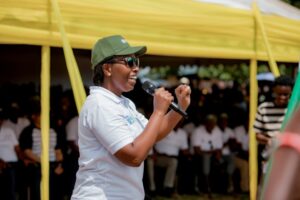
REMA’s Director General, Juliet Kabera, explained why they selected a whole week and involved sport. “We have chosen an entire week, for us to conduct public awareness campaigns to engage the Rwandese in efforts to protect the environment and build resilience to deal with climate change. Our campaign activities involve primary and secondary schools and universities through their clubs.
We have noticed that working with sports clubs can yield a great impact. We have signed a memorandum of understanding with Rwanda Volleyball Federation so that its members may disseminate environment and climate resilience messages wherever they will go to play.”
Geneva Environment Network, in its 08 February 2026 story titled “Sports, the Environment, and the Role of International Geneva”, says “Sports and environment are intimately related, with one influencing the other in significant ways. Sport has the power to change the world; it is a fundamental right and a powerful tool to strengthen social ties and promote sustainable development and peace, as well as solidarity and respect for all. With its close ties to environment, sports can also be an effective instrument to promote environmental protection and sustainability.”
Both the Geneva Environment Network and the United Nations Environment Program [UNEP] frame environmental action as something that goes beyond policies and science, emphasizing the need for collective human systems to drive change. While one highlights sports as a powerful tool for promoting sustainability and social cohesion, the other situates these efforts within a broader global response to the urgent signals of climate change and ongoing environmental transformation.
The UNEP with its undated piece of writing titled “2026 Theme and Host”, reports “The planet doesn’t argue. It doesn’t negotiate. It sends signals—rising seas, raging wildfires, heatwaves, melting glaciers. We said 1.5°C was the limit. We are crossing it. For decades, the world has heard the climate story—warnings, targets, distant deadlines. Too often, the response has been clouded by noise: delay, distraction, denial.
But listen closer now. Beneath the noise, another signal is rising. Solar panels stretch across rooftops. Wind turbines line the horizon. Cities are being redesigned for people. Forests are being replanted. Positive tipping points are taking root in every corner of the planet. World Environment Day 2026 focuses on climate change—on the urgent signals the Earth is sending and the signals we choose to send back. UNEP’s global campaign calls on all of us to step in, to move further, to steer a world already in motion. The question is no longer if change comes, but how we guide it and how fast it happens.”
The World Environment Day is annually observed on 5 June. This year at the global level, this day takes place in Azerbaijan. The theme of this day in this year is Climate Action.