Jean Baptiste Ndabananiye
Look around the world today. More than eight billion people inhabit the Earth, using thousands of languages, upholding different cultures, and exhibiting an extraordinary diversity of physical characteristics, involving skin color, facial features, and hair textures. But, beneath these visible differences occurs a remarkable biological reality: humanity shares an overwhelming proportion of its genetic composition. This elicits a profound question which has occupied theologians, scientists, and philosophers for generations: could all human beings, in spite of their apparent differences, ultimately descend from one ancestral couple?

Long before modern genetics emerged, the Holy Bible provided an account of humanity’s beginnings focused on two individuals: Adam and Eve. According to Genesis, God made the first man, formed the first woman from him, and positioned them as the beginning of the human family. Genesis 3:20 goes even further, calling Eve “the mother of all living.” For generations, this account has formed the biblical foundation for the belief that humanity shares a common ancestral origin.
But what does modern science have to say about this possibility? Has genetics conclusively proven that humanity must have originated from a large ancestral population, or does a single-couple origin stand scientifically possible after all?
Interestingly, a scientific study published in the peer-reviewed journal BIO-Complexity in October 2019 brought this question into renewed focus. In their research article, “A Single-Couple Human Origin is Possible,” mathematicians Ola Hossjer and Ann Gauger investigated whether existing human genetic data could align with humanity having descended from a single ancestral couple. Their mathematical models posited that such an origin could match genetic data under specified assumptions, challenging the assertion that a single-couple origin could simply be dismissed as genetically impossible.
This does not signify that the researchers pinpointed their hypothetical ancestral couple as the biblical Adam and Eve, nor does their research demonstrate that the biblical account has been scientifically established. Nevertheless, their findings raise an important question: if genetic data do not necessarily rule out a single-couple origin, should the possibility be dismissed without further investigation?
There exists another fascinating dimension to this discussion. Humanity’s journey from a relatively small ancestral population to billions of people across the globe has spanned an extraordinarily long period. Yet, the contrast is striking: while it has taken thousands of generations for humanity to expand into its first billion, subsequent centuries witnessed an unprecedented population explosion, multiplying that figure several times over. Remarkably, a comparatively short period of time has sufficed for the human population to explode into billions, particularly over the past few centuries.
Our demographic history substantiates just how dramatically even a couple can grow over successive generations into an incredibly large population. Moreover, research into human ancestry has shown that people separated by geography, nationality, ethnicity, and culture must share common ancestors much more recently than many would imagine.

Could these scientific insights help us to better comprehend the possibility of humanity’s common origin? What does population growth actually tell us about the number of our earliest ancestors? And how should we differentiate what scientific evidence establishes, what mathematical models demonstrate as possible from what the Holy Bible declares about humanity’s beginnings?
In this article, we scrutinize these questions through biblical accounts, genetic research, population history, and scientific perspectives on common ancestry. The objective is not to misconstrue scientific findings as proof of the Scriptures —but to examine whether modern scientific knowledge necessarily refutes the biblical affirmation that humanity originated from a common ancestral pair, or not.
After all, beneath our differences, could we all belong to one extraordinary human family, with a common beginning?
A single-couple origin of humanity: scientific evidence, genetic models, and the possibility of a common ancestral pair

Professor of Mathematical Statistics and
Faculty Member at Stockholm University.
BIO-Complexity constitutes an open-access, peer-reviewed scientific journal focused on questions on the complexity and origin of biological systems. This journal features a research article entitled “A Single-Couple Human Origin is Possible” which it received on 1 January 2019 and published on 21 October 2019. The research article was produced by Ola Hossjer from the Department of Mathematics, Stockholm University, Sweden; and Ann Gauger from the Biologic Institute, Redmond, Washington, USA.

This study does not mention Adam and Eve or posit a theological claim. Yet, its central model matches the population-level idea that humanity has descended from a single founding couple. In particular, the authors simulate scenarios in which human genetic ancestry passes through just two individuals. The authors infer that present-day genetic data, under their stated assumptions, align with such a single-couple origin, including one model situating the couple about 500,000 years ago and another about 2 million years ago.
Thus, the article does not scientifically name its hypothetical founding couple— the biblical Adam and Eve or prove that they existed. It however indicates that a single-couple human origin is not ruled out by the genetic data studied.
Their study reads “It has often been claimed that science shows that humans evolved from a large population over a period of millions of years, and therefore that the notion of one human race descended from just two people, must be false. For example, Francisco Ayala argued that the genetics of HLA-DRB of the major histocompatibility complex necessitates a large population continuing back tens of millions of years. Other scientists have made other estimates using different methods. In addition, several authors of popular-level books have claimed that the human race must have evolved from a large population.
Dennis Venema, for example, has claimed that the human population has always been in the thousands, and has further stated that this is a fact which can be known with the same certainty as heliocentrism. However, recent debates have shown that this representation can be disputed. It seems that certain common assumptions used for convenience have been misinterpreted as if they were data-driven conclusions, without testing the single-couple origin hypothesis scientifically.”
Their findings corroborate that humanity is descended from a single couple. “Human genetic data from non-sex chromosomes is consistent with at least two different but parsimonious models of human origins from a single couple. We show that using assumptions commonly used by evolutionary geneticists, a single-couple origin is possible despite claims to the contrary.
Using a previously published backwards simulation method and some newly developed and faster algorithms, we run our single-couple origin model of humanity and compare the results to allele frequency spectra and linkage disequilibrium statistics from current genetic data. We show that a single-couple origin of humanity as recent as 500kya [500 000 years] is consistent with data. With only minor modifications of our parsimonious model assumptions, we suggest that a single-couple origin 100kya, or more recently, is possible.”
Hossjer and Gauger point out “In any case, the critical point that we wish to make is that, as far as we know scientifically from the genetic data, the human species could have come from as a single couple, so that all humans alive today could have descended uniquely from that first pair.”
The Holy Bible — specifically in different chapters of Genesis— explains how the first couple was created. Genesis 1 explains “26 And God said, ‘Let us make man in our image, after our likeness: and let them have dominion over the fish of the sea, and over the fowl of the air, and over the cattle, and over all the earth, and over every creeping thing that creepeth upon the earth.’ 27 So God created man in his own image, in the image of God created he him; male and female created he them.
28 And God blessed them, and God said unto them, ‘Be fruitful, and multiply, and replenish the earth, and subdue it: and have dominion over the fish of the sea, and over the fowl of the air, and over every living thing that moveth upon the earth.”
Genesis 2 reads “19And out of the ground the LORD God formed every beast of the field, and every fowl of the air; and brought them unto Adam to see what he would call them: and whatsoever Adam called every living creature, that was the name thereof. 18 And the Lord God said, ‘It is not good that the man should be alone; I will make him a helper suitable for him.

21 And the Lord God caused a deep sleep to fall upon Adam, and he slept: and he took one of his ribs, and closed up the flesh instead thereof;22 And the rib, which the Lord God had taken from man, made he a woman, and brought her unto the man. 23 And Adam said, ‘This is now bone of my bones, and flesh of my flesh: she shall be called Woman, because she was taken out of Man.’” Genesis 3:20 states “And Adam called his wife’s name Eve; because she was the mother of all living.”
The name ‘Adam’ comes from the Hebrew word ‘Ādām (אָדָם)’, meaning “man” or “humanity/mankind.” It is closely associated with ‘ădāmāh (אֲדָמָה)’, signifying “ground” or “earth.” This connection mirrors the biblical account in Genesis where God formed the first man from the dust of the ground. Therefore, the name ‘Adam’ signifies man’s earthly origin and his identity as the first human being created by God. This name serves as the personal name of the first human who, the Holy Bible says, fathered Cain and Abel as his first two children.
From a small beginning to billions: what humanity’s demographic explosion reveals
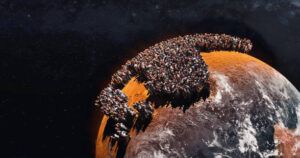
The first and foremost argument that person denying that we are descended from just one couple should advance would be this: it is impossible for only one couple to be the source of the more than eight billion humans alive today. Now, let’s pause and ask “Can over eight billion individuals living today come from only two people?”
The abstract of a document entitled “From 55,000 to 7 billion” and published by Oxford Academic on 24 May 2018 reads, “‘From 55,000 to 7 billion’ describes how global population has evolved over time and space, experiencing a small increase for thousands of years, until around 200 years ago when global population grew dramatically.

1.2 million years ago there were around 55,000 humans, then by the end of the last ice age 20,000 years ago there were around 1 million Homo sapiens. The next 15,000 years saw a dramatic evolution in human economy and society and by 5000 bc [Before Christ] the world population reached around 5 million. It took a further 7,000 years for population to reach one billion by AD 1800. Population now stands at some 7 billion and is projected to reach around 10 billion during this century.”
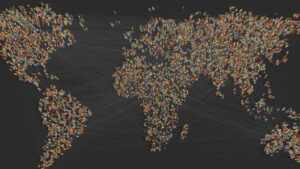
Atlas of Humanity explains “How we became more than 7 billion. It took 200,000 years for our human population to reach 1 billion and only 200 years to reach 7 billion. But growth has begun slowing, as women have fewer babies on average. From our origins in Africa, humans began migrating around the globe roughly 100,000 years ago.
But it was only with the advent of agriculture about 12,000 years ago that our population started to swell to more than a million. This data visualisation from the American Museum of Natural History beautifully charts humanity’s stunning exponential expansion to our current population of roughly 7.4 billion [in August 2016].”
This atlas gives major historical events as far human population is concerned. “Milestones and big events of humanity: modern humans evolved in Africa about 200,000 years ago. About 100,000 years ago, we began migrating across the globe. During this period, the human population remained low – probably less than 1 million people. Irrigation began at about the same time in Egypt and Mesopotamia (present day Iraq and Iran) using the water of the flooding Nile or Tigris/Euphrates rivers. With the advent of farming, growth picked up. By AD 1, world population reached approximately 170 million people. The Roman empire in Europe/Mediterranean/Middle East and the Han Dynasty in China were around their peak.
4th century – the golden age of India begins. Human population around 180 million. 6th century – Mayan civilization was at its peak. 177 million. 7th century – the birth of Islam. 177 million. 8th century – smallpox in Japan (735–737). 195 million. 9th century – gunpowder invented in China. 219 million. 11th century – the compass was used in Song Dynasty China by the military for navigational orienteering. 289 million. 13th century – the rise of Mongol Empire. 364 million. 14th century – the Black Death (Bubonic Plague). After five years 25 million people were dead in Europe – one-third of Europe’s people. The number of humans around 343 million – a rare decline.”
It adds “End of 15th century – the Europeans arrived to Americas. 417 million. 18th century – industrial revolution begins. 804 million. 1 billion – it is estimated that the population of the world reached one billion for the first time in 1804. It was another 123 years before it reached two billion in 1927, but it took only 33 years to reach three billion in 1960. World War I (1914-1917). World population around 1.7 billion. World War II (1938-1945). World population around 2.3 billion. Today (as of August 2016): 7.4 billion.2100 estimate: 11.2 billion.”
Response to the question
Humanity has experienced extraordinary demographic expansion from an intensely small population. More than eight billion people today cannot be invoked as evidence that today’s humanity has come from a large ancestral population. Over eight billion people today from the modest number of individuals proves that, certainly, there first existed two people at the beginning.
The unusual expansion of humanity for a short period of time itself demonstrates that today’s enormous population cannot be used to conclude that humanity’s ancestral population was always comparably large. For thousands of generations, the human population stood relatively small. Then, as agriculture and later technological, medical and socioeconomic advancements improved humanity’s capacity to survive and reproduce, population growth accelerated astronomically.

The journey from roughly one billion people in AD [Anno Domini/the year of the Lord Jesus Christ] 1800 to more than eight billion today- only nearly two centuries later- substantiates just how rapidly a population can multiply when conditions are upgraded. Thus, the fact that humanity now numbers in the billions does not, in itself, contradict the possibility that its ancestry was an exceptionally small population — even, as Hossjer and Gauger investigate, a single ancestral couple.
The contrast is striking. Humanity took thousands of generations to reach its first billion, yet then required just about two centuries to multiply that figure several times. The question, therefore, is not whether two people could somehow multiply into billions by themselves. Perhaps the question would be whether a very small ancestral population like two people, provided with sufficient generations and rich reproductive conditions could eventually produce an exceptionally enormous population.
Human demographic history answers the latter question unequivocally: populations can expand on a staggering scale when circumstances permit it. Hossjer and Gauger’s contribution is to ask the narrower genetic question — whether the genetic record agrees with that expansion having begun from a single couple — and their simulations report that it is possible under their stated assumptions.
The core lesson of humanity’s demographic history is therefore not merely that our numbers have grown colossally. This lesson is instead that an extraordinarily small population [a couple] can, allowed sufficient generations and favorable conditions, develop into an extraordinarily large one. From a human population which remained remarkably small for most of our history to billions today, the demographic record removes the intuitive objection that humanity’s present magnitude necessarily necessitates a comparably large beginning — leaving open, rather than closing, the possibility of an origin in an exceptionally small ancestral population.
Therefore, when Hossjer and Gauger’s genetic simulations independently report that a single-couple origin proves possible under their stated assumptions, humanity’s astonishing demographic expansion offers a striking context in which that finding can no longer be dismissed simply because there are more than eight billion of us today.
What John Hawks states about it

John Hawks is an American paleoanthropologist, geneticist, author, and science communicator whose research focuses on ancient DNA, among others. He serves as a professor and chair of anthropology at University of Wisconsin–Madison. On his website named after him, he released a piece of writing entitled “When did humankind’s last common ancestor live? A surprisingly short time ago” on 10 July 2022.
John Hawks starts the story, with these words. “Back in 2001, I was a postdoc working on human genomics when Steve Olson talked with me for an interview. Steve was doing background research for a book about how geneticists were changing our understanding of human history. He was excited about some recent work in applied math.
Today’s humans must all share a common ancestor within the last 5000 years, he explained. Everyone? I asked. What about the people who came to the Americas more than 12,000 years ago? Everyone, he said, from Aboriginal people in Australia to Tierra del Fuego. It was a simple consequence of math.”
The logic was that in each generation, the potential number of ancestral lines doubles, according to Hawks based on Olson’s reasoning. “Two parents, four grandparents, eight great-grandparents, and so on. In 20 generations, that makes a million possible lines of ancestry; in 40 generations a trillion. A trillion lines of genealogy is impossibly large, way larger than the number of humans that existed. These potential lines cannot have been separate; they must converge to a smaller number of actual ancestors. Within a surprisingly small number of generations—the base 2 logarithm of the population size, in fact—one of those actual ancestors will turn up in everybody’s family tree. For a million people in one well-mixed population, their most recent common ancestor should have lived around 20 generations ago.”
Hawks continues “I wasn’t prepared for that leap. At the time I was running a lot of simulations with gene genealogies, and I had gotten used to thinking from the gene’s point of view. This required looking backward in time in a counterintuitive way. For example, you have two biological parents and you carry two copies of most of your genes, one inherited from each parent. But you don’t carry four copies from your four grandparents.
Your father’s sperm and mother’s egg were products of meiotic cell divisions, leaving them with only one of each chromosome instead of two. You inherited a copy of each gene from two of your grandparents, not four. Those two copies came from two of your great-grandparents, not eight, and from two of your great-great-great-great-great-great grandparents, not 256. It’s always two genetic ancestors, no matter how large the genealogy actually was.”
He highlights “Until, that is, those two ancestors coalesce back into one. All of us are distant cousins, and so were all of our parents. Each of us is inbred, it’s just that most of us don’t know who those shared relatives were. Stepping back in time, generation by generation, your two copies of each gene trace back to a single ancestor. Knowing when this common genetic ancestor lived can reveal a lot—not so much about your immediate family, but about how the population evolved.
A geneticist can extend the same idea to more and more people, taking their shared genetic ancestors step by step, to trace the most recent common ancestor, or MRCA, of all the copies of the gene. Limited as I was to the computing power of a 2001 desktop, the gene’s perspective on genealogy was nothing short of magic. The coalescent approach meant that you could trace just the ancestors of a single gene in a small sample of people, ignoring all the rest of the thousands or millions of people in a population. Of course, the view I just described is incomplete.”
He explains how the view stands incomplete. “A gene is a part of a chromosome. Before meiosis tosses out one of each pair of chromosomes to make the half-genome of a sperm or an egg, the two parental chromosomes recombine with each other. The chromosome you inherit from your father includes some parts from both your paternal grandparents, and your mother’s combines your two maternal grandparents.
Because of this crossing over, parts of a single DNA sequence sometimes come from two different ancestors, not one. My work was centered on understanding how to use that complication to better understand what had happened to genes in the past. What I hadn’t been imagining was the case where every lineage doubles in every generation. That’s the perspective that Olson was thinking about, as he talked with researchers who had begun to investigate genealogy from the individual point of view instead of the genetic point of view. It was this kind of thinking that led to the provocative conclusion that common genealogical ancestors of all of humanity might have lived only a few thousand years ago.”

He further says “Since the turn of the century, the idea of a recent genealogical ancestor for humankind has made an impact on people’s understanding of the past. Olson turned the story into the opening of his 2003 book, Mapping Human History: Genes, Race, and Our Common Origins. Adam Rutherford also discussed the concept in his 2017 book, A Brief History of Everyone Who Ever Lived.
Not only scientists, but also religious thinkers have also been inspired by the recent relatedness of humankind. For example, S. Joshua Swamidass used the math to argue that Biblical notions of human descent can live alongside scientific ideas, in his 2019 book, The Genealogical Adam and Eve: The Surprising Science of Universal Ancestry. Many people find comfort in the idea that each of us is part of the same great story, across all ethnicities and races.”
This raises an obvious question: if we’re descended from just one couple, why do we see such wide variations in skin tone?
Today, human skin color spans a vast spectrum—from very dark to very pale. On the surface, these differences stand so dramatic that it seems almost impossible for a single ancestral pair to be the source of them all. Yet, besides the Holy Bible, modern genetics substantiates that it is entirely possible, and researchers can explain both how and why this has happened. The Holy Bible specifies that humanity is descended from Adam and Eve, though studies don’t name these specific individuals, they do trace our origins back to a shared ancestral line. This actually blends credibility to the Scriptures.
However, we won’t dive into that science just yet. Instead, we will dedicate our next article entirely to exploring this fascinating topic in depth.