By Editorial Staff
“And let’s just say that we do this YouTube video, and for whatever reason, YouTube accidentally labels it as politically inappropriate. Well, you’re completely screwed, right? Because good luck trying to find a person who to complain to. Good luck trying to plead your case. It’s impossible. It’s all controlled by algorithm. And the reason why is the company doesn’t see us as humans anymore.
These people who do AI, their ambition is to make— is not to make society much more vibrant, to make human life much more creative. That’s what they say. Their entire purpose is to make everyone into a robot,” Professor Jiang Xueqin told Gleb Solomin, according to a 21 July 2026 piece headlined “Transcript of Jiang Xueqin Interview: Gleb Solomin Podcast” published by The Singju Post.
AI, automation, and the loss of human agency: the hidden cost of a robotic future

This Chinese man who has attained renown, especially as a result of his accurate predictions that Donald Trump would win the 2024 U.S. presidential election and then attack Iran, continued “So let me give you an example of this. For the past 10 years, they’ve been trying to solve the self-driving car problem. So a lot of these companies, Tesla, Google, they’ve been trying to introduce a fully automatized car. They can’t solve the problem because there’s an edge case. And the edge case is, drivers who’ve lost their jobs, who intentionally get into an accident with the self-driving car. You can’t solve that problem. It’s impossible to map out human intention.
So there’s one solution to this problem, and the solution is make every car robotic, make every car self-driving, take away the steering wheel. And you’ve solved the problem. When you buy a car, it’s all electric, it’s all digitized, there are cameras everywhere, and there’s no steering wheel. So you get in the car and you can tell the car where to go. And it’s great if you think about it, because it’ll be safer for everyone, there’ll be no accidents, but you’ve lost all agency and you lost all autonomy. And that’s the world we’re moving towards. What the AI people are most afraid of is human agency.”
He added “So the way to solve this problem is you take it away from people. You don’t allow people to drive cars. You don’t allow people to make choices. You don’t allow people to waste money, right? If you are buying alcohol, they’ll program their digital currency to prevent you from buying alcohol. There’s nothing you can do about it because everyone’s using digital currency.”
Meanwhile, Solomin said “I think about a country like Russia, it’s very large and it’s hard to manage such a big territory. Some people say there are about 140 million people there and it’s difficult to organize work across such a space. But if you use robots instead of people, you could use the whole territory more effectively, grow the economy and change many things. Why do you think this view is wrong, or do you think it is actually correct?”
Professor replied “To answer this question, we need to think about the fundamental nature of reality. And if you look at how human society is created, the main pillar is the expectation of labor. For the longest time, this concept was called slavery, right? So if you go back to the Greeks and you read Aristotle, he tells us that slavery is just a necessary part of life. Never before in human history have we had a society in which everyone had time to be creative. And so Elon Musk and other tech utopian thinkers believe that robotics, AI, digitization will give us this paradise. I don’t think it’s possible.”
Plato’s allegory of the cave: AI, mass displacement, and the human resistance to a changing reality
To justify his point just expressed, he said “So let me explain why using Plato’s Allegory of the Cave. So in Plato, his book The Republic, he uses a metaphor to describe human society. So imagine a cave underground. It’s dark, no light comes in, and there are prisoners, about a million of them, lined up together, chained to the floor. They can’t move, they can’t even turn around. They can only stare at a wall. Behind them is a great fire.
Around this fire are people. What they do is they take puppets and they project these puppets onto the wall, so the prisoners are seeing shadows on a wall. They believe that these shadows are real, so they start to create civilization around the shadows. They give it names, they create language, they create religion, they even create a priesthood to celebrate these shadows as gods. They create walls in order to teach these shadows to their children. All civilization arises from these shadows.”
He explains that this illusion becomes too welded into minds that it is almost impossible to challenge it. “For whatever reason, a prisoner breaks free of his chains, and so he goes outside. And at first he’s blinded by the light, but over time he adapts to this new world of light, and his eyes feast on the beauty around him. He thinks it’s all divine, and he thinks he’s in heaven. And he asks himself ‘Why did I delude myself all this time?’ So he wants to go back and convince everyone to break off their chains and go into light with him.
And so he goes back. And the elite should want to kill him, right? Because if the prisoners break free, then society collapses and nothing can function anymore. Instead, what happens is the prisoners kill him themselves. Why? Because they’re too wedded to this reality, and they don’t want to be told that this is all an illusion.”
He further states “So to go back to the Elon Musk argument, you’re going to have a lot of people, first of all, who will fight against the robots because they’re afraid of losing their jobs. They’re also afraid of losing their own reality. Right now, what the elite is most afraid of are people sabotaging data centers because it’s actually very easy to destroy a data center, right? It’s all electricity.
You can just rig a drone with explosives and go blow up a data center. So people are naturally resistant towards change. I think that if you have a society in which a lot of men are made redundant, they lose their livelihood, then they will take up arms. They will start to create violence in order to reclaim their livelihood.”

To challenge him, Solomin said “But maybe by the time people understand the risks, it will be too late and they will not have enough power to change things.”
He responded “So being a truck driver is one of the most lucrative jobs that a high school dropout can have, right? You don’t need a college diploma, you don’t need to be educated to be a truck driver. Well, what happens if you make truck driving automated, robotic? These millions of truck drivers would lose their livelihood. Are they going to sit back and not do anything?”
Convinced, Solomin acquiesced “Of course not, right?”
Professor Xueqin to go on, saying “So it’s most likely that they will seek vengeance, that they will try to destroy the robots. And the same thing happened during the Industrial Revolution when you had a lot of craftsmen who made beautiful products by hand. They were proud of the work they did. They also provided good livelihood to their families. And then you had factories come in. You had a lot of work was being mass manufactured. And so these people would go and destroy factories. So you could have a similar situation with AI.”
Solomin agreed and raised a certain truth. “Right. There were people called Luddites, but in the end they lost their jobs and everything changed.”
What are challenges of an AI-driven world?
Professor Xueqin said “So the first problem is social resistance. Second problem is we don’t actually know if it’s possible to create a world of robots.” About this issue, Solomin said “We just hope.”
Professor Xueqin reacted, saying “Yeah, we’re just hoping, but there has not been enough evidence to suggest that this AI robotic vision is possible. So right now, if you look at development of AI, it’s very hard to move AI from the digital world into the real world. I’m just thinking as an industrialist, right? I’m using game theory. And so I need to mass manufacture robots.
To mass manufacture robots, I need a lot of crucial ingredients— silicon, rare earths, lithium. And right now there’s a war going on. So it’s getting harder and harder for me to source a lot of this material. I’m also unsure the profitability of robots. I’m not sure how much it’ll cost to produce. I’m not sure if they’ll work. I’m not sure if people will buy them.
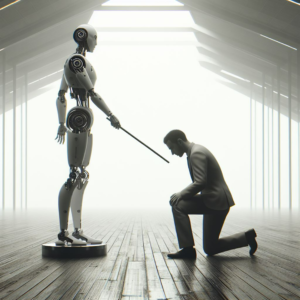
So, but now, is there another way to solve this problem? And a possibility, which I think is much more cost-effective, is to turn humans into robots.”
He pointed out “And all the ingredients are in place, right? So you have in the world something called the gig economy where people are Uber drivers, where people are working part-time as janitors, basically labor on demand. And they’re all controlled by the algorithm, right? We just discussed this. You also have millions, hundreds of millions of immigrants who want to come into these Western societies to work. Because in the future, if you’re in Africa, it’s possible there’s a famine.”
Hearing the word ‘famine in Africa’, Solomin felt surprised, and this professor emphasized upon it, before contending that this disaster would form a key reason for people to be turned into robot.
Professor Xueqin said “Yeah, you could have a famine in Africa in the next 5 years. Yes. What people don’t appreciate is that the Earth itself, the planet itself, can only sustain about 2 billion people. So the way we’ve solved this problem is by inventing fertilizer. And about a third of the world’s fertilizer is transported through the Strait of Hormuz. Strait of Hormuz has been closed down for the past 2 months. It’s planting season right now. So a lot of places can’t grow food.
We don’t know about the consequences now, but wait 6 months and you’re going to hear lots of reports of food shortages around the world, especially in Africa, which is dependent on fertilizer in order to grow crops. So we are moving into a time of tremendous flux and of tremendous volatility. You’re going to have a lot of people who will be desperate just for food. So you can turn them into cheap labor, right?”

Professor Xueqin raised the problem of human slavery to telephones. “And then the last element is your mobile phone. Your mobile phone has become in many ways your best friend. Or your alter ego. You spend so much time on the mobile phone. Now let me ask you this question. Is there really a difference between a mobile phone and a microchip inside your brain?”
Turning humans into robots: a cheaper alternative?
Professor Xueqin said “Well, that’s a good point. But a lot of workers cannot leave behind their mobile phone. If you’re an Uber driver, your mobile phone is attached to you because your mobile phone is what will get you a job and food. You also have people working in the AI industry who label training data. Around the world, they’re also married to their phones.
So you have cheap labor that’s desperate for work. You have microchip technology that you can implant into a person to control how this person behaves. And then you have mass demand in Western aging societies. So all the ingredients are in place. So why not just turn humans into robots, which is cheaper than to actually create robots to replace humans.”
In interaction with the professor on this particular dimension, Solomin said “And it’s true that some companies now are reducing their use of AI because it is very expensive. They lose a lot of money, sometimes millions of dollars. And some companies even tell their workers not to use AI because of the cost. But maybe in the short term it could become cheaper than it is now. Do you think that is possible?”
He answered “So the reason why consumer goods products have become cheaper over the past 20 years is globalization, right? It’s just cheaper for you to source materials from around the world. But in a time of war, in a time of conflict, in a time of deglobalization, in theory, the cost of robots can only go up, but the cost of humans can only go down because you have hundreds of millions of refugees from Africa, from Asia who are desperate for food. So aren’t you better off turning humans into robots, than mass manufacturing robots, not knowing, not being able to control the cost of critical minerals.

So you look at, for example, data centers in America. They consume a tremendous amount of energy. They consume a tremendous amount of fresh water, and they don’t really provide a tangible benefit to society. So I’m not sure how far you can take the AI dream.”
In our upcoming article, we will explore how the Holy Bible and various historical, religious, and philosophical figures have long warned humanity against surrendering its God-given identity, freedom, and human nature to technological forces that seek to turn people into machines. We will scrutinize the mounting concerns around AI, human implants, microchips, and other technological devices inserted into the human body— particularly where such innovations could be used to monitor, manipulate, or control human behavior.
Drawing on biblical teachings and relevant historical perspectives, the article will investigate whether the ambition to change human beings into programmable, robot-like entities represents a dangerous departure from the very essence of humanity. It will also challenge readers to ruminate the moral, spiritual, and ethical implications of a future in which human autonomy, conscience, and individual freedom could be sacrificed in the name of technological advancement. Finally, the article seeks to remind the world that human beings are not machines to be programmed, controlled, or re-engineered at will, but living beings whose dignity, identity, and freedom must be protected.