By Ephrem Murindabigwi
Young miners labor tirelessly, in the heart of Muhanga District, extracting the wealth beneath the earth while their own future security hangs in the balance. District authorities are now sounding a crucial alarm: without early and consistent savings, today’s strength can become tomorrow’s vulnerability.
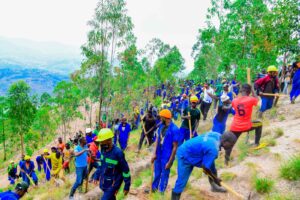
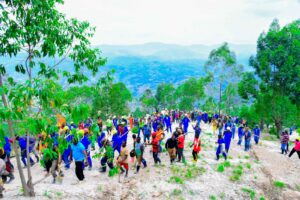
During a recent community work activity (Umuganda), leaders joined hands with miners from the COMAR Cooperative in the process of planting trees and, symbolically, planting the seeds of financial resilience. The message was clear—physical strength wanes with age, but foresight, discipline, and prudent financial planning can ensure that the miners’ hard-earned efforts today translate into security and dignity in their later years.
Early savings: securing the future of Rwanda’s miners
Muhanga District’s authorities have called upon those working in the mining sector to regularly conduct savings while they are still strong and able to work, emphasizing that their physical strength declines as they grow older. This call has been issued during the community work activity that has brought together the district’s leaders and members of the mining establishment—COMAR Cooperative— which operates in Kabacuzi Sector. The community work was designed to create holes where trees will be planted as part of efforts to protect the environment in areas where they work.
The Mayor of Muhanga, Jacqueline Kayitare, has said that mining workforce is dominated by young people and that they should therefore plan wisely for their earnings instead of spending them carelessly. She has pointed out that they should capitalize upon this asset of savings from their youth, underlining that it would be unfortunate for a miner— who once satisfied their every need during their youth— to end up begging in old age due to negligence. She has noted that besides saving through regular financial institutions, the government has also established the Ejo Heza long-term savings scheme— which allows people to contribute small amounts while the government also provides support so that they can receive a pension when they reach old age.
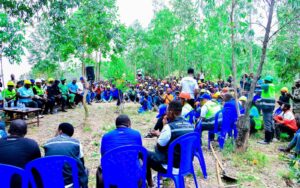
She has highlighted “It would be sad for someone who has earned money to get old without anything, because this kind of work eventually stops when one’s strength is gone. If mining furnishes the owners of the concessions with riches; when you exhaust your own energy in the work, without saving, how will you live when you grow old? No one will be there to take care of you. That’s why, you working in mining should start saving early, while you still possess the strength, so that you can enjoy well-being in old age, without begging whereas you once earned whatever you wanted.”
One of the cooperative’s miners, Emmanuel Ndagijimana, has said that after finishing secondary school education, he immediately joined the mining sector. He has testified that through his daily mining work, he has been able to save money; thus, managing to start a family, among other key achievements from this career. He has added that he is now also saving through the Ejo Heza scheme. “Before, when we were paid in cash, we used to waste the money. But now that we receive our wages through bank accounts, we are all motivated to work hard, save, improve our lives, and live well. Among my achievements rendered possible by mining are getting married, building a house, and acquiring livestock.”
One of the members of the COMAR Cooperative and investor, Patrick Ngendavimana, has said that after receiving the advice from the mayor, they decided to involve all their employees in the Ejo Heza scheme. As a result, around 700 employees immediately began providing their contributions, based on each person’s preference from their salary. He has added that they will continue to receive their remunerations through bank accounts, to enable them to save from their earnings.
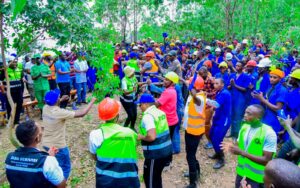
He has clarified “If an employee earns 4,000 Rwandan francs (RWF) per day, deducting 100 RWF and leaving 3,900 RWF is easy and does not cause any loss because it is money that they are setting aside for themselves. We will continue to help our employees improve their work capacity and support them to voluntarily join the Ejo Heza scheme, so that they can truly elevate their life security and confidence when they reach old age.”
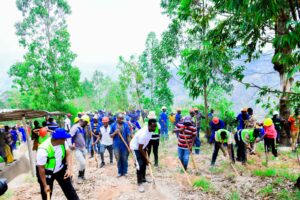
Among other things, miners have been asked to continue protecting the environment. The COMAR Cooperative intends to plant over 10,000 trees. Across the entire district, miners are expected to plant more than 110,000 trees.
However, despite these efforts to promote savings and financial planning, a significant portion of miners in Rwanda still face challenges in building long-term financial security. Several of them are paid in cash on a daily or piece-rate basis; which limits their ability to save consistently and undermines the potential benefits of schemes like Ejo Heza.
According to a 2023 study by the Rwanda Extractive Industry Workers Union (REWU), approximately 78% of miners are employed as casual laborers. Among those paid, 80% receive daily wages in cash based on the minerals which they collect. This payment structure means that miners are not compensated, if they do not extract minerals on a given day. Additionally, a report by the Rwanda Mines, Petroleum and Gas Board (RMB) indicates that 69% of mining workers are paid in cash, 28% through financial institutions, and 3% via mobile money.
RMB’s 01August 2024 story headlined “CEO KAMANZI JOINS RWANDA MINING ASSOCIATION FOR ITS GENERAL ASSEMBLY” reads “Presenting on the issue of establishing a minimum living wage for miners, the Secretary General of REWU, Andre Mutsindashyaka, shared findings from a comprehensive study on miners’ living conditions.
The study revealed that 69% of mining workers are paid in cash, 28% are paid through financial institutions, and 3% are paid via Mobile Money. Additionally, 61% of mining workers are dissatisfied with their wages, while 53% of those paid based on productivity can go up to seven days without receiving any payment, often going home empty-handed.”
Research on savings habits and business diversification in artisan miners
Research in Zimbabwe underscores how savings habits and business diversification can enhance financial resilience among artisan miners. The research was released by EAS Publisher (East African Scholars Publisher) in October 2021. EAS Publisher is an international scholar’s publisher for open access scientific journals in both print and online publishing from Kenya.
The abstract of study titled “Individual Characteristics of Artisan Gold Miners and Their Savings Habits in Rural Zimbabwe: Case of Umzingwane District” reads “The study found that the many artisan gold miners in Umzingwane district have no formal bank accounts and were relying on informal savings methods such as Rotating Saving and Credit Schemes (ROSCAs) and savings from homes Income levels of artisan gold miners were found to have a positive impact on savings.”
The study advises that artisanal gold miners be urged to create savings groups such as Internal Savings and Lending Schemes and to establish links with formal banking institutions. It also suggestes that they diversify their income streams to enhance their financial resilience and reduce vulnerability to economic shocks. “Non Governmental Organisations and Government of Zimbabwe should mobilize artisan miners to form savings groups such as Village Savings and Lending Schemes or Internal Savings and Lending Schemes. Such interventions will encourage the artisan miners to save more. The NGOs and government should then assist to link the savings groups with formal banking. This will give artisan miners the opportunities to participate in economic development of the country.”
About diversification, the study recommends artisan miners “Artisan miners should also be encouraged to diversify their sources of income. They should be encouraged to consider opening businesses and venture into agriculture. This will increase their sources of income and make them resilient in times of natural disasters such as Covid 19 pandemic where their mining activities and incomes are restricted by Covid 19 regulations and protocols. Encouraging artisan miners to diversify their income sources helps in reducing mining activities and environmental degradation.”
In effort to ensure smooth savings among artisan miners in Zimbabwe, the study recommends “Formal financial institutions should be encouraged to set up branches in rural areas and come up with innovative financial products which satisfy the needs of the members of the population such as artisan miners. This will help the formal financial institutions to mobile more savings for lending to the key sectors of economy. Financial institutions, government and NGOs should create awareness of financial products among artisan miners. This will enable them to use less risk and better methods of savings.”
In the Rwandan context, the gap in accessible financial services for artisan miners can be effectively bridged through SACCOs (Savings and Credit Cooperatives), which operate in nearly every—if not every— sector across the country. These community-based financial institutions are well-positioned to provide miners with safe, convenient avenues to save and grow their earnings. By partnering with SACCOs, groups of miners can adopt structured savings habits, access small loans for personal or business needs, and build long-term financial resilience. Such an approach ensures that the physical labor and wealth extracted today translate into security, dignity, and opportunity in the future, mirroring the principles emphasized in broader studies of rural financial inclusion.
Financial savings among miners can be applied anywhere
Life In Humanity has not succeeded in finding or landing a study or any piece exclusively addressing savings habits among miners in developed countries. We, however, are convinced that the principles of financial prudence and income diversification apply universally. Evidence from artisanal mining communities, whether in Rwanda or Zimbabwe, underscores the importance of starting early, saving consistently, and exploring multiple streams of income to safeguard against economic shocks. The challenges faced by miners—irregular pay, dependence on daily output, and the physical limitations of labor-intensive work—are not unique to any one country. They are, in fact, common across mining sectors worldwide.
Studies and initiatives in other contexts suggest that miners, regardless of geography, benefit greatly from financial planning. For instance, research conducted in Zimbabwe revealed that artisan gold miners who engaged in savings groups, such as Rotating Savings and Credit Associations (ROSCAs), and who diversified into small businesses or agricultural activities, were far more resilient to income shocks. Likewise, miners in developed economies enjoy access to structured financial systems, pensions, and institutional support, but they too face challenges such as fluctuating commodity prices, occupational hazards, and periods of unemployment. In these scenarios, the ability to save consistently—even in small amounts—profoundly affects long-term security and well-being.
Life In Humanity recognizes that obstacles to savings, including cash-based payments and informal employment, are not confined to developing nations. Developed countries often address these challenges through regulatory frameworks, employer-facilitated retirement schemes, and accessible banking which collectively encourage savings and financial literacy among miners. The core principle remains: whether a miner in Kabacuzi Sector, Umzingwane District, or in the industrial mines of Europe or North America, building financial resilience requires foresight, discipline, and access to appropriate financial tools.
Therefore, the lessons emerging from Rwandan and Zimbabwean miners’ experiences are broadly applicable. Encouraging early and consistent saving, integrating with formal financial institutions, and diversifying income are strategies that can enhance financial security across the globe. Life In Humanity maintains that supporting miners to adopt these practices not only strengthens individual livelihoods but also contributes to broader economic stability and sustainable development within mining communities everywhere.