By Jean Baptiste Ndabananiye
Undergoing an inhuman crime is torturous, but suffering such a crime at the hands of a person you are related to is far more devastating. Perlina Mukamuyango, a survivor of the 1994 Genocide against the Tutsi in Rwanda, shares her heart-wrenching experience of growing up in an environment where her family faced relentless persecution.
What made this suffering more unbearable for her was that the perpetrators of this violence belonged to the very community she called home. Mukamuyango’s story, deeply painful, highlights the complexities of trauma and wounds inflicted by those around you—people who should protect and care for you. This article is divided into this major sections:
- More details on Perlina Mukamuyango’s experience
- The unbearable weight of betrayal— how suffering at the hands of those who should protect you amplifies trauma
- Neighbors as extended family— the bonds that connect us beyond blood
- Conclusion and call to action
More details on Perlina Mukamuyango’s experience
Perlina Mukamuyango lives in Karama Village, Gihinga Cell, Gacurabwenge Sector in Kamonyi District in Rwanda’s Southern Province. She says that her family started facing problems, long before the 1994 Genocide against the Tutsi occurred. “My family faced consequences, because when the Inkotanyi military attacked in 1990, people said that we were hiding ‘Inyenzi/cockroaches’ as they then called the Inkotanyi army [RPA/Rwanda Patriotic Army—the armed wing of the RPF- Inkotanyi, Rwanda’s ruling party].
There were police people who came to watch us every night, but without us knowing it; we learnt about this afterwards. They came to hunt my father, alleging that he’d broken a radio reportedly because it announced that Rwigema had died. They even told us that they would come to kill us at night and we passed some nights outside.”
She specifies “We spent a whole week, passing nights outside our home, they informed us that they would come to kill us and eat our cows, claiming that my father had smashed the radio receiver when he heard that Rwigema had passed away. On the first day, we were told that we would be killed, but they didn’t then come to murder us. We expected that they would come to murder us on the second day, but they didn’t; we also expected them on the third day and they didn’t come.
As a result, we said ‘Let’s return home; we won’t continue living away from our home in the wilderness. If they come, let them kill us, or they won’t come, let’s leave this wilderness. But in the end, they didn’t come. My father and brothers, my paternal uncle and male paternal cousins passed the nights near the home. We— my mother, my paternal uncle’s wife, and all the girls— walked to a hill beyond the home. They [my father and the others] told us ‘When we hear the attack, we will scream, so that you can run away since you can’t run as fast as us.”
The scars of the past do not fade easily, especially when the very people who have inflicted them upon you remain ever-present in your daily life. The weight of such existence is immeasurable, a wound that is reopened with every glance and every reminder of what was has occurred to you. Healing waits, until you are truly reconciled with those who have caused the pain to you.
Mukamuyango explains “My wounds have been compounded by the fact that those who have perpetrated genocide against my family members live together with me, because of being born and married in the same place where you have been born. I was born in this village while it is in this village that they killed my parents. Therefore, it is extremely difficult to dwell together with people whom you meet every day while others tell you that it is the ones that have murdered your father and mother, destroyed your house and consumed your cows.
Living with those people and looking at each other every day didn’t actually constitute easy wounds. When you fell ill, you said ‘A sibling should take care of me during my illness, there are benefits that I could receive from them.’ However, you were aware that this was impossible, whereas you are together with the person who has plunged you into this situation [who has killed your family members so that you have no one to help you] — the person you see each other in the morning, at noon and the evening. It was extremely difficult, but again you were convinced that you could change nothing on it.”
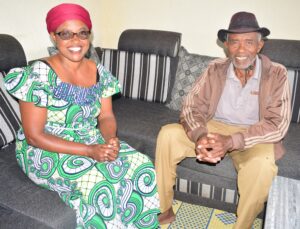
One of those people who killed Mukamuyango’s family is Markia Munyurangabo, a former genocide perpetrator whom you see in this photo with Mukamuyango. As even illustrated by the picture, they now enjoy very good relations.
What has CARSA—Christian Action for Reconciliation and Social Assistance implemented for her to be healed to the extent of forming such relations with those who committed crimes against her?
This question shall be answered in our series of pieces of writing which will provide more details on what happened to Mukamuyango during the genocide.
The unbearable weight of betrayal— how suffering at the hands of those who should protect you amplifies trauma
Suffering at the hands of a person to whom you are related can amplify the trauma far beyond the usual impact of an inhuman crime. When the harm comes from someone within your own family or community, the emotional and psychological wounds become more complex and deeply rooted. The betrayal feels personal, as the very people who should protect and nurture you are the ones who have inflicted the greatest pain.
Your shared history and daily encounters aggravate the pain, as every interaction or remembrance serves as a reminder of the horrific acts that have shattered your world. Unlike a crime committed by a stranger, the perpetrator’s presence is constant, reinforcing feelings of helplessness and isolation. The hope for reconciliation becomes intensely difficult, as forgiveness is complicated by proximity and the ongoing reminders of the past. Every day, Mukamuyango faced the struggle of being surrounded by those who bereaved her of her beloved family and robbed her of her safety and peace.
In such circumstances, the process of moving on becomes much more difficult because the boundary between the victim and perpetrator is blurred. Despite these insurmountable odds, survivors like Mukamuyango demonstrate incredible resilience, as their capacity for forgiveness and healing offers a model for the rest of the world.
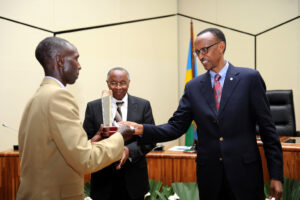
Meanwhile, in 2015 before Protectors Friendship Pact—Abarinzi b’Igihango, the President of Rwanda, Paul Kagame, indicated that the Protectors of Friendship Pact are extraordinary. He declared “When I learn about these people [Protectors of Friendship Pact], I feel that I could not have managed to do what they carried out. They [genocide perpetrators] have already killed your people, and you have also almost been killed [and you are among dead bodies], but when they take you from corpses, you remember to save someone or perform acts of kindness and goodness for somebody else.”
Protectors of Friendship Pact are people (1) recognised for their unparalleled acts of humanity in helping some of the Tutsi to survive the Genocide, and (2) engaged in extraordinary acts in instilling unity among the Rwandese in the aftermath of the Genocide.
Likewise, Life In Humanity is convinced that genocide survivors —like Mukamuyango—who have pardoned those who have perpetrated crimes against them are truly exceptional. They actually are a repository of timeless and boundless wisdom which has emanated from their unspeakable horrors. It resonates with those of today and will always do so, as it also resonates with any person anywhere on this planet. Their profound resilience, compassion, and capacity for forgiveness — qualities that are actually incredibly rare and powerful stand so commendable that they deserve to be emulated anywhere.
That is why Life In Humanity has committed itself to meticulously covering their indescribable experiences, healing journey and contributions to the community nowadays. This lies in the context of Life In Humanity’s contribution to educating not only the Rwandan community but also the global society. You can read this similar piece.
Neighbors as extended family— the bonds that connect us beyond blood
Our neighbors are, in many ways, our extended family, as even underlined by various sources. They are the people with whom we share our daily lives, even though we may not be related by blood. In some cultures, the bond between neighbors is so strong that they are considered relatives, offering support, care, and companionship as family members do. A neighbor is often the first person to check on you in times of need, and their home becomes a refuge when you are experiencing distress.
The relationship extends beyond just being next-door neighbors—it’s rooted in shared experiences and mutual support. Just like relatives, neighbors witness our triumphs and struggles, and they contribute to our sense of belonging and safety. Therefore, it is not far-fetched to consider that a neighbor, in many respects, is indeed a relative.
The Holy Bible in Galatians 5: 14-15 also confrims it. It states “For the entire law is fulfilled in keeping this one command: ‘Love your neighbor as yourself.’” In Rwanda exists a proverb ‘Umuturanyi aruta umuvandimwe wa kure’ which literally means “A neighbor transcends a sibling living far.” It conveys the message that a neighbor, due to their proximity and constant presence, can be more supportive or valuable than a relative who lives far away.
Case proving that your neighbor is your close relative, when you are committed to good relations
In Ruhango District in 2016, I met two neighbors who, despite once experiencing a strong bond, found themselves embroiled in a conflict that had yet to be completely resolved. I was then preparing a radio broadcast which promoted the peaceful resolution of disputes and was aired on various radio stations in Rwanda. The radio program was situated within the context of a certain project which was being implemented by Search For Common Ground.
One of the neighbors shared with me, “Before the conflict, we enjoyed very good relations. One day, it rained so heavily that the torrent was going to destroy my house, but he intervened to channel the torrent away from my house since I wasn’t there. But today, he can’t because of our conflict. I actually agree that our conflict constitutes our immense loss.” This reflects the deep connection they once possessed, where their immediate proximity and willingness to help each other transcended mere neighborly duty.
The other neighbor echoed a similar sentiment, telling me “It came to pass that I urgently needed money to purchase a piece of land and he was the only one person who lent me around $300 and I immediately bought it and I now live on it. Now that he can no longer render me such service, it is a very big loss.”
This experience highlights how the strength of their relationship allowed for acts of kindness that went beyond what one might expect from mere neighbors. In both instances, the conflict between them had not only affected their personal relationship but also deprived them of the tangible support they once could rely on. The mutual benefits they once shared are a testament to the truth that, sometimes, a neighbor can transcend a distant relative in providing practical support and solidarity.
Conclusion and call to action
This piece actually contains a lot of lessons, but we have felt compelled to highlight two key takeaways that stand out in their profound significance.
First, being a good neighbor forms a value that Life In Humanity implores everyone to embrace.
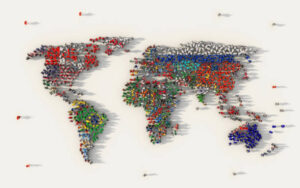
In a world where we often focus on the distance between us and others, it becomes easy to forget the power of proximity and the positive impact we can bring by being present, compassionate, and supportive in the lives of those around us. Being a good neighbor means being a person who offers kindness, extends a helping hand in times of need, and fosters an environment where trust and unity can thrive.
It entails surpassing mere duty and offering meaningful, impactful support to those in your community. As we’ve seen from the story of neighbors in Ruhango District, a seemingly simple act of kindness such as helping to protect someone’s house or lending money in times of urgency, can transform lives and relationships.
More importantly, we should strive to not only avoid any acts which claim the lives of others but also those which even carry the potential to harm others. Striving to avoid harm means actively working to create an environment where people feel safe, valued, and supported.
People’s lives and peace should be treated as unalienable—they are fundamental rights that cannot be taken away or violated by anyone, under any circumstance. When we respect these core rights, we are acknowledging the inherent dignity and worth of every individual, and we recognize that their ability to live in peace, free from fear or harm, is not something that can be infringed upon.
By fostering an environment where each person’s life and well-being are seen as sacred and inviolable, we contribute to a society where everyone enjoys the opportunity to thrive. It is our responsibility to protect not only the physical safety of others but also their emotional and psychological peace, ensuring that they can live without the threat of harm or injustice. We should never forget that peace is a right, not a privilege, and it represents the foundation upon which we build harmonious communities. The more we protect these rights, the closer we come to creating a world where everyone is free to live with dignity and respect.

PHOTO: (MAHMOUD ISSA/REUTERS)
To achieve this, we need to use our minds as our maximally great weapons in this regard, as even underscored by UNESCO—United Nations Educational, Scientific and Cultural Organization. Our intellect, creativity, and capacity for empathy feature among the most powerful tools we possess in the fight for a world where people’s lives and peace are treated as unalienable. The human mind is not only capable of identifying solutions but also of fostering understanding, compassion, and respect.
“Since wars begin in the minds of women and men, it is in the minds of women and men that the defences of peace must be constructed. These opening lines of UNESCO’s Constitution bear witness to our effort to understand and respond to the very origin of conflict. They are the backbone of all our action,” the UNESCO underlines.
UNESCO has long emphasized the role of education and critical thinking in promoting peace, asserting that an enlightened mind is a force for positive change. Yet, the current global landscape across various disciplines deeply intertwined with human life demonstrates that the journey remains very long. The persistence of endless conflicts and wars suffices to corroborate this point.
Nevertheless, when we consciously apply our minds to creating peace, we harness the ability to resolve conflicts, heal divisions, and prevent harm before it occurs. By exercising our intellect in thoughtful and deliberate ways, we can bridge differences, dismantle prejudices, and promote respect for others’ rights. It is through informed, mindful action that we can transform our surroundings into spaces where people are safe, valued, and supported. Ultimately, it is the wisdom and intellect of individuals working together that will ensure that the right to life and peace remains inviolable for everyone.
The second lesson is the incredible strength and resilience found in forgiveness, especially in the face of unimaginable pain. Life In Humanity believes that it’s not just about forgiving others, but about freeing oneself from the weight of the past. Forgiveness is not easy, especially when the perpetrators of suffering are people close to us, as illustrated in the case of genocide survivors like Mukamuyango. Yet, the process of healing begins with taking that difficult step toward reconciliation, not for just the benefit of the perpetrator, but also for one’s own peace of mind and heart. It’s a lesson in understanding that while we cannot change the past, we wield the power to shape the future through acts of kindness, compassion, and forgiveness. This eventually fosters other areas such as the economic progress of those who pardon, as we will also thoroughly address this subject in some of our upcoming articles.
Life In Humanity encourages you to be part of this transformation by becoming someone who spreads love, understanding, and reconciliation in your community. It calls upon all of us to reflect on our own actions, to examine how we interact with our neighbors, and to strive toward creating relationships built on mutual respect and care. A better future starts with small acts of kindness today. We urge you to be the neighbor who uplifts others, who works to heal wounds, and who stands for unity and peace. Together, we can create a world where being a good neighbor is the norm, not the exception.