By Editorial Staff
As geopolitical tensions rise, the threat of nuclear war — once a distant nightmare — has become an ever-present reality. The immediate devastation from such a conflict is almost beyond imagination—cities reduced to ashes, and entire populations obliterated. The true extent of the catastrophe reaches far beyond blast zones. Sources indicate that a nuclear war would not only decimate cities and human lives instantly but also trigger a series of cascading global crises. Nuclear weapons are maximally powerful to the extent that they transcend the Sun’s heat capacities by far. They emit intense heat which extremely surpasses that which melts metallic objects.
The fallout would plunge the world into prolonged darkness and cold, disrupting agricultural systems and leading to widespread famine. In a world already struggling with food security, such a disaster could result in the deaths of up to 5 billion people from starvation alone, according to some sources. As tensions between nuclear-armed nations escalate, understanding the full scope of this potential disaster stands crucial. This article examines some of the immediate and devastating human consequences of a global nuclear conflict, underscoring the urgent need for international cooperation to prevent this imminent catastrophe. Life In Humanity will detail long-terms effects like starvation worldwide in an other edition. This article is organized into the following sections:
- Vaporization of substances including humans, collapse of buildings and ravaging firestorms
- Atomic bombs hurled on Hiroshima and Nagasaki as illustration
- One of harrowing testimonies, highlighting the incomparable intensity of nuclear weapons
Campaign for Nuclear Disarmament (CND) is a movement of people campaigning to abolish the instruments of mass destruction in Britain and worldwide. It points out “Nuclear weapons have been used twice, on Hiroshima, and another Japanese city, Nagasaki. Evidence from these occasions, as well as atmospheric nuclear testing and nuclear power accidents, have formed the basis of our knowledge of the effects of nuclear weapons. Modern nuclear weapons generally have much greater explosive power than those first two bombs, and would greatly increase the scale of the devastation.
Following the Russian invasion of Ukraine, the people of that country are suffering heavily as they are attacked from the air and on the ground. But, the conflict poses an even wider threat – the existential threat of a nuclear war between Russia and NATO. Between them, they have around 12,000 nuclear weapons – some over 100 times the power of the bomb dropped on the Japanese city of Hiroshima in 1945. In short, a nuclear exchange between NATO and Russia would be catastrophic for the whole planet.”
Vaporization of substances including humans, collapse of buildings and ravaging firestorms
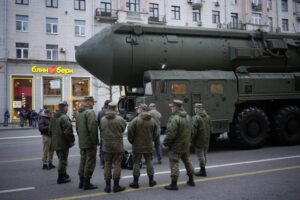
CND alerts “If a nuclear bomb was detonated, the heart of the nuclear explosion would reach a temperature of several million degrees centigrade. The resulting heat flash would literally vaporise all human tissue over a wide area. At Hiroshima, within a radius of half a mile, the only remains of most of the people caught in the open were their shadows burnt into stone.”
By the heart of the nuclear explosion, CND means the central point or core of the explosion where the nuclear reaction occurs. At this point, according to CND, temperatures can reach several million degrees Celsius ; which is numerous times hotter than the surface of the sun.
The same source says that the heat flash would vaporize all human tissue. This signifies that because of the extreme heat, human bodies (flesh, organs and muscles), along with other organic matter, would instantly turn into gas without leaving any trace. This signifies that this effect would exterminate all human beings and other forms of life like animals, plants, and other biological material in the blast zone, either vaporized or burned to ashes.
The phrase “Over a wide area” is subjective, the size of an area affected by the heat flash depending on a bomb’s size and yield. However, in large nuclear explosions, this area can cover several kilometers, causing widespread destruction and loss of life.
The International Campaign to Abolish Nuclear Weapons (ICAN) constitutes a global civil society coalition working to promote adherence to and full implementation of the United Nations nuclear weapon ban treaty.
ICAN also affirms the vaporization of organic matter by these instruments of mass destruction. “Thermal radiation is so intense that almost everything close to ground zero is vaporized.” “Almost everything close to ground zero” means that any object or living being very near the center of the explosion (ground zero) would be touched by the inconceivably intense heat. In other words, virtually every substance—such as buildings, vehicles, and people—would be instantly turned into gas.
The National Institutes of Health (NIH) in its paper “Possible Fatalities from Superfires Following Nuclear Attacks in or Near Urban Areas” by Theodore A Postol, PH.D at Stanford University in Stanford, California, also confirms the point. NIH points out “During the period of peak energy output, a 1-megaton (Mt) nuclear weapon can produce temperatures of about 100 million degrees Celsius at its center, about four to five times that which occurs at the center of the Sun.
Because the Sun’s surface is only about 6,000°C and it heats the Earth’s surface from a range of more than 90 million miles (about 145 million kin), it should be clear that such a nuclear detonation would be accompanied by enormous emanations of light and heat.”
The Sun’s center and surface differ vastly in terms of temperature, composition, and physical properties. For instance, the core of the Sun is extremely hot, with temperatures reaching about 15 million degrees Celsius. The surface, or photosphere, is significantly cooler compared to the core, with temperatures around 6 o00 degrees Celsius as already mentioned.
CND says “People inside buildings or otherwise shielded would be killed by the blast and heat effects as buildings collapse and all inflammable material bursts into flame. The immediate death rate would be over 90%. Individual fires will combine to produce a firestorm as all the oxygen is consumed.
As the heat rises, air is drawn in from the periphery at or near ground level. This would result in lethal, hurricane-force winds, and the fire would be perpetuated as the fresh oxygen is burnt. People in underground shelters who survive the initial heat flash would die as all the oxygen is sucked out of the atmosphere.”
Atomic bombs hurled on Hiroshima and Nagasaki as illustration
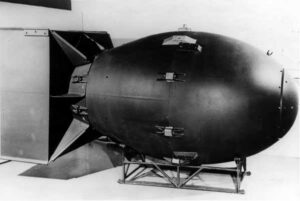
The instantaneous destruction of the only two bombs unleashed on the Japanese cities of Hiroshima and Nagasaki suffice to explain the indescribable destruction of nuclear weapons.
In a 16 December 2019 article headlined “Hiroshima buildings that survived atomic bomb to be demolished” BBC reports “The attack flattened most of the city, and – as of last year – only 85 buildings built before the bomb remained within five kilometres of ‘ground zero’.”
Yale University says “In Hiroshima over 60,000 of 90,000 buildings were destroyed or severely damaged by the atomic bomb; this figure represents over 67% of the city’s structures. In Nagasaki 14,000 or 27% of 52,000 residences were completely destroyed and 5,40O, or 10% were half destroyed. Only 12% remained undamaged. This destruction was limited by the layout of the city. The following (table) is a summary of the damage to buildings in Nagasaki as determined from a ground survey made by the Japanese.”
|
Destruction of Buildings and Houses |
Number |
Percentage |
|
Total in Nagasaki (before atomic explosion) |
50,000 |
100.0 |
|
Blasted (not burned) |
2,652 |
5.3 |
|
Blasted and burned |
11,494 |
23.0 |
|
Blasted and/or burned |
14,146 |
28.3 |
|
Partially burned or blasted |
5,441 |
10.9 |
|
Total buildings and houses destroyed |
19,587 |
39.2 |
|
Undamaged |
30,413 |
60.8 |
The UNESCO World Heritage Center says “The Hiroshima Peace Memorial (Genbaku Dome) is the only structure left standing near the hypocenter of the first atomic bomb which exploded on 6 August 1945.”
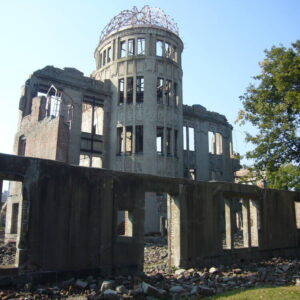
The City of Hiroshima states that when the atomic bomb burst, the intense heat rays ignited houses in the city center and that the firestorm spiraled out of control. “In collapsed houses throughout the city, kitchen and other fires quickly spread out of control. Peaking between 10 am and 2-3 pm, but continuing all day, the city burned as if to scorch the heavens. Within two kilometers of the hypocenter, the entire city burned to the ground. All objects were melted and fused into sheets like cooled lava. Countless people were trapped under fallen buildings and burned alive.
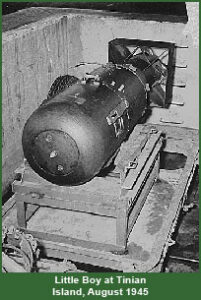
The intense blast and heat rays of the bombing destroyed and burnt almost all buildings within two kilometers of the hypocenter. Even in the area beyond two kilometers of the hypocenter, wooden buildings sustained major damage, and 90 percent of the structures in the city sustained devastating damage. According to the city’s 1946 general survey, 51,787 out of 76,327 buildings were completely destroyed or burnt by the bombing, and 6,180 were partially destroyed.”
The city adds that approximately half of people who were within 1.2 kilometers from the hypocenter passed away within the day. “80 to 100 percent of those who were closer to the hypocenter are thought to have died. Even among those who were able to escape an instant death or death within the day, the closer they were exposed to the bombing, and the more serious damages they suffered, the higher mortality rate they had.”
“Various institutions have investigated the number of people who perished in the bombing, but so far, the precise number is unknown.” The City of Hiroshima estimates that nearly 140,000 people had died by the end of December 1945, when the acute effects by the radiation diminished. “It is thought that approximately 350,000 people were in the city when the bomb exploded on August 6, 1945.”
This figure comprises ordinary citizens, military personnel, and people from neighboring towns and villages who commuted to work or were involved in building demolition work, according to the city. “Those who were involved in the tragedy were not only Japanese, but also people with various nationalities, such as Japanese-Americans who were born in the US, German priests, exchange students from countries in Southeast Asia, people from Korea and Taiwan which were then Japanese colonies, and mainland China, as well as US prisoners of war”.
Office of Scientific and Technical Information (OSTI) forms part of the U.S. Department of Energy (DOE). Its mission is to advance science and support the DOE’s research by providing access to scientific and technical information. It says “A B-29 bomber named Enola Gay took off from the island of Tinian and headed north by northwest toward Japan. The bomber’s primary target was the city of Hiroshima, located on the deltas of southwestern Honshu Island facing the Inland Sea. Hiroshima had a civilian population of almost 300,000 and was an important military center, containing about 43,000 soldiers.”
OSTI also recognizes that no person will ever surely know the number of people who died as a result of the attack on Hiroshima. “Some 70,000 people probably died as a result of initial blast, heat, and radiation effects. This included about twenty American airmen being held as prisoners in the city. By the end of 1945, because of the lingering effects of radioactive fallout and other after effects, the Hiroshima death toll was probably over 100,000. The five-year death total may have reached or even exceeded 200,000, as cancer and other long-term effects took hold.”
The City of Hiroshima highlights that at the time of the explosion, the temperature of the detonation point exceeded 1,000,000℃. It adds that the fireball generated in the air grew to a radius of over 200 meters one second later. “8:15 am on August 6, 1945 the first atomic bomb used against humans was dropped on Hiroshima. 600 meters over the city and with a blinding flash, the atomic bomb exploded 43 seconds after being dropped, creating a fireball that blazed like a small sun.
More than one million degrees Celsius at its center, in one second the fireball reached a radius of over 200 meters, and the surface temperatures near the hypocenter rose to 3,000 to 4,000℃. For reference, iron melts at 1,536℃.”
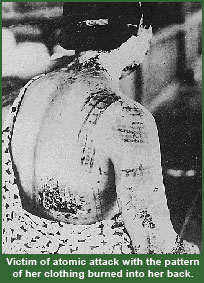
The city adds “People sustained severe burns from the powerful heat rays, and many died as a direct result. The burns were only on the side directly exposed to the heat rays, with some as far as 3.5 kilometers away suffering burns on exposed skin. The surface of roof tiles within 600 meters of the hypocenter melted and blistered. Many trees ignited, and within three kilometers, electric poles, trees, and lumber were charred.”
The residents of Hiroshima were then unimaginably surprised on the day which dawned bright and clear in this city. The City of Hiroshima explains “As the summer sun climbed in the sky, the temperature rose rapidly. The air-raid warning just after midnight at 12:25 am was cleared at 2:10 am.
Having finally settled back to sleep, people were abruptly awakened by another siren at 7:09. That turned out to be a US military reconnaissance plane cruising at high altitude, so the all-clear was sounded at 7:31. Sighing in relief, people returned from their air-raid shelters and other places of refuge. They were eating late breakfasts or on their way to work, beginning the day.”
The city goes on, saying “Suddenly, a bell in the Information Relay Room at the Hiroshima Central Broadcasting Station signaled the notice to broadcast an air-raid alarm. Furuta, the announcer, ran to the Alarm Office, grabbed the text for the announcement and rushed to the studio to push the buzzer.”
“This is a report from the Chugoku Regional Military Headquarters! Three large enemy planes advancing from Saijo.” Suddenly, “he heard a terrible cracking sound, felt the ferro-concrete structure tilt to one side, and was thrown through the air.”
OSTI also affirms that the detonation created the unspeakable tragedy to people whose life was progressing as normal. No critical portending sign had first manifested itself. “An air raid alert from earlier that morning had been called off after only a solitary aircraft was seen (the weather plane), and by 8:15 the city was alive with activity — soldiers doing their morning calisthenics, commuters on foot or on bicycles, groups of women and children working outside to clear firebreaks.
Those closest to the explosion died instantly, their bodies turned to black char. Nearby birds burst into flames in mid-air, and dry, combustible materials such as paper instantly ignited as far away as 6,400 feet from ground zero.”
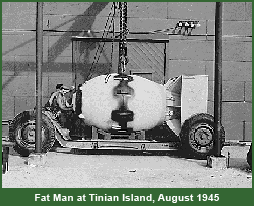 OSTI further says that the bomber, piloted by the commander of the 509th Composite Group, Colonel Paul Tibbets, flew at low altitude on automatic pilot before climbing to 31,000 feet as “it neared the target area.” OSTI concurs with the City of Hiroshima on the detonation time of the bomb. “At approximately 8:15 a.m. Hiroshima time the Enola Gay released ‘Little Boy’, its 9,700-pound uranium gun-type bomb, over the city.
Tibbets immediately dove away to avoid the anticipated shock wave. Forty-three seconds later, a huge explosion lit the morning sky as Little Boy detonated 1,900 feet above the city, directly over a parade field where soldiers of the Japanese Second Army were doing calisthenics.”
OSTI points out that the blast rocked the Enola Gay, although it was already eleven and a half miles away. “At first, Tibbets thought he was taking flak. After a second shock wave (reflected from the ground) hit the plane, the crew looked back at Hiroshima. The city was hidden by that awful cloud, boiling up, mushrooming, terrible and incredibly tall,” Tibbets recalled.
After scorching Hiroshima, according to OSTI, Tibbets’s bomber group was simply waiting for the weather to clear, to launch its next bomb, the plutonium implosion weapon nicknamed “Fat Man“. This was earmarked for the city of Nagasaki.
“In general, Fat Man exploded with greater force than Little Boy”, but as even mentioned by Yale University, “the damage at Nagasaki was not as great as it had been at Hiroshima. The hills of Nagasaki, its geographic layout, and the bomb’s detonation over an industrial area all helped shield portions of the city from the weapon’s blast, heat, and radiation effects.
The explosion affected a total area of approximately 43 square miles. About 8.5 of those square miles were water, and 33 more square miles were only partially settled. Many roads and rail lines escaped major damage. In some areas electricity was not knocked out, and fire breaks created over the last several months helped to prevent the spread of fires to the south.”
OSTI adds that though the destruction at Nagasaki has generally seen less worldwide attention than that at Hiroshima, it was huge. “Almost everything up to half a mile from ground zero was completely destroyed, including even the earthquake-hardened concrete structures that had sometimes survived at comparable distances at Hiroshima.”
According to a Nagasaki Prefectural report, humans and animals died almost instantly within 1 kilometer (0.62 miles) from the point of detonation. OSTI says “Almost all homes within a mile and a half were destroyed, and dry, combustible materials such as paper instantly burst into flames as far away as 10,000 feet from ground zero. Of the 52,000 homes in Nagasaki, 14,000 were destroyed and 5,400 more seriously damaged. Only 12 percent of the homes escaped unscathed.
As with the estimates of deaths at Hiroshima, it will never be known for certain how many people died as a result of the atomic attack on Nagasaki. The best estimate is 40,000 people died initially, with 60,000 more injured. By January 1946, the number of deaths probably approached 70,000, with perhaps ultimately twice that number dead total within five years. For those areas of Nagasaki affected by the explosion, the death rate was comparable to that at Hiroshima.”
One of harrowing testimonies around the nuclear atomic bombs
This is one of stories produced and released by Time Magazine. Life In Humanity has not succeeded in pinpointing the time when this publication put these stories out. Takato Michishita, interviewed while aged 78, was living in Nagasaki at 4.7 kilometers from the center of the detonation.
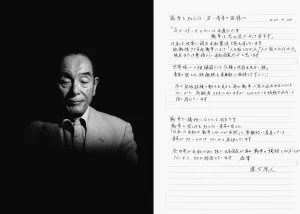
Michishita begins with these words “Dear young people who have never experienced war, ‘Wars begin covertly. If you sense it coming, it may be too late.’ Within the Japanese Constitution you will find Article 9, the international peace clause. For the past 72 years, we have not maimed or been maimed by a single human being in the context of war. We have flourished as a peaceful nation. Japan is the only nation that has experienced a nuclear attack. We must assert, with far more urgency, that nuclear weapons cannot coexist with mankind.
The current administration is slowly leading our nation to war, I’m afraid. At the ripe age of 78, I have taken it upon myself to speak out against nuclear proliferation. Now is not the time to stand idly by. Average citizens are the primary victims of war, always. Dear young people who have never experienced the horrors of war – I fear that some of you may be taking this hard-earned peace for granted. I pray for world peace. Furthermore, I pray that not a single Japanese citizen falls victim to the clutches of war, ever again. I pray, with all of my heart.”
Testimony proper
“Don’t go to school today,” my mother said. ‘Why?’ my sister asked. ‘Just don’t.’ Air raid alarms went off regularly back then. On August 9, however, there were no air raid alarms. It was an unusually quiet summer morning, with clear blue skies as far as the eye can see. It was on this peculiar day that my mother insisted that my older sister skip school. She said she had a ‘bad feeling.’ This had never happened before.
My sister begrudgingly stayed home, while my mother and I, aged 6, went grocery shopping. Every- one was out on their verandas, enjoying the absence of piercing warning signals. Suddenly, an old man yelled ‘Plane!’ Everyone scurried into their homemade bomb shelters. My mother and I escaped into a nearby shop. As the ground began to rumble, she quickly tore off the tatami flooring, tucked me under it and hovered over me on all fours.”
Michishita’s mother was intuitively/perfectly right, when she prevented her daughter from going to study on that day. Michishita said “Everything turned white. We were too stunned to move, for about 10 minutes. When we finally crawled out from under the tatami mat, there was glass everywhere, and tiny bits of dust and debris floating in the air. The once clear blue sky had turned into an inky shade of purple and grey. We rushed home and found my sister – she was shell-shocked, but fine.
Later, we discovered that the bomb was dropped a few meters away from my sister’s school. Every person at her school died. My mother singlehandedly saved both me and my sister that day.”