By Jean Baptiste Ndabananiye.
Various people including those connected with agriculture vehemently oppose people who disdain the sector, proving that it forms the backbone for the life of everyone and economy of every country; which represents their basis to instead affirm that this sector deserves to be heeded the most. Some personalities contend that public education on the incomparable importance of this field is more necessary now than ever.Different personalities on different continents across the globe and organizations also tout the sector of farming. Two of them, Portia Phohlo and William Ruto being Kenya’s president, declare that agriculture is the only potential sphere which will produce future billionaires and that it should not be overlooked.
Meanwhile, a Rwandan professional and successful farmer Potien Niyonambaza says “In Rwanda, while counting people who hold jobs, they [citizens/people in general, not the government]say that those who are remaining [don’t occupy any formal positions] are farmers while they are roamers, thieves and so on. I wish a law, to be voted, which recognizes farmer as a professional person like others so that the law will contribute for all people to know that those who don’t occupy jobs are just classified as unemployed people.” Did you know that “Of the 3.83 billion people reliant on agrifood systems for their livelihoods, 2.36 billion live in Asia and 940 million in Africa,” according to an 03/04/2023 Food and Agriculture Organization article?
This article focuses on these major segments:
- Portia Phohlo’s statement and observation on agriculture
- How Phohlo’s statement is felt in Rwanda
- Agriculture trivializing expressions to be eradicated
- Case of a person who has openly disdained Potien Niyonambaza
- Niyonambaza now extremely proud of farming
- President Ruto and some other prominent personalities on agriculture
- Agriculture situation in the developing, emerging and developed worlds
Farming forms the foundation of life of all human beings. It’s true: no farming, no life. Moreover, most of industry-processed products emanate from agriculture.
Crop Care is a Kenyan organization that manufactures small to midsize agricultural sprayers and specialty vegetable equipment designed to assist in good crop yield and quality of life. It also produces content on the protection and management of crops to improve agricultural productivity and sustainability.
To prove unmatched agriculture importance, Crop Care is founded on the world population which this sector feeds. “The United Nations predicts the population will increase to 10.4 billion by 2100. Because the population is steadily growing, so is the demand for food, which is why agricultural education is vital. Through agricultural education, generations can have a thorough knowledge of where their food comes from, and more people may be inclined to become employed in agriculture to help meet the needs of a growing population.”
The world Bank states “Healthy, sustainable and inclusive food systems are critical to achieve the world’s development goals [Sustainable Development Goals]. Agricultural development is one of the most powerful tools to end extreme poverty, boost shared prosperity, and feed a projected 10 billion people by 2050. Growth in the agriculture sector is two to four times more effective in raising incomes among the poorest compared to other sectors.”
Portia Phohlo’s statement and observation on agriculture

Portia Phohlo worked as a researcher within the organization, Trace and Save, working in South Africa on agriculture. She now serves as a consultant. She is skilled in Sustainable Agriculture, Natural Resource Management, Agronomy, Pasture and Soil management, and Soil Sampling. She holds a Bachelor of Science in Agriculture where she’s majored in crop and soil science at the University of Fort Hare. She has additionally obtained her honors and master’s degree in soil science at the University of the Free State. This strong consulting professional is now studying at Stellenbosch University, for a Doctor of Philosophy – Ph.D. focused in Soil Science and Agronomy. She is enthralled by soil health and soil microbiology and believes that applying soil health principles will heal degraded soils.
She underlines the point that farming constitutes the foundation of all. She praises agriculture without any reservations. “I felt I needed to highlight the importance of our farmers, especially in terms of the positive role agriculture plays in our country’s GDP. There is no time like the present when it comes to educating the public about agriculture and the role it plays in our lives. It cannot be overstated how crucial it is for more people to understand agriculture and not be influenced by common misconceptions, for example, that cows cause global warming. On the contrary, cows might actually be the solution to global warming and that cows can be carbon neutral.”
“There is no doubt in my mind that the public needs to become more knowledgeable about agriculture, as well as more aware of just how much it impacts all our lives. Considering this, I have decided to discuss these 3 important reasons why we should be thankful to our farmers.”
The important reasons, according to her, are that farmers produce (1) food which nourishes humans, (2) resources for most things that humans employ, and (3) maintain the health of soil. Phohlo clarifies it in these words. “Farmers Feed Us. I thought I should start off with the most obvious one. Without farmers, we would have no reason to go to the supermarket where we have access to a variety of foodstuff to choose from. We would have no food to feed our families. At all scales, starting from a smallholder to a commercial farmer, farmers play a significant role in feeding the world.
Farmers provide raw materials for most products we use in our daily lives. The finished goods from the furniture, paper, pharmaceutical, textile, energy, health and beauty sectors all depend on agricultural raw materials. The list of industries dependent on farming is much longer than this. These were just from the top of my head. Imagine what would happen to these industries if the farming sector collapsed. Farmers need not only to be thanked for the food they produce but also for the clothes we wear, and the furniture we use daily. Paper money is produced from cotton pulp which is grown on farms. Human society is completely reliant on agricultural produce.”
Affirming that farmers create food from farming, she adds that sustainable farmers conduct the responsible use of “our planet’s natural resources and utilize both ancient and very advanced technologies to achieve this. Sustainable farmers also invest in building healthy soil to grow healthy, nutritious food. They make sure that they do not mine the soil of its minerals, returning what is necessary to keep the soil in balance. Farmers are caretakers of the soil.”
Phohlo further says that today people no longer comprehend the unquestionable importance of the farming sector. She thus suggests that the present time forms the most convenient time at which the entire humanity should apprehend, care about and support this field which represents the foundation of life. She exhorts all people to support local farmers. “We are indirectly participating in exploiting our farmers whenever we choose to buy food produced in other countries rather than locally produced food or products. We are also participating in wasting the local food.”
“We are encouraging imports of foreign foods into the country resulting in the wastage of locally produced food. When we don’t buy locally produced food, we are also taking away farmer’s incomes which they would use to pay their employees, their farm debt and in maintaining their farm. Considering the earlier mentioned industries that depend on the farming sector, you can start connecting the dots of which other sectors could get affected by the domino effect of a farm closing down.”
Different individuals and institutions defend Pholo’s suggestion of public education on agriculture, to comprehend its crucial importance. But, Life In Humanity will thoroughly explore this suggestion in another article.
How Phohlo’s statement is felt in Rwanda
Phohlo’s statement is echoed by Potien Niyonambaza is a professional farmer dwelling in Minazi Sector in Gakenke District in Rwanda’s North. He also maintains that he has noticed that it is upon the farming sphere that all other things rest, but that it also represents an extremely disdained sector. Though it is Niyonambaza that we only feature in this article, he is not the only person who harbors this complaint, Life In Humanity will illustrate it in a separate article.

Nevertheless, he affirms that people generally scorn this area just because they don’t fathom it. His affirmation corroborates Phohlo’s observation that people don’t generally understand this field of agriculture.
Niyonambaza says “As soon as I undertook this farming career, one of my friends with whom I studied asked me ‘My brother, what are you currently doing?’ And I think his then job was paying him around 40, 000 Rwandan francs [RWF (nearly $40 then)] per month, while I had started reaching the average of 200, 000RWF [around $200 that time] a month with my farming business. In a quiet voice, I answered him ‘I’m cultivating’ and I then felt he was very saddened by hearing that his friend is farming and said ‘Have you attempted other endeavors and definitively failed?
In sectors’ offices there are cleaner jobs and there is a sector here in Kigali City which carries this job vacancy, and I can direct you to the sector so that you may apply for it.’ I said ‘How much can they remunerate me?’ He replied ‘There is a colleague of ours who has obtained the job and he has told me that he is well paid, as he gets the salary of 30 000RWF [around $30]. ” Sectors constitute the 2nd lowest official administrative entity in Rwanda from a cell which is the 1st lowest one.
He further says that this interaction between him and his acquaintance really offended him to the extent that he felt that action is needed to transform the mindset of people toward agriculture. “I then thought of that person’s opinion about me and said ‘If people think of us like this, it prevails the highest delusion. Even saying that you are a farmer impacts upon you negatively in marriage, and this challenge has happened to me.
While I was going to get wedded, my family-in-law asked my wife ‘What does your betrothed do?” When she answered he’s a farmer, they didn’t digest it, though they didn’t openly express it but it was conspicuous that they doubted whether I could even obtain food for their daughter. But we were eventually married at the end of 2014, since she doesn’t scorn the profession; she has studied accounting in secondary education but I and she are engaging in farming. ”

Niyonambaza discloses this information which he should otherwise keep confidential, for a reason that he explains in these words “I say so, just to emphasize upon the scorn toward agriculture whereby you are regarded as a person doing nothing at all. When you say that you are a farmer, it is possible for even a cleaner to come between you and your betrothed partner; then, replacing you, this being due to the mere fact that you are a farmer and that he’s a worker getting a monthly salary.
As I come back to this point, let anyone who will hear about it comprehend that my only intention is just for people to comprehend that a farmer is a person who can be important for themselves and others and even help the country in its advancement.”
Agriculture trivializing expressions to be eradicated
There are words branded as those which are designed to devalue the field of agriculture. Such terms said to underestimate this sphere extremely shock Niyonambaza. “ Let those terms trivializing and devaluing farmers be abolished. In fact, there are people who call themselves farmers while it’s wrong, so that I have determined to fight for it to be eliminated.
“You see that my employees are sweating and cultivating in the field. When you liken me to a person who never takes a hoe and goes to cultivate because you have lacked a category in which you categorize them, this is an issue I wish our nation’s leaders-as far-seeing people- to examine.”
Niyonambaza mentions some of terms which he maintains that they trivialize farmers and their field of agriculture. “You will hear people say that a person cultivating is burying their legs. They will say that a person who has experienced bankruptcy has returned to the hoe; something extremely heavy that I intensely loathe, a person gets insolvent and you say they are returning to the hoe. What do you then mean? This expression trivializes the sector and those engaged in it.”
Returning to the hoe has been literally translated, its Kinyarwanda expression being “gusubira ku isuka”. In Rwanda when they spell this expression, they mean “become poverty-stricken.” For instance, if you were a successful trader but then encountered bankruptcy, they normally say that you have returned to the hoe. In other words, you have returned to cultivate. Cultivation is then associated with indigence.
Case of a person who has openly disdained Niyonambaza
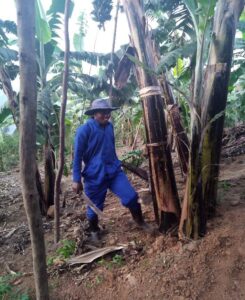
Niyonambaza further points out that farmers are generally regarded as uncivilized people. He adds that there is a certain official who visited him on his farm and that his driver scorned him, just for seeing him very dirty because of cleaning his pigs’ sheds. “Though you see that I have been removing livestock manure from the sheds, you notice that if I change the clothes and wear clean ones, people can’t differentiate me from those working in offices.”
“There is a driver who disdained me in the past while he was driving a boss from the NAEB who was coming to see me. They arrived while I’d just taken manure from the livestock’s houses; in fact I like it because I am even proud of it, though I have an employee in charge of it, but he removes manure from one shed while I am doing the same in another one. Really, it can be difficult to do something you don’t love. Even those employees who are cultivating, when I reach them, I also assist them, in brief I immediately help my staff in whatever they are performing. In this context, those people parked a RAV 4 vehicle there at the gate of my farm where I also park my motorcycle.
When I saw them, I joined them while the boss- who knew me especially since as person working in the NAEB comprehends the value of farmers- was busy on a telephone on another side. He even helped me so much, I regularly updated him on achievements and he advised me on how to move on. Then, I immediately materialized on the side where the driver was sitting, and as a person eager to talk to the guests, I was going to greet him since though my clothes [overalls] were dirty, my hands were clean since I’d just washed them. But he prohibited me to approach the vehicle. He even talked to me negatively, telling me ‘Do not approach the vehicle lest you mark it, washing a vehicle is expensive. In fact, he spoke to me, boastingly and smugly but he didn’t know it’s me the farm owner.”
NAEB standsfor the National Agricultural Export Development Board, a government agency responsible for promoting and developing agricultural exports.
Niyonambaza highlights that as soon as the driver’s boss finished the call, the boss rushed to request him to greet him, hugging him. “The boss who needed information from me asked me ‘Why aren’t you coming to hug me?’, because seen the driver, I kept distance a bit from them. So, he went out of the vehicle and hugged me, without considering the dirtiness of my clothes.”
Niyonambaza points out that he was astonished at this NAEB official’s behavior. He explains that he was dumbfounded by the fact he embraced him, without fearing the dirtiness that his overalls bore. “Afterwards, I asked him ‘Why do you hug me tightly while your driver has told me to remain away from the vehicle?’ But, he’d followed the entire interaction between me and the driver though he was on the call. He suddenly fulminated against him so that he even adopted a decision to have him fired, but I intervened to request him to forgive him.
He was so sad that he took the driver out of the vehicle and told him ‘Come and observe and tell me whether we pay the same amount of cash as that he earns from his business. We are coming for him to furnish us with information and we join him at work on his farm, do you think he could have gone home to don a business suit while he’s working?’ He finally pardoned him, but it was extremely tough for me to convince him since he was so shocked that he felt that the only way which could show me that he didn’t support him at all was to suggest that he be dismissed.”
Niyonambaza now extremely proud of farming
In the meanwhile, Niyonambaza underlines that he currently stands proud of farming but that it has required him enormous energy to feel proud of it. He explains that the very beginning of his farming business, he was ashamed to publicly say that he is a farmer. But he contends that this has changed and that he now speaks about it very proudly. “Except that it is now I’m daring to proudly say that I’m a farmer, in the past when they asked me what I do, I used to hide it since I knew they would immediately mark my position with a red line meaning I have no job.
Except that the Government is performing efforts to improve service delivery, but there are services which you approach, so that when you tell them that you are a farmer, they reduce the respect they owe you. There is a meeting to which I was invited by a certain bank and I saw that those who had also been invited wrote on the attendance form that they were managers or directors. I then felt so disgraced that, as soon as I left the meeting, I created Multi-Supply Company Ltd which is connected with my farming agriculture. I have since then become Managing Director of the company, because even if it were a phantom company, such a title would startle people. But now I am working to instead ensure that I am known as a professional farmer rather than the Managing Director of the company.”
According to Niyonambaza, the non-comprehension of this sector constitutes an issue which causes banks to refuse to provide loans for this sector and the Government ought to reverse the situation. “If the banks don’t trust the farming sector, let the Government trust it since all developed countries owe the development to their developed farming because all commodities produced in factories come from agriculture.
If you want to raise strong industries, you have to first advance farming. Almost all things, 99%, which are used including clothes and even that notebook in which you’re writing emanate from farming. Farming represents the start and primary industry on which all others rest, that’s why I suggest that the Government treat it with special consideration.”
To know, what the Government and Rwanda’s farmers organization- Imbaraga Farmers Organization say about Niyonamba’s suggestions and other relevant questions, Life In Humanity will approach them soon.
Ruto and some other prominent personalities on agriculture
In the 13th Africa Food Systems Summit in Tanzania on September 7, 2023 President Ruto said future wealth lies in farming. He told Tanzanians that the secret of becoming a billionaire is concealed in farming.
He benefitted from this occasion, to encourage Tanzanian people to engage in farming, if they desired to become billionaires in the future. He declared that he based his encouragement on the African Development Bank’s research. He specified that this bank had conducted research and inferred that future billionaires would invest in agriculture, not in other sectors. He thus underscored that he spoke to the Tanzanians from a point of experience, and having accumulated his vast wealth through farming.
“According to African Development Bank, future billionaires will not be people in Google and other spaces. If you want to be a rich man in the future, you have to begin to go to the right corner and start being a farmer and am telling you this from experience because I am one of them. Plan yourselves around that area of agriculture because that is where the next set of billionaires will come from,” stated Ruto while also recognizing that Africa carries the greatest potential in the agricultural space, and highlighting people should exploit it.
Late Thomas Jefferson and George Washington are both among the Founding Fathers of the United States of America. The Founding Fathers are the 7 men who created the US government and forged it as new nation.
Actually, there are numerous others who have contributed immensely to the founding of the United States. Yet, these seven are regarded by most people as the Founding Fathers. They all accomplished key roles in gaining American independence from Great Britain and in the creation of the government of the United States of America.
These founding fathers have bequeathed the world with an unmatched legacy in world history. These wise and learned men also commended the sphere of agriculture, so that they articulated quotes which have become very popular. “Agriculture is our wisest pursuit, because it will in the end contribute most to real wealth, good morals, and happiness” once declared Thomas Jefferson, the 3rd US President from 1801 to 1809. George Washington, the 1st US President from 1789 to 1797 stated “Agriculture is the most healthful, most useful and most noble employment of man.”
Agriculture situation in the developing, emerging and developed worlds
Niche Agriculture Limited, an agriculture and organic farming company based in New Delhi, India lists top 9 agricultural countries of the world. The countries include China, the United States of America [USA], Brazil, India, Russia, France, Japan, Germany, and Turkey.
Most of these countries are superpowers, major powers and regional powers that possess great influences in the world. USA and China are classified as superpowers, owing to their capabilities of global dominance politically, economically and militarily. Russia, India, France, Japan and Germany are considered a major powers and influential in global geopolitics but not superpowers on the same scale as the USA or China. Brazil is regarded as a giant or regional power, with significant influence in Latin America but not a global superpower.
Agriculture has played an incomparable role in the development of all the 9 most powerful nations in agriculture. Niche Agriculture Limited reports “In recent decades, China’s agriculture sector has undergone significant modernization and transformation, thanks to government policies aimed at increasing productivity, improving infrastructure, and expanding market access. This has led to substantial increases in agricultural output, particularly in grains, vegetables, and fruits. China is the world’s largest producer of many agricultural products, including rice, wheat, corn, potatoes, soybeans, cotton, and tobacco. Livestock production is also a significant component of China’s agricultural sector, with large numbers of pigs, chickens, and ducks raised for meat and eggs.”
“Agriculture has played a vital role in the United States economy and culture since its inception. The United States is one of the world’s largest producers and exporters of agricultural products, and the industry employs millions of people across the country. Modern technology and farming practices have transformed agriculture in the United States, with farmers using advanced machinery and techniques to increase yields and efficiency. The U.S. government plays a significant role in supporting the agriculture sector, providing funding for research, development, and infrastructure, as well as implementing policies and programs to help farmers manage risk and stay competitive in the global market.”
China, India, Turkey, and Brazil are considered emerging countries rather than developed countries while the USA, France, Germany, Japan, and Russia are categorized as developed nations.
The fact that agriculture has accomplished a critical role in the development of the developed and emerging countries suggests that this field of agriculture is highly respected there. This is even substantiated by interventions performed by those countries’ governments, to revolutionize and modernize this sector, as indicated in the above quotes.
Life In Humanity has not found a credible source contending or suspecting that agriculture doesn’t constitute a respected field in developing nations. But this platform suspects that this field is not as highly valued in the developing world as it is in the developed one.
Nevertheless, Niche Agriculture Limited points out “In developing countries, agriculture is the primary source of employment, income, and food.”
Thank you for your sharing. I am worried that I lack creative ideas. It is your article that makes me full of hope. Thank you. But, I have a question, can you help me?
Thanks for sharing. I read many of your blog posts, cool, your blog is very good.
Your article helped me a lot, is there any more related content? Thanks!
Thank you for your sharing. I am worried that I lack creative ideas. It is your article that makes me full of hope. Thank you. But, I have a question, can you help me?
Thanks for sharing. I read many of your blog posts, cool, your blog is very good.
Your point of view caught my eye and was very interesting. Thanks. I have a question for you.
I don’t think the title of your article matches the content lol. Just kidding, mainly because I had some doubts after reading the article. https://accounts.binance.com/ro/register?ref=V3MG69RO
I don’t think the title of your article matches the content lol. Just kidding, mainly because I had some doubts after reading the article.
Thank you for your sharing. I am worried that I lack creative ideas. It is your article that makes me full of hope. Thank you. But, I have a question, can you help me?
I don’t think the title of your article matches the content lol. Just kidding, mainly because I had some doubts after reading the article.
Thank you for your sharing. I am worried that I lack creative ideas. It is your article that makes me full of hope. Thank you. But, I have a question, can you help me?
You’re very welcome, and thank you so much for your kind words. We’re really glad our article could inspire you.
Your article helped me a lot, is there any more related content? Thanks!
Thank you a lot for this inspirational feeback and the website contains more related content.
Your point of view caught my eye and was very interesting. Thanks. I have a question for you.
Thank you for your thoughtful comment—we’re really glad the perspective captured your interest. Please ask your question; we’ll be more than happy to reply and engage further!
Your point of view caught my eye and was very interesting. Thanks. I have a question for you.
We are delighted that you have found the article very interested and we are also delightet to respond to your question, if you raise it.
I don’t think the title of your article matches the content lol. Just kidding, mainly because I had some doubts after reading the article.
We are happy with your engagement with the article, and while are committed to clarifying any doubts faced, though you jokingly express it, we would like you to enlighten us on where you have experienced the doubts.
Thanks for sharing. I read many of your blog posts, cool, your blog is very good. https://www.binance.com/de-CH/register?ref=UM6SMJM3
Thank you so much indeed.
Thanks for sharing. I read many of your blog posts, cool, your blog is very good. Lumikha ng Personal na Account
Thank you very much indeed.
I don’t think the title of your article matches the content lol. Just kidding, mainly because I had some doubts after reading the article.
Hahah! We have noted your joke and comment so that we are more than prepared to address your doubts, if you raise them.
Thanks for sharing. I read many of your blog posts, cool, your blog is very good.
Thank you very much indeed. We are delighted with this very good comment.
Your article helped me a lot, is there any more related content? Thanks!
We are actually galvanized by your feedback. Yes, there is more related content.
Can you be more specific about the content of your article? After reading it, I still have some doubts. Hope you can help me. https://accounts.binance.info/en-IN/register?ref=UM6SMJM3
Please, elucidate the doubts; we will address them. Meanwhile, thank you for taking the time to read the article.
Thanks for sharing. I read many of your blog posts, cool, your blog is very good.
Thank you immensely for these kind and inspiring words.
Your article helped me a lot, is there any more related content? Thanks! https://www.binance.com/ES_la/register?ref=VDVEQ78S
Yes, there is more related content. To be honest, we are galvanized by your feedback.
Can you be more specific about the content of your article? After reading it, I still have some doubts. Hope you can help me. https://accounts.binance.com/da-DK/register?ref=V3MG69RO
We really attach great importance to such feedback, especially when we are enlightened on areas which raise issues. So, we implore you to clarify the doubts.
Can you be more specific about the content of your article? After reading it, I still have some doubts. Hope you can help me. https://accounts.binance.com/register-person?ref=IHJUI7TF
We thank you for engaging with the content and would be more grateful if we elucidated your doubts for us to be able to work on them.
I don’t think the title of your article matches the content lol. Just kidding, mainly because I had some doubts after reading the article.
Thank you for the engagement and we are eager to get your clarifications on the doubts so we can address them.
Your article helped me a lot, is there any more related content? Thanks!
Thank you very much indeed. Yes, the website contains more related content.
Your article helped me a lot, is there any more related content? Thanks! https://accounts.binance.com/uk-UA/register-person?ref=XZNNWTW7
Thank you so much for the feedback. Yes, there is more related content.
I don’t think the title of your article matches the content lol. Just kidding, mainly because I had some doubts after reading the article. https://www.binance.bh/register?ref=JW3W4Y3A
Please, shed light on the doubts so we can try to assuage them.
Your article helped me a lot, is there any more related content? Thanks!
Yes, there is. Happy to learn that it helped you.
I don’t think the title of your article matches the content lol. Just kidding, mainly because I had some doubts after reading the article.
Please, share your question with us so that we may work on it.
I don’t think the title of your article matches the content lol. Just kidding, mainly because I had some doubts after reading the article. https://accounts.binance.bh/ES_la/register-person?ref=VDVEQ78S
Please, elucidate your doubts to us.