By Jean Baptiste Ndabananiye.
Heatwaves are getting more severe and prolonged. Heatwaves and other various disasters like wildfires rage in different parts of the planet. The most recent cases of the crisis involve extreme heatwaves in Iran and ravaging wildfires in the United States of America. The boiling heat has recently forced shops and public institutions in Iran to shut, temperatures reaching 45C in various parts of the country and more than 220 people seeking treatment for heatstroke. Wildfires in various countries including the United States of America and Canada have threatened millions of people.
Amidst these calamities, a debate brews: is this the price of human progress, or we are witnessing nature’s natural fury? This article delves into the heart of this crisis, exploring the science, and the stark realities of a world on fire.
Baking heatwaves
Because of exceptionally hot weather in Tehran, people were recommended to shelter indoors and stay cool on 27 Jul 2024. Weather reports stated that temperatures ranged from 37C (98.6F) to 42C (107F) in the capital, Tehran. Sadegh Ziaian, an official within the National Meteorological Organization, said that temperatures exceeded 45C (113F) in 10 out of 31 Iranian provinces on Saturday. The highest temperature of 49.7C (121F) was recorded in Delgan, the south-eastern city in Sistan and Balochistan province, which neighbors Pakistan and Afghanistan.
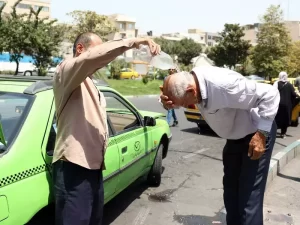
The heatwave in Iran forced authorities to cut operating hours in various facilities on Saturday, 27 July 2024, and oblige all government and commercial institutions to close on Sunday. Banks, offices and public institutions across the country closed on Sunday to protect people’s health from the burning heat and conserve energy. The government only let emergency services and medical agencies work. Authorities said that electricity consumption reached record levels of 78,106MW on 23 July 2024 as people tried to stay cool. Nournews, closely linked to Iran’s Supreme National Security Council, reported on 24 July 2024 that temperatures in Iran are rising at twice the pace of global temperatures. This platform specifies that Iran has become 2C warmer over the past 50 years, compared with 1C worldwide.
“2C warmer” refers to an increase in the Earth’s average global temperature by 2 degrees Celsius above pre-industrial levels. This concept is critical in the context of climate change and global warming discussions.
A CBC News article points out “A large majority of environmental scientists warn that if global temperatures rise by more than 2 C above pre-industrial levels, the consequences will be severe and, in some cases, irreversible.
How will the rising global temperature affect North America? Expect more floods, heat waves and wildfires. What will a 4C increase mean for Africa? Crops will fail, water resources will be depleted and diseases are likely to become widespread. These are among the severe consequences we face if the world continues to warm, according to the IPCC. The UN body notes, however, that we can take measures, in a process known as adaptation, starting now.” IPCC, Intergovernmental Panel on Climate Change, is an international body established to assess science pertaining to climate change.
Meanwhile, a 2014 IPCC report compiled by hundreds of scientists around the globe cautioned “Each of the last three decades has been successively warmer at the Earth’s surface than any preceding decade since 1850.”
Back to Iran, A similar incident occurred there last year. Le Monde in its 3 August 2023 story reported “The government [of Iran] decreed the country’s first-ever near-total shutdown due to unprecedented heat.The government decreed the closure of banks, schools and public offices, while temperatures topped 50°C in the south of the country [for two days].
In many regions, temperatures have reached unprecedented highs since the beginning of July, particularly in the south of the country, where they have exceeded 50°C.”
CNBC in its 2 August 2023 article, citing the United Nations’ Secretary-General António Guterres, reported “The two-day shutdown [in Iran] comes at a time of extreme heat across the globe, with July poised to be the hottest month in history.”
Last year, commenting on new data released from the European Union and the World Meteorological Organization, Guterres, declared “The era of global warming has ended; the era of global boiling has arrived. For vast parts of North America, Asia, Africa and Europe, it is a cruel summer. For the entire planet, it is a disaster.
For scientists, it is unequivocal — humans are to blame. All this is entirely consistent with predictions and repeated warnings. The only surprise is the speed of the change. Climate change is here. It is terrifying, and it is just the beginning. The evidence is everywhere: humanity has unleashed destruction. This must not inspire despair, but action.”
Guterres stated that it is still feasible to confine global warming to 1.5° Celsius above preindustrial levels, yet with “only with dramatic, immediate climate action.” He said “We have seen some progress: a robust rollout of renewables, some positive steps from sectors such as shipping. But none of this is going far enough or fast enough.”
Underscoring that greenhouse gas emissions need to be globally and quickly decreased, he said “Fossil fuel companies must chart their move towards clean energy, with detailed transition plans across the entire value chain: no more greenwashing. No more deception.”
“Extreme weather is becoming the new normal. All countries must respond and protect their people from the searing heat, fatal floods, storms, drought and raging fires that result.”
Greenwashing signifies the practice of companies, organizations, or governments deceiving consumers or the public about the environmental benefits or sustainability of their products, services, or practices. It encompasses communicating false, misleading, or exaggerated claims about environmental initiatives to present an environmentally responsible image, often without meaningful or genuine efforts to improve environmental performance.
Wildfires
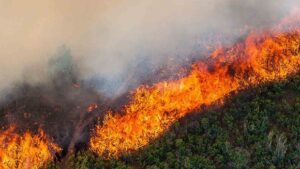
The National Interagency Fire Center, NIFC, constitutes a pivotal institution across the United States of America in terms of wildfire management and emergency response infrastructure. This multi-agency coordination center supporting wildland firefighting and other emergency response activities reported that from the morning of 28 July 2024, 103 large active wildfires were being battled nationwide. It added that these fires had scorched 2,011,853 acres. “Fire managers are using full suppression strategies on 96 of these wildfires”.
According to NIFC, 26,478 wildland firefighters and support personnel were assigned to wildfires nationwide, besides 30 complex and 6 Type 1 incident management teams, 590 crews, 1,567 engines, numerous aviation resources, and four Modular Airborne Fire Fighting Systems.
Yahoo’s 29 July 2024 story reads “Some [of these wildfires in the U.S] were sparked by the weather, with climate change increasing the frequency of lightning strikes as the western U.S endures blistering heat and bone-dry conditions.”
Can the weather spark wildfires, if so, how?
To respond to this question, Life In Humanity is first going to briefly explain the terms “fire weather.” This concept refers to specific weather conditions conducive to the ignition, spread, and intensity of wildfires.
The National Oceanic and Atmospheric Administration [NOAA] of the U.S. Department of Commerce, in its 4 September 2018 “Ask the Scientist: how can the weather spark and spread fires?” article, answers the questions. This article features the fire weather forecaster, Nick Nauslar, of NOAA’s Storm Prediction Center. Nauslar started by defining fire weather in these words “Any sort of weather that ignites and/or helps spread fire. Stronger winds; low, relative humility; unstable atmospheric conditions; and thunderstorms all fall under the umbrella of fire weather.”
Answering how weather starts wildfires and helps to spread them, he clarified “Lightning striking a tree and igniting it is the most common weather cause for wildfires. Strong winds can also cause power lines to spark, which can ignite wildfires if there is dry brush and grass nearby.
Fires spread in hot, dry, and windy conditions. Warmer temperatures and lower relative humidity make the fuels more receptive to ignition. Stronger winds supply oxygen to fire, preheating the fuels in the path of the fire, and transport embers ahead of the flaming front. When hot, dry, and windy conditions occur simultaneously, wildfires can spread quickly.” Lightning constitutes a natural electrical discharge occurring during thunderstorms, characterized by a sudden, intense flash of light and the associated sound of thunder.
“Climate change causes heatwaves and wildfires”
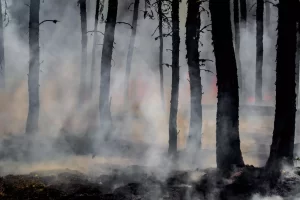
Royal Society figures among prestigious scientific institution and is based in the United Kingdom, dedicated to promoting scientific excellence and advancing knowledge across various fields of science and technology. This organization states that a warming climate possesses the capacity to contribute to the intensity of heatwaves. It additionally says that climate warming also increases evaporation on land, which bears the ability to worsen drought and create conditions more prone to wildfire and a longer wildfire season.
The Center for Climate and Energy Solutions is a non-profit organization based in the United States, focusing on addressing climate change and advancing clean energy solutions. It says “Climate change has been a key factor in increasing the risk and extent of wildfires in the Western United States. Wildfire risk depends on a number of factors, including temperature, soil moisture, and the presence of trees, shrubs, and other potential fuel.
All these factors have strong direct or indirect ties to climate variability and climate change. Climate change enhances the drying of organic matter in forests (the material that burns and spreads wildfire), and has doubled the number of large fires between 1984 and 2015 in the western United States.”
This organization further states that research shows that changes in climate generate warmer and drier conditions, and that increased drought and a longer fire season are boosting these increases in wildfire risk.
A 17 June 2024 BBC article says that in April 2024, temperatures in Mali hit 48.5C during an extreme heatwave across the Sahel region of Africa. “This level of heat would not have been possible without human-caused climate change,” the WWA noticed, and “will become more common as the world continues to warm”, according to BBC.
The WWA added “In the UK, temperatures topped 40C for the first time on record in July 2022, causing extensive disruption. This would have been extremely unlikely without climate change.” WWA stands for the World Weather Attribution, an initiative that concentrates on understanding and attributing the influence of climate change on specific extreme weather events. It is designed to determine how much climate change has contributed to the intensity, frequency, or occurrence of extreme weather phenomena.
Divergence on the point that the global climate crisis is human-prompted
Rick Perry and Senator Al Franken
Rick Perry served as the Energy Secretary under former President Donald Trump’s Administration. According to Vox’ 23 June 2017 article, Perry received questions from senators in the the Energy and Natural Resources Committee. It was in the framework of discussion on the Department of Energy’s budget request.
Perry had recently said on CNN that carbon dioxide does not form the primary driver of climate change, “contradicting the very robust scientific evidence that it is”.
He reasserted to the Senate Appropriations Committee his belief that man-created global warming “is not settled science.”
Former Senator Al Franken then seized an opportunity to challenge Perry. He told Perry that Dr. Richard Muller, of the Berkeley Earth surface temperature project, had declared “Last year [2012], following an intensive research effort involving a dozen scientists, I [Muller] concluded that global warming was real and that the prior estimates of the rate of warming were correct, and I’m now going to step further: humans are entirely the cause.”
Franken nevertheless forgot the crucial word “almost” while referencing Dr. Muller. Muller’s actual words which he wrote in 2012 were “Humans are almost entirely the cause.” Muller specified that his team did conclude that humans’ carbon emissions had caused “90 percent” of global warming since the Industrial Revolution.
In response to what the former senator had just declared, Perry said “100 percent? Every bit of that global warming? I don’t buy it. To stand up and say that 100 percent of global warming is because of human activity, I think on its face, is just indefensible.” Vox said “Perry suggested multiple times this week that climate change is naturally occurring.”
While Perry said that climate change is happening naturally, the 17 June 2024 BBC article also states that fires happen naturally in numerous parts of the world, but that the climate change bears its role in it. “It’s difficult to know if climate change has caused or worsened a specific wildfire because other factors are also relevant, such as changing land use.” “But climate change is making the weather conditions needed for wildfires to spread more likely,” the IPCC says, according to the article.
Opposing views by some scientists and the public in general
According to Ballotpedia, opposing views of climate change theory include scientific challenges to the theory that human activity is responsible for changes in the climate. “Scientists and the members of the general public who are skeptical about the theory of human-caused climate change have varied viewpoints along a spectrum.
Some reject the idea that human-caused climate change exists; others have argued that human-made climate change is occurring but that the extent to which climate is changing and the precise impact of human activity is uncertain. Another group has argued that policies aimed at addressing human-caused climate change are misguided or counter-productive.”
This website further says that some scientific critics of the theory of human-made global warming have argued that observed world temperature data differs from the accelerating warming projected by climate models. They notably point fingers at models used by the IPCC in the United States.
These scientists have argued that the theory of human-caused climate change involves scientific uncertainties about the nature of global warming and its causes. These scientists like Judith Curry, former professor of earth and atmospheric science at the Georgia Institute of Technology, have argued that observed climate data does not indicate accelerating temperatures or an increased frequency of extreme weather.
Other scientists have said that observed global temperatures have risen less than what has been predicted by the climate models. According to Ballotpedia, these scientists have argued that observed world temperatures show that warming has abated. “Former NASA scientists John Christy and Roy Spencer argued that observed temperature data sets, such as data sets collected by NASA and the National Oceanic Atmospheric Administration, show less warming than climate models that have projected a larger increase in global average temperature.
These scientists have argued that the climate models projecting global temperatures from 1980 and 2015 showed more warming than observed temperatures measured by satellites and weather balloons during the same period.”
According to these scientists, the difference between model projects and observed temperature data indicates that models have presented an imprecise representation of temperature changes and global climate.
Pew Research Center [PRC], said to be a nonpartisan, is a nonprofit organization conducting public opinion polling, demographic research, content analysis, and other data-driven social science research. Its aim is to supply information on social issues, public opinion, and demographic trends shaping the United States and the world.
PRC held in-depth interviews with 32 U.S. adults who do not view urgency on climate change, including some who do not believe there exists evidence that the Earth is warming. The report of this center appeared on 9 August 2023. PRC states “The interviews revealed that language describing climate change as a crisis and an urgent threat was met with suspicion by many participants. The disconnect between crisis rhetoric and the participants’ own beliefs and experiences drove doubt about the motivations of the people making these claims, sowing suspicion and deeper mistrust.
Interviewees widely rejected the national news media as a credible source for climate information. They see these outlets as presenting information that suits their own agendas. Interviewees generally expressed greater openness toward hearing from scientists on climate change because of their subject matter expertise. Still, participants stressed the importance of hearing factual statements from scientists rather than beliefs that may be shaped by their own political leanings or their research funders.”
PRC says that its nationally representative surveys show that fewer than half of all Americans reject that humans are major contributors to climate change. These Americans contend that addressing this issue is not too important for the country. They include those who harbor the most skeptical views, saying that the Earth is not warming at all and that no action should be accomplished. “When it comes to policy action, 37% of Americans think addressing climate change should be a top priority for the president and Congress, and another 34% say it is an important but lower priority. By contrast, about three-in-ten say action on climate change is not too important (17%) or should not be done (11%).
Republicans are much less likely than Democrats to prioritize climate action, though individuals who are skeptical about addressing climate change are seen within both party coalitions and across demographic groups.”
PRC provides further details on the 32 interviews. In-depth interviews with adults, who see climate change as a lower priority and do not think the Earth is getting warmer primarily due to human activity, were conducted virtually in May 2023. These interviewees were across five geographic areas: the Midwest, Mountain West, South, Southwest and Coastal Florida. Participants were chosen, based on their views on climate change. The following are some of the interviewees’ quotes.
“I do believe [the climate] is changing, but I believe it is changing in a natural cycle that happens all the time. What I don’t believe is that humans are 100% responsible for climate change.” –Man, 50s, Mountain West.
“I think that [extreme weather events] are not happening more. I think people know about them more. We know about a tsunami that happened across the world, whereas 50 years ago we never even heard of it. It may seem like things are happening more and more, but I think that just that’s the cycle of life, the cycle of Earth. And if they are happening a little more, then that is just the cyclical part of what’s going on with the planet.” –Man, 50s, Coastal Florida.
About suspicion on climate change action urgency, a respondent said “People who are alarmist tend to want really drastic policies that seem to not make sense, so it kind of makes me disbelieve the other things they’re saying.” –Man, 20s, Midwest.
Another said: “From a personal standpoint, whether it’s the climate or anything else, when the statements are too large … like when the statements are, ‘The world is getting warmer and Earth is going to be ended in five years because we’re all terrible humans and we throw trash on the ground.’ Those things cause me to be, instead of causing me to be concerned, it causes me to be more skeptical about where the information is coming from and why it’s being presented in such a grandiose term, for lack of a better word.”–Woman, 30s, Midwest.
Some of the participants revealed that they don’t nourish full trust in scientists because of uncertainty about their financial motivations and personal biases. For example, Woman, 40s, Mountain West said “I think that scientists, if they worked hard for their degree, it’s good to listen to them. I do always wonder, with anybody – anybody – if they have an agenda. It’s looking into maybe where their education is, what groups or environmental groups are they a part of. What is their main focus? And then, is there an agenda behind what they’re saying?”
PRC highlights that a common view among all the interviewees was that changes in the Earth’s climate are emanating from natural patterns that the Earth has always experienced.
What next?
None of the above details excludes efforts to protect our planet. For example, a man, 50s, Coastal Florida, in PRC’s survey said “And it is so very important that we take care of our planet. Let’s not litter. Let’s have good clean water. Let’s not do anything that’s going to hurt our planet that we live in. And so that’s what I feel about everybody’s duty, to take care of – everybody takes care of their own little piece, and I think it’s going to be fine.”
Ballot Pedia says that some scientists have argued that if human-caused global warming is occurring, more cost-effective policies exist to address the potential consequences of warming, “rather than government regulations requiring reductions in carbon dioxide emissions.” “Freeman Dyson, a former professor of physics at the Institute for Advanced Study at Princeton University, has argued that while global warming may be caused by human activity, policies should focus on making renewable energy, which emits less carbon dioxide, more affordable.
Bjorn Lomborg, a visiting professor at Copenhagen Business School, has argued that policies such as the Clean Power Plan and the Paris Climate Agreement will do little to reduce global temperatures and that policies should focus on lowering the costs of renewable energy sources so more individuals and businesses choose them over coal, oil, and natural gas .”
Thank you for your sharing. I am worried that I lack creative ideas. It is your article that makes me full of hope. Thank you. But, I have a question, can you help me?
You can raise your question, so we can see wether we can help you. If it is a question that you don’t want to raise publicly, you can our email already communicated in this platform. We are excited to hear that our article fills you with hope; which is one of reasons for the existence of this platform.
Thank you for your sharing. I am worried that I lack creative ideas. It is your article that makes me full of hope. Thank you. But, I have a question, can you help me?
Thanks for sharing. I read many of your blog posts, cool, your blog is very good.
Your article helped me a lot, is there any more related content? Thanks!
Thank you for your sharing. I am worried that I lack creative ideas. It is your article that makes me full of hope. Thank you. But, I have a question, can you help me?
Thank you for your sharing. I am worried that I lack creative ideas. It is your article that makes me full of hope. Thank you. But, I have a question, can you help me?
I don’t think the title of your article matches the content lol. Just kidding, mainly because I had some doubts after reading the article.
Your article helped me a lot, is there any more related content? Thanks!
We’re so glad to hear it was helpful! Yes, we have more related content — feel free to check out our latest posts, and stay tuned for even more coming soon!
I don’t think the title of your article matches the content lol. Just kidding, mainly because I had some doubts after reading the article.
We notice your kidding, and we will be excited to receive your clarifications on the doubts.
Can you be more specific about the content of your article? After reading it, I still have some doubts. Hope you can help me.
Elucidate your doubts, so we can be able to address them. Thank you a lot for engaging with the piece.
Thank you for your sharing. I am worried that I lack creative ideas. It is your article that makes me full of hope. Thank you. But, I have a question, can you help me?
Thank you indeed for the feedback and we are committed to answering your question.
Thank you so much for your thoughtful feedback, and we are ready to respond to your question. Please, raise it.
Can you be more specific about the content of your article? After reading it, I still have some doubts. Hope you can help me.
Thanks for reading and for your comment! We completely understand—some parts of the article might have been a bit unclear. Could you let us know which sections or points have left you with doubts? We’d be happy to clarify or provide more details so it makes more sense. Your feedback also helps us render the article better for everyone.
Looking forward to your questions/doubts!
Can you be more specific about the content of your article? After reading it, I still have some doubts. Hope you can help me. https://www.binance.info/uk-UA/register?ref=XZNNWTW7
Thank you for your thoughtful feedback— we actually appreciate you allocating the time to read the article carefully. We understand that some points may need further clarification. Could you please tell us specific sections which have raised doubts for you? We would be pleased to expand on them and, if necessary, refine the article to make it clearer and more precise.
Your point of view caught my eye and was very interesting. Thanks. I have a question for you.
Thank you so much for your kind words—we really appreciate you taking the time to read and reflect on the piece. We’re glad that the perspective has caught your attention and prompted your interest. Please feel free to raise your question whenever you’re ready; we’ll be happy to respond as clearly as possible. Looking forward to hearing from you.
Your article helped me a lot, is there any more related content? Thanks!
Yes, the website features more related content. Thank you for your motivational feedback.
Thank you for your sharing. I am worried that I lack creative ideas. It is your article that makes me full of hope. Thank you. But, I have a question, can you help me?
We will be happy to receive your question and work on it. Thank you for the feedback.
Your article helped me a lot, is there any more related content? Thanks! https://accounts.binance.com/register/person?ref=IXBIAFVY
Very motivating words. Yes, there is more related content.
Thanks for sharing. I read many of your blog posts, cool, your blog is very good.
Delighted to hear that.
Thanks for sharing. I read many of your blog posts, cool, your blog is very good.
Excited indeed!
Can you be more specific about the content of your article? After reading it, I still have some doubts. Hope you can help me.
In fact, we are ready to help you as soon as we understand your doubts.
Your article helped me a lot, is there any more related content? Thanks!
Yes, the website features more related content. And we are delighted with your kind words.
Thanks for sharing. I read many of your blog posts, cool, your blog is very good.
Your words actually uplift us.