By Jean Baptiste Ndabananiye
Zachary Kibiri, a Kenyan farmer, has discovered a remarkable solution— hidden in nature’s design—against limited wind blowing which often hinders crop pollination and then causes yields to falter. Seeking to overcome low productivity inside his greenhouses, he introduced a beehive among his crops—an experiment that turned into a revelation. The results were astonishing: yields rose fourfold, and honey production doubled in half the usual time.
What began as a simple trial soon evolved into a model of climate-smart agriculture, showing how working with nature can generate both ecological and economic rewards. Inside Kibiri’s greenhouses, bees have become more than pollinators—they are partners in resilience, proving that sustainability and productivity can thrive side by side when innovation listens to nature’s hum.
Harmony of wings and roots— bees boosting harvests and honey

Amid his greenhouse revolution, Zachary Kibiri beams with satisfaction as he recalls the moment his discovery met nature in perfect harmony. What has begun as an attempt to solve a pollination challenge inside his greenhouses has turned into a groundbreaking discovery—where bees not only boosted crop yields but also doubled honey production.
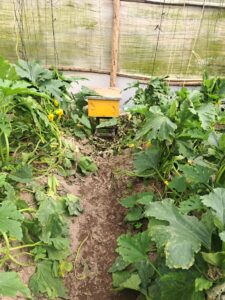
He explains “In the greenhouses we used to have challenges in various crops—in pollination, because in the greenhouses we have limited wind blowing. We decided to put a beehive in the greenhouse. After putting one of the beehives in the greenhouse, we found that the yield went up four times from the yield we used to experience before, because the bees as they are feeding, they also assist with the pollination inside the greenhouse and the yield actually shoot up in a level we could not even expect.
That assisted us to have better returns from the greenhouses, at the same time we are also still harvesting honey from the greenhouse. I come from an area that is usually cold, but in the greenhouse it is quite warm; you find that bees make honey faster than they do normally. Outside the greenhouse, bees take about four months for us to harvest honey; but inside the greenhouse, they just take two months, because it is warm. When it is cold, the bees consume the honey, but when it is warm, they don’t consume honey. So, from the crops we are getting more production and from the bees we are being able to get more produce; it was more beneficial to have the bees in the greenhouse than having them outside.”
Pollination is the biological process through which pollen—male reproductive material of a flower—is transferred to the female part ( stigma) of the same or another flower, enabling fertilization and the production of seeds and fruits. The Cambridge Dictionary defines ‘pollen’ as a powder, produced by the male part of a flower, that causes the female part of the same type of flower to produce seeds.
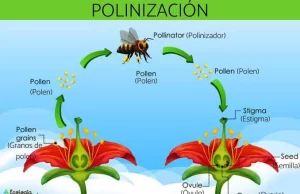
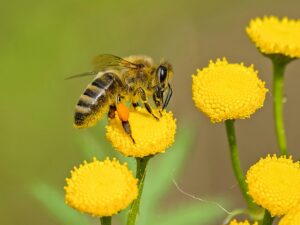
In scientific and agricultural contexts, pollination forms a critical step in plant reproduction and food production. It can occur naturally, through agents like wind and animals (especially insects such as bees, butterflies, and beetles), or artificially, through human intervention such as hand-pollination or controlled pollination in greenhouses. Bees collect pollen, which is protein-rich, from anthers, to especially feed their larvae. While doing this, some pollen unintentionally sticks to their bodies and is therefore inadvertently transferred to the stigma, enabling fertilization — this is pollination.
Pollination can be described as the bridge between plant biology and ecosystem sustainability—a process that not only ensures crop yields and biodiversity but also underpins global food security.
If pollination didn’t exist, the consequences would be catastrophic for both nature and humanity. Without pollination, most plants would be unable to reproduce, meaning that they couldn’t produce fruits, seeds, or new plants. This would trigger a collapse in ecosystems, as many creatures—including humans—depend on plants for food, shelter, and oxygen. In agriculture, the absence of pollination would lead to drastic declines in crop yields, especially for fruits, vegetables, nuts, and oilseeds that rely on bees and other pollinators.

Economically, the loss of pollination could cause food shortages, higher prices, and global hunger, while ecologically, it would mean the disappearance of countless plant and animal species, disrupting natural balance. In essence, without pollination, life as we know it would unravel, because this single process represents the invisible thread weaving together biodiversity, food systems, and climate stability.
In open fields, wind and insects help to transfer pollen from the male parts of flowers (anthers) to stigmas, especially for wind-pollinated crops like wheat, maize, and some vegetables. But inside greenhouses, this natural process is often disrupted because the enclosed structure limits air movement and restricts insect activity. Without the gentle motion of wind or the regular visits of pollinators, pollen remains trapped within flowers, leading to poor fertilization, lower fruit set, and reduced yields. This is the reason why greenhouse farmers experience low productivity, unless they introduce artificial or biological pollinators—such as bees—to compensate for the absence of wind or other insects, and ensure effective pollination.
Studies corroborate Kibiri’s fact
Various studies confirm Kibiri’s point—that bees generally produce more honey in warmer environments due to increased activity and extended foraging periods. In the controlled warmth of a greenhouse, bees hum with unmatched efficiency, turning flowers into honey at a pace far faster than in the chill of the outdoors. As research shows, their activity—and ultimately honey yield—peaks within optimal temperature ranges, highlighting why warmth can transform both bee productivity and crop pollination.
Pub Med Central (PMC)—a free online database managed by the U.S. National Library of Medicine (NLM) at the National Institutes of Health (NIH)— features a 7 December 2024 review entitled “A review of short-term weather impacts on honey production”. It states “Beekeeping is an exceptionally weather-sensitive agricultural field. Honey production and pollination services depend on the complex interaction of plants and bees, both of which are impacted by short-term weather changes. In this review, classical and recent research is collected to provide an overview on short-term atmospheric factors influencing honey production, and the optimal and critical weather conditions for bee activity. Bee flight can be directly obstructed by precipitation, wind, extreme temperatures and also air pollution.
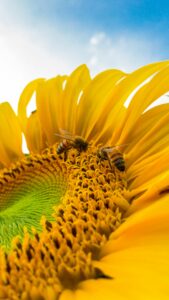
Bees generally fly within a temperature range of 10–40 °C, with optimal foraging efficiency occurring between 20 and 30 °C. Wind speeds exceeding 1.6–6.7 m/s can reduce foraging efficiency. Additionally, bee activity is significantly correlated with temperature, relative humidity and solar radiation, factors which influence nectar production. Optimal conditions for nectar collection typically occur in the morning and early afternoon hours with mild and moist weather. The diurnal nectar collection habit of bees adjusts to the nectar production of individual plant species. Extreme weather occurring in the sensitive hours is noticeable both in the nectar production of plants and in the activity of bees, thus in the honey yield. Understanding the impact of weather on honey bees is crucial in the management and planning of honey production.”
A 24 December 2016 study titled “Long-term effect of temperature on honey yield and honeybee phenology” also published by PMC highlights the same observation. “In the current study, we examine honeybee and beekeeping activity in southern Poland for the period 1965–2010, supplemented by hive yields from a beekeeper in southern UK in the same period. We show that despite negative reports on honeybee condition, and documented climate change, the studied apiary managed to show a marked increase in honey production over the 46 year study period, as did that from the UK.
The proportion of the annual yield originating from the first harvest decreased during the study period and was associated with rising temperatures in summer. Honeybee spring phenology showed strong negative relationships with temperature but no overall change through time because temperatures of key early spring months had not increased significantly. In contrast, increasing yields and an increased number of harvests (and hence a later final harvest and longer season) were detected and were related to rising temperatures in late spring and in summer.”
These findings align with Kibiri’s observation in his greenhouse where warmer conditions led to faster honey production cycles. Kibiri thus urges his fellow farmers to embrace a farming model that works hand-in-hand with nature rather than against it. By avoiding harmful chemicals and creating safe, organic environments, he believes that farmers can protect bees, improve yields, and keep both consumer trust and ecological balance. “It is also an education that the crops which are grown inside the greenhouse are safe; and we are not using harmful chemicals, because if we used chemicals, the bees could not survive. So, actually it creates more confidence to the consumer that the product is safe for consumption and also the environment in which it is grown is also safe and conducive. The products actually have better markets.
We mostly use organic fertilizers and we also use beneficial insects and predators like Amblyseius cucumeris to control spider mites. That is able to protect the bees and give safety to the crops you are growing. The bees multiply faster because it is warm inside the greenhouse and it is conducive for the breeding of the bees, you can put one colony and within a short time you can be able to get another colony, because they are breeding very faster unlike when farmers are using pesticides, you find that bees are being killed day-to-day. So, it is one way we can increase our produce and also have the safety of our produce and we can also increase the population of the bees which is being affected outside greenhouses. ”
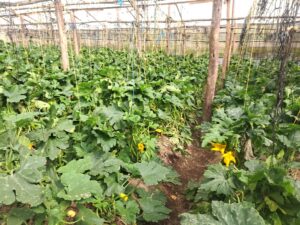
Greenhouses act like natural heat traps; the reason why they are warmer than their surrounding environment. Greenhouses capture sunlight through their transparent walls and keep temperatures up to 17°C (30°F) higher than the surrounding open fields. This steady warmth protects plants from cold winds that can hinder pollination, while providing bees with an ideal environment to forage and pollinate continuously. For Kibiri, this meant faster honey production and dramatically increased crop yields, as the greenhouse not only safeguarded his plants but also created a thriving habitat where bees could work efficiently, changing a potential challenge into a remarkable advantage.
Beneficial chemicals are substances used in agriculture or environmental management which help crops to grow or protect them without causing harm to plants, animals, humans, or ecosystems. In contrast to toxic pesticides or synthetic fertilizers, beneficial chemicals are often biologically based or environmentally safe compounds that promote plant health or control pests in a sustainable way.
Low cost, high yield— simplicity behind Kibiri’s bee farming
Kibiri affirms that this practice of bee farming in greenhouses isn’t expensive at all. “Actually, it is not expensive, because the place I come from during the month of September we usually have bees migration; and it’s easier to get bees anywhere. We usually use a catcher box to collect bees, and after getting the bees inside the catcher box, we deliver the bees inside the greenhouse. As long as you are able to access one colony of bees and you put them in a catcher box, you put them in the greenhouse, and immediately you can start the process. It is not difficult; it is not expensive, the only cost is having a catcher box. And the catcher box is not expensive, you can construct your own, if you can get pieces of wood.”
Amid rows of vibrant crops basking under the filtered sunlight of his greenhouses, Kibiri proudly experiments on nature’s finest partnership—bees and blossoms. Each hive hums with a purpose, turning courgette, capsicum, and tomato flowers into golden honey while multiplying harvests to levels he once thought impossible.
He says “There is a greenhouse where we have mixed two crops, capsicum and courgette, and another greenhouse where we have tomatoes; in most greenhouses we have one or two crops. But when you have one crop and it has enough flowers they are feeding, you can even sell the honey, indicating it is honey from which crop; you can be able to specify ‘This is honey from capsicum flowers, this is made from courgette, this is from a certain crop.’ We have other regions where they are honey from eucalyptus, and such; and it actually has benefits treating various diseases like cold and so on.
Us, where we are focusing mostly is how to safeguard the bees, increase their population and the yield of our crops and reduce pesticides. In the future, we expect to have various crops in one greenhouse whereby bees can be able to collect [nectar]. Currently we have one beehive per greenhouse and the greenhouse is 550sq m. The production, I experienced for a period of about four months is on courgette, which went high four times. I used to harvest two to three crates, in such an area of 550sq m, that’s about forty kilos per day, but then it shot up to about 15 and even 16 crates per day.”
Bee raising in greenhouses across the world
Farmers in various regions actively introduce bees into greenhouses to improve pollination, increase crop yields, and sometimes boost honey production. Practices such as using bumblebee colonies, honeybees, or solitary bees are documented in multiple countries, especially for crops like tomatoes, peppers, and cucumbers.
For example, “In Japan, more than 100 000 honey bee colonies are necessary for crop pollination each year. Among these, approximately 80% are used in greenhouses. About 60% of them (approximately 50 000 colonies) are used for pollination of strawberry and the rest are used for pollination of eggplant, melon, and watermelon in greenhouses,” according to an October 2011 study “The Habitat disruption induces immune suppression and oxidative stress in honeybess” on Research Gate.
In the United States, particularly in greenhouse vegetable production, bumble bees are employed for pollination services across various crop systems, including tomatoes, fruit trees, berries, and soybeans. This method is recognized for improving crop quality, increasing yield, and reducing labor requirements. Ohio State University Extension, in its 23 May 2023 story titled “Bumble Bee Pollination in Tomato Greenhouses” states “Bumble bees are managed for their pollination services in a variety of crop systems, including tomatoes, fruit trees, berries, and soybean (Abrol & Shankar, 2012; Feltham et al., 2014; Stanley et al., 2015; Suzuki et al., 2007).
Most commercial bees are used in greenhouses, including for the growth of berries, squash, eggplant, and peppers (Abak et al., 1995; Shipp et al., 1994; Strange, 2015). However, around 95% are specifically used in tomato greenhouses (Velthuis & van Doorn, 2006).”
It adds “Bumble bees were first discovered to have value in greenhouses in 1985, by Belgian veterinarian Dr. de Jonghe (Velthuis & van Doorn, 2006). He discovered that bumble bees could replace the need for manual pollination by human workers, a practice that formerly required shaking the plants three times a week. After this discovery, three major commercial bumble bee productions began, and those same three companies are still the premier suppliers of bumble bees globally: Biobest (founded by Dr. de Jonghe), Koppert (a Dutch company), and Buntin Brinkman Bees (another Dutch company). Koppert is the biggest supplier in the United States.”
In India, researchers at Nagaland University have discovered that two species of stingless bees—Tetragonula iridipennis and Lepidotrigona arcifera—significantly boost agricultural productivity and crop quality through efficient pollination in greenhouse settings. These bees not only enhance crop yields but also produce medicinal honey, offering farmers additional income opportunities.
In its 26 May 2025 story entitled “Buzzing discovery: NU researchers find how stingless bees boost crop yield and quality”, The Times of India says “ Researchers at Nagaland University (NU) discovered two species of stingless bees, Tetragonula iridipennis Smith and Lepidotrigona arcifera Cockerell, that enhance agricultural productivity through pollination. The introduction of these stingless bees as pollinators in greenhouse farming has improved crop yields and quality across various plant species. These bees offer safe pollination services without the risk of stings, while also producing medicinal honey that provides additional income opportunities.
Research findings by NU researchers demonstrated that chilli crops pollinated by these bees show enhanced production and quality compared to non-pollinated crops. NU researchers said conservation efforts are necessary for stingless bees A dorsata, A florea, and other wild species like halictid, syrphid, and Amegiella bees to address pollination deficits. Studies show king-chilli experienced a 29.46% increase in fruit set versus 21% in non-pollinated crops.”