By Jean Baptiste Ndabananiye
The world is facing a hunger crisis of unprecedented proportions. According to the World Food Program (WFP), over 340 million people in the world are experiencing acute food insecurity, a number that has more than doubled since 2020. This alarming trend is driven by a convergence of factors including climate change, ongoing conflicts, and disruption to global food supply chains. The crisis has reached a tipping point, disproportionately affecting vulnerable populations in developing countries, while also highlighting the necessity of interdependence of nations in addressing food security. This article is subdivided into these parts:
- Status of the problem
- Root causes of the problem
- How to solve the intricate problem?
- Conclusion and call-to-action
Status of the problem

“In 74 countries in the world, 374 million people are facing acute hunger. The scale of the current global hunger and malnutrition crisis is enormous. A total of 1.9 million people are in the grips of catastrophic hunger – primarily in Gaza and Sudan but also in pockets of South Sudan, Haiti and Mali.
They are teetering on the brink of famine. In Zamzam camp in northern Sudan, famine has been confirmed. Many food crises involve multiple overlapping issues that are building year on year,” points out the World Food Program—WFP.
As suggested by the WFP, this acute crisis has been worsening exponentially year after year since 2020. In its 3 May 2023 piece entitled “Global report on food crises: Number of people facing acute food insecurity rose to 258 million in 58 countries in 2022”, the WFP said “The report finds that around 258 million people in 58 countries and territories faced acute food insecurity at crisis or worse levels (IPC/CH Phase 3-5) in 2022, up from 193 million people in 53 countries and territories in 2021.” The UN in its 5 May 2021 UN-partnered flagship report stated “155 million faced acute food insecurity in 2020, conflict the key driver.”
In its 15 October 2024 article titled “Up to 21,000 people are dying each day from conflict-fuelled hunger around the world”, Oxfam points out “On World Food Day [every 16 October], hunger has reached an all-time high exposing the flaws in global peacebuilding and conflict recovery efforts. Between 7,000 to as many as 21,000 people are likely dying each day from hunger in countries impacted by conflict.”
A more regrettable issue is that the world really produces sufficient food to nourish all the current world’s population. Concern World Wide with its 10 October 2024 story “World hunger facts: what you need to know in 2024 (and 2025)” reports “The world produces enough food to feed all of its 8 billion people, yet 733 million people (1 in 11) go hungry every day.
Hunger rates in Africa are especially high, with 1 out of 5 people going hungry each day. 2.8 billion people around the world cannot afford a healthy diet — 35% of the global population. In low-income countries, 71.5% of people cannot afford a healthy diet. In high-income countries, that figure drops to 6.3%.9 million people die from hunger-related causes every year; many are children under the age of 5.”
Root causes of the problem
Conflict and food supply chains
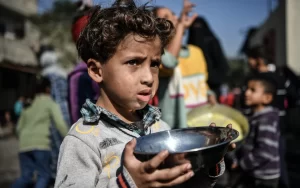
Conflicts exacerbate food insecurity by disrupting production, supply chains, and markets. The war in Ukraine constitutes a stark example of how localized conflicts beget global repercussions. As two of the world’s largest exporters of wheat and sunflower oil, Ukraine and Russia’s conflict has led to significant shortages and price surges in these commodities, negatively affecting millions of people worldwide.
In Yemen, a country ravaged by civil war, over 17 million people face acute hunger. The destruction of infrastructure— including farms, irrigation systems, and storage facilities— has rendered local food production nearly impossible. Similarly, in the Democratic Republic of Congo, armed conflicts have displaced millions of farmers, leaving them unable to plant or harvest crops.
Displacement caused by wars often forces people into fragile ecosystems, where they exploit limited natural resources for survival, further degrading the environment. This cycle perpetuates poverty and hunger, leaving affected communities with little hope for recovery.
“Conflict and hunger are mutually reinforcing,” wrote the UN Secretary-General, António Guterres, in the UN-partnered flagship report. The WFP’s 3 May 2023 report reads “The report findings confirm that the impact of the war in Ukraine has had an adverse impact on global food security due to the major contributions of both Ukraine and Russia to the global production and trade of fuel, agricultural inputs and essential food commodities, particularly wheat, maize and sunflower oil.
The war in Ukraine disrupted agricultural production and trade in the Black Sea region, triggering an unprecedented peak in international food prices in the first half of 2022.”
Oxfam’s report— Food Wars, published on the last World Food Day— which examined 54 conflict-affected countries found that they account for almost all of 281.6 million people struggling with acute hunger today.“Conflict has also been one of the main causes of forced displacement in these countries, which has globally reached a record level today of more than 117 million people. It argues that conflict is not only a primary driver of hunger, but that warring parties are also actively weaponizing food itself by deliberately targeting food, water and energy infrastructure and by blocking food aid.”
“It is no coincidence that the lethal combination of war, displacement and hunger has often occurred in countries rich in natural resources. The exploitation of these raw commodities often means more violence, inequality, instability, and renewed conflict. Too often, large-scale private investment—both foreign and domestic —has also added to political and economic instabilities in these countries, where investors seize control over land and water resources forcing people out of their homes.”
The role of climate change in escalating hunger
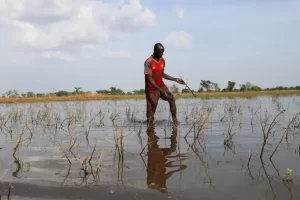
The combination of conflict and climate change creates a vicious cycle. Climate change has emerged as a formidable force disrupting agricultural systems worldwide. Extreme weather events such as droughts, floods, and hurricanes are becoming more frequent and intense, destroying crops and reducing arable land.
In sub-Saharan Africa, prolonged droughts have decimated harvests, leaving millions dependent on food aid. Similarly, floods in Pakistan in 2022 submerged vast agricultural lands, affecting food supply for millions. In its 3 March 2024 story, DW (Deutsche Welle) reports “The two agencies [the UN’s Food and Agricultural Organization (FAO) and the World Food Programme (WFP) ] estimate that 27.4 million people in southern Africa will face hunger in the next six months due to poor harvests following a series of 14 extreme droughts within the past two decades, far more than on any other continent.”
A father of six n Malawi’s southern region of Mangochi, sad and desperate M’madi, staring out at his field, with all of his work in recent months totally reduced to nothing, told DW “In December, we lost everything. So we uprooted what was planted and started all over again. .A lot of crops are destroyed. I don’t know what to do.”
Moreover, rising temperatures are altering growing seasons and reducing crop yields for staples like wheat, maize, and rice. A study published in Nature Climate Change predicts that for every degree Celsius increase in temperature, global wheat production could decline by 6%. These shifts not only threaten food availability but also increase the cost of food, pushing millions into poverty.
Smallholder farmers, who produce around one-third of the world’s food, are among the hardest hit by climate change. Farmers in various nations struggle to adapt to these changes, often lacking access to resources, technology, and knowledge about climate-resilient practices.
Economic shocks in relation to other key causes
The WFP’s 3 May 2023 report reads “Economic shocks grew as driver of food crises. Economic shocks have surpassed conflict as the primary driver of acute food insecurity and malnutrition in several major food crises. Cumulative global economic shocks, including soaring food prices and severe disruptions to markets, undermine countries’ resilience and capacity to respond to food shocks.”
The report explains that economic shocks including the socioeconomic impacts of COVID-19 and the repercussions of the war in Ukraine emerged as the main driver in 27 countries with 83.9 million people in “IPC/CH Phase 3 or above or equivalent – up from 30.2 million people in 21 countries in 2021. The economic resilience of poor countries has dramatically decreased over the past three years, and they now face extended recovery periods and less ability to cope with future shocks.
Conflict/insecurity was the most significant driver in 19 countries/territories, where 117 million people were in IPC/CH Phase 3 or above or equivalent. In 2021, conflict was considered the main driver across 24 countries/ territories with 139 million people in these phases of acute food insecurity. The lower estimate is explained by the fact that economic shocks surpassed conflict as the main driver of acute food insecurity in three countries still affected by protracted crises – Afghanistan, South Sudan, and the Syrian Arab Republic.”
IPC stands for Integrated Food Security Phase Classification. Phase 3 (Crisis) households face significant food consumption gaps or are only able to meet minimal food needs by depleting essential assets or adopting crisis-level coping strategies. Phase 4 (Emergency) households experience large food consumption gaps, leading to very high levels of acute malnutrition and excess mortality. Phase 5 (Catastrophe/Famine) households face extreme lack of food, leading to starvation, death, and destitution.
The report adds “Weather/Climate extremes were the primary driver of acute food insecurity in 12 countries where 56.8 million people were in IPC/CH Phase 3 or above or equivalent, more than double the number of people (23.5 million) in eight countries in 2021.
These extremes included sustained drought in the Horn of Africa, devastating flooding in Pakistan, and tropical storms, cyclones and drought in Southern Africa.”
How to solve the intricate problem?

The escalating severity of acute food insecurity underscores the urgent need for immediate and coordinated action from all stakeholders. Governments, humanitarian organizations, and international agencies must prioritize efforts to address the root causes, mobilize resources, and deliver targeted interventions, especially in the most affected regions. This crisis demands not only short-term relief but also long-term solutions to build resilience and prevent further deterioration.
A combination of technological innovation, policy reform, and international cooperation is essential. Technologies— such as precision agriculture which uses data and artificial intelligence to optimize farming practices—are revolutionizing the way food is produced. For example, drones and satellite imagery are helping farmers to monitor crop health and identify areas needing intervention, significantly reducing waste.
Organizations intervening in the sector of agriculture need to foster collaboration between farmers and governments to implement sustainable and fruitful agricultural practices at a higher extent than the current one. Additionally, this sector should attract greater investment from other stakeholders—with initiatives focusing on improving access to quality seeds, efficient irrigation systems, and affordable credit, empowering farmers to boost yields and incomes to a significantly higher degree than present levels.
On the policy front, international agreements like the 2015 Paris Climate Accord aiming to address the root causes of food insecurity should be respected. By committing to reduce greenhouse gas emissions and supporting climate adaptation projects, nations can mitigate the impact of climate change on agriculture.
Furthermore, global initiatives like the UN’s Zero Hunger Challenge aiming to eradicate hunger by 2030 by promoting inclusive and sustainable food systems should be implemented. But Guterres wrote in the 3 May 2023 report’s foreword “This seventh edition of the Global Report on Food Crises is a stinging indictment of humanity’s failure to make progress towards Sustainable Development Goal 2 to end hunger and achieve food security and improved nutrition for all.”
Significant challenges actually persist. Financing for climate adaptation and food security projects often falls short, particularly in low-income countries. According to the International Fund for Agricultural Development (IFAD), only 1.7% of global climate finance is directed toward smallholder farmers, despite their critical role in feeding the world.
In its 3 November 2022 press release headlined “Adapt or starve – UN Agricultural Fund calls for urgent climate finance for small-scale farmers”, IFAD stressed “Small-scale producers are essential to global food security but only receive 1.7 percent of climate finance – though they produce one-third of the world’s food overall.
Many of the 3 billion people living in the rural areas of developing countries rely on small-scale farming for their food and livelihoods. Yet, they are disproportionally affected by frequent and intense extreme weather events and the overall effects of global warming.”
To deal successfully with the global food crisis, it demands an urgent, united response from every corner of the world. Governments, financial institutions, the private sector, and partners must rally together to prevent the catastrophe from claiming more lives. In places like Somalia, the international community has shown that concerted action can pull nations back from the brink of famine—yet, the path forward requires not just survival but a deeper, systemic commitment to addressing the root causes of hunger.

The WFP strongly recommends the point. “A coordinated effort across governments, financial institutions, the private sector and partners is the only way to end the global food crisis. In countries such as Somalia, the international community came together and managed to pull people back from the brink of famine in 2022.
Political and diplomatic solutions are needed to strengthen peacebuilding efforts and ensure safe and unrestricted access across borders and conflict lines – to save lives and prevent the hunger catastrophe spreading even further. But it is not sufficient to solely keep people alive. We must go further, and this can only be achieved by addressing the underlying causes of hunger.”
If the WFP secures the support of additional partners and investors, the battle against the global food crisis may well be won. Through initiatives like the R4 Rural Resilience program and transforming barren land into fertile fields, the WFP has shown that with adequate resources and unrestricted access, it can overcome obstacles hindering progress.
It says “In just four years, WFP and local communities turned 158,000 hectares of barren fields in the Sahel region of five African countries into farm and grazing land. Our climate-insurance programme – the R4 Rural Resilience initiative – had benefited nearly 550,000 vulnerable households and families in 18 countries across Africa, Asia, and Latin America and the Caribbean by 2023. At the same time, WFP is working with governments in 83 countries to boost or build national safety nets and nutrition-sensitive social protection, allowing us to reach more people with emergency food assistance.
Lack of funding and access risks a heavy cost. Severe funding shortfalls are forcing WFP to scale back assistance and refocus efforts on the most severe needs. With persistent access constraints also hampering support, some of the most vulnerable people are being left behind. Unless resources are made available and unrestricted access granted, lost lives and the reversal of hard-earned development gains will be the price to pay.”
Conclusion and call-to-action
The global food crisis represents a grave and multifaceted challenge that demands urgent, coordinated action from all sectors of society. Climate change, conflict, and economic shocks have converged to plunge millions into the brink of hunger, disproportionately affecting vulnerable populations in developing countries. While short-term relief efforts are crucial, the long-term solution lies in addressing the root causes—through innovation in agriculture, robust policy reforms, and international collaboration.
The success of initiatives like the WFP’s program provides hope, but greater commitment and resources are necessary to secure a sustainable future where hunger no longer defines the fate of millions. The time for action is now.
It is imperative that governments, organizations, and individuals act swiftly to mitigate the effects of the global food crisis. Now more than ever, nations must prioritize investments in climate adaptation, agricultural resilience, and food security, especially in the most affected regions. Supporting smallholder farmers, fostering international partnerships, and ensuring equitable access to resources are essential steps in preventing further suffering.
To address the devastating weaponization of food and its catastrophic impact on civilians, we must urgently advocate for stronger enforcement of international laws to protect vulnerable populations and ensure unhindered access to humanitarian aid. Additionally, it is imperative to push for equitable management of natural resources and hold investors accountable to prevent exploitation that fuels violence, inequality, and displacement.
While Oxfam also underscores that the international community’s pledge of “zero hunger” by 2030 remains out of touch, it says that states and institutions globally, including the UN Security Council, must hold to account those committing “starvation crimes” in accordance with international law.
“To break the vicious cycle of food insecurity and conflict, global leaders must tackle head-on the conditions that breed conflict: the colonial legacies, injustices, human rights violations, and inequalities – rather than offering quick band-aid solutions.
We cannot end conflict by simply injecting foreign investments in conflict-torn countries, without uprooting the deep inequalities, generational grievances, and human rights violations that fuel those conflicts. Peace efforts must be coupled with investment in social protection, and social cohesion building. Economic solutions must prioritize fair trade and sustainable food systems,” says Farr.
Let us unite, not just to respond to the immediate needs of the hungry, but to build a global system where food security forms a reality for all. Join the efforts, advocate for change, and contribute to the solutions that can transform lives and communities.