By Jean Baptiste Ndabananiye
When we speak of modernity, our minds often jump to images of glittering cities, towering skylines, fast-paced technology— humming machines or the digital glow of a screen, and the age of industrial revolutions. All this feels recent, rapid, and unmistakably tied to the industrial age—or perhaps even the information era we’re still trying to easily comprehend.
But what if viewing modernity only through the lens of factories, computers, and skyscrapers is to miss the profound arc of its story ? What if extremely long before steam engines hissed or satellites orbited the Earth, a quiet but seismic shift occurred to pave the way for what we describe as modernization today? What if modernity didn’t begin in the age of steam or silicon?

What if the historical moments—the Renaissance, Enlightenment, Reformation, the American and French Revolutions, and the Industrial Revolution— that are generally said to have set the stage for modernity don’t actually constitute the true movements behind modernity? What if these were merely milestones in a much deeper, quieter revolution? Instead, what if its origins were buried far deeper in time—before factories, before cities, before even writing?
The answer lies in a quieter revolution—one that has reshaped human life so fundamentally that everything we now call modern flowed from it. It wasn’t a sudden leap, but the slow and steady unfolding of a world in transition. In this article, we trace that long arc of transformation, uncovering how a seemingly simple shift set humanity on a path of no return—a path we are still racing down today.
The mentioned movements are affirmed to be behind modernity
SAGE Publishing also written as SAGE Publications is an independent academic publishing company known for producing high-quality scholarly content, particularly in social sciences, humanities, education, health sciences, and business. It is headquartered in Thousand Oaks, California, USA, with offices in London, New Delhi, Singapore, and other locations.
This publisher has released a publication— entitled “In the Beginning there Was Modernity”— which starts, saying “The words modern and modernity are used in a number of different ways. Sometimes ‘modern’ is used in the same way as contemporary or up-to-date. Other times it’s used as an adjective, as in modern art or modern architecture. In the social disciplines, there has been a good bit of debate about the idea of modernity.
Some argue that we are no longer modern, others that we never were, and still others that we are living in some different form of modernity, like liquid modernity. We’re not going to enter into this debate directly; but the existence of the debate is important for us. The reason it’s important is that this debate has implications for the kind of person we can be and the kind of society we can have. Whether we realize it or not, those are the very issues that sociology addresses.”

The Cambridge Dictionary defines “modern” as “designed and made using the most recent ideas and methods”, giving this example “My grandpa’s attitudes are very modern, considering his age.” This dictionary also states that “modern” means “present”— “of the present or recent times, especially the period of history since around 1500” or “existing in the present or a recent time, or using or based on recently developed ideas, methods, or styles like ‘modern life or modern architecture/art’.”
Even these definitions, grounded in 17th-century transformations, may overlook an older genesis. Multifarious sources certify that modernity is very recent. Meanwhile, the aforesaid publication on Sage Publications is one of the sources that situate “modernity” in the very recent context.
It states “As a historical period, modernity began in the seventeenth century and was marked by significant social changes, such as massive movements of populations from small local communities to large urban settings, a high division of labor, high commodification and use of rational markets, the widespread use of bureaucracy, and large-scale integration through national identities.
In general, the defining institutions of modernity are nation-states and mass democracy, capitalism, science, and mass media; the historical moments that set the stage for modernity are the Renaissance, Enlightenment, Reformation, the American and French Revolutions, and the Industrial Revolution.”
The publication adds that modernity, more than a mere historical era, bursts forth as a mindset born of the Enlightenment. It says “But modernity is more than a period of time; it’s a way of knowing that is rooted in the Enlightenment and positivism. The Enlightenment was a European intellectual movement that began around the time Sir Isaac Newton published Principia Mathematica in 1686, though the beginnings go back to Bacon, Hobbes, and Descartes.
The people creating this intellectual revolution felt that the use of reason and logic would enlighten the world in ways that fate and faith could not. The principal targets of this movement were the Church and the monarchy, and the ideas central to the Enlightenment were progress, empiricism, freedom, and tolerance.”
The Enlightenment is regarded as a fierce intellectual revolt that discouraged faith while championing reason, dethroned divine right with empiricism, and cast the glow of logic and liberty across a world long dominated by monarchy and Church. The Council on Foreign Relations—CFR— constitutes a think tank and publisher saying that it stands independent and non-partisan. It published an article titled “What Is the Enlightenment and How Did It Transform Politics?” last updated on February 17, 2023. It reads “For centuries, intellectual and political authority came from religion and other traditional beliefs.
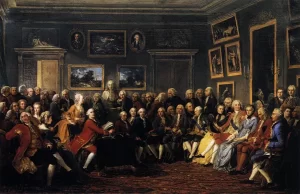
Source: Anicet Charles Gabriel Lemonnier via Château de Malmaison,”—the Council on Foreign Relations—CFR.
To explain political systems—like why a particular family had absolute rule over a kingdom—leaders turned to religion, claiming a divine right from God. But during this time [Enlightenment], a series of religious, political, and scientific upheavals began challenging the status quo, culminating in the Enlightenment. In the early 1600s, English philosopher Francis Bacon revolutionized intellectual thought by demonstrating that scientific discovery could not be achieved through faith and religion but rather rigorous research and observation.”
The article adds “His scientific method set the gold standard for future research. It also coincided with a wave of breakthroughs in the fields of astronomy, mathematics, and physics by scientists such as Galileo Galilei, Johannes Kepler, and Isaac Newton.
Although many of those intellectuals were devout Christians who believed that science and religion were easily reconcilable, religious authorities nonetheless viewed those discoveries as threats to their power. Officials, for instance, placed Galileo under house arrest for his writings on how the earth revolved around the sun, which undermined the teachings of the Catholic Church.”
Nevertheless, a growing body of interdisciplinary thought—including perspectives from health sciences and anthropology—suggests that modernity’s roots are far more ancient: Neolithic Revolution with agriculture.
Agriculture forms the true beginning of modernity
The National Center for Biotechnology Information [NCBI] represents a significant division within the United States’ National Library of Medicine (NLM). The NLM constitutes a key institution of the country acting as the world’s largest biomedical library and being part of the National Institutes of Health— NIH. On 2012 January 12, NCBI released a review titled “Depression as a disease of modernity: explanations for increasing prevalence”.
The review reads “Modernity is a continuous concept that begins with agriculture, followed by industrialization, urbanization, and ever-accelerating changes in technology and social structure. Modernization is loosely defined in this review as the conglomeration of a society’s urbanization, industrialization, technological advancement, secularization, consumerism, and westernization.”
It further says “Departure from a hunter-gatherer living is an opportune window for insight into the effects of modernization. The Ik of Uganda purportedly become more depressed upon shifting from hunter-gather to agricultural practices.”

The review suggests that the transition from hunting and gathering to agriculture is not just a change in survival strategy—it represents the very first step into what we now call modern life. It marks the beginning of structured society, labor division, ownership, institutions—and even emotional or psychological consequences.
Depression among the Ilk highlights that while agriculture brought advancement, it also introduced social, emotional, and even spiritual dislocations. The Ik’s case is often cited in anthropology as an example of how forced transitions—from communal, flexible, mobile lifestyles to sedentary, survival-focused living— undermine traditional values, increase individualism, and lead to emotional strain.
So, how does this support the origin of modernity?
It first shows that modernity isn’t only marked by skyscrapers or machines, but by deep psychological, social, and cultural shifts that started long ago. The shift to agriculture is the first rupture from the “natural” rhythm of life that hunter-gatherers led. It’s the foundational moment when humans began shaping nature—and society—for control, productivity, and permanence.
The Ik’s experience serves as an early illustration of how the shift toward a more structured, sedentary lifestyle—ushered in by agriculture— fractured traditional social bonds and psychological well-being. In fact, many of the emotional challenges that emerged at the dawn of farming, such as depression and isolation, are continuing to manifest in today’s modern societies. As highlighted by the NCBI, modern populations are experiencing unprecedented levels of depression, anxiety, and loneliness paralleling— in a much more complex context— the psychological toll first witnessed when humanity began departing from its primal, communal ways of life.
Key justifications
The dawn of agriculture marked the most magnificent turning point in human existence—a quiet revolution that irreversibly set humanity on the path toward everything we now call modern. There occur countless justifications for why the start of agriculture forms the most magnificent changing course in human life. The following three are some of the most compelling justifications.
Foundation of settled societies and civilization
Before agriculture, humans lived as nomadic hunter-gatherers. The ability to cultivate crops and domesticate animals allowed communities to live in one place. This shift led to the creation of villages, then cities, and eventually complex civilizations. It additionally enabled the development of infrastructure, governance, art, religion, and written language. It also created conditions for property ownership, social hierarchies, and economic systems. Without agriculture, urbanization and organized society would not have been possible.
Dramatic increase in food supply and population growth

Agriculture made it possible to produce food in larger and more predictable quantities than hunting or gathering. This supported larger populations and allowed for population density growth, freed time and labor for other activities (craftsmanship, trade, education), and spurred innovations in food storage, irrigation, and tools. With more food and more people, humanity could invest in progress beyond mere survival.
Catalyst for technological and cultural innovation
Once basic survival was secured through farming, humans could invent new tools, technologies, and methods for productivity. They explored philosophy, art, science, and religion. They created and transmitted knowledge through written language and education. Agriculture didn’t just feed us—it liberated our minds to think, invent, and create.
Another key aspect—arguably the most dominant of them all—is that agriculture feeds virtually every other field from industry to innovation that we enjoy today. It’s easy to overlook, but even the simplest items that define modern life trace back to agriculture. Paper, for example, is processed from agricultural products like trees and fibers. Textiles depend on cotton, flax, or other cultivated crops. Bio-based fuels and oils power engines and machinery.
Even mining, the backbone of our today technologies—from smartphones to satellites—wouldn’t have been feasible without agriculture first. Why? Because only once humanity mastered consistent food production, could people specialize beyond food-gathering—enabling labor for exploration, mining, metallurgy, and eventually science and engineering.
Without agriculture, there would exist no industrial workforce, no urban centers to house innovators, no surplus food to support thinkers, artists, or miners, no logistics systems to move materials across distances.
Agriculture represents the silent engine powering progress, transforming it into not just a sector of the economy, but the original enabler of every other domain.
The name which was given to the beginning of farming also corroborates that modernity started with agriculture. National Geographic with its 5 April 2019 article headlined “What was the Neolithic Revolution?”reports “The Neolithic Revolution—also referred to as the Agricultural Revolution—is thought to have begun about 12,000 years ago. It coincided with the end of the last ice age and the beginning of the current geological epoch, the Holocene. And it forever changed how humans live, eat, and interact, paving the way for modern civilization.”

The very name “Revolution” indicates a seismic change—comparable in significance to later events like the Industrial or Digital Revolutions. But it’s even the most foundational, because it was the first time humans exerted large-scale control over their environment in a way that generated cascading effects on everything: settlement patterns, governance, social roles, economy, technology, and even emotional well-being, as discussed with the Ik of Uganda.
Northern Arizona University currently ranked 519 in the Best Global Universities says “The Neolithic Revolution was the critical transition that resulted in the birth of agriculture, taking Homo sapiens from scattered groups of hunter-gatherers to farming villages and from there to technologically sophisticated societies with great temples and towers and kings and priests who directed the labor of their subjects and recorded their feats in written form.”
The revolution marked the dawn of civilization, according to this university. It says “The Neolithic Revolution was viewed as a single event—a sudden flash of genius—that occurred in a single location, Mesopotamia, between the Tigris and Euphrates Rivers in what is now southern Iraq, specifically the site of a realm known as Sumer, which dates back to about 4000 B.C.E. It then spread to India, Europe, and beyond.
Most archaeologists believed this sudden blossoming of civilization was driven largely by environmental changes: a gradual warming as the Ice Age ended that allowed some people to begin cultivating plants and herding animals in abundance.”
According to the same source, the shift from foraging to farming formed a definitive changing course in human history, laying the foundation for settled life, rapid innovation, and the quick rise of civilization. “One part of humankind turned its back on foraging and embraced agriculture. The adoption of farming brought with it further transformations. To tend their fields, people had to stop wandering and move into permanent villages, where they developed new tools and created pottery. For thousands of years men and women with stone implements had wandered the landscape, cutting off heads of wild grain and taking them home.
Rather than having to comb through the landscape for food, people could now grow as much as they needed and where they needed it, so they could live together in larger groups. As the population quickly increased, ideas could be more readily exchanged, and rates of technological and social innovation soared. Religion and art—the hallmarks of civilization—flourished.”
Core lesson

True modernity began not with machines, but with the moment humans turned soil and seed into power. The agricultural revolution was the original disruptor—it triggered the transformation of human life from fluid, communal, nature-aligned systems to structured, sedentary, and hierarchical ones. Everything we associate with modern life—urbanization, bureaucracy, capitalism, mental health challenges, even loneliness—flows from that fundamental shift.
We owe an enormous debt of gratitude to those early cultivators, whose bold break with foraging laid the very groundwork for everything we celebrate as progress today. Their ingenuity and perseverance in taming wild plants and animals unlocked the full potential of human cooperation, creativity, and specialization. In honoring their legacy, we recognize that every skyscraper, smartphone, and social institution stands upon the silent labors of those first farmers—true pioneers of modernity. So, we have to highly respect them because we owe to them all that we boast today.
To revisit modernity is not merely to revise a timeline—it is to reframe our understanding of who we are, where we come from, and why we feel the way we do today. If the plow was humanity’s first tool of modernity, then our psychological burdens may well be its first cost. Recognizing this longer arc allows us not only to understand modernity more fully—but to navigate it more consciously. We will explore more in one of our upcoming articles which will focus on the intense toll brought by modernity and how to navigate it, as already suggested by the NCBI.
Good https://is.gd/N1ikS2
Thank you for this feedback.
Good https://is.gd/N1ikS2
Thank you for this pleasant comment.
Very good https://is.gd/N1ikS2
Thank you so much indeed for these inspiring words.
Awesome https://is.gd/N1ikS2
We are indeed very grateful for your great comment.
Very good https://is.gd/N1ikS2
Thanks a lot! We really appreciate your feedback. Very glad that you’ve liked it!
Awesome https://is.gd/N1ikS2
Patrick4033, we are excited that you have found it awesome.
Very good https://is.gd/N1ikS2
It is actually great,Cedric4230, to hear that you have found the piece very good.
Very good https://is.gd/N1ikS2
Thank you so much, Mathew1145! We truly appreciate your kind and encouraging words. It’s great to know the piece has resonated with you.
Awesome https://is.gd/N1ikS2
Dear Edwin4178, we are actually thrilled by the fact that the article is awesome.