By Jean Baptiste Ndabananiye
A substantial transformation is materializing—one that promises cleaner air, healthier families, restored forests, and a new path for inclusive economic growth in Rwanda— where nearly 80% of households still rely on firewood for daily cooking. Deep in the hills of Rubavu, Biomassters Ltd, a homegrown startup founded by six visionary Rwandans, is turning forest waste into high-efficiency fuel pellets—and in doing so, is rewriting the future of cooking in Rwanda.
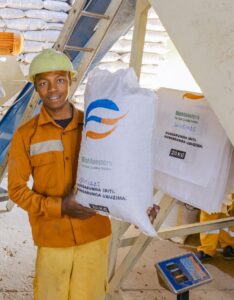
With critical support from the ReCIC project and a clear national vision to cut firewood reliance nearly in half, Biomassters’ journey from startup struggle to scalable solution offers a rare and powerful example of what happens when local innovation meets targeted international support. More than a business success, it is a blueprint for climate action, gender inclusion, and rural transformation. ReCIC stands for Reducing Climate Impact of Cooking in Rwanda through Improved Cooking Energy Systems Action.
“Rwanda is a small land, now it is time to give clean cooking the highest priority. We are still struggling to achieve the target; [the reason why] we have to partner with the private sector, international organizations. Our target is to reduce the percentage of households using firewood for cooking [from a baseline value of 79.90% in 2017] to 42%. That’s why we have this kind of initiative,” Jean Bosco Mugiraneza said.
He is Director General for Energy within the Ministry of Infrastructure. He said so during the ReCIC Project Stakeholders Meeting and Launch of Clean Cooking Exhibition in Kigali on 11 June 2025. The ReCIC project is precisely the initiative Mugiraneza was referring to.

ReCIC is an intervention—launched in November 2020 and implemented by SNV and GIZ as the lead, with funding from European Union under the Global Climate Change Alliance Plus (GCCA+) initiative— which ended in June 2025. The ReCIC project has supported cooking energy companies in Rwanda, to improve their stoves and fuels and to enhance their overall business, particularly through a business challenge fund called Cooking Energy Business Grant Fund (CEBGF).
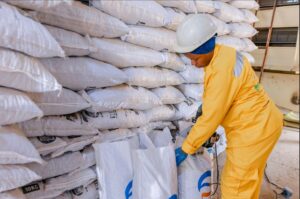
As part of the project, originally 14 companies were selected through a long competitive process, including business incubation support from different expert stakeholders. Two companies dropped out and currently the remaining 12 have been supported technically for capacity development and with grant financing under the CEBGF, paid based on performance milestones. These 12 companies are EPD (Energy Private Developers)’s members, the reason why it is EPD which organized the stakeholders meeting and exhibition.
All these companies wholeheartedly laud the project, while indicating that the project has strengthened them to contribute significantly to Rwanda’s target. Biomassters is one of those companies which have benefitted from ReCIC.
How Biomassters is revolutionizing clean cooking
In the scenic hills of Rubavu District, western Rwanda, inside a modest factory, what was once considered waste—sawdust and wood chips—is being transformed into clean-burning fuel pellets that are changing how Rwandan families cook their meals. This is the story of Biomassters Ltd, a company that turned forest waste into a game-changing solution for clean cooking.
When six ambitious entrepreneurs co-founded Biomassters at the end of 2020, they possessed technical expertise, a committed team, and supportive government incentives in the form of tax exemptions for renewable energy imports. What they lacked was sustainably sourced biomass. “We had the knowledge and the team to succeed”recalls Innocent Nsekeyukunze, Chief Production Officer and cofounder. “But we were stuck with a major bottleneck that was literally risking our business.”
The sawdust they used to make pellets came, contaminated with nails and metallic debris. When these materials hit their production machinery, the result was always damaged equipment, costly repairs,and frustrating downtime. Meanwhile, all around Rwanda’s forests, perfectly goodraw materials—leftover wood from harvested trees—were going to waste. The company knew that this clean, sustainable resource could increase their efficiency and reduce the risks of equipment damage, contamination, and production delays. But they did not gain access to the tools to process it.
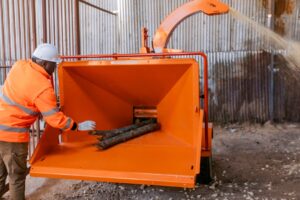
Four years ago, when the ReCIC project issued a call for applications to support environmentally conscious clean cooking businesses, Biomassters saw an opportunity. Their application was straight-forward: they needed a woodchipper that could convert post-harvest forest waste into clean, high-quality input for pellet production.
ReCIC Intervention
Upon selection for the ReCIC project’s CEBGF, the company received a grant support they needed and purchased the woodchipper that transformed their business. “The journey with the ReCIC project was a very productive and much-needed one. It moved us from one point to a much more significant one,” Nsekeyukunze reflects.
The woodchipper did not just solve their raw material problem, it revolutionized their entire operation, from cleaner production, streamlined operations, enhanced visibility, job creation, and increased capacity.
The chipped wood was far cleaner than sawdust, considerably reducing machine damage and the need for costly repairs. With fewer breakdowns, production became smoother and more predictable. ReCIC also supported their marketing efforts through promotional activities, connecting them with new customers who are continuing to contact the company even today. The company hired additional staff to operate the new equipment, including chipper operators, as well as pellet sellers, and distributors as customers had increased as a result of the marketing efforts. The chipper can process 3.5 tons of wood chips per hour, enabling potential 24-hour operation and massive expansion of production.
This business has even begun claiming carbon credits, recognizing the broader climate benefits of their operations. Perhaps most ambitiously, they’ve set a goal to increase the proportion of women staff to over 80%, reinforcing their commitment to inclusive employment. For further details on carbon credits, open this article.
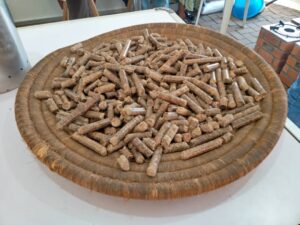
Biomassters’ products offer a considerable environmental impact. It requires 9 kg of firewood, to produce 1kg of charcoal. 1kg of pellets only needs 1.3kg of sawdust or wood chips. Their pellet stoves emit no smoke, protecting the environment and family health. This matches the nation’s direction where Mugiraneza told the media in place during the exhibition launch “Our aim is to decrease fuels that harm the environment and human health. This demands that we work closely with the private sector for us to achieve this goal.”
The impact extends beyond environmental benefits. These pellets are competitively priced compared to charcoal, providing households with a strong economic incentive to perform the switch. In rural Rwanda where children often spend several hours collecting firewood, this shift also affords time to be more committed to education and personal development. By promoting pellet use, the company is helping to reduce this burden and enabling children to focus on their studies and wellbeing.
“Future: Biomassters’ Customer-Centered Approach”
According to EPD, since 2024, the results regarding Biomassters have been remarkable. “Production is now smoother, safer, and more consistent. Client feedback has been overwhelmingly positive, with satisfied customers directly referring new clients to the company. The company now plans to open a second factory in Rwamagana, closer to the capital Kigali, a major market for them. Biomassters also distributes imported clean-burning stoves specifically designed for their pellet fuel. This combination of a gasifier stove with electric fan induced air supply plus quality biomass pellets provides a rare example of high quality solid biomass clean cooking solution.
These high-efficiency stoves, while initially expensive to many low-income households, offer remarkable performance benefits. They produce no smoke, eliminating the respiratory health risks associated with traditional cooking methods that are particularly hazardous for children and expectant mothers. The company also offers flexible payment systems to make these stoves more accessible to customers, understanding that the upfront cost can be a barrier despite the long-term savings.”
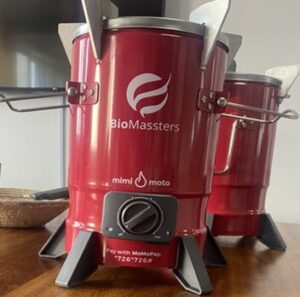
One stove costs from Biomassters 40 000 Rwandan francs (RWF). A person purchasing two stoves just pays 70 000RWF. As already suggested, it is true that several Rwandans still find this cost prohibitive. With one stove priced at 40,000 RWF, this amount represents a significant portion of income for households living below or near the poverty line, especially in rural areas. For the context, numerous Rwandans survive on less than 2,000 RWF per day, meaning that it could take weeks of savings—without spending on food, school fees, or healthcare—to afford even one stove, let alone two. This low income makes it extremely difficult for many households to afford products like improved cooking stoves, even at a subsidized price.
Therefore, despite the discount, clean cooking stoves remain financially out of reach for a large segment of the population without external support or subsidies. Meanwhile, the true worth of these Biomassters stoves corresponds to 80 000 RWF, signifying that the value has been halved so as to increase chances for a lot of people to afford it. The ReCIC project is the key reason behind this price halving.
The National Institute of Statistics of Rwanda (NISR) and World Bank data indicate that a large portion of Rwandans—especially in rural areas—live on less than 2,000 Rwandan francs (RWF) per day, with approximately 27 % of the population living in the national poverty line. NISR states “The 2023/24 Integrated Household Living Conditions Survey (EICV7) is the seventh in a series of surveys that began in 2000/01. The EICV7 survey revealed that 27.4% of the population was living in poverty in 2023/24.
Modelling shows that if the same methodology had been applied in 2016/17, the poverty rate at that time would have been 39.8%. This represents a reduction in poverty of just over twelve percentage points over seven years. This is a significant drop in poverty, but it is also clear that much remains to be done in order to eliminate poverty.”
While clean cooking stoves still lie out of reach for several households in Rwanda, the government declares that it is working diligently with the private sector and its partners, to render them more affordable and accessible for all—a point to which we will come back in our upcoming story.
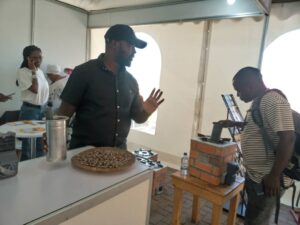
Meanwhile, the company—Biomassters— constitutes a compelling example demonstrating that targeted support and local innovation can create sustainable solutions that benefit businesses, uplift communities, and protect the local environment and global climate. With increasing demand for clean energy solutions and a clear roadmap for expansion, Biomassters represents the kind of home grown and sustainable innovation Rwanda needs, to achieve environmental and development goals.
2.3 billion people across the world rely on traditional cooking methods which are reported to pollute the environment and harm human health. By the end of April 2025, owing to the ReCIC, 449 315 sales had been accomplished— signifying that 449 315 improved cooking stoves had been sold to customers: 449 315 households.