By Jean Baptiste Ndabananiye
The Global Environment Facility (GEF) approves $9 million grant to restore ecosystems and strengthen climate resilience in the Nyungwe–Ruhango Corridor, according to Rwanda Environment Management Authority (REMA). This government organ is set to implement a new project aimed at restoring degraded ecosystems and enhancing climate resilience in Rwanda’s Southern Province, thanks to the newly approved grant from the GEF.
Climate crises escalate and ecosystems collapse under mounting pressure. In a world searching for real, replicable solutions, could this be one of the clearest blueprints?
More on the project
The Ecosystem-Based Restoration Approach for the Nyungwe–Ruhango Corridor Project will focus on integrated landscape restoration and climate-smart land management practices across Nyamagabe, Nyanza, and Ruhango districts. This initiative builds on the success of the Green Amayaga Project—a six-year initiative to be closed this year— which is also being implemented by REMA to rehabilitate degraded ecosystems in the Amayaga region.
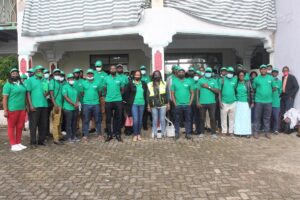
According to REMA, the Green Amayaga Project has already achieved significant results by restoring degraded landscapes through agroforestry, the planting of new forests, the protection of the Kibirizi–Muyira natural forests, and the implementation of livelihood-enhancing initiatives for local communities.
REMA clarifies why it has chosen those three districts. It explains that while selecting districts for project implementation, it prioritizes those facing the most critical environmental challenges, since “it is not feasible to secure a project that can operate in all 30 districts of the country”. This institution adds that it would be ideal to obtain a project covering the entire nation, though this is highly unlikely.
As a typical example to substantiate its selection process, REMA points to the Amayaga Region which was on the verge of turning into a desert. The fact that this region was going to become a desert is the reason behind its selection. The Amayaga Region is situated within four districts—Kamonyi, Nyanza, Ruhango, and Gisagara—but it comprises only 20 neighboring sectors located in these districts, not all the sectors across the four districts.
Kibirizi and Muyira forests are interconnected and represent the only remaining natural forests in the region. For example, the Muyira forest had been heavily encroached upon, with people living in and cultivating parts of it, causing it to nearly disappear. However, REMA says that the forest has since been restored, and there is now a plan to have it registered as an international heritage site, similar to Gishwati Forest.

“We are deeply grateful to the Global Environment Facility for this new support,” says Juliet Kabera, Director General of REMA. “This project allows us to build on the momentum created by the Green Amayaga Project and expand our efforts to restore ecosystems and protect biodiversity. Restoring degraded ecosystems is not just about protecting nature—it’s about securing livelihoods, building resilience to climate change, and creating a better, more sustainable future for all.” “We also appreciate the World Bank for the technical support provided throughout the development of this project, which has been critical in shaping its ambition and design.”
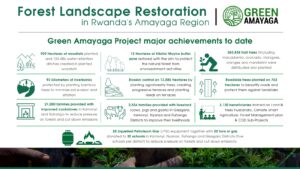
REMA contends that the Green Amayaga Project has accomplished great achievements. For instance, it says “Today, it rains in Amayaga in June, while this had never happened before the project.” The visual summary below provides other details around the project’s attainments.
The new project’s implementation is expected to start in August 2025. Under this project, Rwanda will rehabilitate 2,162 hectares of forests and wetlands, promote sustainable land management practices across 8,931 hectares of farmland, and support the development of income-generating activities that reduce pressure on natural resources. The project is expected to directly benefit more than 289,000 people in the targeted districts.
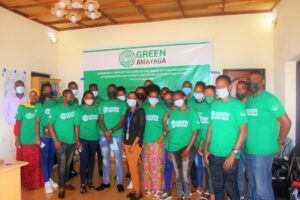
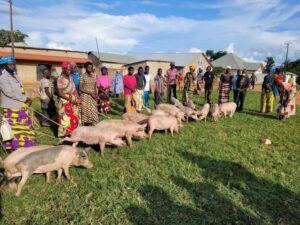
REMA explains that income-generating activities refer to initiatives aiming to improve beneficiaries’ living conditions, such as providing livestock or planting trees—especially fruit trees—combined with crops on their land. This approach, according to this public agency in charge on the environment, enhances the beneficiaries’ nutrition and serves as a source of income, as beneficiaries sell the fruits to earn cash.
The fact that the beneficiaries will be directly positively impacted by the project means that they will benefit from income-generating activities including receiving livestock, being supported to undertake agroforestry, and having their land developed.
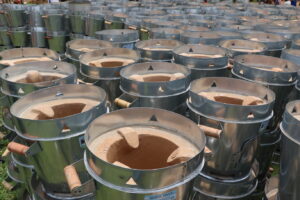
Sustainable land management practices include land development activities such as creating terraces, planting grass that both reinforces the soil and serves as livestock feed, promoting agroforestry and forestation, and providing economic and improved cooking stoves.
Using a landscape-based approach, the project will address critical environmental challenges— such as land degradation, food insecurity, and climate-related disasters, including floods and landslides— which threaten infrastructure, agricultural production, and community well-being in the Southern Province.
At its core, the Rwanda GEF-8 project seeks to restore ecosystems that provide essential services such as erosion control, flood mitigation, and biodiversity conservation. Key interventions will include afforestation, reforestation, riverbank and wetland rehabilitation, as well as the promotion of agroforestry and other climate-smart agricultural practices.
A local initiative with global implications?
The GEF’s approval of a $9 million grant to support Rwanda’s ecosystem restoration in the Nyungwe–Ruhango Corridor does not merely constitute a national milestone—it forms a timely contribution to an urgent global cause.
As the world contends with unprecedented climate and biodiversity crises, localized projects like this represent exactly the kind of interventions needed globally—particularly in regions where environmental and climate vulnerability is most acute.
Globally, land degradation negatively affects over 3.2 billion people and is responsible for nearly a quarter of greenhouse gas emissions. The restoration of ecosystems—forests, wetlands, and farmlands—not only curbs emissions but also strengthens nature’s ability to absorb carbon, manage water flows, and support biodiversity. The Nyungwe–Ruhango Corridor project, focusing on agroforestry, reforestation, and climate-smart land management, aligns closely with international commitments like the UN Decade on Ecosystem Restoration, the Bonn Challenge, and Sustainable Development Goals (SDGs)—particularly Goals 13 (Climate Action) and 15 (Life on Land).
The Southern Province of Rwanda, especially the Amayaga Region, offers a stark illustration of the stakes involved. Once on the brink of desertification, it is now seeing signs of ecological revival—evidenced not just by greener hillsides, but by the unexpected return of June rains, a symbol of hope in a region that had begun losing its seasons. This transformation underscores the power of targeted, evidence-based interventions—a message with profound global resonance.
Moreover, the decision to rehabilitate over 2,000 hectares of forests and wetlands and implement sustainable land management across nearly 9,000 hectares of farmland speaks to the scale needed worldwide. With over 289,000 people expected to benefit directly, this project—if greatly successful, represents a scalable model for countries seeking to simultaneously address environmental degradation, climate vulnerability, and poverty.
International cooperation plays a critical role in such efforts. Rwanda’s partnership with GEF and the World Bank mirrors the kind of multilateral engagement the world must deepen to meet climate targets. As climate-related disasters become more frequent and severe, lessons from projects like the Green Amayaga and the new one as well as other successful in other nations can inform broader strategies—especially for regions facing similar pressures in Africa, Asia, and Latin America.
In a time when despair about environmental decline is common, projects like the Nyungwe–Ruhango Corridor one offer a counter-narrative: one of restoration, resilience, and regeneration. What begins in Rwanda echoes far beyond its borders—reminding us that global progress depends on local action, and that the road to a sustainable planet runs through communities like those in Nyamagabe, Nyanza, and Ruhango.
Reversing the trend through scalable solutions
The environmental and climate challenges facing the world today require more than pledges—they demand practical, scalable solutions firmly tied to the needs of local communities. Rwanda’s Nyungwe–Ruhango Corridor project, backed by a $9 million GEF grant, is one such example. Yet its significance extends beyond Rwanda’s borders. This type of intervention—focused on restoring degraded ecosystems, building climate resilience, and uplifting livelihoods—is exactly what is needed in countries facing severe environmental pressures.
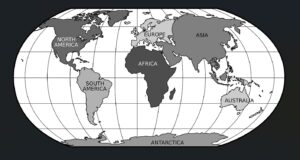
Across Africa, Asia, Latin America, and even parts of Europe, land degradation, biodiversity loss, and climate-driven disasters are intensifying. What Rwanda and other countries on the same path are doing offers a roadmap for how nations can combine environmental rehabilitation with economic empowerment. Income-generating activities, sustainable farming techniques, and forest restoration are not luxuries—they are tools of survival and long-term sustainability.
To reverse global environmental decline, people need thousands of projects like this one—tailored to local contexts, rooted in scientific and indigenous knowledge, and supported by national commitment and international cooperation. Countries experiencing the most severe degradation must be placed first for such interventions.
A global strategy rooted in local realities

If the global community is serious about reversing the trend of climate deterioration and biodiversity loss, it must begin by replicating grounded, community-focused restoration projects. If the one now being launched in Rwanda’s Southern Province succeeds especially extraordinarily, lessons to be drawn from it—especially its integration of climate-smart agriculture, forest and wetland rehabilitation, and livelihood support— should be emulated in many of the world’s most environmentally fragile areas.
Countries that are most vulnerable to climate change often lack the resources to implement large-scale interventions. Yet they are the very places where action is most needed—and where it can generate the most dramatic impact. Projects like Rwanda’s show that when supported with the right financial and technical resources, even small nations can lead the way in ecosystem restoration.
By focusing on vulnerable communities, degraded landscapes, and income diversification, the Nyungwe–Ruhango Corridor project addresses multiple crises at once. It reduces pressure on forests, improves food security, and prevents disasters like floods and soil erosion. If immensely successful and replicable across other regions—particularly in countries facing similar environmental stress—such interventions could become a central pillar of global climate response.
It is not global conferences or policies alone that will reverse environmental decline—it is projects like these, replicated and sustained. Rwanda’s effort—as well as that of other nations— should serve as a call to action for international donors, development agencies, and governments: the solutions are here; they simply need to be applied where they’re most needed, and at the scale the crisis demands.