By Editorial Staff
The world is undergoing a profound transformation as geopolitical rivalries intensify, international organizations struggle to resolve competing interests, and technologies like artificial intelligence expand humanity’s power while engendering new risks.
Against this unsettled backdrop, Russian President Vladimir Vladimirovich Putin delivered a wide-ranging speech at the 23rd annual meeting of the Valdai Discussion Club in Moscow on 1 October 2026. He grabbed an occasion to warn about escalating confrontation, a changing international order and the rising difficulty of remedying global challenges such as climate change, environmental degradation, poverty and inequality amid geopolitical rivalry. The Valdai Discussion Club constitutes a Moscow-based thinktank and international forum which hosts annual discussions on global politics and Russian foreign policy.
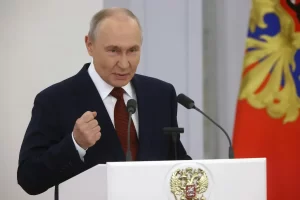
According to The Singju Post where we have found a transcription on which this article predominantly hinges, Putin’s speech focused on the emerging multipolar world order, the crisis of international institutions, artificial intelligence, and the growing risk of global escalation. Putin also responded to questions on the Ukraine conflict, NATO and Kaliningrad, Iran, China, India, BRICS, the Russian economy, and the future of Europe.
His call for a less Western-dominated, more multipolar order and his argument that confrontation over competing blocs can enfeeble wider international cooperation gain broad points of convergence with arguments advanced independently by influential thinkers.
American political scientist John J. Mearsheimer has argued that NATO enlargement formed a central cause of the Ukraine crisis. Professor Jeffrey Sachs, also an American, has similarly criticized NATO expansion and the failure to build a broader European security arrangement. German statesman Egon Bahr earlier cautioned against perpetuating Europe’s division into hostile blocs.
Nevertheless, these convergences should not be mistaken for complete agreement with President Putin: rather, they show that some of the questions he raises—about the consequences of bloc confrontation, the architecture of European security and the shape of a changing international order—stretch beyond Moscow and have been debated by prominent thinkers from different intellectual and political backgrounds.
The subsequent question is therefore larger than President Putin’s speech itself: as the international system experiences a deep change, can humanity defeat geopolitical rivalry sufficiently to collaborate on the problems which threaten its common future?
The world is starting an era of transformation across every sphere
At the very start, this chief of state declared “We are gathering the annual forum of Valdai International Discussion Club in order to discuss the most topical global issues. We’ve always tried not only to give the diagnosis for the state of the world, but also to outline the shapes of the emerging world order.
And I’m convinced that the intellectual expertise and experience of a direct and trustworthy conversation accumulated by the club will come in handy necessarily when all of us, East and West, North and South, sooner or later will have to agree on the principles of the shaping of the new world order capable of ensuring progress and development of humanity for the coming decades.”
President Putin utters the following words, always at the beginning of his speech. “Unfortunately, we have to admit that today we are facing different tasks, much more urgent and acute. Our moderator [Fyodor Lukyanov] has already told me that we need to calm everyone down, but the acute issues are still there. The alarming trends that we observe at the international arena make us think primarily not to… The way how we should organize the global interaction currently in a more reasonable, effective and just way, though all of that is extremely important. But we have to think on how to maintain global peace and security.
Right now, when many previous rules have been cast aside and the new rules are not yet emerging. What needs to be done in order to avoid most catastrophic scenarios? The responsibility of our common future is far from an abstract motto. This is a set of practical actions with a view to prevent humanity from coming to the brink of extinction and to avoid the irreparable. The world has come to a decisive turning point in development. The matter is not only about politics. Politics is, as usual, a derivative of deep changes.”
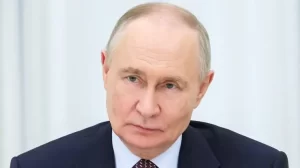
Russia’s leader, Putin, underlines profound changes are already taking place and that they are skipping no sector. “These changes are happening in all spheres, starting with any technology, ending with the social structure of society, climate to health care, military affairs, to bioethics, matters of future of energy, to demographic shifts, comprehensive digitalization and artificial intelligence, to comprehensively new models of economic development. This list is rather long. On the whole, it creates conditions for a qualitative transformation.
All of these circumstances and outcomes cannot be evaluated definitively and comprehensively, at least for a reason that the changes that I mentioned are happening simultaneously and their impact on the society and state are rather contradictory, and I will go in more detail later. The scale of changes of what’s happened and what is yet to come is tremendous. We seem to understand that. It’s for a reason that there are so many debates on the future quite often with a well pronounced sense of alarm due to uncertainty and unpredictability.”
“A completely new reality”
A new environment being forged by the changes has already gotten to the door, according to President Putin, but humans have not utterly realized it. “However, humanity, though it feels tremendous changes, still is not yet fully aware of the caliber of challenge that it’s facing. This is a beginning of a completely new reality. Trends and dangers are closely intertwined with opportunities and outlooks. They are part and parcel of each other.
Our whole life is going through change. I’d like to highlight once again when not really talking about the shift of balance of powers between major powers or redistribution of economic and technological impact. Naturally, it’s all important and it’s happening. But most importantly, these changes touch upon biological, moral, and ethic nature of human and his essence, the modus, the of human and foundation of the world outlook.”
He stresses the paradox of technology. “Technology is opening a fantastic, important sci fi outlook for extension of longevity and quality of life, but they also bring the new level of possibility of total destruction.”
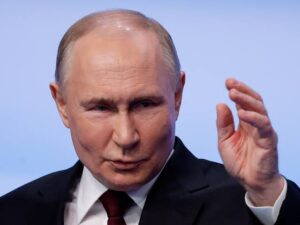
He continues “And as a result of military conflict, fast deterioration of environment or cost of control over the […] And very we [way] of achieving increased domestic tensions without… With the lack of understanding what the future is to hold. One of the consequences of that is feverish domestic politics, especially so since the classic party systems diminishing in their reflection of the fast shifts in social structure. Any state, whatever the system or whatever the cultural historical traditions it has, inside stability, and I think you will agree with me here, is always most important.
And in order to maintain such stability, governments may undertake very different actions that could have an impact on the situation outside of the country, neighboring countries, regions, and in the world on the whole. In other words, unfortunately, this could be called the export of instability. All of that only exacerbates and increases and raises the temperature, so to speak, in international atmosphere.”
President Putin doesn’t rule out continual wars. Yet, he underscores that ‘Western hegemony’ is crumbling and hopes a better world. “Whatever the scenario that will happen in the future, unfortunately, it is very likely that international conflicts will continue, especially since major changes and opportunities opened by that only feed into the ambitions and stimulate the ambition, appetite for the risk for a seemingly big gamble. I would like to be wrong in my evaluation, but it seems that Brazilian trends of today are unfortunately indeed such.
But we’re confident that in strategic perspective, as a shift from Western hegemony is happening, the global situation will change for the better towards a more stable democratic and free multi polar world order. But it’s also apparent that on the path to such world order, many risks await us for states, communities, for each and every person. It is unavoidable amid major changes. Therefore, minimization of risks at all levels, from global to personal level, is the main task and responsibility of decision makers in politics, businesses, science, and in life in general.”
He adds “Many things depend on such people. Responsibility is to help people to become cognizant of such risks and be prepared for them so that a person, a family would not be left alone with the issues in fear of security, changing labor market for digital space and so on. What is especially important in my view? Carefulness and caution not to land under an avalanche of uncontrolled changes. Should there be an active and proactive approach to prevent most unfavorable scenarios? Should the current circumstances be used to their own advantage?
There is no single answer in each case. A separate policy is more relevant. People are trying to adjust to what’s happening… However, amid a public crisis, as it is called today, comprehensive and ubiquitous, it’s very hard to detach themselves from daily governance crisis and to look to the future beyond the crisis. The current responsibility is tremendous. Any mistake may come at a very high price for the future. For example, current tasks often push to the back burner strategic goals. It is easily explained. However, it is tremendously dangerous.”
“The Crisis of International Institutions and the United Nations”
“Responding to many current issues is impossible without taking into account how our current actions will impact the future. As one of the famous classics of Russian political thought said, one should see the forest for the trees. So what’s the picture on the whole?
It is apparent that the mechanisms of agreeing on the interests and actions of states that used to be created during the previous periods are incapable of efficiently conducting governance, [not] because these mechanisms are bad, but since the conditions when and why they were created have changed. A new reality that is emerging will naturally help create new tools, but it is a very lengthy process,” President Putin states.
He bluntly highlights “Let’s be frank. Some international organizations quite often do not curb risks, but rather beget and provoke such risks serving the interests of one country or a group of states. And they were not created for that. Criticisms is voiced towards such foundational institution as organized as the United Nations, which according to its charter is called to play the central coordinating mechanism in global affairs. Quite often, this criticism is not objective.
However, there founded criticisms as well. Partly, it has to do with the fact that the UN, though it is the most representative global organization, is essentially managed not as collegially and democratically as it was conceived. Disproportionately great impact is in the hands of the limited group of western countries, which being an apparent global minority has essentially hijacked the management function. And since the real impact of these countries is diminishing towards a more sovereign and confident global majority, the imbalances of the UN institution are thrown into great relief. This is a systemic issue that cannot be solved overnight.”
Russia’s Number one vehemently promotes a UN reformed actively engaging all nations from Asia, Africa, Latin America and the Middle East too. “Russia, before and right now, supports the idea of a just reform of the United Nations, but it’s impossible without the inner consensus, which is hard to achieve right now. I’d like to repeat that we’re consistently advocating for the UN structure to reflect the diversity of the whole world. So a more significant role would be played by the countries of Asia, Africa, Latin America, and Middle East.
It’s important to keep in mind that the UN transformation is not only the expansion of the Security Council and other measures on a more balanced geographic representation of the countries in the international governance bodies. This is new content and essence of the work of the organization.”
“Artificial intelligence and digital sovereignty.”
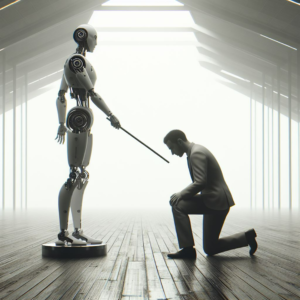
This top leader is Russia points out “Priority dimensions for its activity, including future dimensions, especially since the global changes create tremendous number of new dilemmas, which were simply not present in the past. Most evident example is the artificial intelligence and we yet to learn how to live with it. What would be the impact of its rapid development on the intellectual level of humanity? The impact on spiritual and cultural heritage. It is no coincidence since such a term as careful digitalization is being discussed.
That is, abandoning uncontrollable introduction of such technologies into those fears that have always been important and doubted for ethical development of the person. And socio humanitarian aspects of expansion of artificial intelligence is now being analyzed more thoroughly than technical or economic.”
He adds “Experts increasingly alarmed by the development and distribution of artificial intelligence, which could be yet another attempt to bring everyone to a common denominator to facelessness now through the use of algorithm established by someone. Such digital totalitarianism would be a dead end and dark and inhumane as well known examples of totalitarian societies of the past.
And yet another important matter, it is relevant today and will become even more relevant. It is how the states are becoming more and more digitized, may ensure sovereignty in this sphere. It is how can they guarantee their security and uniqueness without falling off from global progress and falling behind in technological development.”
Advancements in science and technology are arming humanity with unprecedented power to deeply alter not only the world around us but also human biology and potentially influence human behavior and thought—bringing deep questions about the limits of human intervention and the need for international cooperation to handle them responsibly. Putin underlines that humanity should be cautious about assuming powers regarded as belonging to God. “A different dimension where science and technology drastically change the world is the capacity of human to deeply interfere into what was previously thought as prerogative of the creator.
Genetic changes of the body impact on the shaping of a human and programming human behavior in a way of thinking. We need to bring together efforts of countries and communities in order to find acceptable solutions for these very delicate existential matters of existence. It would make sense to conduct such work as part… within international organizations, but many of them, as I have already said, are under excessive influence of the West. […] that have an interest…”
He however underscores that the interest doesn’t benefit all humanity. “They have an interest not in overall progress, but rather in maintaining their power. Institutions, which used to be efficient after the 2nd world war, do not reflect the situation of the second quarter of the current century..”
“New international associations and BRICS. The responsibility of great powers”
President Putin says “Is it possible to effectively reform it so that it would be in line with the modern reality? This is an open question. New international associations emerged born by the current global situation. Naturally, they have great outlook. Be that regional associations or such global associations, for example, as BRICS. However, we need to admit that they have a lot of work ahead of them to define their own functionality, how to optimize the spheres of application and the limits of their capacity.
It’s hard to expect from recent associations that [they] will be fast in building the world and shape its multipolar model. Well, it will be too much. This is a lengthy and thorny path with many unknowns, but it will bring results. Absolutely. Does it mean that we are right now doomed to chaos? No. Such a verdict would be premature. In general, the world regulated through clearly written norms and defining institutions, the world, and ordered world, so to speak, is a recent invention of the past century. All previous centuries did without it.”
The following words also emphasize that the world is not condemned to chaos. “Conceitedness, jealousy, and lead have always had place in global politics, and this happens today as well. Nevertheless, responsible powers have always, this way or another, have competed with each other, but still they cooperated. They constructed and conducted systems of relations, other smaller states as well. And in general, they try to preserve stability.”
“The responsibility of great powers”
According to Chief of State Putin, “Right now, against the backdrop of crisis of institutions and deterioration of international law, big countries have tremendous responsibility commensurate with their tremendous opportunities. Such states have potential for actions that could, in one fell swoop, change the global trends towards greater predictability and security or, on the contrary, to deterioration and avalanche of issues. Such potential has a multiplier effect due to new technologies that I’ve already mentioned.
It is apparent that how efficiently the risks are being managed at the stage of rapid changes would define the future of all world and means every person. The lack of widely recognized rules, understanding of the principle of equal and indivisible security quite often pushes or abandon such principles pushes towards egoistic behavior. And in some cases, it’s turning into aggressive attempts to achieve unilateral advantages, worsen the chaos and music in their own interest. Global politics gives us examples of that basically every day. Taboos, thinkable and unthinkable, are being violated. I will not be naming what’s happening, but I think that everyone present here is fully aware of that.”
He goes on, underlining “I’m deeply convinced that such complicated matters as international relations requires delicacy, observing not only the laws adopted, but as the advocates of common law, usually say, not only the letter, but the spirit of law and established and recognized custom. Moral and ethical limitations in decorum are important because the respect for him creates an opportunity for at least some kind of dialogue.
On the contrary, systematic violation of commitments, deceit, turning communication into travesty, turning every meaningful conversation to a propaganda, conspicuous mockery of facts and turning them inside out in order to achieve temporary benefit, that all that diminishes the foundation of international existence.”
There is conduct that President Putin castigates. “And I think this behavior is very myopic and dangerous. Temporary gain achieved through that might turn into a long term failure and most importantly deteriorate the situation for everyone since the interconnectedness of the world is still there. ‘All brawn and no brain’ principle seems guiding for some international stakeholders. They’re convinced of their own military, political, economic, and as I think moral exceptionalism. We know very well from history that it would bring nothing good.”
What has he declared about the Ukrainian conflict and NATO?
“I’ll get distracted from the main topic. I think there are people present here who have very different viewpoints on the very acute conflict that is the Ukrainian conflict. Views of reasons for him. I would like to say a few words about it. Yes. Many hundreds, even thousands of experts, your colleagues will be studying the materials of this session of the Valdai Club also have their own thoughts in this regard. And I’m sure that part of the expert community will have a question. ‘Russia is talking about peace, and Russia started a war.’”
“And I’ve responded to that notion many times. But I’d like to repeat myself the war, but the war was started against us. They shouldn’t have encouraged aggressive nationalism and Russophobia in Ukraine in order to turn it a tool of fighting against Russia. They should… NATO should not have started military exploration of our historic territories in the interest of NATO.”
He continues, mentioning other acts, in connection with Ukraine, that NATO should not have accomplished. “They should not have planned their bases there. They should not have pushed radicals in Kyiv towards a coup d’etat. They should not have used this legal regime created through this coup. They should not have pumped it through different offensive weapons.
They should not have made plans of how to organize concentration camps for Donbas and Crimean citizens. They should not have used tanks, fired missiles, shut down from airplanes, and burned alive unarmed people only for the fact that they’re Russian in nationality and in spirit. There are many such ‘they shouldn’t have,’ but I will stop here.”
He explains thar the war stands justifiable. “I’m sure that Russia has been deliberately put in a situation where it was simply forced to respond to this apparent aggression. Was forced to defend itself, taking up arms. They put us to this red line deliberately, and Russophobia, prosecution, killing of Russians and destruction of Russia should not be turned into a state ideology. They should not put it as goal of strategic defeat of Russia. That’s the way we’ve heard it all. No one forgot it. At least we didn’t forget it. If we want to live and everyone wants to live, but as I said, once when I spoke publicly, ‘let’s believe in peace and friendship.’”
He further states “Let’s search together for making this a reality. Building trust is a process both complicated and fragile. Trust is very difficult to foster, very easily broken. The interests of the most close partners cannot coincide fully, much less so the countries that are in a state of rivalry, fierce competition, let alone confrontation sooner or later, the international system will come to a state of stable balance.
Certainly, this is a complex multifaceted, multi tier process which requires compromise, accommodating one another, and a clear headed assessment of the situation, in particular, from the part of the West. The former hegemon will inevitably have to realize the realities of the multipolar world. This is inevitable. Look at the economic trends. It will have to learn to cooperate with the countries of the world majority on the basis of respect for its… For their brute interest.”
He underlines that the state of stable balance won’t materialize for one day or be an easy achievement. “This will not happen overnight. We will have to live in a very unstable, volatile world. The path towards the new system will be rife with unexpected turns and twists, and very often, they will be unpleasant and dangerous, unfortunately.”
John J. Mearsheimer on President Putin’s point
John J. Mearsheimer, an American political scientist and prominent international-relations realist, concurs with President Putin on the issue of NATO expansion toward Russia. He has argued for years that NATO expansion, particularly the prospect of Ukrainian membership, creates a serious security dilemma with Russia. In his analysis of the Ukraine crisis, he explicitly describes NATO expansion into Eastern Europe and ultimately toward Ukraine as a major source of the confrontation.
That overlaps strongly with Putin’s claim that NATO’s eastward expansion and prospective presence in Ukraine has begotten the security crisis. However, Mearsheimer’s analytical framework does not automatically endorse Putin’s subsequent military actions.
In his 2014 article headlined “Why the Ukraine Crisis Is the West’s Fault: The Liberal Delusions That Provoked Putin” published in Foreign Affairs— a highly influential U.S. foreign-policy magazine/journal published by the Council on Foreign Relations, he says “According to the prevailing wisdom in the West, the Ukraine crisis can be blamed almost entirely on Russian aggression.
According to the prevailing wisdom in the West, the Ukraine crisis can be blamed almost entirely on Russian aggression. Russian President Vladimir Putin, the argument goes, annexed Crimea out of a long-standing desire to resuscitate the Soviet empire, and he may eventually go after the rest of Ukraine, as well as other countries in eastern Europe. In this view, the ouster of Ukrainian President Viktor Yanukovych in February 2014 merely provided a pretext for Putin’s decision to order Russian forces to seize part of Ukraine.”
He continues “But this account is wrong: the United States and its European allies share most of the responsibility for the crisis. The taproot of the trouble is NATO enlargement, the central element of a larger strategy to move Ukraine out of Russia’s orbit and integrate it into the West. At the same time, the EU’s expansion eastward and the West’s backing of the pro-democracy movement in Ukraine—beginning with the Orange Revolution in 2004—were critical elements, too.
Since the mid1990s, Russian leaders have adamantly opposed NATO enlargement and in recent years, they have made it clear that they would not stand by while their strategically important neighbor turned into a Western bastion. For Putin, the illegal overthrow of Ukraine’s democratically elected and pro-Russian president—which he rightly labeled a ‘coup’—was the final straw. He responded by taking Crimea, a peninsula he feared would host a NATO naval base, and working to destabilize Ukraine until it abandoned its efforts to join the West. Putin’s pushback should have come as no surprise.”
He emphasizes “After all, the West had been moving into Russia’s backyard and threatening its core strategic interests, a point Putin made emphatically and repeatedly. Elites in the United States and Europe have been blindsided by events only because they subscribe to a flawed view of international politics. They tend to believe that the logic of realism holds little relevance in the twenty-first century and that Europe can be kept whole and free on the basis of such liberal principles as the rule of law, economic interdependence, and democracy.
But this grand scheme went awry in Ukraine. The crisis there shows that realpolitik remains relevant—and states that ignore it do so at their own peril. U.S. and European leaders blundered in attempting to turn Ukraine into a Western stronghold on Russia’s border. Now that the consequences have been laid bare, it would be an even greater mistake to continue this misbegotten policy.”
To clarify it, he says “Imagine the outrage in Washington if China built an impressive military alliance and tried to include Canada and Mexico in it. Logic aside, Russian leaders have told their Western counterparts on many occasions that they consider NATO expansion into Georgia and Ukraine unacceptable, along with any effort to turn those countries against Russia—a message that the 2008 Russian-Georgian war also made crystal clear. The United States and its allies should abandon their plan to westernize Ukraine and instead aim to make it a neutral buffer.”
Professor Jeffrey D. Sachs echoes both of them: Putin and Mearsheimer
Professor Jeffrey D. Sachs is an American economist and international-policy scholar. Professor Sachs has likewise argued that NATO expansion and the failure to negotiate a European security arrangement acceptable to Russia constituted important factors resulting in the Ukraine war. He has equally specifically argued that Ukrainian neutrality would have formed a safer path and criticized the U.S. refusal in 2021 to negotiate over NATO enlargement.
“This conflict is actually decades in the making. It didn’t just come out of a Russian invasion in 2022, as is often said in the Western mainstream media. The war is often defined as an unprovoked attack in 2022. Actually, the roots of this war go back to the end of the Soviet Union and to the geopolitics around that. In 1990, the US and Germany promised the Soviet government at the time, Mikhail Gorbachev, the President, that NATO would not move one inch eastward if Gorbachev went ahead and disbanded the Soviet Military Alliance.
In other words, there would be a deal that on the Soviet side, the military alliance, the so-called Warsaw Pact, would be ended, and on the Western side, NATO would not take advantage and Germany would be reunified, but NATO would not move one inch eastward. The US cheated on that because as soon as the Soviet Union ended in 1991, the policymakers in Washington, especially in the Pentagon and in the permanent state in the United States, immediately planned for the Eastern expansion of NATO,” explains Professor Sachs in his June 2023 interview, with The Creative Process — One Planet Podcast.
This bestselling author, global leader in sustainable development— works as a Columbia University Professor and Director of the Center for Sustainable Development. He published the interview on his website named after in June 2023.
He continues “Well, many things happened over the 30 years between the early 1990s and today, but probably the highlights to mention are that in 2008, George W. Bush forced NATO, pushed NATO, but really pressed that NATO would announce that Ukraine would become a member. And that happened at the Bucharest NATO Summit in 2008. The Russian leadership was furious. They had warned again and again: Don’t do that. We don’t want your military right up against our 2000-kilometer border with Ukraine. Then a Ukrainian President won the election in 2010 on the program of neutrality for Ukraine.
Viktor Yanukovych won the election based on the idea that Ukraine doesn’t want to become the battlefield between two superpowers and called for neutrality, which had been enshrined in the original Ukrainian Declaration of Independence, but then was abandoned by some of the NATO-oriented politicians of Ukraine. So in 2010, Jankovich called for neutrality, but he was overthrown violently in early 2014 with US participation. So this was really a terrible escalation because the relatively pro-Russian president, but one who called for neutrality, which I think was the only safe course for Ukraine, was overthrown. And the United States played a significant role in that.”
Expanding upon what he has just said, Professor Sachs adds “People know about the famous tape of Victoria Nuland, who is now our Under Secretary of State. At the time, she was the Assistant Secretary of State and she described who the US would see as the next government three weeks before a violent overthrow. The US signed several statements in 2021 confirming that NATO would enlarge. I think this was all absolutely irresponsible.
Russia massed troops on its border and put on the table a draft US-Russia security agreement on December 17th, 2021 based on no NATO enlargement. The Biden administration formally replied that it was not willing to negotiate over that issue in a response in January. Then Russia invaded on February 24th, 2022, making clear that it was the failure to reach an understanding on the NATO question that was central to Russia’s action.”
Professor Sachs reminds us that it came to pass that Ukraine’s President Volodymir Zelenskyy changed his mind with regard to the war, but that he was dissuaded by the United States of America. “Four weeks later, Zelenskyy declared that Ukraine was accepting of neutrality. In other words, the initial Russian invasion brought Ukraine to the negotiating table, and during the second half of March, with the Turkish government being the mediators, Russia and Ukraine hammered out a peace agreement.
Incredibly, the United States blocked it because the United States told the Ukrainian government you fight on because American policymakers had two ideas. One was that Ukraine should not be neutral. It should be a NATO country. And second, that the war would be won by some combination of Western armaments and financial sanctions.”
The Creative Process —One Planet Podcast raised to Professor Sachs a question around the U.S. ‘hegemony’. The question was asked as follows: right now the US is not looking after the prosperity of its own citizens but is going out conducting these irresponsible wars when it could be focusing on other things: the environment, education, health care, infrastructure… Ironically, what seems to be behind it all this insistence on a unipolar world and dominance, is the US wants to hold onto its status as a reserve currency but under the economic sanctions the US has also suffered. It might even be hastening the strengthening of currencies of other countries.
The following is Professor Sachs’s response. “The basic point is the US has 4.1% of the world population. So how could it presume to be the world leader? You know, the US is a powerful country. It’s a rich country, but it doesn’t run the world, and it should not aspire to run the world. That’s a kind of madness, and the US ideology for a long time has been that the US should run the world. It’s, to my mind, unbelievable. But then again, I’ve spent most of my career outside the US seeing the other 95.9% of the world.
And I know that the other 95.9% of the world doesn’t want the United States to run the world. It’s not against the United States. It just says: let us have our own part of the world. We don’t want you running the world. We don’t want you deciding what our government is, who we are, how we rule ourselves. You know, you’re just one place. And this, the United States leaders don’t understand. They’re very arrogant. They’re very ignorant because of the two big oceans. They’re very unaware of the history of other parts of the world.”
He underscores “And we end up with this arrogant and naive and dangerous foreign policy because, there’s no doubt the United States is rich and powerful, and it makes lots of weapon systems. And I’m 68 years old and the United States has been at war almost every year of my life from Vietnam and Laos and Cambodia and Nicaragua, Afghanistan and Iraq and Syria and Libya, and now Ukraine. Come on, give it a break.”
“Lessons From the Collapse of the Soviet Union”
He says “And in this particular case, I would like to turn to our Russian history. Russia has traveled the arduous path of radical transformation, and this process is still ongoing. 35 years ago, we survived the collapse of our state system, which turned out to be a genuine tragedy for dozens of millions of people, both in our country and in other countries because in one night, people woke up to a new country. It changed their future and their children’s future both within Russia and in the neighboring countries, which brought about fundamental transformations within the world affairs in Russia.
I would like to take note of a certain naivety, Syriite idealism, carelessness probably of the people who stood at the helm of the country during the last Soviet years. They blindly trusted the Western partners. They were confident that certain gentlemen’s agreements would be sufficed when you take your partner on their word, which played a cruel joke with the Soviet Union.”
He provides clarifications on blunders that the Soviet leaders perpetrated. “In hindsight, it becomes clear how devastating a role it has played in the history of the USSR and for the long term world stability. The Soviet leaders wanted the West to like them, whereas the western leaders wanted to reshape the world to their liking, and they wanted to cut the legacy of the Soviet share, the bigger the better, and we see how it turned out.
The Soviet Union’s collapse was due to a combination of internal imbalances. We have to be frank about that as well as the mistakes made by succeeding generations of the country’s leadership, the short sightedness, the narrow minded, and erroneous ideological stereotypes rather than pragmatism, unprofessionalism, and also downplaying apparent problems, all of that gradually eroded and chipped away at the internal and external position of the USSR and brought about its collapse at the end.”
He says that current wars represent the legacy of behavior which characterize the leadership at end of the last century. “The ongoing conflicts and shocks that are engulfing the world, to a large extent, are the fruit of the reluctance, the unwillingness, or inability of the politicians of the end of the 20th century, both in the West and in the East, to have a serious and in-depth look at the nonnumental changes they were facing.
This is not shifting the blame. This is a reality. But back then, both in the East and in the West, there were other politicians who had an in-depth understanding of the problems. And I think they proposed the right ways to dealing with those problems. And their assessments right now can be called prophetic.”
“The Vision of Egon Bahr”
President Putin says “A couple of times, I spoke publicly about Egon Bahr, a political leader who was a member of the leadership of the Social Democratic Party of Germany. Let me… When I read about his contacts with the Soviet leadership both in Bonn and in Moscow, I was surprised, astonished by how well versed he was, how unwell he understood the situation. Let me quote some of the statements that he made in June and February 1990. As you understand, this was the turning point for both Europe and the world.
The most important thing that Mr. Bahr was concerned about was the threat that the confrontation would persist in Europe even after Germany reunited and the positions would be reinforced of those circles, and I quote, ‘of NATO that were far from willing to embark on the path of pan European cooperation and putting an end to this confrontation.’ This is a quote.”
This chief of state adds “He saw that firsthand, so he understood that better. And because of the talks in 1990, Egon Bahr said, and I quote, ‘unless decisive steps are made to overcome Europe’s split into hostile blocks, the development work might have very… Would take a very unfavorable turn that would condemn the Soviet Union to international isolation.’ This is another quote of his. So what was he proposing instead? Incidentally, his forecasts turned out to be true in the end.
So what was the proposal instead? There was a proposal that a council of Europe should be established with the participation of both The US and The Soviet Union and endowed with big powers. It was supposed to include almost all of Eastern and Central Europe. And yet after the Soviet Union’s collapse, the West saw the triumph on those forces that, according to Egon Bahr, were ‘far from willing to embark on the path of pan European cooperation.’”
President Putin explains why the world of today is experiencing a tragedy. “And I would like to highlight that despite the many years of Russia’s attempting to become part of the so called Western civilization, in practice, those sagas were doing their best to isolate and finish the dismantling of the Russian Federation itself because they saw it despite all of the changes that had transpired within Russia as a key part of historical Russian empire, and they’re still seeing that. Different events, different get togethers, they say ‘we have to finish the dismantling of Russia.’
All of this has brought about the current dangerous situation Europe and the world are facing. I would like to draw your attention, ladies and gentlemen, that I believe Mr. Bahr was thinking solely about the future of Europe, and he was also thinking about the common European home that the Soviet leaders had been speaking about so much. Unfortunately, they did not go beyond rhetoric.”
“A road map for the future” and “the danger of escalation”
President Putin notes “Russia probably knows better than anyone else how difficult it is to overcome the consequences of historic catastrophes and trying to discover the way forward in favorable circumstances. It had to use the trial and error and come up with off the cuff solutions. But we never lose sight of the fact that any nation needs a long term vision. It needs to understand where it’s moving in future because there is future.
The legacy of our ancestors who built a great unique country should be reinforced and enriched. Without historical foundation, without respect for traditions, no society can exist. But the adverse is equally true. Without the future, the past loses its sense. Whatever and however grandiose the achievements of our forefathers, we cannot allow ourselves to turn into a museum, a shrine of erstwhile greatness. The genuine greatness of the country is impossible without the ability to keep a breath of time ideally ahead of it. We have to enrich our legacy and develop it creatively to make it adapted to the new circumstances.”
He adds “This will be the best guarantee that our national tradition is not going to be an antique, a passionable historical accessory. It should be rather a living, fruitful environment. This is what our guiding principle should be for our future achievements.
As far as the future is concerned, a lot of it is truly veiled with uncertainty because there are too many factors that are volatile and uncertain, but we need a road map to this future. This is no utopia. These are no abstract concepts nor is it… We should think in that is divorced from reality. This is rather a realistic assessment of risks, opportunities, and goals we need. Russia is building such a road map for itself, but it stands ready to work together with other countries. And nations of the world on a similar road map of the world.”
“The danger of escalation”
President Putin highlights “And I would like to say that the scale and the pace of the changes the world is facing are unprecedented. And we have to understand that the point of no return can happen very fast and very unexpectedly. It will just turn out that the logic of escalating mutual tough responses will turn into a fatal inevitability. Right now, there are descriptions and forecasts about the world, conflicts, and the world escalation is heard increasingly often.
The unwillingness to turn to genuine diplomacy, is based on realities and on due respect for the interest of one another, pushes everyone to escalating the situation, to breaking the stakes, to bluffing, to overcoming, overstepping the red lines, and the hopes of overwhelming and intimidating the opponents of breaking them. This escalation of hostilities and sanctions, there’s nothing new there. It was resorted to in many conflicts, but it is never unilateral because provocative steps from one side get a response from another, and the spiral is winding up, and the devastating consequences are becoming increasingly dire.”
He adds “This escalation is based on arrogance and self conceit, and this is what pushes us to the edge of the abyss. Right now, leading countries of the world have their disposal armaments that can swipe away all… While away all life or at least push the path to catastrophic consequences.
Can we be certain that these weapons will never be used? Unfortunately, we cannot be sure because there’s this famous statement ‘if there is a gun hanging on the stage at the beginning of the on the wall, on the stage at the beginning of show, it’ll certainly fire at the end.’”
As the battle over the emerging world order grows more intense, the danger is no longer confined to political or military confrontation—it can reach the fundamental question of whether societies can keep their independence, dignity, and very existence. Against this increasingly dangerous backdrop, President Putin alerts that humanity must not passively await the shape of the future, but must work actively to preclude the most devastating consequences from becoming reality. “So the more intransigent of the counteraction, the more openly the goal of strategic defeat is announced, the greater the chances that the conflict will enter the fiercest stage because the fight for survival is not just happening in the wild, but in social communities as well when people are faced with the prospect of losing their independence, dignity, and existence, ladies and gentlemen.
Let’s hope that the new world would have been trying in the near future, but so far, things are happening very chaotically, very spontaneously. But we are only trying to grasp what the outline of the future will look like, but this doesn’t mean that we should sit idle waiting for whatever will happen. We have to move towards creation, and the stage will arrive sooner or later, and we have to survive the current dangerous moment. We have to prevent the most devastating threats from realizing.”
“Artificial intelligence and the rules of warfare”
Russia’s leader says “I believe there are 2 aspects that are important to be highlighted. I think they have to be a subject for our serious discussion at the political, technical expert, and even philosophical level. The 1st aspect is AI. Right now, the world is engulfed in a discussion whether measures have to be taken to deliberately slow down research and development in AI so as not to allow these technologies to slip away from human control. This is a multifaceted issue which requires a comprehensive consideration.
Humanity’s history demonstrates that technical progress is impossible to stem, but we have to understand what the consequences of progress are, especially when these achievements are used in warfare. There are cases when AI makes its own decisions based on what considers expedient. It applies to both civilian and military users. And in the course of implementation of AI, it’ll assume a greater role.”
He additionally says “The algorithm will… The algorithms will assume greater responsibility, especially because human beings are in… Cannot rival the machine’s capacity to analyze the situation almost instantaneously, but human beings have other qualities such as intuition and possibility of thinking out of the box and making the solution which turns out to be the right one, even sanitary.”
To elucidate his point, he explains “Let me remember a story from the Soviet days, from the Soviet era. September 1983, Lieutenant Colonel Stanislav Petrov was the duty officer, and he received an alert from the early warning system. There’s early warning systems exist both in the US and the USSR. The alert was about the launch of 5 American intercontinental ballistic missiles, and algorithms would have seen that as grounds for a reciprocal strike.
But this officer was experienced, and he had doubts about the accuracy of the alert. He suspected a malfunction of the system, and he turned out to be right. Were at an AI being in his stead, it could have turned out to be quite differently. I think this is a very compelling example. How far AI can be used in security here is the issue that will determine humanity’s survival. AI increases the efficiency of warfare, which in turn brings about greater destructiveness of the conflicts. So what we need is an unbiased professional international discussion on modern warfare.”
He emphasizes “We have to think about preserving humanitarian frameworks, how to limit the cruelest manifestations of hostilities that are caused by the growth of destructive capabilities. I know that you have had a session at this forum which had a very apt subject, and that is ‘the ethics of the new war, humanity, and inhumanness.’ Indeed, this inhumanness of modern conflicts can be seen in 2 ways. On the one hand, there’s the growing cruelty, neglect from humanitarian norms.
There are new forms of confrontation when AI and autonomous systems play an increasingly important role in warfare. They supplant people, especially in the decision-making process. This is a very complex subject which requires our utmost attention because the automation and digitalization of warfare leads to its gamification when bloodshed and the loss of human lives turns out to be a computer game. And this, let’s be frank about that, leads to the degradation, the sliding back of humanity into barbarity.”
President Putin reflects on the long history of warfare and the international efforts to humanize it. Within this context, he argues that the world must once again confront the question of how wars can be fought without relinquishing the humanitarian norms designed to restrain their worst consequences. “Back at the end of the 19th century in 1899, Russia was the one that stood at the origins of the Hague Conferences that, for the 1st time enshrined the rules of warfare as well as peaceful settlement of disputes and humanization of hostilities. These were lofty ideals, but they failed to save humanity from the shocks of the 20th century. World wars seemed to have canceled the achievements of humanitarian law, but now is the time to once again brace the issue of the rules of warfare.
We’re hovering under no illusions. There have always been wars throughout humanity’s history and very probably they will keep happening. Unfortunately, this is an inherent part of humanity’s existence. Combat is the profession of those people who say… Who protect the interests of their countries, but professionalism in warfare requires respect for humanitarian norms. The Russian military have always been guided by the indivisibility of these norms, and I have to highlight that they were never once to be the 1st to attack objects or facilities that have no direct relation to the military infrastructure of the adversary.”
“Global problems and the greater Eurasian partnership”
But these rising international tensions and increasingly acute general confrontation, according to Russia’s leader, carries another negative long-term consequence, and this forms the 2nd factor “I’d like to draw your attention to. The thing is, in this atmosphere of conflict, what gets sacrificed is the search for solutions to global problems that affect humanity as a whole. They have been discussed in the recent years, but they have been relegated to the background. I refer to climate, environment, poverty, inequality. They’re becoming increasingly acute.
But right now, there are no grounds to hope that international community can band together in the near future to tackle these tasks in the near future. But if they cannot be addressed globally, we have to deal with them at the regional level because that’s closer, that’s more understandable for the people because all of us are responsible for the planet Earth, and especially we are responsible for our respective countries and what happens around.”
He specifies “Our home is Eurasia, which is a vast territory, and this is the center of most important processes that are unfolding across the world. How well we build this Eurasia will, to a large extent, determine the future of the world affairs. Amid the growing world instability, the idea of greater Eurasian partnership proposed by Russia and the past takes on a new importance, military and political confrontation undermines the connectivity of the world.
What comes under threat are the supply chains, transportation chains, as well as the established trade routes and communications. So our task and responsibility of Eurasian countries is to protect the space from global risks and their devastating consequences. We have to use these technological opportunities to improve our cooperation within Eurasia, improve the connectivity across these vast territories.”
He indicates that culture and civilizations within this huge region already possesses the ability to act as a solid framework for the region’s cooperation which, in its turn, can affect all humanity. “And I would also like to say that cultural and civilizational entities that are located in Eurasia have the experience of cooperation even during the most difficult historical eras. Across many centuries, Eurasia can serve as a model for international cooperation in the environment of homogeneity of heterogeneity of cultures and approaches and interests when differences become an advantage rather than an obstacle.
And I would like to draw your attention to the initiative our Belarusian friends and we have come up with, and that is the development of a Eurasian charter of multipolarity and diversity in the 21st century. Last week, foreign ministers of Russia, Belarus, Kazakhstan, Kyrgyzstan, and other partners of ours met in the sidelines of the UN General Assembly launching practical work on this fundamental document. The value of Eurasia is that it is self-sufficient. It is capable of overcoming any problems. The only thing what it needs is indivisible security, lack of military threats, and durable peace.”
This vision is not restricted to the Kremlin. Alexander Lukin, a Russian international-relations scholar, and Dmitry Novikov have reasoned that a Greater Eurasian Partnership could allow to create a continent of development, peace and closer cooperation. In their research article published online 5 April 2021 and entitled “Sino-Russian rapprochement and Greater Eurasia: From geopolitical pole to international society?”, they contend that it could bring together Russia, China, India, Central Asia and other parts of Eurasia within an emerging multipolar order. They argue that a new, non-Western international society may be emerging in Eurasia, driven by Russia and China through expanding transport, economic, institutional and security cooperation across the continent.
The article’s abstract reads “Can international anarchy be stabilized, if not globally, then at least regionally? Those scholars who give a positive answer usually refer to the North Atlantic community which can be categorized as an international society from the viewpoint of the English school. The emergence of such a community outside the West is traditionally considered hardly possible. However, this article argues that it may already be emerging in Eurasia, with Russia and China being the key drivers of this trend.
In the past few years, these two powers have put forward a number of major initiatives aimed at developing transport networks and logistics, and deepening economic and institutional ties between different parts of the continent. These include but are not limited to Eurasian Economic Union, supported by Russia, and China’s Belt and Road Initiative. Together, Moscow and Beijing began to form a new platform for security and economic cooperation “from Kaliningrad to Shanghai”—the community of Greater Eurasia. Based on the analysis of the geopolitical logic of these initiatives, this article suggests that a new, non-Western international society may be forming in Eurasia among the states with different political systems and cultures, but common geopolitical aims and fears.”
“Responsibility for the future of the world”
President Putin says “Distinguished colleagues, all of us, the world’s community as a whole, are responsible for the future of the world. This is no exaggeration nor is it a metaphor. It’s an applied task, and we have to address this task immediately.”
He harbors some optimism. “I would like to believe that when our descendants read textbooks, history textbooks, they will see that the second quarter of the 21st century became the turning point when humanity realized the scale of changes and challenges facing its existence and managed to set aside its scaffolds, ambitions, and self-centeredness and banded together to address general problems and turned the technological revolution into an opportunity started to address the issues of social inequality and environmental degradation, not just in words, but in truth, understood there was no future to military confrontation in Diplkad, and understood the need to search for solutions to the problems we are facing and start to build a new stable world order.”
And I’m confident that this is exactly what they will read in those history textbooks because unless this happens, there is a risk that there will be no one to read those textbooks, and these textbooks will never be written. But let’s hope for the future. And most importantly, let’s do whatever we can to make sure this better future arrives and stays with us. And I would like to thank you for your attention, and I would like to wish every one of you success. I highly value these meetings of ours. Once again, thank you.”