By Jean Baptiste Ndabananiye
Colossal trees of California rank among the largest living things that the Earth boasts. These are unbelievably massive and towering trees. Among them, the General Sherman Tree holds the title of the largest by volume, with a staggering 1,487 cubic meters —imagine a cube with each side being 11.4 meters long. The volume of this cube would equal 1,487,000 liters— an immense volume sufficient to fill a large swimming pool, a warehouse or a significant container. Following closely is the General Grant Tree, boasting a volume of 1,320 cubic meters. To visualize their size, these trees each stand as tall as a 16-story building, with the General Sherman Tree’s base being wider than that of numerous city streets in the United States. Transporting trunks of these trees would require at least 20 railroad cars, containing wood equivalent to what is produced on 20 acres of average pine forest.
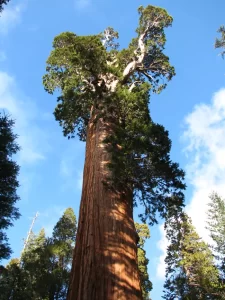
These giants not only constitute natural wonders but also hold significant cultural and historical value. These two trees, along with other sequoia trees in the U.S., offer numerous benefits to the country, underscoring the importance of preserving large trees worldwide, even if they didn’t match the USA’s in size. However, these ancient trees face new threats. As we marvel at these natural phenomena, it is crucial to recognize their vulnerability and commit to their preservation, ensuring that future generations can continue to experience their awe-inspiring presence. Climate change has rendered them more susceptible to pests, diseases, and wildfires. Recent severe droughts and fires have ravaged large swaths of these trees, emphasizing the urgent need for conservation efforts. Meanwhile, the National Park Service (NPS) and various partners are working to bolster the resilience of these iconic trees through controlled burns and other management strategies. This article consists of these key parts:
-
Further details on the size of the trees
-
Top thirty largest sequoias, according to the NPS
-
The General Grant Tree has been made the Nation’s Christmas Tree
- The General Grant Tree, a Living Shrine
-
Benefits of such trees
-
Challenges marring these sequoia trees and action being taken
Further details on the size of the trees
These trees possess an unimaginable size, as already indicated. For example, the General Sherman Tree’s height above the base matches 274.9 feet [83.8 meters]. The NPS, founded in 1916, is a U.S. federal agency responsible for managing and preserving national parks, monuments, historic sites, and other protected areas across the United States.
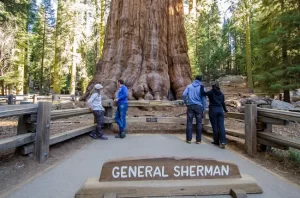
It says that the General Sherman and the General Grant trees are the largest of the giant Sequoias now known. “Many others rank very close to these, including the Washington, Lincoln, and President Trees of Giant Forest; the Hart Tree in Redwood Canyon; the Boole Tree in Converse Basin near Grant Grove; and the Grizzly Giant in Yosemite. It is sometimes difficult to appreciate the size of these trees because neighboring trees also are so large.
At least 20 railroad cars would be required to move the trunks alone, which contain as much wood as is produced on 20 acres of average California pine forest. It is difficult to comprehend the immense size, age and stature of the General Grant Tree, but it is easy to let your mind and spirit rise as its trunk carries your gaze toward the skies. As far as known, the General Sherman is the largest living thing in the world.”
The General Sherman Tree’s dimensions are those below:
|
Tree Description |
Feet |
Meters |
|
Height above Base |
274.9 |
83.8 |
|
Circumference at Ground |
102.6 |
31.1 |
|
Maximum Diameter at Base |
36.5 |
11.1 |
|
Diameter 60′ (18.3 m) above base |
17.5 |
5.3 |
|
Diameter 180′ (54.9 m) above base |
14.0 |
4.3 |
|
Diameter of Largest Branch |
6.8 |
2.1 |
|
Height of First Large Branch above the Base |
130.0 |
39.6 |
|
Average Crown Spread |
106.5 |
32.5 |
The General Sherman and the General Grant Tree belong to the sequoia species. A sequoia constitutes a very tall tree growing in California. The General Sherman Tree is situated in the Giant Forest, a large sequoia grove, set on a rolling plateau between the Marble and Middle Forks of the Kaweah River in Sequoia National Park. “It [the forest] is the largest of the unlogged giant sequoia groves, and it contains more exceptionally large sequoias than any other grove.
In this grove, visitors can see the effects of decades of prescribed burning: open forest conditions and clumps of giant sequoia seedlings that establish after fire,” says the NPS.
The Sanger District Chamber of Commerce (SDCC) is an organization based in Sanger, California, serving as a business advocacy group that supports local businesses and promotes economic development in the area. It points out that the General Grant Tree is large enough to produce enough lumber to construct 35 houses of five bedrooms each. “The tree stands 267 feet high, its lowest branch is 130 feet above the ground, and the circumference of its trunk is 107 feet.”
Top Thirty Largest Sequoias, according to the NPS
|
Tree |
Sequoia Grove |
Land Manager |
Height (ft) |
Ground circumference (ft) |
Trunk Volume (cubic ft) |
|
General Sherman |
Giant Forest |
Sequoia National Park |
274.9 |
102.6 |
52,508 |
|
General Grant* |
Grant Grove |
Kings Canyon National Park |
268.1 |
107.5 |
46,608 |
|
President* |
Giant Forest |
Sequoia National Park |
240.9 |
93 |
45,148 |
|
Lincoln |
Giant Forest |
Sequoia National Park |
255.8 |
98.3 |
44,471 |
|
Stagg |
Alder Creek |
Private Land |
243 |
109 |
42,557 |
|
Boole |
Converse Basin |
Giant Sequoia National Monument |
268.8 |
113 |
42,472 |
|
Genesis |
Mountain Home |
Mountain Home State Forest |
253 |
85.3 |
41,897 |
|
Franklin |
Giant Forest |
Sequoia National Park |
223.8 |
94.8 |
41,280 |
|
King Arthur |
Garfield |
Sequoia National Park |
270.3 |
104.2 |
40,656 |
|
Monroe |
Giant Forest |
Sequoia National Park |
247.8 |
91.3 |
40,104 |
|
Robert E. Lee |
Grant Grove |
Kings Canyon National Park |
254.7 |
88.3 |
40,102 |
|
unnamed |
Garfield Grove |
Sequoia National Park |
273.1 |
99.5 |
39, 562 |
|
Adams |
Giant Forest |
Sequoia National Park |
250.6 |
83.3 |
38,956 |
|
Ishi Giant |
Kennedy Grove |
Giant Sequoia National Monument |
255 |
105.1 |
38,156 |
|
Column |
Giant Forest |
Sequoia National Park |
243.8 |
93 |
37,295 |
|
Summit Road |
Mountain Home |
Mountain Home State Forest |
244 |
82.2 |
36,600 |
|
Euclid |
Mountain Home |
Mountain Home State Forest |
272.7 |
83.4 |
36,122 |
|
Washington |
Mariposa Grove |
Yosemite National Park |
236 |
95.7 |
35,901 |
|
Pershing |
Giant Forest |
Sequoia National Park |
246 |
91.2 |
35,855 |
|
Diamond |
Atwell Grove |
Sequoia National Park |
286 |
95.3 |
35,292 |
|
Adams |
Mountain Home |
Mountain Home State Forest |
247.4 |
94.2 |
35,017 |
|
Roosevelt/False Heart |
Redwood Mountain Grove |
Kings Canyon National Park |
260 |
80 |
35,013 |
|
Nelder |
nelder Grove |
Sierra National Forest |
266.2 |
90 |
34,993 |
|
AD |
Atwell Grove |
Sequoia National Park |
242.4 |
99 |
34,706 |
|
Hart |
Redwood Mountain Grove |
Kings Canyon National Park |
277.9 |
75.3 |
34,407 |
|
Grizzly Giant |
Mariposa Grove |
Yosemite National Park |
209 |
92.5 |
34,005 |
|
Chief Sequoyah |
Giant Forest |
Sequoia National Park |
228.2 |
90.4 |
33,608 |
|
Methuselah |
Mountain Home |
Mountain Home State Forest |
207.8 |
95.8 |
32,897 |
|
Great Goshawk |
Freeman Creek |
Giant Sequoia National Monument |
255.2 |
90.2 |
32,783 |
|
Hamilton |
Giant Forest |
Sequoia National Park |
238.5 |
82.6 |
32,783 |
General Grant Tree has been made the Nation’s Christmas Tree
The NPS says that this tree has inspired thousands of people including R.J. Senior (whom Life In Humanity has not managed to know whether he still lives or not) and the late Charles E. Lee of Sanger, California. “In 1924, R.J. Senior visited what was then General Grant National Park, and found himself standing by the Grant Tree with a little girl. As they admired the huge tree, the girl exclaimed, ‘what a wonderful Christmas tree it would be!’
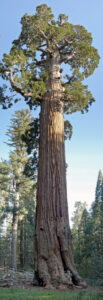
The idea stayed with Mr. Senior, and in 1925, with the help of Mr. Lee, the first Christmas program was held at the Grant Tree at noon on Christmas Day. Mr. R.J. Senior, president of the Chamber of Commerce, and Mr. Lee, then secretary of the Chamber, conceived the idea of an annual ceremony. Mr. Lee wrote to President Calvin Coolidge, who designated the General Grant as the Nation’s Christmas Tree on April 28, 1926.”
The Sanger District Chamber of Commerce (SDCC) echoes the NPS, though there emerges a slight difference on the girl’s quote. The difference can be attributed to the fact that the girl might have spoken in a different language than English, since people rarely translate the same.
The SDCC states “The first Christmas service at the base of the tree was inspired by R.J. Senior-then President of the Sanger Chamber of Commerce and Charles E. Lee-then Secretary of the Sanger Chamber of Commerce, in 1925. In 1924 R.J. Senior was wandering through the Grant Grove area. He approached a huge tree, stopped, and stared in awe at the enormous tree. As he stood looking at nature’s masterpiece, a small girl approached. After a moment of complete silence she said, mostly to herself, “What a lovely Christmas tree that would be.”
She then turned and ran off into the grove. They never learned her name, but they couldn’t forget her words. The following Christmas, Senior, Lee, and some friends trekked over what was then a snow covered dirt road to the park. They placed some flowers beside the tree and held a short service. Upon returning home Lee wrote a letter to President Calvin Coolidge. Four months later, on April 28, 1926, the president adopted Lee’s suggestion and officially designated the General Grant Tree as the Nation’s Christmas Tree. The service is always held on the second Sunday in December at 2:30pm at the base of the General Grant Tree in Sequoia-Kings Canyon National Park.” Coolidge (1872–1933) was the 30th President of the United States, serving from 1923 to 1929.
The SDCC adds that since 1926 these services have been held annually. The SDCC specifies that the service concludes the Christmas Festival Celebration which the citizens of Sanger and people from all over the world attend, stimulating the spirit of “Peace on Earth, Good Will To All Men”. This organization further says that on October 1, 1949, the Post Office Department proclaimed Sanger the Nation’s Christmas Tree City. “Each year the crowds gather, they sing, pray, and pay tribute to this wonder of nature. The members of the National Park Service join in the services by placing a wreath at the base of the tree.
Because of such dedication, and because of the work done and interest shown by the citizens of Sanger, California, the Nation’s Christmas Tree has become known nationally and internationally. During the war years, when travel was restricted due to gas rationing, there were no official services. However, a member of the National Park Service walked to the tree and placed a wreath at its base.”
The SDCC goes on, saying that Congress, by public law 441, made the General Grant Tree a National Shrine on March 29, 1956.
The celebration at the tree sounds so special that various people who attended the first ceremony of Christmas celebration at the tree also returned there for the same purpose more times. Elizabeth Gates, Peter Beier, a Sanger native, Jasper G. Havens are some of them.
Gates appeared in the 50th ceremony in 1976 when she recalled the adventure of joining the first program with Senior, according to the NPS. “It was a much longer, colder and more hazardous trip than today’s.”
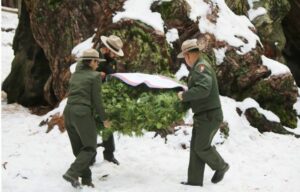
The NPS adds “Beier was 27 years old at the first ceremony and still had a perfect attendance record at the 50th anniversary. He even made the trek to the tree in 1971 when a snowstorm had closed the road and the ceremony was held outside the park. He and a handful of hardy campers made it to the tree to watch as park rangers placed the traditional wreath.
A Sanger native who took part in the first ceremony as a child later returned to deliver the Christmas message. Jasper G. Havens was a minister in Idaho and Utah when he returned to speak in 1978. He recalled the cold trip of 1926 in the family’s Model-T Ford. In 1984, Al Saroyan, then 73, was honored at the 58th ceremony as one of the three Sanger High School trumpet players who performed at the 1926 event.”
The General Grant Tree, a Living Shrine
President Dwight D. Eisenhower (1890–1969) was the 34th President of the United States, from 1953 to 1961. Before his presidency, he was a highly respected military leader, notably working as Supreme Commander of the Allied Expeditionary Forces in Europe during World War II. His leadership during the war earned him reputation as a skilled and effective leader.
He declared the General Grant Tree to be a National Shrine in 1956. The NPS explains that this tree was dedicated “in memory of the men and women of the Armed Forces who have served and fought and died to keep this Nation free.” The NPS underlines “It is the only example of a living shrine in the United States. During the dedication ceremony, Fleet Admiral Chester Nimitz mentioned its ‘equal stature with that other great shrine in Arlington Cemetery – the Tomb of the Unknown Soldier’.”
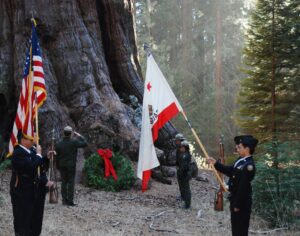
Fleet Admiral Nimitz was personal representative of the President of the United States He inaugurated the tree “as a perpetual shrine to our nation’s war dead” in a special ceremony at the base of the tree. Since 1925 each Christmas, a wreath has been laid at the base of the General Grant Tree, to pay tribute to those who have served in the armed forces.
The General Sherman Tree and the General Grant Tree are unimaginably ancient. The SDCC says that the General Grant Tree “monarch in both age and stature”, having grown to the height of 267 feet, has stood for an estimated 2,000-4,000 years. The NPS says that the most recent age estimate of the General Sherman Tree is approximately 2 200 years.
Benefits of such trees
Mammoth trees, like the General Sherman and General Grant trees, provide a range of significant benefits to the USA, both environmentally and economically. Some of them are these which follow.
As already suggested, trees like the General Sherman and General Grant represent major tourist attractions, drawing visitors from around the world to national parks such as Sequoia and Kings Canyon. This tourism generates significant revenue for local economies and supports jobs in hospitality, guiding, and park management.
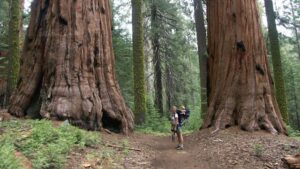
Giant trees like these sequester large amounts of carbon dioxide from the atmosphere, helping to alleviate the effects of climate change. Owing to their size and longevity, they can store vast amounts of carbon over centuries, acting as critical carbon sinks.
Trees contribute to air purification by absorbing pollutants such as sulfur dioxide, ammonia, and nitrogen oxides, and by filtering particulates out of the air by trapping them on their leaves and bark.
Large trees play a crucial role in water regulation. Their root systems help to stabilize the soil, reduce erosion, and enhance water retention, which is important for maintaining the water cycle and preventing floods.
Giant trees inspire awe and wonder, fostering a deeper appreciation for nature and motivating conservation efforts. This emotional connection can enhance community support for environmental protection policies and initiatives. It is this inspiration that eventually prompts people from across the globe to visit these gargantuan trees.
Challenges marring these sequoia trees and action being taken
NPR, National Public Radio, forms an American public broadcasting organization headquartered in Washington, D.C. It released a story titled “Some of the oldest trees on Earth — the giant sequoias — are facing new challenges” on 29 May 2024. The story reads “Because of a change in the climate, giant sequoias have become more vulnerable to insects, disease and wildfire.
Giant sequoias are survivors. They can live more than 3,000 years. But in a changing climate, the trees have become more vulnerable.”
The story features Clay Jordan, Superintendent of Sequoia National Park and Kings Canyon National Park. NPR’s Julie Depenbrock begins asking Jordan about the General Sherman’s signs of stress.
Jordan says “A little bit of beetle activity in the canopy of the tree, but not anything to cause us great concern at this point.” Depenbrock explains that this beetle is the sequoia bark beetle, which had coexisted peacefully with the trees.
JORDAN additionally says “Until just a few years ago, we didn’t have a single instance where this beetle has killed a giant sequoia, and now we have a few dozen.”
According to Depenbrock, Jordan says that climate-change-driven drought has likely enfeebled the trees. “The National Park Service, along with the U.S. Geological Survey, found in 2021 that warming temperatures mean more bark beetles and more vulnerable sequoias,” says Depenbrock.
Tina Carpenter is a park ranger. Carpenter told Depenbrock “But it’s not the sequoias’ only threat.” Carpenter added “With the two most severe recent wildfires that we’ve had, between 2020 and 2021, we lost 13-19% of the giant sequoia species.”
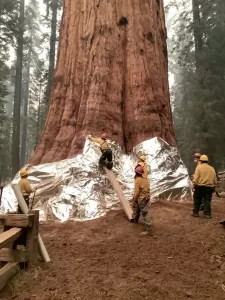
Depenbrock points out “In 2021, as wildfire encroached, General Sherman was wrapped in fire-resistant material. The more-than-2,000-year-old tree was safe, but others were scorched.”
Carpenter reassures “We’re here to preserve and protect these places, so future generations also get to experience that, as well.”
The NPS says that giant sequoias are known for their resistance to insects and disease and their fire-adapted life cycle. “Prior to the recent severe drought, research about giant sequoia mortality suggested that large sequoias typically died by falling or, occasionally, having extensive crown scorch from fire.
Death while standing, unrelated to crown scorch, was almost never observed by scientists who had spent decades working in the Sierra Nevada. And while mature giant sequoias did die from fire impacts, that was a relatively rare event, typically the result of many accumulated injuries over their long lives.”
The NPS adds that hotter drought of 2012-2016 appears to have been a tipping point for giant sequoias and other Sierra Nevada mixed-conifer forests. “In hotter droughts, unusually high temperatures worsen the effects of low precipitation, resulting in greater water loss from trees and lower water availability. This is an emerging climate change threat to forests.”
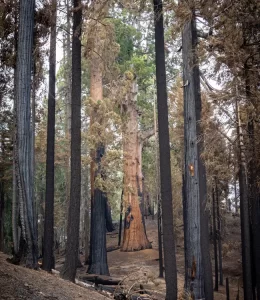
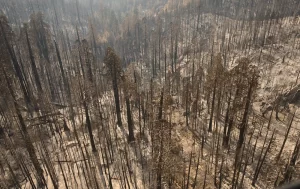
“Over 85 percent of all giant sequoia grove acreage across the Sierra Nevada has burned in wildfires between 2015 and 2021, compared to only one quarter in the preceding century. Thousands of large giant sequoias (those with trunks 4 feet in diameter or larger) are estimated to have been killed in six recent wildfires, most of those in the 2020 Castle Fire and the 2021 KNP Complex and Windy fires.”
The NPS points out that aerial surveys from a helicopter, fire severity estimates, and sequoia grove maps have shown that 13 to 19 percent of the world’s large sequoias are estimated to have died. It clarifies that the Castle Fire and the KNP Complex and Windy fires combined have killed 8,431 to 11,897 trees.
The NPS underscores that responses to these issues will necessitate coordination across organizations managing giant sequoias and with scientists, and non-governmental organizations. The National Park Service asserts that it is working with partners to create, among others, increased efficiency in planning and implementing management actions that improve forest resilience and stronger public communications around giant sequoia conservation.
“While severe wildfire has become a threat to giant sequoias in recent years, prescribed burning remains one of the most important management tools to reduce fuels in sequoia groves, favor regeneration of young sequoias, and increase resilience of these groves to climate change and wildfires.
Increased death of large giant sequoias is just one of many recent and profound changes in the Earth’s forests, other wildlands, and oceans. What changes can we make as individuals and a society to help sustain these special places? By sharing current science, rangers and park partners seek to begin conversations about the meaning of change in public lands—places preserved by and for all who care about them.”
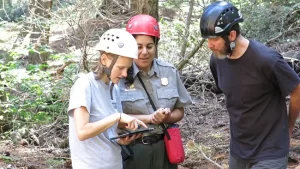
Prescribed burning is a forest management technique employed to maintain the health of sequoia groves and other forest ecosystems. It involves intentionally lighting controlled, low-intensity fires under carefully monitored conditions to achieve specific ecological objectives.
One of the benefits of prescribed burning includes the reduction of excess fuels, by decreasing the accumulation of dry leaves, needles, branches, and other organic material (collectively known as fuels) on the forest floor. In the absence of regular fires, these fuels heighten the risk of severe wildfires.
Thanks for sharing. I read many of your blog posts, cool, your blog is very good.
Thank you so much indeed for your feedback which is very good too.
Your article helped me a lot, is there any more related content? Thanks!
We appreciate your comment.
I don’t think the title of your article matches the content lol. Just kidding, mainly because I had some doubts after reading the article. https://accounts.binance.com/ur/register?ref=WTOZ531Y
Can you be more specific about the content of your article? After reading it, I still have some doubts. Hope you can help me.
Thanks for sharing. I read many of your blog posts, cool, your blog is very good.
Thank you for your sharing. I am worried that I lack creative ideas. It is your article that makes me full of hope. Thank you. But, I have a question, can you help me?
Can you be more specific about the content of your article? After reading it, I still have some doubts. Hope you can help me.
Your point of view caught my eye and was very interesting. Thanks. I have a question for you.
Your point of view caught my eye and was very interesting. Thanks. I have a question for you.
I don’t think the title of your article matches the content lol. Just kidding, mainly because I had some doubts after reading the article.
Your article helped me a lot, is there any more related content? Thanks!
We really appreciate your feedback—we’re glad the article was helpful! Yes, there’s definitely more related content.
Your article helped me a lot, is there any more related content? Thanks!
We’re really gladdened to learn that the article has assisted you—thank you! Yes, there’s more related content. Are you looking for something specific, or would you like a few general recommendations?
Your article helped me a lot, is there any more related content? Thanks!
Thank you so much for the comment and we do bear more related content, while we are delighted that the article has assisted you.
Thank you for your sharing. I am worried that I lack creative ideas. It is your article that makes me full of hope. Thank you. But, I have a question, can you help me?
hank you so much for your heartfelt message — it truly means a lot to know the article gave you hope and encouragement. Creative blocks happen to the best of us, but the fact that you’re seeking inspiration is already a strong sign of your potential. And absolutely, I’d be happy to help with your question — feel free to ask, and I’ll do my best to support you!
hank you so much for your heartfelt message — it truly means a lot to know the article gave you hope and encouragement. Creative blocks happen to the best of us, but the fact that you’re seeking inspiration is already a strong sign of your potential. And absolutely, I’d be happy to help with your question — feel free to ask, and I’ll do my best to support you!
Thank you so much for your heartfelt message — it truly means a lot to know the article gave you hope and encouragement. And absolutely, we’d be happy to help with your question — feel free to ask, and we’ll do our best to support you!
Can you be more specific about the content of your article? After reading it, I still have some doubts. Hope you can help me.
Thank you for taking the time to read the article and share your thoughts—we truly appreciate it.We’re sorry to hear that some parts weren’t as clear as they should be. We’d be happy to clarify! Could you let us know which sections or points felt too general or raised questions for you? Your input will also help us to improve future content.
I don’t think the title of your article matches the content lol. Just kidding, mainly because I had some doubts after reading the article.
Thank you for the feedback! If the title felt a bit off compared to the content, that’s definitely something I’ll keep in mind going forward. We’d love to hear more about the doubts you had—feel free to share, and we’ll do my best to clarify or improve.
Your point of view caught my eye and was very interesting. Thanks. I have a question for you.
Thank you for your kind words—we’re gladdened that the point of view caught your attention. Please feel free to ask your question; we’re here and happy to help.
Thank you for your sharing. I am worried that I lack creative ideas. It is your article that makes me full of hope. Thank you. But, I have a question, can you help me?
Thank you for your kind and heartfelt message. We’re truly glad the article has given you hope and inspiration. Please feel free to ask your question—we’re here to support you and help in any way we can.
Thanks for sharing. I read many of your blog posts, cool, your blog is very good.
We are extremely thrilled by your kind words which constitute a great motivation for us.
Your point of view caught my eye and was very interesting. Thanks. I have a question for you. https://accounts.binance.com/register?ref=P9L9FQKY
Thank you considerably. Ask your question, so we can address it.
Can you be more specific about the content of your article? After reading it, I still have some doubts. Hope you can help me.
While we appreciate your time spent on engaging with the article, we will appreciate more, if you clearly express the doubts.
I don’t think the title of your article matches the content lol. Just kidding, mainly because I had some doubts after reading the article.
We thank you for engaging carefully with the article. In the meantime, we humbly ask you to elucidate the doubts.
Your article helped me a lot, is there any more related content? Thanks! https://accounts.binance.info/id/register-person?ref=UM6SMJM3
Thank you so much! Yes, there is more related content.
Can you be more specific about the content of your article? After reading it, I still have some doubts. Hope you can help me.
Could you please clarify parts where you harbor doubts, so we may deal with them? Meanwhile, thank you for engaging with the content.
Thank you for your sharing. I am worried that I lack creative ideas. It is your article that makes me full of hope. Thank you. But, I have a question, can you help me? https://www.binance.com/register?ref=IHJUI7TF
We thank you so much for the comment and are ready to respond to the question immediately after you raise it.
Your point of view caught my eye and was very interesting. Thanks. I have a question for you. https://www.binance.info/register?ref=L4EUT9FG
Please, ask it.
Can you be more specific about the content of your article? After reading it, I still have some doubts. Hope you can help me. https://www.binance.bh/register?ref=QCGZMHR6
Please, give us clarifications on your doubts
Your article helped me a lot, is there any more related content? Thanks! https://www.binance.com/register?ref=JW3W4Y3A
We are delighted to hear this. Yes, there is more related content.