By Jean Baptiste Ndabananiye
Different Rwandan farmers and Imbaraga Farmers’ Organization- a national nongovernmental organization of Rwandan farmers pointed out banks’ reluctance to lend money to Rwandan farmers around 3 years ago. However, this organization now says that Rwandan banks have performed a change but that there still persists a big issue of high interest rates.
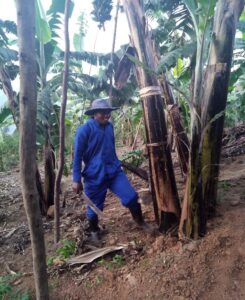
Potien Niyonambaza is a professional farmer in Nyabitare Village, Munyana Cell in Minazi Sector in Gakenke District, Rwanda’s Northern Province. More than two years ago, he said that no farmer still standing at the embryonic stage could then actually obtain a loan from a bank, if s/he said that they were going to invest it in agriculture. “While I am conversing with youth or my peers, they tell me ‘You’re farming because you possess land to cultivate.”
“What the Government ought to do is to change some loan conditions; for instance, let them say ‘farming loans will start being repaid within 6 months when a farmer has begun harvesting, and let the banks not charge interest for these 6 months. You know that the Government provides some young people having completed technical and vocational education with a tool kit [such as sewing machines] meant for helping them to start small businesses relating to knowledge and skills they’ve acquired.”
Niyonambaza said that a similar approach should be introduced in the farming field. “I don’t suggest that they [the Government] should stop this [the support for technical and vocational education graduates], but they should also earmark a certain amount of money to support farmers. For example, they can say ‘Let’s allocate this amount, for farmers to procure loans with a small interest.’
Though we persevere in working with banks, we work with banks as an intense cross we have to bear on our backs. When you design a farming project and that you submit it to a bank, they tell you ‘Change the project from farming to trade, so that we can grant you the loan. For instance, request for a loan to establish a shop. What profitability does farming produce, how will you explain that this farming project will repay the loan?’”
He added that he eventually got a loan, but with difficulty. However, Niyonambaza said that he never failed to repay different loans for which he asked. He explained a tactic that he employed for him not to find himself in loan arrears especially at the start of his farming business when the latter one had not grown yet. “I reserved a certain portion which I would pay back while my crops had not ripened yet. For example, when I was given a loan of a million Rwandan francs ([RWF] around $740 today), I could set around 300 000 RWF ($222) apart for me to spend them on repaying the loan for the first 3 months.
I have always repaid my loans without any arrears, but you understand that this practice then actually caused me a certain loss, because this amount which I kept inactive generated no profit to me while the bank had given it for me to exploit it fully.”
He moved that financial institutions should develop confidence in the farming sphere, since according to him, this sector is vital for every nation. “Banks should trust the farming sector, since all developed countries owe the development to their developed farming because all commodities produced in factories come from agriculture. If you want to raise strong industries, you have to first advance farming.
Almost all things, 99%, which are used including clothes and even that notebook in which you’re writing emanate from farming. Farming represents the start and primary industry on which all others rest, that’s why I suggest that the financial institutions treat it with special consideration.” The fact that agriculture constitutes an unparalleled sector and foundation of all is more elucidated by this article.
Jean de Dieu Mwiseneza is a Burera district resident who is also farmer and told me that he had also attempted to obtain a bank loan but in vain. “In 2017 I approached a bank for a loan to inject into farming. They requested me to fill high conditions most of which were impossible for me to meet; I realized I realized it was their tactic to wear me down, causing me to eventually abandon the loan request. I consequently relinquished it. There are other people- I know- who have encountered the same issue in some other banks. For example, there is a guy who has asked for a loan to invest it in a banana plantation here in our locality, but they have refused it to him.”
Mwiseneza thought that at least cooperatives were easily furnished with bank loans. Nevertheless, Charles Uwamungu- the then President of Irish Potato Farmers Union in Musanze district also in the North- explained that getting loans constituted an intensely heavy burden. “It is extremely harsh for a farmer to secure a bank loan, since banks are reluctant, advancing ‘If we give farmers our cash, we will lose it’.
There are certain banks- KCB [Kenyan Commercial Bank], Equity Bank and Urwego Opportunity which -that are the only banks which try, but they also provide loans for farmers in cooperatives or groups, yet still it is little cash they give them. They have a ceiling to which they are confined, they give 500 000 RWF, 600 000RWF, they don’t exceed 700 000RWF per person [ in a cooperative or group]; they can’t lend you [a big loan of] 3 000 000RWF.”

All the farmers suggested special interventions to reinforce this sector. Jean Paul Munayakazi, Imbaraga’s Legal Representative, also defended the suggestion of strategies special for the agriculture field. He highlighted that this problem would be solved by a financial institution uniquely designed for farmers. He added that such a bank would give special attention to farmers who are still new in the sector, giving them affordable loans which don’t go beyond the annual interest of 6%. “It could be better, if there were a special fund which provides loans for farmers, like in other countries.
Other countries possess farmer banks specific for farmers. As the Government has instituted Umwarimu SACCO and other various banks assigned to improve the living conditions of certain categories of people, the government should also think about how the farming sector should have its own bank. A bank currently close to citizens is SACCO, in our recent study we have observed that in some places the interest rates ranges between 24% and 32%. Commercial banks give loans on the interest rates lying between 18% and 24%.”
He further stated that the organization had already discussed this issue with the Ministry of Agriculture and Animal Resources [MINAGRI/French acronym]. He added that the organization had formulated to the ministry the wish to create the farmers a bank and that this ministry had saluted it. The MINAGRI had additionally told Imbaraga that there were reserachers who had recommended this idea too. Munyakazi then trusted that the wish would be implemented, saying that the Government cares considerably about agriculture.
A change introduced by banks, despite the high interest rate
Munyakazi now says that banks have conducted a “positive” change. “For example banks have now hired employees especially in charge of agriculture. Banks like Bank of Kigali, Equity Bank and Banque Populaire have these staff members responsible for this sector.
This happened after you talked to us the last time. It is a positive and great thing that the banks have accomplished. For it to materialize, we performed advocacy with the government through its agencies- the MINAGRI and RAB[Rwanda Agriculture Board] and we commend their intervention.”

He instead reiterated the problem of high interest, emphasizing that the current rate cannot allow farmers to progress significantly. “For example, if you secure a five-year loan of 5 000 000 RWF from a SACCO at 22% interest rate, you will pay the interest worth 6 000 000RWF. What will have a farmer done, which will have generated all this amount? They should have at least obtained the profit of 12, 000, 000 RWF for them to be able to repay the amount.
The interest rate for farmers ought not to exceed one digit. It should at most stand at 9%, it can even attract a lot of investors. But now a person applies for a loan, claiming that they will invest it in farming, only to divert the funds into other ventures like restaurants, shops, and so on. Nevertheless, it is agriculture that feeds every nation, and a country which is self-sufficient in farming enjoys true independence; agricultural self-sufficiency represents the cornerstone of independence.”
Notwithstanding, Munyakazi adds that he also agrees that banks cannot reduce their interest rate to one digit. It is for this reason that he reiterates a special financial institution for the farming sector. “Banks are traders, so they can’t decrease their interest rates to 9%. A fund exclusively for farmers stands as the only solution to the problem. As I said it to you last, we are discussing it with the government and we believe that this fund will also be established though I cannot exactly specify time when it will exist.”
Special financial institutions for the farming field in the region
The International Monetary Fund says that agricultural development banks were created across the world, to extend credit and other financial services to customers not considered creditworthy by commercial banks. Most of countries around Rwanda also have financial establishments that have been created to exclusively finance their agriculture.
Uganda
The Government of Uganda- in partnership with Commercial Banks, Uganda Development Bank Ltd (UDBL), Micro Deposit Taking Institutions (MDIs) and Credit Institutions all referred to as Participating Financial Institutions- founded the Agricultural Credit Facility (ACF) in 2009.
The ACF aims to solve challenges related to financing in the agricultural sector, like high-interest rates and limited access to credit, particularly for long-term investments. It seeks to promote agricultural modernization by providing financing to farmers and agribusinesses.
A document released by the African Development bank and prepared by the Bank of Uganda reads “Max loan amount ≤ UGX 2.1bn. (can go up to UGX 5bn on a case by case basis. Max loan period – 8 Yrs [years] & [and] minimum 6 months. Grain Trade 2 Yrs & max loan amount up to UGX 10BN per individual or company. Grace period – maximum of 3 years. Interest rate – max of 12% per annum & 15% for working capital for grain trade. Primary security is machinery & equipment.”
“What is Eligible under the ACF? Most activities along the agricultural value chain e.g acquisition of agricultural machinery & equipment ,post-harvest handling equipment, storage facilities ,agricultural inputs, irrigation facilities etc. Agro-procesing [processing] activities. BUT We don’t finance purchase of land , planting of trees & trading (apart from grain) and refinancing existing facilities.”
A March 18, 2024 article by the Uganda Investment Authority confirms some pieces of this information from the document published by the African Development Bank. It reads “The fund is accessed through Bank of Uganda-supervised financial institutions up to 2.1 billion shillings repayable in eight years (maximum), with a grace period of three years (maximum) and an interest rate of 12 percent per annum.” Yet there are sources that say that loan amounts for agricultural value chain can exceed 5 billion Ugandan Shillings.
A grace period in the context of loans means a specific time frame, after the loan is issued, during which the borrower is not required to perform payments or is allowed to delay payments. With this, the borrower doesn’t incur penalties, late fees, or default. This period can apply to both the principal amount and the interest.
Tanzania
Tanzania Agricultural Development Bank Limited (TADB/Farmers Bank) was established in September 2012. Tanzania Farmers Bank says that it conducts financing of assets, projects, smallholder farmers, and season financing. These different types of loans serve various purposes.
For instance, this bank clarifies that the purpose of asset financing is to facilitate agriculture mechanization by buying agricultural assets like tractors, planters, harvesters, machinery, post-harvesting technologies and fishing boats. This type of loan targets people who have formed a group like cooperatives, unions and SMEs [small and medium-sized enterprises]. The bank adds that the loan amount does not go beyond 75% of the cost of an asset to be acquired and that the payment duration corresponds to one year.
The purpose of smallholder farmer financing is to encourage other banks to improve access to lending smallholder farmers who face challenges getting finance to adopt modern farming techniques and create employment, promote food security and transform operations from subsistence to commercial farming.
This bank’s interest rates vary, depending of a category of a client. For example, it says that it provides smallholder farmers, livestock keepers and fisheries with loans with interest rate ranging between 8% and 12% per annum. Medium and large scale farmers get loans with interest rates lying between 13% and 15%. The loan repayment duration is 1 to 3 years.
Burundi and the Democratic Republic of Congo/DRC
Burundian investors founded Banque Communautaire et Agricole du Burundi on 21 April 2020, to support Burundi’s farmers, according to this bank’s website. Yet, Life In Humanity has not managed to find other pieces of reliable information on this bank’s relevant details like those pertaining to its interest rates.
Radio Okapi released a story on 29 September 2021 about the DRC’s intention to establish a bank to fund the agriculture sector. This radio reported that the former Prime Minister of the Democratic Republic of Congo declared the imminent creation of a national development bank to finance and make agriculture the top priority in the country. Jean Michel Sama Lukonde stated it on 27th September 2021, according to the radio. Nevertheless, Life In Humanity has not been able to find any updates on this point either.
Agriculture banks and funds across the world
Agriculture banks and funds exist in various nations, chiefly in the developed world where they play a crucial role in supporting farmers, agribusinesses, and rural communities by providing financing, investment, and advisory services.
Some notable agriculture financing institutions include Rabobank in the Netherlands, Farm Credit System [FCS] in the United States, AgriBank belonging to FCS, Agricultural Bank of China also called AgBank, Landwirtschaftliche Rentenbank in Germany, Canadian Agricultural Loans Act (CALA) Program in Canada, AgriBank PLC and AgriFinance in the UK, Australian Government – Regional Investment Corporation (RIC), and the Russian Agricultural Bank.
A few details on these banks
Rabobank says that it started as a movement of cooperative banks founded by Dutch farmers. “More than a century later, food and agriculture (F&A) remains our core international business. We envision a food system that meets rising demand for affordable, nutritious food.”
Investopedia says tha the FCS forms a nationwide lending network specializing in serving the agricultural community. “It is made up of cooperative banks and associations who provide credit to individuals and businesses throughout the United States. The FCS assists the rural community and organizations of all types and sizes, ranging from small family farms to corporations with global operations.”
The Agricultural Bank of China features among the top 4 major banks both in the country and the globe, as stated by Investopedia. “By asset size, the largest four banks in the world are Chinese, according to the 2023 annual rankings by S&P Global Market Intelligence. They include the Industrial & Commercial Bank of China, the China Construction Bank, the Agricultural Bank of China, and the Bank of China, holding more than $19.87 trillion in combined assets.”
Landwirtschaftliche Rentenbank says” During the course of the German ‘peasant liberation’ in the first half of the 19th century, state mortgage banks called ‘Rentenbanks’ were established in the western provinces of Prussia and in many other German states.” This bank adds that these banks enabled farmers, who had previously not been considered creditworthy, to take out mortgages on the land which they farmed.
The bank further states “In October 1923, Deutsche Rentenbank was founded as a central bank to combat hyperinflation. The bank issued the Rentenmark as a currency which was, by law, covered by mortgages on agricultural, commercial and industrial real estate. This meant that the money supply was limited and therefore the value of the currency remained stable.
In 1925, Deutsche Rentenbank-Kreditanstalt (RKA) emerged from Deutsche Rentenbank. It operated as a key funding institute for agriculture, where a greater demand for funding was the dominant concern. That’s because the agricultural enterprises had often found it difficult to pay back the mortgages they had taken out when the Rentenmark was created. RKA’s revival failed to take effect after World War II and Landwirtschaftliche Rentenbank was established instead.”
The CALA Program constitutes a loan guarantee program meant for raising the availability of loans to farmers and agricultural co-operatives. “Farmers can use these loans to establish, improve, and develop farms, while agricultural co-operatives may also access loans to process, distribute, or market the products of farming,” the CALA says.
Pan Finance says taht the AgriBank chartered in 2012 acquired the necessary passporting rights to render its services specifically designed for the agricultural and the renewable energy industries.“AgriFinance Ltd is a sister company registered in the UK and supervised by the Financial Conduct Authority. It was also established in 2012 and its main aim is to handle the UK lending side of the business within the agricultural and the renewable energy industries.”
Australian Government – Regional Investment Corporation says that it offers loans to farm businesses to strengthen Australian agriculture and build thriving regional communities.
Investopedia in its July 29, 2023 article says “The 5 Biggest Russian Banks. After these two giants [top two banks, Sberbank (SBER) and VTB (VTBR), which together account for more than half of the Russian banking industry’s assets], the next three largest banks by assets are Gazprombank, Promsvyazbank which was nationalized in 2018 and turned into a lender to the Russian defense industry, and the fully state-owned Russian Agricultural Bank established in 2000.”
Even many people who have land don’t have possibility to invest in professional farming projects, and the mindset is also a barrier to do that.
Right.
Can you be more specific about the content of your article? After reading it, I still have some doubts. Hope you can help me.
Thank you for your sharing. I am worried that I lack creative ideas. It is your article that makes me full of hope. Thank you. But, I have a question, can you help me?
Great! Thank you so much for sharing this. Visit my websitee: free stresser
Thanks for sharing. I read many of your blog posts, cool, your blog is very good.
Can you be more specific about the content of your article? After reading it, I still have some doubts. Hope you can help me.
I don’t think the title of your article matches the content lol. Just kidding, mainly because I had some doubts after reading the article. https://accounts.binance.com/si-LK/register-person?ref=V2H9AFPY
Thanks for sharing. I read many of your blog posts, cool, your blog is very good.
Binance bonus za za registráciu,
Thank you so much.
Thanks for sharing. I read many of your blog posts, cool, your blog is very good.
Thank you so much for your kind words and for taking the time to read many of our posts. We’re thrilled to hear you’re enjoying the blog. Your support truly motivates us to keep creating great content!
Can you be more specific about the content of your article? After reading it, I still have some doubts. Hope you can help me.
Thank you for your feedback—we really appreciate you taking the time to read the article and share your thoughts. We ’d be happy to clarify any points that seemed unclear. Could you let us know which parts you’d like me to elaborate on, so I can provide you with more specific details?
Thank you for your sharing. I am worried that I lack creative ideas. It is your article that makes me full of hope. Thank you. But, I have a question, can you help me? https://www.binance.info/lv/register?ref=B4EPR6J0
We are very moved by your inspirational comment.
Your article helped me a lot, is there any more related content? Thanks!
Thank you so much. Yes, there is more related content on the website.
Your point of view caught my eye and was very interesting. Thanks. I have a question for you.
Thank you so much for your feedback and we are ready to answer your questio; please, ask it.
Your point of view caught my eye and was very interesting. Thanks. I have a question for you.
We are pleased with your comment and are ready to respond to your question as soon as you ask it.
Reading your article has greatly helped me, and I agree with you. But I still have some questions. Can you help me? I will pay attention to your answer. thank you.
Thank you so much indeed for this galvanizing comment and we are ready to respond to your questions, please, ask them.
Your point of view caught my eye and was very interesting. Thanks. I have a question for you.
We’re so gladdened that our perspective has caught your attention — thank you for your kind words! We always appreciate thoughtful engagement. Please go ahead and share your question; we’ll be happy to help.
Can you be more specific about the content of your article? After reading it, I still have some doubts. Hope you can help me.
Thank you for your feedback. We’d be happy to clarify—could you please specify which parts of the article you found unclear?
I don’t think the title of your article matches the content lol. Just kidding, mainly because I had some doubts after reading the article. https://www.binance.com/register?ref=P9L9FQKY
Haha, first, thank you for your joking! And, thank you for the honest feedback—we truly appreciate it. If the title has raised expectations that the article didn’t fully meet, that’s valuable for us to reflect on. In the meantime, we’d love to hear which parts left you with doubts so we can elucidate or improve the piece. Your thoughtful reading means a lot.
Thank you for your sharing. I am worried that I lack creative ideas. It is your article that makes me full of hope. Thank you. But, I have a question, can you help me? https://accounts.binance.info/es-AR/register?ref=UT2YTZSU
Thank you so much for your heartfelt message—it truly means a lot to know the article gave you hope. We’d be happy to help with your question—feel free to share it with us.
Can you be more specific about the content of your article? After reading it, I still have some doubts. Hope you can help me.
Thank you for taking the time to read the article and share your thoughts. We appreciate your feedback, and we would be glad to clarify—could you please let us know which specific parts or points you would like me to elaborate on?
Looking forward to your feedback.
Howdy just wanted to give you a brief heads up and let you know a few of
the pictures aren’t loading correctly. I’m not sure why but I think its a
linking issue. I’ve tried it in two different browsers and both show the same outcome.
Thank you for informing us about the images not loading correctly. We truly appreciate you testing the site in different browsers, and we will examine the linking issue and address it as soon as possible.
Great site you have here.. It’s difficult to find high-quality
writing like yours nowadays. I seriously appreciate individuals like you!
Take care!!
Thank you so much for your incredibly kind and encouraging words. Your feedback truly means a lot to us. Knowing that the writing resonates with readers like you is the greatest motivation to keep going. We genuinely appreciate you taking the time to share your thoughts—it’s support like yours that renders this journey worthwhile.
Meanwhile, we wish you all the very best, and thank you very much again for being part of this community.
If you want to obtain a great deal from this post then you have to apply these techniques to your won website.
I love reading a post that can make people
think. Also, thank you for allowing for me to comment!
We are actually very encouraged by your invaluable comment.
We are really inspired by your kind and uplifting words. It is our duty to create space for you to comment.
I have read several excellent stuff here. Certainly price bookmarking for revisiting.
I surprise how so much attempt you set to create this sort of fantastic informative web site.
Thank you sincerely for your generous words. We’re truly gladdened that you find the content valuable enough to revisit — that is deeply encouraging. A great deal of thought and effort go into each piece, so it means a lot to know it resonates. We look forward to continuing to share meaningful and informative work with you. W are maximally gladdened.
I don’t think the title of your article matches the content lol. Just kidding, mainly because I had some doubts after reading the article. https://accounts.binance.info/zh-CN/register-person?ref=WFZUU6SI
Thank you for reading so attentively — we appreciate that. Titles are meant to invite curiosity, but we understand they must also reflect the substance of the piece.
We would therefore like to be glad to hear which part raised doubts for you. Constructive reflections always help us to refine the conversation.
I don’t think the title of your article matches the content lol. Just kidding, mainly because I had some doubts after reading the article.
Thank you for the good writeup. It in fact was a amusement account it.
Look advanced to far added agreeable from you! However, how could we communicate?
Thank you very much indeed for your inspiring comment!
Thanks for sharing. I read many of your blog posts, cool, your blog is very good. https://www.binance.info/register?ref=IXBIAFVY
Thank you so much indeed!
Every weekend i used to pay a quick visit this site, as i wish for enjoyment,
as this this website conations in fact fastidious funny material too.
Actually thrilled!
Your point of view caught my eye and was very interesting. Thanks. I have a question for you.
Thank you indeed and share your question, please.
Excellent pieces. Keep writing such kind of info on your site.
Im really impressed by your site.
Hello there, You have done an incredible job. I will certainly digg it and individually recommend to my friends.
I am sure they will be benefited from this site.
We are actually extremely thrilled by your comment which constitutes an optimal motivation.
Generally I do not learn post on blogs, but I wish to say that this write-up very pressured me to take a look at and do it! Your writing taste has been surprised me. Thanks, very great article.
Thank you greatly for your thoughtful and profoundly motivating message—it truly means a lot to hear that the article produced that kind of impact on you, especially given that you don’t usually do so.
We’re extremely glad that the writing style and content have been able to draw you in. That’s exactly what we hope for: not just to inform, but to genuinely engage and spark reflection. Your encouragement is deeply appreciated—thank you very much again for taking the time to share your feedback.
Greetings from Ohio! I’m bored to tears at work so I decided to check out your site on my iphone during lunch break.
I love the information you present here and can’t wait to take a look when I
get home. I’m amazed at how fast your blog loaded on my
mobile .. I’m not even using WIFI, just 3G .. Anyways, amazing
site!
Greetings from Rwanda—thank you so much indeed for taking the time to share this with us, especially during your work break! We’re really glad to hear that you enjoyed the content and that the site performed well on your mobile connection too—that kind of experience is exactly what we aim for, so your feedback is colossally encouraging. We hope you enjoyed exploring more when you got home, and we truly appreciate your support and inspiring words. Thank you a lot again for stopping by!
What’s Going down i’m new to this, I stumbled upon this I have discovered It positively useful and it has helped me out loads. I hope to contribute & aid other users like its helped me. Good job.
Thank you so much for your kind and encouraging message—we’re really glad to hear that you found the content useful and that it has helped you.
It’s especially wonderful to hear your willingness to contribute and support other users in return. That spirit of sharing and learning is exactly what makes these kinds of spaces meaningful. We truly appreciate your support, and we’re happy to keep you here. Looking forward to more of your engagement in the future—keep exploring and sharing!
Excellent website you have here but I was wondering if you knew of any community forums that cover the same topics discussed here? I’d really love to be a part of group where I can get feed-back from other experienced individuals that share the same interest. If you have any suggestions, please let me know. Appreciate it!
We are extremely galvanized by your generous words—we really appreciate your support and interest in the topics we cover. At the moment, we don’t know a specific community forum we can confidently recommend that fully aligns with these themes. However, your idea about being part of an active discussion space is immensely valuable.
If you don’t mind, we’d actually love to hear your thoughts: what kind of forum or community structure would you find most useful? For example, would you prefer something more discussion-based, expert-led, or open peer-to-peer exchange? Do you suggest we can create one which is affiliated with Life In Humanity?
Your input could really help us to understand how best to shape something meaningful around this in the future. Thanks again for engaging with our work—it truly means a lot.
Hi would you mind stating which blog platform you’re using?
I’m planning to start my own blog in the near future but I’m having a difficult time selecting between BlogEngine/Wordpress/B2evolution and Drupal.
The reason I ask is because your layout seems different then most blogs and I’m looking for something unique.
P.S My apologies for getting off-topic but I had to ask!
It is fine that you have asked the question indeed, and we are using WordPress.
You really make it seem so easy with your presentation but I find this matter to be actually something which I
think I would never understand. It seems too complex and extremely broad for me.
I’m looking forward for your next post, I will try to get
the hang of it!
Thank you so much for this thoughtful comment—it truly means a lot. One of the central aims of our work is exactly what you’ve pointed out: to take complex, real-world issues like agricultural finance and banking systems and translate them into clear, engaging, and understandable stories for every reader.
We believe that important topics should not feel distant or overly technical, but rather accessible enough to spark curiosity and action. Your feedback reassures us that this mission is resonating. We’re grateful that you’re following along, and we look forward to continuing to explore and simplify these important conversations with you.
It’s an awesome article for all the online viewers; they will take advantage from it I am sure.
Thank you so much for your generous words—we truly commend it. It’s thrilling to know that you believe the article can benefit others as well. That’s exactly the purpose behind what we do: to share ideas that inform, inspire, and add value. Grateful to have you as part of this community.
My spouse and I stumbled over here different web address
and thought I might as well check things out. I like what I see so i am just following you.
Look forward to checking out your web page again.
What a lovely surprise—welcome to Life In Humanity! We’re so pleased that you and your spouse have found your way here, even if by chance. Sometimes the most meaningful discoveries happen that way. We hope that you enjoy exploring the ideas we share, and we’re grateful to walk this journey with you.
Thanks a lot for sharing this with all people you actually recognize what you’re speaking about!
Bookmarked. Please also discuss with my site =). We could have a hyperlink change arrangement between us
Thank you so much for your thoughtful message—it truly means a lot to us. We’re gladdened that the piece has resonated with you, and your encouragement inspires us to keep exploring these important topics with depth and clarity. We’d be happy to discuss the area you’ve mentioned as well—it’s a valuable suggestion. Grateful to walk this journey with you, and thanks again for bookmarking and supporting our work.
Saved as a favorite, I really like your website!
Thank you so much for your kind words—it truly means a lot to us. Knowing that our work resonates with you and has earned a place among your favorites is incredibly encouraging. Life In Humanity exists because of readers like you who believe in thoughtful dialogue and meaningful change. We’re grateful to have you with us on this journey.
I’m gone to tell my little brother, that he should also pay a
visit this web site on regular basis to get updated from latest information.
Thank you for your great support of considering sharing our work with your brother. There is no greater compliment than a reader recommending our platform to others, and we remain committed to providing thoughtful, reliable, and insightful content that informs, inspires, enriches conversations across generations, and consequently ignites massive action to solve issues affecting humanity.
Highly energetic post, I loved that a lot. Will
there be a part 2?
We are sincerely moved by your kind and motivating words. Yes, very soon we will publish part 2.
of course like your website but you need to check the spelling on several of
your posts. A number of them are rife with spelling issues and I
find it very troublesome to inform the truth on the other
hand I’ll definitely come again again.
Thank you so much indeed and we are very sorry for the typos and we commit ourselves more to ensuring that our content is free of errors.
What’s up, yeah this piece of writing is actually nice and I have learned lot of things from it
concerning blogging. thanks.
We are actually highly joyful that you have learned a lot from it.
Thank you for your sharing. I am worried that I lack creative ideas. It is your article that makes me full of hope. Thank you. But, I have a question, can you help me?
Thank you so much indeed for this feedback. Please, share the question.
Ahaa, its good discussion on the topic of this piece of writing at this place at
this web site, I have read all that, so now me also commenting here.
Thank you for reading the article in full and for joining the conversation. Thoughtful engagement from readers like you is what transforms a publication from a collection of articles into a genuine forum for learning, reflection, the exchange of ideas and then the translation of content and ideas into meaningful action, and we are delighted to gain your voice among them.
I just like the valuable info you supply for your articles. I’ll bookmark your blog and check once more right here regularly. I am relatively certain I’ll be informed many new stuff right right here! Good luck for the next!
We are actually excited with your invaluable, kind and uplifting words which highlight that you will regularly check new information and we are committed to assuring that we publish useful content. Thank you so much ineed.
This post is truly a nice one it assists new internet visitors,
who are wishing in favor of blogging.
We are galvanized by your feedback.
Your point of view caught my eye and was very interesting. Thanks. I have a question for you. https://www.binance.bh/cs/futures/ref?code=OMM3XK51
Thank you a lot and ask it.
Why visitors still use to read news papers when in this technological globe everything is existing on net?
Thank you so much indeed for your invaluable feedback.
Wow, wonderful weblog format! How long have you been running a blog for? you made blogging look easy. The total glance of your site is excellent, as neatly as the content
We’re really thrilled by your inspiring words. In fact, I have not been running a blog for long time because this platform has existed for less than two years, but I actually possess unquenchable passion and over-15-year experience in writing. However what matters most is not the experience, but the insatiable hunger for writing.
Hi there to every body, it’s my first pay a visit of this website; this webpage carries remarkable and in fact good material designed for visitors.
We are actually optimally galvanized by your kind and extremely motivating words.
obviously like your web-site however you need to check the spelling on several of your posts.
A number of them are rife with spelling problems and I to find it
very bothersome to inform the reality however
I will surely come again again.
Thank you a lot for your feedback which we actually value.
This is a great tip especially to those new to the blogosphere. Simple but very precise information… Many thanks for sharing this one. A must read article!
Thank you so much indeed for your kind words.
I don’t think the title of your article matches the content lol. Just kidding, mainly because I had some doubts after reading the article.
Can you clarify your doubts?