By Life In Humanity Analysis Desk
A wound can break a life—or turn into the place from which a mission is born. Behind some of humanity’s most consequential acts of courage, service, invention and advocacy lie experiences that once seemed unbearable: grief, poverty, rejection, injustice, failure and trauma. The question, therefore, is not merely “Why did this happen to me?” but the far more transformative one: “What can this pain become?”
What pains really mean
To countless individuals, a wound may signify the end of their lives. On one hand, we say so, based on the alarming statistics of individuals who sustain mental health disorders, potentially as a result of life pains they have encountered. On the other hand, we are founded on the fact extremely numerous individuals even think of killing themselves just because of failing to bravely confront their financial adversity.

Zero Suicide Alliance, with its 29 November 2024 piece of writing headlined “Debt, money worries, and suicide risk”, says “Economic adversity, money worries and financial problems are all risk factors of suicide. Rises in the cost of living have been linked to some people feeling unable to cope, with some feeling suicidal. People in debt are three times more likely to consider suicide than those not in financial difficulty.
Over 420,000 people in problem debt consider taking their own life in England each year. Research has found that one in six people who experience money problems have suicidal thoughts. Three in every 50 people consider taking their life due to the cost-of-living crisis.”
In its 29 May 2026 story entitled “Mental Health Disorders Now No. 1 Cause of Disability Worldwide”, U.S. News reports “Mental health disorders are now the leading cause of disability worldwide, according to a major new study. Researchers found nearly 1.2 billion people were living with a mental health disorder in 2023 — almost twice as many as in 1990.”
U.S. News quotes first author Damian Santomauro, an associate professor at the Queensland Center for Mental Health Research in Australia, as having said “These rising trends may reflect both the lingering effects of pandemic-related stress and longer-term structural drivers such as poverty, insecurity, abuse, violence and declining social connectedness.”
The study explains that the global analysis examined data from 204 countries and that it found anxiety and depression have surged since the COVID-19 pandemic. Rates of major depressive disorder have increased by about 24% since 2019, while anxiety disorders skyrocketed more than 47%, according to the study.
“Our findings show that mental disorder burden peaks among 15-to-19-year-olds, which is a critical developmental period that can shape trajectories for education, employment and relationships” said coauthor Alize Ferrari, also from the Queensland Center for Mental Health Research. According to U.S. News, the study also indicates that women are disproportionately affected, “possibly due to caregiving pressures, gender inequality and higher rates of abuse”.
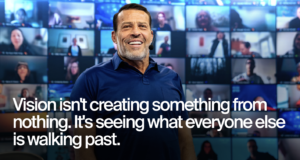
However; if you are battling with a hurdle, Tony Robbins— an American self-made billionaire, about whom you can learn more by clicking on our various published articles such as “Who would have guessed that this decision would bring me to such an incredible moment?”, Proof that with adversity, you are on the right path to incredible success and transformation, and Beyond what we were taught — tells you that you mustn’t despair. He instead exhorts you to engage in action to reverse your situation. You have to take action; how insignificant it may seem. He says “Stop waiting for permission. Some of the greatest businesses ever built weren’t invented from scratch. They were seen. Vision isn’t creating something from nothing. It’s seeing what everyone walks past.”
A typical instance
“I want to tell you about a man whose story I’ve shared at my Business Mastery seminars for years,” says Robbins, before adding “Howard Schultz didn’t invent espresso. He wasn’t the founder of Starbucks. He saw what everyone else was walking past and refused to ignore it. Hearing no 217 times couldn’t stop one man with a vision. They can’t stop you either.”
According to him, Schultz spotted a pattern that everyone else overlooked, he received ‘no’ responses for more than 200 times, but built one of the most recognized brands in the world anyway. “It’s not just a business story. It’s a story about what vision actually is, what persistence looks like, and what happens when a wound becomes a mission. Discover why vision isn’t creating something from nothing. Learn what hearing ‘no’ 217 times means for your own pursuit.

I want to tell you about a man whose story I’ve shared at my Business Mastery seminars for years. Not because he invented something. Not because he built something from scratch. Because he saw something everyone else was walking past—and he refused to look away. It’s 1981. Howard is going through a sales report and notices something strange. A tiny four-store coffee company in Seattle is ordering more drip coffee brewers than Macy’s,” says Robbins.
He adds “Most people would have moved on. Howard got on a plane. The little company was called Starbucks. Two years later, Howard visits Milan and sees over 1,500 espresso bars—baristas knowing people’s names, a sense of community, and a third place between home and work where people could think and connect. He flies home on fire.
The founders say no to his idea of bringing coffee and a third space together. So Howard walks away and builds it himself. He pitches 242 investors. 217 say no. He keeps going. And in 1987, those same founders sell him the company. He’s 34 years old. 11 stores. Today—40,000 stores. 80 countries. Over $36 billion a year. The founders of Starbucks said no to the idea that became Starbucks.”
Robbins explains what pleases him the most about Howard. “But here’s my favorite part. Howard grew up in the housing projects in Brooklyn. When he was seven years old, his father broke his ankle on the job. No health insurance. Little Howard answered the phone and lied to the bill collectors. That moment never left him. The year his father died, Howard gave full health benefits to every Starbucks employee working 20 hours a week or more—including every barista. Then he gave them all stock.”
Robbins cites Howard as having said “I wanted to build the kind of company my father never got a chance to work for.”
Robbins underlines “The seven-year-old who answered the phone for bill collectors became the man who made sure no one who worked for him ever had to. That’s what happens when a wound becomes a mission. Howard Schultz didn’t invent espresso. He wasn’t the founder of Starbucks.

He saw what everyone else was walking past and refused to ignore it. Vision isn’t creating something from nothing. It’s recognizing what’s already working and having the courage to act when everybody says no. So let me ask you. What pattern is sitting in plain sight in your life right now?”
Back to the real meaning of pain
We won’t actually dwell upon true meaning of pain, since besides the fact that Robbins has already expanded upon it, it constitutes a topic that we have already explored considerably. Your pains don’t signify or portend that your life is imperiled forever as it appears. Your pains are happening to you, but with a noble mission. They carry the mission to steel you, as we clarify it in our different articles on this website, including those already mentioned in this piece. We are preparing another article thoroughly explaining how pains steel you.
Sufferings are bringing you, but in disguise, an extremely big deal— exceedingly great goal. They hold a crucial purpose— they are messengers sent to hand you the purpose. In other words, if they had not occurred, besides not accomplishing the purpose, you could not even think of this noble goal for which you have been basically created.
“The founders of Starbucks said no to the idea that became Starbucks.” Schultz was not one of Starbucks’ original founders. He entered the company after its creation and proposed to transform it from a retailer of coffee beans and equipment into an Italian-style coffeehouse experience. The original founders—Jerry Baldwin, Zev Siegl, and Gordon Bowker—initially rejected Schultz’s idea because they did not wish Starbucks to become a restaurant or coffeehouse.
Nevertheless, Schultz finally quit it and established Il Giornale which eventually purchased Starbucks in 1987. Thus, the people who founded the original Starbucks rejected the business concept that ultimately became the modern Starbucks. This makes Robbins’ statement a powerful illustration of how founders or owners of an organization can sometimes reject an innovation which later transforms their own organization.
This also offers a compelling testament that you should not be discouraged by demoralizing factors like frequently receiving ‘no’.

Schultz Family Foundation says “Howard Schultz built Starbucks Coffee Company into one of the world’s most recognized and respected businesses, a company committed to strengthening communities through human connection and innovation. Howard grew up in public housing in Brooklyn and was the first in his family to graduate college. As a young entrepreneur, he set out to build a different kind of company, one that delivers business excellence through a culture of compassion.
Under his leadership, Starbucks grew from eleven stores with 100 partners (employees) to more than 28,000 stores in 77 countries, employing nearly 350,000 partners serving approximately 90 million customers per week. As ceo, he pioneered programs like comprehensive healthcare, stock ownership and free college tuition for full and part-time employees. In 2011, Fortune named Howard ceo of the year and, in 2019, Fortune ranked Starbucks fifth on its list of “World’s Most Admired Companies.”
The real meaning of pain, as this section develops it, is not merely that suffering renders you stronger. Pain can become a messenger that reveals a purpose, awakens a possibility, or redirects you toward a goal you might never have conceived without the experience that wounded you. Schultz’s story illustrates this beautifully: the rejection that could have discouraged him instead pushed him to pursue his vision independently, ultimately creating the very coffeehouse concept that colossally changed Starbucks—showing that a painful “no” can sometimes form a redirection rather than a dead end.
In this sense, pain does not necessarily happen to ruin your future. It can come disguised as an interruption, rejection, failure, or hardship, carrying the uncomfortable message that something within you must be strengthened, discovered, chased, or transformed into an extraordinary purpose.
How does your pain turn into a mission?
You transform your tribulations into a purpose, first by becoming aware that they merely constitute a package concealing something colossal inside. For you to access what a container holds, you first open it— otherwise, you cannot reach the content. The same principle is observed, to take the mission which the pain includes. You won’t have to flee the pain or avoid it— you will go through it, so as to grip the mission.
Nevertheless, the awareness mentioned above is not the ordinary one— it is the awareness which unwaveringly keeps you on the right track. This forms awareness which will never be obstructed by any issues, even if they were torturous to the maximal possible extent. It is a deep, steadfast awareness that continually keeps you aligned with your purpose. Since this awareness is unwavering, no problem, hardship, or even extreme suffering can prevent you from staying committed to that path —even when those difficulties become torturous in the extreme.
Ordinary awareness is generally a fluctuating consciousness of what is happening around and within us, shaped and often redirected by circumstances, emotions, fears, and immediate difficulties. It may recognize a purpose or the right path, yet that recognition can become clouded, weakened, or even temporarily displaced when problems and suffering become overwhelming. In this sense, ordinary awareness does not necessarily provide the steadfast inner orientation needed to remain committed to one’s purpose when confronted with severe adversity.

A monk in South Vietnam immolated himself in 1963 by burning his body to death, without trying to budge even an inch away from the cruelest flames or showing any signs of feeling a pain. He offers an unquestionably compelling case of an extraordinary, steadfast awareness that remained unwaveringly anchored to a purpose even in the face of excruciating physical suffering beyond imagination—a capacity that is needed to remain firmly aligned with one’s purpose when confronted with even the most overwhelming adversity. For more on him, read this piece.
Like Howard, there exist other famous examples of pain becoming a purpose. In fact, history and modern culture are filled with people who have permitted their minds to accomplish this vital shift this article focuses on.
After John Walsh experienced the tragic loss of his son, he ferried his unthinkable grief into creating America’s Most Wanted, helping to capture hundreds of fugitives and protect children. Late Viktor Emil Frankl was a psychiatrist who survived Nazi concentration camps. He used his suffering to write Man’s Search for Meaning and found Logotherapy. It proves that an adversity actually contains a mission and that human beings can endure any pain, if they pursue a purpose. After her personal survival of sexual assault, Tarana Burke transformed it into the global “Me Too” movement, giving a voice and community to millions of survivors.
Rwanda boasts such instances. There are a lot of survivors of the 1994 Genocide against the Tutsi who have created very impactful organizations— to not only support their fellow survivors, but also engage actively in unity, reconciliation and peacebuilding in Rwanda. Despite unspeakable ordeal which they have faced, the survivors through their organizations have produced a very great impact in their communities. We will make a story illustrating the impact in one of our upcoming articles.
What you have to do, to transform your wound into a mission

Our minds represent the most important resources with which we are endowed. All inventions, discoveries and innovations have stemmed from humans’ minds. It signifies that your mind will play a vital role in revolutionizing your life by changing your pains into a mission. That actually represents a profound and deeply true insight. Transforming personal pain into a meaningful mission constitutes one of the most powerful shifts a person can accomplish. When you deeply change how you view your struggles, you rise from feeling like a victim of your circumstances to becoming the author of your own purpose.
The first tactic involves moving from “Why Me?” to “What For?” The snare— asking “Why has this occurred to me?” —results in helplessness and keeps you stuck in the past. The shift— asking “How can I use this to help others?” or “What can this teach me?” instantly restores your power. It shifts your focus toward action and the future.
The second one is to recognize that pain produces unique expertise. First, pain has meddled in your life, to develop empathy in you. Your deepest pain arms you to comprehend someone else’s suffering in a way that others cannot. Then, pain has intervened in your affairs, to equip you with credibility. People listen to survivors, not just theorists. Your raw experience renders your voice authentic and fruitful. As a result, the strategies you develop to survive your own tribulations turn into the exact blueprint another person needs to learn more about.
In truth, your mind is the ultimate translator. It processes raw, painful life experiences and translates them into passion, drive, and ultimate purpose. If you are currently navigating a difficult season, remember that the story has not finished yet—you are just gathering the material for your ultimate mission.
When you transform your hardships into a mission
To build your mission—driving purpose, you will observe this process: healing, lesson extraction and creating a vehicle.
You cannot base a stable mission on an open, bleeding wound. You therefore first have to be healed of the trauma caused by your wound, accepting the reality of what has happened, and gain your footing.
Afterwards, you extract a core lesson to guide your entire life. It entails identifying the core truth which your pain has taught you. It can include (1) resilience, (2) the discovery of flaws in a specific system and action to handle them, (3) the need for robust mental health awareness campaigns, (6) the power to courageously continue despite hardships appearing insuperable, or (7) the discovery of your capabilities which remained dormant for a very long period of time until your adversities condemned you to discover them, among others.
Finally, you will have to construct a vehicle. Here, you will decide how you will deliver that lesson to the world. It could be fulfilled through different approaches like writing, mentoring, initiating an organization, creating art, advocacy, or simply changing how you interact with the world around you.