By Life In Humanity Analysis Desk
We’re continuing to execute Life In Humanity’s reporting project “Echoes of the Earth: From the Congo Basin to the Amazon”. We have already completed the part of the Congo Basin to which this article can take you, to comprehend the basin’s gargantuan ecological wealth, intensifying threats including weak governance frameworks, among others, action to implement and the rising set of interventions striving to safeguard this global crucial ecosystem.
As indicated by this article, we have already embarked on the Amazon Basin. This run article demonstrates the mammoth importance of this basin. In this regard, this current piece focuses on threats and challenges affected the basin and demanding urgent action without which irreversible consequences can happen.
Threats and challenges significantly undermining the Amazon Basin
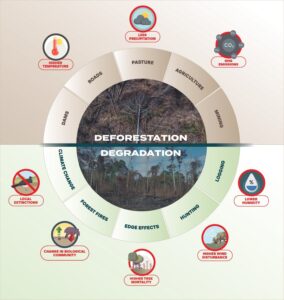
As we have detailed it in the above article, the Amazon Basin constitutes an extremely significant resource not only to the region across which it extends but also to the entire world. Despite this importance, this splendid resource is marred by challenges.
Geographical, with 25 November 2024 story headlined “What would happen if the Amazon was destroyed?”, reports “However, despite the importance of the Amazon, it has faced extensive deforestation in recent years – from 1978 to 2017, more than 750,000 sq km of the rainforest was destroyed.
With 64 per cent of the Amazon falling within its borders, Brazil takes the number one spot for its involvement in deforestation, contributing the most toward the rainforest’s destruction between 2001–2012 out of any other country. The biggest reason for this destruction is in the name of cattle ranching, as forests are cleared to make way for cattle, whose produce of beef makes up one-quarter of the cattle products across the world.”
The Science Panel for the Amazon is the world’s ‘first high–level’ regional science initiative devoted to the survival and sustainable development of the Amazon basin. This initiative’s undated story headlined “What is the Amazon and why is it important?” also affirms the issue. “Despite the Amazon’s regional and global importance, the region faces accelerating threats to its ecosystems and communities. Currently, approximately 18% of the Amazon has been converted to other land uses, mainly for unsustainable agriculture and cattle ranching. Similarly at least an additional 17% of the region is degraded, due to fire, unsustainable extraction practices (e.g., timber), and fragmentation.”
The Nature Conservancy, in its 08 May 2026 story headlined “Amazon in Peril” warns “Shifting weather patterns are disrupting life across Amazonia. And a new report suggests it could get worse.” “The last three decades have seen a crisis in Amazonia. Erratic water levels in the Amazon River—lower than at any time in the past century—are combining with deforestation, wildfires and water pollution to upset the natural balance between forest, rivers and people. Climate change is amplifying major events like El Niños, droughts and wildfires.”
This organization adds “Silvia Benitez, freshwater director of the Latin American Region for The Nature Conservancy, and a team of conservation scientists recently released a technical report that models the future impacts of climate change on Amazonia. The data predicts even more erratic rainfall and river levels in the coming decades.
Benitez, an Ecuadorian who has a degree from the Yale School of the Environment, has been with TNC for 24 years and is based in Bogotá, Colombia. Her passion is freshwater conservation, and it shows as she rhapsodizes about the freshwater rays, dinosaur-like catfish and swimming sloths of the Amazon River. Today she is worried about the future facing these amazing freshwater resources and all Amazonia.”
Benitez clarifies the problem. “For our report, we conducted simulations using historical data on flow, temperature and precipitation from 1981 to 2010. Using time series modeling, which statistically analyzes data over time and predicts future values, we forecast likely outcomes through 2050.
The results showed us something that is happening already, and that will get worse: The Amazon is going to get drier. The projected annual flow showed reductions of up to 48% in most of the basin. Overall, it will get more droughts and longer droughts, though some areas could see river-flow increases of up to 11%. We’re already experiencing this. In the last three years, the Amazon River has seen the largest declines in water levels in over a century. We’re seeing boats stuck, fisheries failing, freshwater dolphins dying. We are not used to extended periods of no rain.”
She goes on, explaining why the Amazon Basin will become drier overall. “Higher temperatures are extending the naturally occurring dry season. Heat also causes more evapotranspiration in the Amazon forest: trees sweat, and they will lose more moisture. Rivers will get warmer. It’s a very complex system that will lead to less rain. But we’re also going to see flooding. That’s the thing about climate change: everything becomes more chaotic. The Amazon has a lot of water, but in extended drought periods things will dry out. But then we will recover the water with extreme rains.
Usually, the rain is distributed over time, so soil can absorb it. But a lot of rain in a very short time causes flash flooding. The Amazon system has a natural regime of water movement: a period where the forests get flooded, and a period where the water returns to the rivers. As that system becomes more extreme, the forest is stressed because it dries out more than usual. Trees can die, fires can start. Then when it floods, it will flood areas that aren’t used to being flooded. In some mountain areas, this will bring landslides. When climate cycles become extreme, they affect the whole system.”
Consequences, especially of no action
The Science Panel for the Amazon highlights that if no action is taken to prevent this basin’s problems, it will come to pass that the situation culminates into an irreversible issue which would beget catastrophic effects. “If current trends continue, the Amazon will be pushed closer to crossing a point of no return, or ‘tipping point,’ a state where continuous forests can no longer exist and are replaced by more open vegetation or degraded forests.
Crossing a tipping point would unlock potentially irreversible, cascading effects with tremendous impacts on climate by accelerating global warming and extreme temperatures, reducing moisture flow across South America, and causing mass species extinctions, in turn, impacting agriculture, hydropower generation, and human health and well-being in the region and globally.”
It adds “Deforestation and global climate change are increasing biodiversity loss and putting human health and livelihoods at risk. Extreme weather events––such as droughts––are becoming more frequent and intense, leading to higher frequency of wildfires, and leading to an increase in tree mortality, and a decrease in evapotranspiration. All these changes are converting the Amazon forest from a carbon sink to a source, as more carbon is being released to the atmosphere.”
The Nature Conservancy expounds on how the environmental changes will touch wildlife in Amazonia. “Amazonia is unique. No other place in the world has more fresh water, or more freshwater biodiversity. When you think of Africa, you imagine big, famous animals: elephants, rhinos. In Amazonia, those big animals are in the water. We have huge fish like the arapaima, a submarine-shaped fish that can be 10 feet long and weigh up to 440 pounds. We have manatees, freshwater dolphins, river otters. We have anacondas, the world’s heaviest snakes—they also swim. Sometimes it’s hard to see that biodiversity because it’s in the water.
The longest freshwater fish migration in the world is in the Amazon. The Dorado catfish is born in the foothills of the Andes, travels to the mouth of the Amazon and then returns—a journey of more than 11,600 kilometers (7,200 miles). Now if climate change starts drying up rivers, this connectivity is lost. Land animals use the water, too. Jaguars, for example, are very good swimmers. They travel and hunt in the water. And other animals use fresh water, for example, sloths. They are also very good swimmers.”
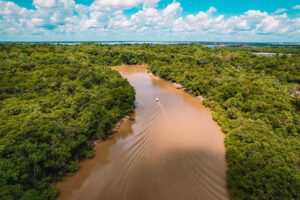
To elaborate on the effects of the changes on humans, The Nature Conservancy says “Many communities depend on the water for drinking and for food. For some, fish is the main source of protein. And more than 80% of the food fish caught in the Amazon are migratory species. Also, much of the Amazon doesn’t have roads, because people travel via the river.
Large areas of Amazonia are territories of Indigenous people who have been there for a very long time. Their beliefs, their cultures, their spiritual lives are built around this water. But so are markets. A lot of grains and food exports get to the Atlantic via the Amazon and its tributaries. There are important Amazon River port cities, like Iquitos in Peru or Manaus in Brazil. And many South American countries depend on hydropower that comes from Amazon basin water.”
It stresses “So, the impacts of losing water are huge. Pollutants can get concentrated, and drinking water is compromised. Fisheries are depleted. People become isolated. We have seen this already. In our recent droughts, thousands of people couldn’t get to a store. Helicopters had to drop food and medicine. And in Ecuador, low water led to electricity cuts of more than 10 hours a day. Impacts were felt locally, but also in places that weren’t even that close to the main stem of the Amazon.”
Mongabay, with its 19 February 2026 article headlined “The Amazon’s most valuable export isn’t timber — it’s rain”, reports “By combining satellite observations with climate models, the authors estimate that each square meter of tropical forest generates roughly 240 liters of rainfall per year across the broader landscape, rising to about 300 liters in the Amazon Basin. Rather than treating forests as passive recipients of climate, the study depicts them as active participants in shaping it.
Modeling studies indicate that dams in the Amazon basin could generate far less electricity if surrounding forests are cleared, because reduced rainfall diminishes river discharge. In some scenarios, projected deforestation would cut expected output dramatically, undermining infrastructure designed to operate for decades.”
Solution
Although our next article in this reporting project on the basins will focus on solutions to address the Amazon Basin’s challenges, we prefer to report solutions suggested by The Nature Conservancy. “We believe that the solutions can be provided by nature. Our research shows that it is important to focus on maintaining the Amazon system’s connectivity. That can reduce the impact of drought, because even if one area is dry, the river will still be flowing. Floodplains can be critical, because they can act like a sponge and hold water.
Wetlands can also store water in vegetation and soil, then release it slowly in a drought. If we maintain the riparian forests, maintain the wetlands, maintain the floodplains, the impacts of climate change will be mitigated. The systems will be more resilient. To protect this connectivity, we need the nine nations that are home to Amazonia to collaborate, but we also need collaboration at other levels. Local governments, municipalities, national parks and NGOs like TNC.”
It continues “And coordination among Indigenous territories is critical. Many of the people who are neighbors between countries are Indigenous people. If anybody understands how this system works, it’s the people who have lived there for centuries. So we’re promoting locally led, community-led, Indigenous-led adaptation plans. We need to appreciate the knowledge that Indigenous people have and listen to their ideas. And not just listen—act on them.”
The Amazon Basin stands at a critical tipping point, necessitating immediate, coordinated action from the local and global publics, policymakers, and dedicated donors to halt the alarming deforestation caused by cattle ranching. Every acre of destroyed rainforest emits massive amounts of carbon dioxide into our atmosphere, threatening the ancestral homes of Indigenous guardians and the stability of our global climate system.
As citizens of this planet, we have to act on the basin’s call for rescue. The general public must shift their purchasing power away from destructive supply chains and loudly demand environmental accountability. Concurrently, policymakers must swiftly enact and enforce rigid legal frameworks which prohibit illegal land clearing, while global donors inject vital funding into local, Indigenous-led conservation initiatives that protect the frontline. By uniting these three pillars of action, we can safeguard the world’s largest rainforest basin and secure the vital life-support system that sustains all humanity.
Yet still, the interventions of these pillars need to address the root cause of the devastating deforestation – a critical question must be answered: are our interventions actually eradicating the problem from its main root?
Suppose that people driving the frightening deforestation of the Amazon Basin are doing so, just for them to survive. It would then be unfair, if you conducted interventions to prevent them from encroaching on the basin, while you don’t create them alternatives to live on. The basin must be protected, yet again people relying on it to live– even if their actions are illegal– must also be helped to find other ways to eke out a living. You can argue that they should be sued rather than being supported to engage in other ways of living or ways not detrimental to the basin. But we swear to you that this cannot produce a lasting solution. As already promised, we will detail this particular dimension of solutions to deal successfully with the basin’s threats.