By Jean Baptiste Ndabananiye
True peace is more than the absence of conflict; it’s a state of harmony that touches every facet of society, deeply rooted in justice, equity, and mutual respect. Building lasting peace requires an approach that encompasses all areas of development—health, education, governance, and economy—and recognizes how these fields sustain and depend on peace. The United Nations Development Program (UNDP) notes, “There can be no sustainable development without peace, and no peace without sustainable development.”
Yet, this essential interconnectedness between peace and development often goes unnoticed. My experiences in peacebuilding have shown me that while many prioritize sectors with visible, measurable impacts; fewer resources and attention are allocated to initiatives promoting peace and its allies like good governance and justice. Various sources concur with me on this observation.
This article explores why a holistic approach to peacebuilding is crucial to creating enduring harmony, drawing on real-world examples to highlight the benefits of inclusive, multi-sectoral support for peace. From conflict transformation in rural Rwanda to global insights on peace as a force for sustainable growth, we’ll look beyond traditional definitions and delve into the transformative power of peace at every level. This article is organized around these key sections:
- The overlooked necessity: why holistic peacebuilding deserves greater attention and funding
-
Why the overlook? Is it because donors believe that funds they allot to peacebuilding work suffices?
- Illustrative Case from Rwanda
The overlooked necessity: why holistic peacebuilding deserves greater attention and funding

A holistic approach to peacebuilding is a major requisite to ensure lasting peace. By a holistic approach to peacebuilding, I intend to mean that lasting peace must be supported by every person in all their capacities, organizations and development sectors. All the development sectors are to be strengthened and then used to directly support peace, since every field develops because peace prevails. Lasting peace is also actually dependent on every field, as already highlighted by the UNDP.
Yet, I am worried that most people don’t directly and explicitly notice that interconnectedness of peace and every other development sphere. My past peacebuilding work and experience have convinced me that even high level institutions may not pay attention to that holistic approach to peacebuilding. I’ve learnt that most organs actually give more weight to programs and projects designed to produce tangible results, such as those in the fields of health, agriculture, education.
Furthermore, I’ve observed that even the funding community values such projects and programs more than those in the field of peace and its closely related ones like good governance, and justice. You’ll hear that a donor has granted $50 million in a certain country for those sectors linked with peacebuilding, while earmarking hundreds of millions for one of the other sectors. A major reason is that the latter ones generate tangible results or visibly support economy. Nonetheless, none of those domains can register sustainable development, without lasting peace.
As indicated in the introduction, different institutions agree with us upon peace underfunding. Saferworld and Relief Web are some of them.
Saferworld is an international organization with over 35 years in work to prevent violent conflict and build safer lives. This organization involves people and partners in Asia, Africa, Europe, the Middle East and North America.
The Harvard University states that Relief Web constitutes a humanitarian information portal under the United Nations Office for the Coordination of Human Affairs. This university adds that this portal contains over 720,000 reports, evaluations, guidelines, and additional resources, and works to provide reliable, up-to-date information on global crises and disasters around the world.
A Saferworld 6 June 2023 article “The forgotten pillar of the triple nexus – why is peace so under-resourced?”reads “Recent analysis shows that funding for peace is at a five-year low. Not only is peace the least-defined area of the triple humanitarian-development-peacebuilding nexus in terms of its objectives, but it is also the least well-funded. New analysis by Development Initiatives and Saferworld of official development assistance (ODA) looks at the balance of humanitarian, development and peace financing in crisis settings.
It finds that peace is not only the least-funded nexus pillar but that its funding has been steadily decreasing: the most recently available figures from 2021 showed that peace funding was at a five-year low of USD$3.2 billion, 12 per cent less than in 2018. Only 11 per cent of all bilateral ODA funding in 2020 and 2021 was focused on peace, even in conflict and crisis contexts. By contrast, in 2021 countries experiencing protracted crises increasingly relied on humanitarian assistance, with humanitarian-focused ODA at a five-year high of 41 per cent.”
In its 13 Sep 2023 article, Relief Web also reports “The work of peacebuilding has always been underfunded in comparison to need.”
Based on Development Initiatives and SIDA’s latest report ‘Leaving no crisis behind with assistance for the triple nexus‘, Saferworld recommends the urgent need for an increased focus on peace and conflict prevention.
Nonetheless on one hand, peace unquestionably represents the maximal resource. In 1989 it was established the concept of Culture of Peace at the UNESCO International Congress on “Peace in the Minds of Men” in Yamoussoukro, Ivory Coast. It was on this occasion that UNESCO adopted the vision that peace is much more than the end of armed conflict. The congress in Yamoussoukro generated the Yamoussoukro Declaration stating “Peace is reverence for life.
Peace is the most precious possession of humanity; peace is a deep-rooted commitment to the principles of liberty, justice, equality and solidarity among all human beings. Peace is also a harmonious partnership of humankind with the environment.”
On the other hand, Conciliation Resources, an international organization committed to stopping and violent conflict and creating more peaceful societies, points out “Wars prevent communities from developing, stop children [from] going to school and make it harder for people to secure healthcare. Poverty then drives more conflict, and the cycle continues.” “By 2030, it is predicted that half of the world’s poorest people will be living in conflict-affected places. We need to think differently – it’s time we started putting an end to the cycles of violence; it’s time we invested more in peacebuilding.”
All this signifies that war and violent conflict negatively affect everybody and everything, as, in the opposite, peace positively affects everyone and everything. This suggests that everyone and everything (development sector] have to defend enduring peace, as the latter one defends everyone and every development sector. Done this way, it embraces the holistic approach.
Why the overlook? Is it because donors believe that funds they allot to peacebuilding work suffices?
I can’t dare to say that I can accurately answer the question. But in my opinion, the mentioned issue may not be the reason. I believe that one of key reasons for the low funding of peacebuilding work is the lack of thinking which promotes a holistic approach to peacebuilding.
Saferworld suggests it, saying “The humanitarian-development-peacebuilding nexus – known as the ‘triple nexus’ – was developed to address severe pressures on the international aid system. While humanitarian needs have more than doubled within the past five years, funding, despite reaching record levels, has increased by only one and a half times in the same period. One of the main reasons for this unsustainable situation is conflict.
This year (2023) has seen the highest number of conflicts since the Second World War. Conflict is the common denominator across the majority of countries with the greatest humanitarian needs, such as Afghanistan, Ethiopia, Haiti, Syria and Yemen. The nexus pushes for ‘prevention always, development wherever possible, humanitarian action when necessary’ – but the peace pillar is crumbling’.
Saferworld underlines the urgent need for a transformative approach to financing within the triple nexus, stating “If the triple nexus is to be effective in preventing conflict-driven crises and reducing humanitarian needs, we must change our approach to financing it. The concentration of humanitarian needs and poverty in protracted conflict settings needs to be addressed as a matter of urgency. This is not just about providing more funding, although this is clearly necessary.
It is about deeper integration of peacebuilding approaches in the nexus; ensuring that aid is delivered in a conflict-sensitive way, with transparent data to track how integration is happening; distinguishing peace from ‘security’ programming; and a targeted, long-term focus on the root causes of conflict. Without building on the deep knowledge of peacebuilders and conflict-affected communities of what it takes to tackle the root causes, the treadmill of humanitarian crises may prove impossible to escape.”
Illustrative Case from Rwanda
The case involves a legal couple of Jacqueline Murekatete and Jean de Dieu Habiyambere whom I interviewed in 2015 in Tabagwe Sector in Nyagatare District in the Eastern Province of Rwanda. It was within the context of the Promoting Peace Project funded by the USAID (United States Agency for International Development) and implemented by Landesa and Search For Common Ground, among other key project implementing partners. The project was executed from 2013 to 2016 in Kayonza and Nyagatare Districts. This couple had experienced a prolonged and unbearable land property-related dispute.
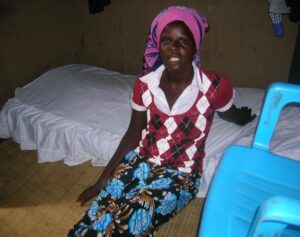
“We couldn’t believe our 8 year-dispute could end,” said Murekatete. Their violent conflict started in 2006 and ended peacefully in 2014. “The only reason was that my husband used to disregard and infringe my land and property rights, like other men saying that women don’t have rights to land and other household invaluable possessions.”
Murekatete said that her husband wished to sell property as he pleased. She added they suddenly started fighting when she complained. She specified they’d spent 2 years clashing because of ‘wasting our jointly owned property’. He once sold a piece of land for 150 000 Rwandan francs (then around 187.5 US Dollars then), according to Murekatete who added that the land value then actually equaled about 600 000 Rwandan francs (750 US Dollars then) and ‘this was the trigger of the escalation of the conflict.’
Negative Consequences
As explained by Murekatete, this dispute was disastrous. “We were living between death and life, my husband was once on the point of dying because of drinking poison to commit suicide and he was healed in a health center. It’s because of the violent conflict that he decided to kill himself, accusing me of depriving him of peace and security at home for the mere reason that I opposed his wish to continue selling our property.” “After the 2 years of physical violence at home, my husband moved to his family where he spent 2 years. He was eventually tired of such life and decided to move to Toro in Uganda to evade the situation and he spent there 4 years.”
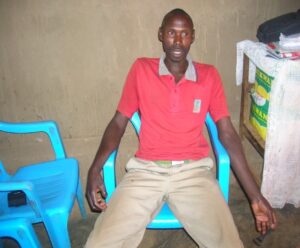
When Habiyambere compared his family to others in the region, he acknowledged the family faced a huge loss. “We’ve suffered an intolerable loss because we could now own at least a four-wheel vehicle of more than 10 000 000 (around 12 500 USD) Rwandan francs and other possessions since we possessed a strong shop worth more than 2 000 000 (nearly 2500 USD) in 2005.”
“I know a man, who was then nearly at the same level as me, who now owns a 6 000 000 (nearly 7500 USD) Rwandan franc vehicle and a lorry worth 28 000 000 (about 35 000 USD that time) Rwandan francs and over 10 hectares of land as well as other things we don’t know since he has moved to another sector, while I don’t even possess a bicycle of 30 000 (37.5 USD) Rwandan francs.”
A shop of about a 2 500USD value in 2005 actually was very strong. A piece of land/plot in an advanced/urban place which then cost then around 200 USD can now cost around 10 000USD.
Techniques used for the dispute to be peacefully resolved
Murekatete said that their dispute was resolved, thanks to the project’s Common Ground Approach. “Oh, God. Thanks for the project’s Community Resource Person (CRP), Anna Batesi and a group of women who accompanied her to assist us in getting out of the violent conflict. They performed a fabulous achievement.”
The Tabagwe CRP, like other 25 CRPs in Kayonza and Nyagatare Districts covered by the project, had been trained by SFCG on Conflict Transformation. Murekatete explained that the women approached her to talk to her about the dispute. She added the women helped her to understand she’d also perpetrated some mistakes though she was right to some extent as she was striving to defend her rights.
The women clarified to her that she claimed her rights aggressively, instead of peacefully or non-violently. “The woman, Batesi and the other women managed to show me that the conflict wouldn’t have escalated into violence if I had used constructive and peaceful dialogue to defend my rights; they emphasized that the conflict was actually aggravated by the destructive approach I applied.” “I was convinced I’d not been humble towards my husband, because I couldn’t fear that we even beat each other and I felt I was right.”

The women advised her to go to Uganda to initiate a peaceful interaction with her husband, and request him to come back. “After elucidating me that I have to show respect to my husband and clearly explaining the mistakes I committed, the women suggested that I should ask my husband for pardon and that he should also request me for pardon.” “Consequently I immediately decided to meet him in Uganda while I neither knew where he was nor possessed money to use to reach there since I was then cultivating people’s land for food; I didn’t have any other source of income.”
According to Murekatete, for her to be able to get to Uganda, she requested Urwego Opportunity Bank for a loan. She also requested a neighbor to lend her a phone so as to try to speak to his husband. “I called him and asked where he was and he replied he was in Toro and to reach there I had to spend 40 000 (around 50 USD); and the bank gave me the money.” “So I told him that I wanted us to amicably settle our dispute and he accepted. I begged him for pardon and he begged me for pardon.”
The man actually recognized the mistake he had committed. “I asked her for the pardon; I’d wasted our jointly owned property and you’ve learnt the huge loss we’ve experienced because of my behavior. So, I sincerely begged her for pardon for that.”
Benefits of peaceful resolution of the dispute
Murekatete and Habiyambere affirmed that they immediately started reaping good fruits from the end of their violent conflict. It was then only around one year after Batesi and the group of women peacefully transformed their dispute. However, they said they’d been able to have two houses constructed during this period only. They had additionally cemented all of their rooms. “We’ve even got a shop, we’re paying school fees for our 6 children and we get them all necessary needs like clothes while two of the children had failed to pursue courses since they irregularly studied so that they dropped out of school,” says Murekatete before adding “Currently here reigns a peaceful atmosphere and the children are always joyful.”
Habiyambere then believed that they were ready to exploit the peaceful environment to recover things they’d lost. “I nourish great hope that we’ll have accomplished a lot of achievements by two years from now, if things continue in this way. I strongly believe that we’ll have acquired some motorcycles.”
Benefits to the Community
Furthermore, Murekate confirmed that she had achieved a very important accomplishment, owing to the peaceful resolution of their violent conflict. “I now provide testimonies about our violent conflict and how it has been peacefully resolved so that the testimonies are helping a lot of people. Thanks to this, I’ve been elected the President of the Parents’ Evening Forum in our village.”
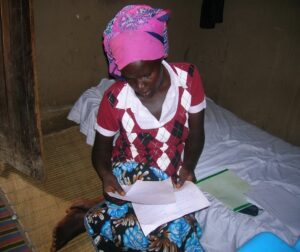
Murekate, in this photo, holding sheets of paper where she’d recorded cases peacefully handled, said that on 8th March 2015 on the International Women’s Day she was the only woman, from the whole sector of Tabagwe, given an opportunity for speech. Her testimonies healed numerous people- both women and men, as she said. “I now have 9 disputes I’ve peacefully resolved; 4 of them are land-related while the others are relationship-based.” “Allow me to praise the Lord thanks to this marvelous project employing the Common Ground Approach, it has been my redemption and is being redemption for other people I’m helping because of it.”
Moreover Murekatete had succeeded in accomplishing what most women really fail to do in Rwanda, owing to the peaceful resolution of the dispute. “After we were assisted in peacefully transforming the conflict whereby we both recognized our mistakes; I accepted the children that my husband procreated with a concubine; they are here, they’re my children, I’m treating them the same as my own children and they’re learning like my own children.”
Based on the dispute, Habiyambere went beyond to prioritize projects and programs related to the Peaceful Conflict Resolution Field over projects and programs situated in other fields like education, health, agriculture and infrastructures usually more valued thanks to their nature of delivering tangible results or impacts. “People saying or thinking that projects, dealing with intangible things shouldn’t be attached value, deceive themselves considerably; they are totally wrong. This project has been designed to peacefully resolve land-related conflicts and it has managed to successfully transform our dispute peacefully while even local government leaders had failed. During the time when the violent conflict was still existing, we never knew peace- we stagnated in the war, a fighting environment; therefore, our children were no longer eating well and sometimes lacked food, some of the children had dropped out of school, the violent conflict forced me to even move from the country to Uganda, I once attempted to perpetrate suicide of myself because of the dispute”.
“Our neighbors- who haven’t encountered a dispute but who were at the same level as us- are enjoying well-being; some of them possess a lot of property while I don’t even have even a bicycle of 30 000 RWF. However, for only 7 months after your project succeeded in peacefully handling our conflict, we have achieved tremendous accomplishments since we’ve got a shop, we’ve constructed two houses-one that we occupy and the other one that we rent to people for money. All of the children have returned to school, they’re well dressed and fed. They’re not right, those people only defending projects designed for tangible products like schools; but, where can they find students to join their schools, if the parents are stagnating in the war and fighting environment as we used to be?”
A long period of time has passed without us receiving any updates about this family. We plan to visit them, to assess their current situation.