By Jean Baptiste Ndabananiye
The Farmers’ Potato Academy in Rwanda is redefining agricultural education through innovative practices and collaboration. Founded by non-governmental organizations, the academy unites Imbaraga Farmers Organization-Rwandan organization said to support over 27 000 Rwandan farmers, Agriterra—an international organization of the Netherlands’s farmers, the Federation of Rwanda’s Irish Potato Farmers, INESI-Ruhengeri—Institute of Applied Sciences, with plans to involve ISAE Busogo. The academy values the expertise of seasoned farmers—akin to holding a doctorate in farming—while bridging the gap to modern agricultural technologies.
According to Imbaraga Farmers Organization, the academy promotes sustainable practices such as composting, empowering farmers to produce their own organic fertilizers, thus reducing reliance on costly chemical alternatives. If it succeeds in enhancing local farming practices, the academy will likely contribute to global food security, nurturing a community of skilled farmers ready to tackle modern agricultural challenges. As over 700 million people go to bed hungry each night, such initiatives across the globe could help to address this problem. This article consists of these major subdivisions:
- Further details on the academy
- Global food security and sustainable agriculture
- Climate resilience in agriculture
- Could such practices being promoted by the academy be a relief to the plight of hunger?
Further details on the academy
“The Farmers’ Potato Academy, a school of farmers is working smoothly. We have now formed its board of directors that consists of the Federation of Rwanda’s Irish Potato Farmers, INESI-Ruhengeri, Agriterra as the funder of the academy, and we are planning to involve ISAE Busogo by this year,” Jean Paul Munyakazi-Imbaraga Farmers Organization’s Legal Representative has recently told Life In Humanity.

“INESI-Ruhengeri and ISAE Busogo as higher learning institutions will provide researchers who will work with farmers. We regard mature farmers like those who have passed 30 years in the career as people holding doctorate in farming though this isn’t a formal degree. A farmer of Irish potatoes with that experience is so expert at the crop that they possess a lot of extensive knowledge and skills about this crop. For example, they know diseases of the crop and how to deal with them. However, these farmers also need modern technologies; that’s where ISAE [Institute of Agriculture and Animal Husbandry/ Busogo] and INES-Ruhengeri higher learning organs come in.”
Munyakazi adds that the academy, which has already decided to also include the weather forecasting field, employs two agronomists who teach farmers. “Besides farming techniques, we now intend to involve weather forecasting whereby the farmers will use information from the Rwanda Meteorological Agency in farming.
We have now trained 60 farmers on using weather and climate information, so that they now listen to weather-related information supplied by the agency and then apply it in their farming. These 60 trained farmers are those from Musanze and Nyabihu Districts under a pilot project in partnership with a German University.”
Munyakazi describes criteria upon which the academy is founded, to select farmers for training. “The academy currently admits passionate Irish potatoes and those who desire to farm them. Another criterion is that you must come from a potato-growing zone. The academy educates farmers for two days a week, Wednesday and Friday, the remaining days are allocated for practice on the field. We receive farmers close to the academy; that is how even formal schools have started. They began with students near to the schools’ location and then extended to other regions later.”
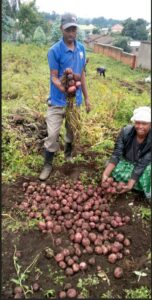
The academy started in around 2020. Munyakazi says that 800 farmers have currently graduated from it. Those who are now studying aren’t paying fees but the academy plans to charge those who will follow the current farmer students a fee falling between 50 000 Rwandan francs (RWF) and 100 000 RWF. In other words, the academy will charge a fee of not less than 50 000 and not above 100 000RWF in a three-month training program. “We can even admit 3000 people concomitantly but we are limited by financial means to pay teaching agronomists. We employ 2 teaching agronomists.
Colonialists have harmed us by shaping agronomists to become employees in the agricultural sector, rather than teaching them to become farmers. I feel that this policy needs to change, preparing students learning agronomy to turn into famers instead of agriculture employees.”
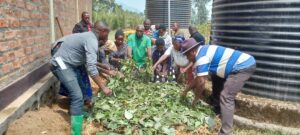
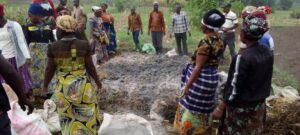
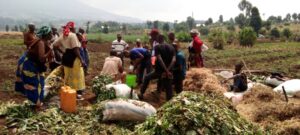
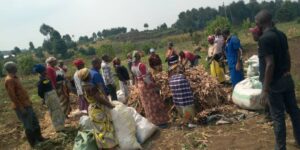
According to Munyakazi, composting is also taught in the academy. “Farmers have been accustomed to employing chemical fertilizers, though these fertilizers are also good, we are teaching them to compost, because compost produced by compost-manufacturing companies is costly.
One kilo costs around 120RWF or even 200 RWF sometimes. We are imparting composting knowledge and skills to 15 cooperatives in Burera, Rubavu, Gicumbi, Musanze and Nyabihu Districts. We will extend this program to other districts.” It costs around 60 RWF, to produce a kilo of compost.
This academy concentrates on Irish potatoes only. Munyakazi explains the reason why it is only this crop being focused on in the academy. “We started with Irish potatoes, because we built the academy on teacher farmers who were already available, and these were Irish potato farmers. It is for this reason that we requested Agriterra to bring us Irish potato specialists. But, we are planning to incorporate some other crops like maize and beans.”
Global food security and sustainable agriculture
The Farmers’ Potato Academy’s commitment to sustainable practices, particularly through composting and organic fertilizer production, resonates with global efforts to ensure food security and reduce dependence on chemical fertilizers. Such practices are pivotal in achieving Sustainable Development Goals, especially SDG 2 (Zero Hunger) and SDG 12 (Responsible Consumption and Production), which emphasize sustainable food systems and environmental responsibility.
By empowering farmers to produce their own compost, the academy reduces costs for local farmers while promoting soil health. This model is especially valuable for regions worldwide where high fertilizer costs and soil degradation negatively affect food production. If this model succeeds in Rwanda, it could inspire similar initiatives globally, helping to address the challenge of feeding a growing population sustainably.
Research Gate forms a professional networking site specifically designed for researchers, scientists, and academics to share their research, collaborate, and connect with others in their field. Founded in 2008, it allows members to upload their publications, access and request copies of research papers, and discuss research topics.
Its website contains an undated document titled “Harmful Effects Of Chemical Fertilizer” where this body states “Plants require a number of soil nutrients like nitrogen, phosphorus and sulfur for their growth. But, soil nutrient levels can decrease over time when crop plants are harvested, as nutrients are not returned to the soil. Hence, these essential nutrients needs to be compensated either through the natural process of decomposition, when plants die and decay, and the nutrients extracted from the soil return to the soil or by the easy means of adding fertilizers.”
“Fertilizers are substances used to add nutrients to the soil to promote soil fertility and increase plant growth. Today fertilizer has become essential to modern agriculture to feed the growing population. Use of fertilizers, especially, the chemical fertilizers has brought in blessings on humanity, which helped contain hunger and death in different corners of the world.”
It however raises this alarming question on chemical fertilizers. “Though chemical fertilizers increase crop production; their overuse has hardened the soil, decreased fertility, strengthened pesticides, polluted air and water, and released greenhouse gases, thereby bringing hazards to human health and environment as well. It has already been proved how chemical fertilizers pose serious challenges to the balanced and sustainable growth. Accordingly, scientists and researchers are seen arguing in favor of organic fertilizers as the best solution to avoid soil pollution and many other threats to environment and life caused by overuse of chemical fertilizers.”
Research Gate provides some of reasons causing chemical fertilizers to be harmful. “Since salt content is one of the most critical characteristics of chemical fertilizers; they are expected to be harmful to agriculture in the long run as salts are harmful for plants as well as soil. Continuous use of these chemical fertilizers depletes essential soil nutrients and minerals that are naturally found in fertile soil.
When we use chemical fertilizers; they do not help replenish soil nutrients and its fertility contrary to the popular belief; but, replenish only nitrogen, potassium and phosphorous. And we know phosphorous does not dissolve in water and its overuse may cause hardening of soil. Likewise alkaline fertilizers like sodium-nitrate develop alkalinity in soil reducing its fertility and making it barren. So to say; soil fertility and vegetation depend much on the balanced supply of essential nutrients and minerals.”
This networking site explains that though chemical fertilizers will help plants to grow faster, plants will not be healthy and strong. It clarifies that plants grown in that manner do not possess sufficient time to mature to develop good root growth, strong stems, or nutritious fruits and vegetables. “Even they (plants) will be less likely to survive because they will be more susceptible to pests and diseases as they lack good immune system and enough resistance against these forces.
Besides this, chemical fertilizers can cause root burn or fertilizer burn, as chemical fertilizers do not allow enough water intake for the plants. As already said; chemical fertilizers are high in nitrogen salts, and when the nitrogen is absorbed by soil too quickly; it will dehydrate and dry up the plant.”
Nitrogen fertilizers also mar water. “Another important issue of using nitrogen fertilizers is the groundwater contamination. Nitrogen fertilizers break down into nitrates and travel easily through the soil. Because it is water-soluble and can remain in groundwater for decades, the addition of more nitrogen over the years has an accumulative effect.”
Research Gates recommends organic fertilizers. “But, organic fertilizers are not like them; they are slow release which will allow time for microbial activity to break down the organic materials in the fertilizers. When we talk of microbial activity; we need to remember that natural microbes; which include beneficial insects, fungus, and bacteria found in the soil, are very much helpful for healthy soil and plant growth. Needless to say, use of chemical fertilizers will kill these soil friendly micro-organisms.
In their larger threat to environment, animals and human health; chemical fertilizers will ultimately end up leaking into our water bodies; ponds, streams, ground water etc. and contaminate water supply as a result of which humans as well as animals may suffer numerous short term and long term hazardous chemical effects on their health and body. In reply to this, organic fertilizers will be the right solution without which gardening and growing healthy and natural food and crops could be possible.”
This alarming issue is also highlighted by International Advanced Research Journal in Science, Engineering and Technology (IARJSET). In its June 2017 article entitled “Effects of Chemical Fertilizers on Human Health and Environment: A Review”, IARJSET points out “Pollution is one of the major concerns on the globe today. Farmers use a variety of chemical fertilizers to increase production and manage weeds and insect pests in order to meet the demand for agricultural products and to feed the growing population. Synthetic pesticides and fertilizers have been utilized excessively, which has had a negative impact on both the environment and human health.
As a result, the greatest important hazard to humanity on the planet is the increasing degradation of environmental contents. The imbalance between human needs and resource sustainability was accelerated by the rapidly expanding population in developing nations. The use of chemical fertilizers in agriculture has caused numerous environmental and health issues while increasing agricultural productivity. Water pollution is mostly caused by phosphates and nitrates found in chemical fertilisers.”
It also echoes the point raised by Research Gate, in these words “By boosting agricultural productivity, chemical fertilisers have proven to be a blessing for farmers everywhere. Today, various chemical poisons in the form of fertilisers and pesticides are produced in greater than 300 million tans under various brand names (Tomkins & Bird, 2002).
Although Indian average consumption of pesticide is far lower than many other developed economies, the problem of pesticide residue is very high in India (Abhilash and Singh, 2008). In many developing nations over the past three decades, the careless use and handling of pesticides in agriculture has resulted in major issues with human health (Dasgupta et al. 2007).”
Climate resilience in agriculture
Incorporating weather forecasting into the curriculum, the Farmers’ Potato Academy will help farmers to develop climate resilience—a crucial factor as agriculture faces increasing challenges from climate change. With farmers now trained to interpret meteorological data, they can adopt informed planting decisions and respond proactively to weather patterns.
This approach not only safeguards their yields but also builds a more adaptable agricultural system, able to withstand climate fluctuations. Such training is a vital example for other regions facing similar climate-related challenges. By demonstrating how smallholder farmers can leverage technology to mitigate risks, the academy contributes to a broader global effort to make agriculture resilient and sustainable in the face of an unpredictable climate.
The World Bank in its 18 March 2019 story states “Ninety percent of disasters are weather-related, according to the United Nations. Major disasters can have significant impacts on people’s lives and communities, even jeopardizing a country’s economic progress.Accurate forecasts and sufficiently early warnings for floods, high winds, and extreme heat, save lives and property. Forecasts can also help public and private institutions make more-timely, better-informed economic decisions to address climate challenges. Reliable weather services help operations run more smoothly in many weather-dependent sectors, such as transport, agriculture, energy, and tourism.”
Energy Policy Institute at the University of Chicago with its 26 February 2024 article headlined “Better Weather Forecasts Can Help Farmers Adapt to Climate Change” says “Climate change is making weather more variable, with rainfall patterns becoming less predictable and extreme temperatures occurring more frequently. Agriculture is particularly sensitive to these changing conditions, jeopardizing the livelihoods of the majority of the world’s poor who depend on agriculture for survival. Highly variable weather makes it challenging for farmers to prepare for the coming season because they don’t know if this year will be like the last. But accurate long-range weather forecasts have the potential to help farmers decide how much to plant, what to plant, or whether to plant at all.”
Could such practices being promoted by the academy be a relief to the plight of global hunger?
“Around 9 million people die every year of hunger and hunger-related diseases. This is more than from AIDS, malaria and tuberculosis combined. A child dies from hunger every 10 seconds. Poor nutrition and hunger is responsible for the death of 3.1 million children a year. That’s nearly half of all deaths in children under the age of 5. The children die because their bodies lack basic nutrients.
Globally, 822 million people suffer from undernourishment. Well into the 21st century hunger is still the world’s biggest health problem. 1 in 9 people go to bed, hungry. And it’s about to get worse,” reports The World Counts, a comprehensive online platform for global statistics.
Released annually by Concern Worldwide and Welthungerhilfe, the 2024 Global Hunger Index (GHI) points out “In 2024 adequate food is out of reach for billions of people, while both the human right to adequate food and international law are blatantly disregarded by those in power.
Hunger rates in Africa are especially high, with 1 out of 5 people going hungry each day. 2.8 billion people around the world cannot afford a healthy diet — 35% of the global population. In low-income countries, 71.5% of people cannot afford a healthy diet. In high-income countries, that figure drops to 6.3%. Half of all child deaths are linked to malnutrition. 9 million people die from hunger-related causes every year; many are children under the age of 5.”
Such practices popularized globally, they assuredly hold the potential to reverse the problem of global hunger. Meanwhile, different sources involving the GHI, Action Against Hunger and the World Food Program (WFP) underline that the world produces sufficient food to nourish all the 8 billion humans. For more on this, read this article.
I am always searching online for articles that can assist me. Thanks!
Well I sincerely enjoyed reading it. This information provided by you is very practical for proper planning.
Wow, fantastic blog layout! How long have you been blogging for? you make blogging look easy. The overall look of your web site is great, let alone the content!
Thank you greatly for the inspiring feedback.
Hi there just wanted to give you a quick heads up and let you know a few of the pictures aren’t loading correctly. I’m not sure why but I think its a linking issue. I’ve tried it in two different web browsers and both show the same results.
Do you have a spam problem on this website; I also am a blogger, and I was curious about your situation; we have developed some nice methods and we are looking to exchange methods with others, please shoot me an e-mail if interested.
Thanks for reaching out! Fortunately, we haven’t experienced any spam issues on our website so far. That said, I’d definitely be open to learning and exchanging ideas—it’s always great to connect with fellow bloggers. Feel free to send me an email, I’d be happy to hear about the methods you’ve developed!
It is actually a nice and useful piece of info. I am satisfied that you just shared this helpful info with us. Please keep us informed like this. Thank you for sharing.
Thank you so much indeed for your thoughtful and extremely encouraging words — we’re truly overjoyed to hear you’ve found the information useful! It means a lot to know the content is producing a positive impact. We’ll definitely keep sharing more like this, and we really appreciate you being part of the conversation. Thanks again for your support!