By Jean Baptiste Ndabananiye
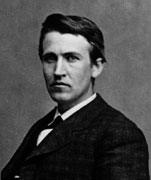
At first, they laughed. They scoffed at the light bulb, mocked the idea of flying machines, and rolled their eyes at the notion of a computer in every home. Time and again, the world’s most transformative ideas were dismissed as nonsense, fantasies, or doomed experiments. Yet behind each “dumb” idea was someone who believed—relentlessly, audaciously, and wholeheartedly.Thomas Edison endured colossal scorn from the world’s greatest minds. The Wright brothers defied gravity and mockery alike. Steve Jobs was ridiculed for putting a phone, a camera, and the internet into one pocket-sized device.
PayPal— a global payments platform saying it is available to people in more than 200 markets, allowing customers to get paid in more than 100 currencies, withdraw funds to their bank accounts in 56 currencies and hold balances in their PayPal accounts in 25 currencies— was initially voted as one of the worst business concepts of the year in the United States of America in 1999. What all these trailblazers held in common was not just vision—it was stubborn faith in what others couldn’t yet see.

History bears a funny way of vindicating the so-called fools. The truth is, what often starts as a thing the world calls “stupid idea” is just the first sign that you’re onto something revolutionary. Every time a breakthrough loomed on the horizon, it had to pass through a storm of ridicule, fear, and doubt. And still, the believers pushed on. To prove the point, this article is going to avail itself of the most groundbreaking inventions that were massively mocked as absurd concepts.
The light bulb
Alumni Ventures is a U.S.-based venture capital firm. It offers diversified venture capital funds to accredited investors and is supported by graduates of elite universities such as Dartmouth and Yale and employs the network to reach competitive rounds. The firm’s August 7, 2024 story “How Stupid Is That?” “The ‘Dumb’ Ideas That Have Reshaped Society and Made People Rich” highlights breakthrough concepts—like the light bulb—that have revolutionized the world, despite early unspeakable mockery. However, this article draws not only from that story, but from a broader perspective.
The firm states “When Thomas Edison introduced his incandescent light bulb on New Year’s Eve, 1879, many scientific minds of the time were unimpressed”. A British Parliamentary Committee tasked with investigating the value of Edison’s bulb judged it “unworthy of the attention of practical or scientific men.” Another critic said “His idea is utterly impractical.”
The most smarting rebuke was issued by one of the era’s most respected scientists, who said “Everyone acquainted with the subject will recognize it as a conspicuous failure.” Various sources including the website—Understandably— say the esteemed scientist was Henry Morton, the then president of the Stevens Institute of Technology who said so in 1880.

According to Library of Congress, the late Edison is one of the greatest scientists of all time. In its story entitled “Life of Thomas Alva Edison”, it reports “One of the most famous and prolific inventors of all time, Thomas Alva Edison exerted a tremendous influence on modern life, contributing inventions such as the incandescent light bulb, the phonograph, and the motion picture camera, as well as improving the telegraph and telephone.
In his 84 years, he acquired an astounding 1,093 patents. Aside from being an inventor, Edison also managed to become a successful manufacturer and businessman, marketing his inventions to the public. A myriad of business liaisons, partnerships, and corporations filled Edison’s life, and legal battles over various patents and corporations were continuous.”
In fact, the greatest innovators and leaders have failed multiple times before achieving breakthrough success. The late Edison, when asked about his thousands of failed attempts to invent the lightbulb, famously answered “I have not failed. I’ve just found 10,000 ways that won’t work.” His failures weren’t roadblocks; they constituted a bridge that allowed him to refine his work until he finally succeeded.
Trains
According to Alumni Ventures, the advent of trains was received by great suspicion, ridicule, and anxiety. “What can be more palpably absurd than the prospect held out of locomotives traveling twice as fast as stagecoaches?” asked The Quarterly Review, a British periodical, in March 1825. There prevailed widespread fears about trains’ potential health effects. Alumni Ventures also says that one scientific writer even cautioned “Rail travel at high speed is not possible because passengers, unable to breathe, would die of asphyxia.”
Various sources maintain that it is Dr. Dionysisus Ladner who stated the latter words. The website—Julius Baer, one of the sources, with its 30 July 2018 story titled “Ten mobility predictions that were dead wrong”— reports “ Before we had cars, planes and space shuttles, there were trains. Rather slow trains we may add, as the maximum speed in 1830 was 48 km/h (30 mph).

It comes as no surprise that Dr Dionysius Lardner, a professor of Natural Philosophy and Astronomy, did not deem feasible a high-speed train to carry its passengers safely: ‘Rail travel at high speed is not possible, because passengers, unable to breathe, would die of asphyxia.’ If only he could see that nowadays the maximum operating speed of a Japanese bullet train is 320 km/h (200 mph) – and passengers seem to be just fine.”
Planes
According to Forbes in its 16 December 2020 story entitled “Why The Wright Brothers Flew”, in 1902, the late Simon Newcomb— professor of mathematics and astronomy at Johns Hopkins University and in the United States Navy, said “Flight by machines heavier than air is unpractical and insignificant, if not utterly impossible.”
Forbes emphasizes that Newcomb was so widely renowned that when he said something, especially in his writings and well-placed publications, people heeded it. According to this platform, as late as October 22, 1903, he wrote “May not our mechanicians…be ultimately forced to admit that aerial flight is one of the great class of problems with which man can never cope, and give up all attempts to grapple with it?”

Surprisingly, the late Edison figured among those who dismissed the possibility or practicality of planes, though he had also faced similar issues. “Newcomb was by far not alone in his doubt; almost everyone shared it.
Even Thomas Edison, the greatest inventor of them all, thought the effort to fly had been exhausted and that it made little business sense to pursue. Think for a moment about Edison’s unique perspective on this, the fact that he was, at his essence, a nineteenth century scientist and a twentieth century businessman. Given that juxtaposition, his view of the odds against flying was ominous,” says Forbes.
However, a bit later, the inventors of the plane— Wilbur Wright and Orville Wright after four years of research and development— proved them totally wrong. Forbes says “At 10:35 AM on this very date, December 17, 1903, Orville and Wilbur Wright made their first flight: a 59-second journey of 120 feet on the wind-swept, wintry beach at Kitty Hawk, North Carolina. Incidentally, it was Orville flying the plane with Wilbur on the ground, but neither of them craved the fame or distinction of being the first to fly. They were a perfect team, inspired by vision, unburdened by ego.”
“This wasn’t their first attempt; they failed initially, much like Edison did with his light bulb, but that never stopped them. That sub-one-minute flight, no longer than a touchdown pass from the 40-yard line, changed the world forever to a degree very few inventions or discoveries ever did. Orville and Wilbur did not doubt themselves. They flew.”
The engineering editor of The Times of London frequently said “All attempts at artificial aviation are not only dangerous to human life but foredoomed to failure from the engineering standpoint.” In response to the editor’s words, Forbes says “It was an adamant pronouncement of death to the Wright brothers’ effort to fly, and a dismal forecast of what lay ahead in humanity’s eternal striving. These were not the most encouraging words, at all, especially given their source.
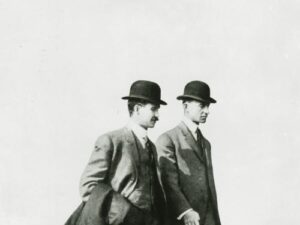
But what made his proclamation totally crazy and of no value whatsoever was that he made it more than two years after Orville and Wilbur made their famous flight. After! Two years after the Wright brothers flew, this guy proclaimed that they couldn’t. After all, there were competitors who were vying for this position in history.”
Forbes adds “Oh, and by the way, this critic (if we can call him such), working under chief editor George Geoffrey Dawson, was educated as an engineer and an editor. The Wrights? Neither of them finished high school. For historical accuracy, Wilbur, the older of the two, went to high school for four years but never finished; his diploma was posthumously awarded in 1994, when he would have been 127.
It goes to show you that while most people can’t envision something before it’s happened, some just can’t even understand it once it has happened. Wilbur and Orville not only took humanity into the skies; they taught us one of the great leadership lessons of all, that a vision, a belief in that vision, and a determination to make that vision a reality can never be deterred by others who – for some reason or another – doubt you.”
Automobiles
Alumni Ventures says “Early automobiles faced a legion of naysayers, convinced that cars were either too dangerous or merely a passing fad.” “The ordinary ‘horseless carriage’ is a luxury for the wealthy, and although its price will probably fall in the future, it will never, of course, come into as common use as the bicycle,” asserted a reporter for The Literary Digest in 1899. “Get a horse!” was commonly shouted at early motorists, encapsulating the public’s skepticism of self-propelling machines, according to Alumni Ventures.
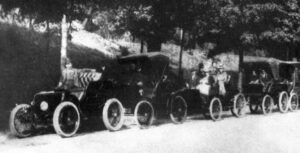
The Saturday Evening Post constitutes a historic American magazine that has played a major role in shaping U.S. popular culture, founded in 1821; thus, one of the oldest magazines in the United States. It gained huge popularity in the early to mid-20th century, especially between the 1920s and 1960s. This magazine contains an article headlined “Get A Horse! America’s Skepticism Toward the First Automobiles”. The magazine clarifies that this article was published in the 8 February 1930 issue of the Saturday Evening Post featured in the Post’s Special Collector’s Edition: Automobiles in America!
The magazine reports “In 1930, Alexander Winton, by then one of the legends of the auto industry, wrote this article for the Post about the wild early days when even promoting the idea of a self-propelling machine would make you the object of ridicule. Winton was a bicycle maker, he soon became infatuated with the idea of a bicycle that ‘a rider wouldn’t have to push and keep pushing.’
In 1896, he founded the Winton Motor Carriage company, and soon began turning out cars at the dizzying rate of four per year. He would sell his first car in 1897 — arguably the first automobile sold in the U.S. — for the princely sum of $1,000.”
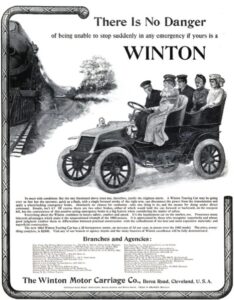
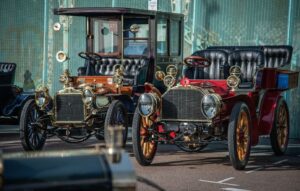
In the article, the late Winton wrote “There has been much argument as to who made the first automobile in this country. My own conviction is that the honor belongs to Charles E. Duryea. I began serious experiments in 1893, and I am sure Duryea was conducting them prior to that year. But whether Duryea built the first automobile or whether he didn’t, the fact remains I built, and sold, the first American- made gasoline car.
The exact date of the sale was March 24, 1898, and about a week later — on April 1, 1898 — I received payment and shipped the car to its new owner, Robert Allison, a mechanical engineer of Port Carbon, Pennsylvania. I bought it back after Allison had used it a few years, and it is now in the Smithsonian Institution, in Washington.”
In an age when the clatter of hooves ruled the roads and the thought of horseless travel was sheer madness, Winton dared to dream of a machine that moved not by muscle, but by fire and fuel. “When I first contemplated the application of gasoline for vehicles, I had a bicycle plant in Cleveland. Because bikes interested me, my mind naturally turned to something a rider wouldn’t have to push and keep pushing if he was trying to get some place. But the great obstacle to the development of the automobile was the lack of public interest.
To advocate replacing the horse, which had served man through centuries, marked one as an imbecile. Things are very different today. But in the ’90s, even though I had a successful bicycle business, and was building my first car in the privacy of the cellar in my home, I began to be pointed out as ‘the fool who is fiddling with a buggy that will run without being hitched to a horse.’ My banker called on me to say: ‘Winton, I am disappointed in you’.”
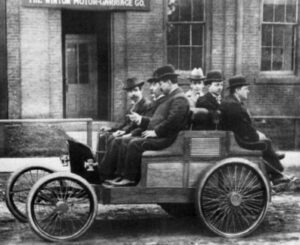
The air was thick with disbelief and disdain as the banker’s fury erupted—not over money lost, but over a machine so outrageous, it dared to challenge the noble reign of the horse. “That [the banker’s words] riled me, but I held my temper as I asked, ‘What’s the matter with you?’ He bellowed: ‘There’s nothing the matter with me. It’s you! You’re crazy if you think this fool contraption you’ve been wasting your time on will ever displace the horse’.”
Home computer
Alumni Ventures points out “The idea of a computer in every home seemed laughable to many at first. Even industry experts were skeptical of their potential.” It adds that Ken Olsen, who founded the Digital Equipment Corporation, said in 1977 “There is no reason for any individual to have a computer in their home.” Similarly, it further states, in the early 1970s, the chairman of IBM was quoted as saying “I think there is a world market for maybe five computers.” “According to the 2023 U.S. Census Bureau survey, 94% of American households own personal computers.”
The internet
According to Alumni Ventures, when the internet was starting to rise, there existed widespread doubt about its usefulness and potential. In 1988, Nobel Prize-winning economist Paul Krugman stated “By 2005 or so, it will become clear that the Internet’s impact on the economy has been no greater than the fax machine’s.”
A 1995 Newsweek article by astronomer Clifford Stoll also predicted the Internet would quickly die. “Hardware and software will all top out in the mid-90s and, thus, the Internet will never ever get any more user friendly or portable.” Alumni Ventures adds “Stoll had his moment in history as the article has since been held as a classic example of misjudging the potential of emerging technologies.”
Despite the early skepticism from experts like Krugman and Stoll who predicted the internet’s impact would be minimal or short-lived, it has now become an inseparable part of our daily existence. From revolutionizing communication to reshaping economies, the internet has woven itself into the very fabric of modern life, transforming everything from how we work to how we interact. Today, the internet is not only ubiquitous, but indispensable, far surpassing the limited visions of its early critics.
Smartphones

“Smartphones were once seen as extravagant gadgets, combining phones and computers” says Alumni Ventures adding that critics doubted their necessity, with then-CEO of Microsoft, Steve Ballmer, famously stating in 2007 “There’s no chance that the iPhone is going to get any significant market share.” Innovation expert Clayton Christensen also predicted limited success. “It’s not [truly] disruptive. History speaks pretty loudly on that, that the probability of success is going to be limited.” Christensen later acknowledged his mistake, “using it to refine his theory of disruptive innovation, which has greatly influenced business strategy”.
Fast forward to today, smartphones have become indispensable, with almost everyone relying on them for communication, work, and entertainment. In fact, owning a smartphone has become so ingrained in modern life that not owning one today is often seen as a notable exception, far beyond the limited success once predicted.
Emerging technologies and driverless cars
“Lest we be tempted to think we’re all much wiser now, we should recognize that many promising technologies now face the same doubts and fears as past game changers. In the early stages of Artificial Intelligence development, even Bill Gates expressed early skepticism, calling it more of a ‘dream’ than a reality. However, he later became a strong advocate for AI research and development as the technology gained momentum,” highlights Alumni Ventures before adding “Driverless cars are in an even earlier stage of public acceptance.
Recent AAA surveys reveal that 66% of U.S. drivers express fear, up from 55% in 2022. At the same time, tech watchers predict a growing acceptance of driverless technology as people experience fully autonomous ride-hailing services such as Waymo One.”
From internet doubters to smartphone skeptics, history is filled with naysayers of innovation—yet time and again, technology has proven them wrong. “The list goes on, with new advances in fusion power [among others] deemed impractical or destined to fail. But if history is any guide, it’s not a question of if many of these emerging technologies will reshape our world but when. Of course, there are ample examples of technologies that have failed to work or have failed to find product-market fit.”
From ridicule to revolution: an optimal lesson for every bold believer
If you’re holding a wild, misunderstood idea—don’t forsake it. You might just be the next “crazy” person to revolutionarily change the world. As Arthur C. Clarke so wisely stated it “Every revolutionary idea seems to evoke three stages of reaction: (1) It’s completely impossible.
(2) It’s possible, but it’s not worth doing.
(3) I said it was a good idea all along.”
Let this be your reminder: ridicule is often the echo of unrealized and incredible greatness. History doesn’t remember the mockers—it remembers the makers. Believe boldly. Persist audaciously. The world may not see it yet, but your “impossible” might just be the next inevitable
Good https://is.gd/N1ikS2
Thank you!
Very good https://is.gd/N1ikS2
Thank you a lot,Kristin955, for your uplifting comment!
Good https://is.gd/N1ikS2
Thank you, Silas2996, for your positive feedback.
Awesome https://is.gd/N1ikS2
We appreciate that, Lola — it means a lot!