Perlina Mukamuyango, in a voice both calm and unshakably resolute, recounts her unimaginable ordeal during the 1994 Genocide Against the Tutsi in Rwanda. Fleeing from one hill to another as massacres advanced with ferocity, she witnessed her family perish one by one—her parents killed by their neighbors, her siblings butchered, and her hope nearly extinguished. Yet, even amid terror and despair, she and her older sister chose compassion over survival instinct—refusing to abandon their 12-year-old brother, despite the warnings that his presence marked them for death. Her story, shared in chilling detail, is not only a testimony of unbelievable loss but also of a defiant will to survive, remember and strengthen generations.
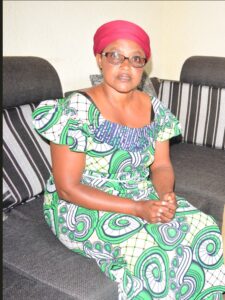
As we have always emphasized with our various articles on this subject of unity and reconciliation in Rwanda, as even evidenced by this previous piece featuring Mukamuyango—Undergoing an inhuman crime is torturous, but suffering such a crime by a person you are related to is more torturous, such narratives are not only colossally important for Rwanda but also the entire globe. This article: Elisabeth Hagenimana’s journey from stigma to strength, as a genocide perpetrator’s child also underscores that such stories resonate deeply today with the whole world. Mukamuyango dwells in Karama Village, Gihinga Cell, Gacurabwenge Sector in Kamonyi District in Rwanda’s Southern Province.
“They were killed where I now live”
Perlina Mukamuyango: Instantaneously after the genocide started in 1994, we fled our home, but we didn’t go far from it. Our parents told us “In 1959 and 1973, brutal violence was carried out against the Tutsi. At that time, we took refuge in churches. They killed people, slaughtered cows, and burned houses. But when some stability came back, we went back home and life continued.” So, when the genocide began, we thought that it would unfold in the same way.
We kept fleeing from one hill to another. Whenever the massacre reached the hill where we were hiding, we would move to another one. Eventually, we reached a place called Musambira. But soon after arriving there, an attack came from Muhanga District, and another one from Kigali, to surround and completely corner us.
My father was then still alive and told us “There exists a place named Kigembe, a hill inhabited by several Tutsi, let’s go there; they [Interahamwe] will kill us quickly — they’ll shoot us dead instead of torturing us by beating us to death with maces/ cudgels [ubuhiri] or by cutting us to pieces. ” When we arrived there, we indeed found many Tutsi.
People said the Hutu residents of the hill had refused to participate in the genocide— they had refused to massacre the Tutsi. Because of this, buses full of Interahamwe were sent to the hill. It was those Interahamwe who killed the Tutsi gathered on that hill, Kigembe, where we had just taken refuge. Numerous people died there. Our parents were severely stoned while hiding, their bodies wounded all over. As a result, our parents decided to return to our native locality to assess the situation, so that they could come back to bring us home, if they found the situation favorable.
As soon as my father and mother arrived here, the Interahamwe killed them. They murdered them in the neighborhood [village] where I now live. It was our cousin—who was not among those who were being hunted—that informed us of their death. Our cousin was living on the hill where we were hiding. Even though we were hiding, we sometimes ventured out to ask people for food.
It was during one of these trips that our cousin told us “Did you know your parents have been killed?” We replied “No. They told us they were going to check the situation and would come back to take us from here.” Our cousin explained “They were killed as soon as they entered your native community; which is why they didn’t come back to take you.” I was the fifth child. All of my older siblings were killed. I was 20 years old.
Resting from horror: when death seemed kinder than life
Jean Baptiste Ndabananiye: Upon learning that your parents had been killed and that you were the oldest among those still alive, how did you feel?
Perlina Mukamuyango: Given the unimaginable horrors we were enduring, when someone died, you didn’t feel sadness. You thought “At least they are resting from this overwhelming situation.” We were facing extreme hardships. When it rained, we were drenched; when the sun shone, we were scorched. We were always running, with people chasing us and throwing stones at us. When they caught people, they threw them into pits, though sometimes they could spared somebody, saying, “Don’t throw this one into the pit, leave them alive so they can tell the story.”
So, when you heard that someone had died, you weren’t sorrowful. Instead, you thanked God in your heart, thinking “They are resting. Let them leave this cruel world, especially since we all knew that we would eventually be killed. You would think ‘Today, they die; tomorrow, it’s my turn, or I will die soon.’”
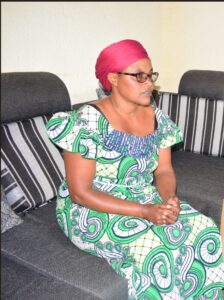
I instead faced sadness, after the genocide ended, but during the genocide I wasn’t saddened that our parents died, I instead said “They are resting.”
It is our cousin who told us that our oldest sibling—my sister who was then married and had two children—was also killed. We had known that her husband had been murdered, but we didn’t know that my sister had died until we were informed by our cousin. My older sister— next to whom I was born— eventually died while the Inkotanyi were close to liberating us; the genocide was nearing its end.
She and I had been fleeing together with our youngest siblings including my brother who was then aged around 12. People recommended us to abandon this child, saying “We advise you to leave this child, since he bears this face/appearance. Nobody will offer you mercy, anyone who will see you with the child will kill you because they will immediately discover that you are Tutsi. As a warning, forsake him.” But, we couldn’t. That my older sister said “Rather than abandoning him, we shall die together with him.”
When the assaults by the Interahamwe ceased, we returned to the ruins and harvested some crops, like beans, to cook and eat. While we were cooking beans in the ruins, an attack by the Interahamwe came from Gatiza where we had been hiding, and from the distant area of Mugina. It was they who immediately murdered my older sister and some others with whom we were hiding. However, I, my younger siblings, and some other people with whom we were together managed to survive.
Jean Baptiste Ndabananiye: Where were you then, when they killed them?
Perlina Mukamuyango: When the attack arrived, we ran away very quickly, since we were sitting outside a demolished house while my sister and the others were inside the house, cooking. They were unable to flee. We normally went into a ruined house of the Tutsi the roof of which had been stripped of iron sheets or tiles, and then cooked. The Interahamwe usually chanted “power”, when you heard them sing “power”, you instinctively ran away, without thinking of anything else. You instantaneously learnt that they were coming to massacre people. They also sang the song “Tubatsembatsembe/Let’s Exterminate them.”
Since we were outside, when we heard it and then dashed from there. The others never knew what had occurred; they knew it only when they had been fully encircled and trapped inside. The Interahamwe took them out of the house and went to kill them. That’s how they died.
I then survived the attack, with my two younger brothers, but I was eventually separated from them. These children went to hide in a certain home which was sheltering a woman of a Tutsi man who had joined the Inkotanyi army [RPA—Rwanda Patriotic Army]. When this man came to take this woman, the home owner told him “If you are going to take your wife, don’t leave these children since they are also being hunted. That’s how they went with that man.” So, that’s how I stayed alone. Though the Inkotanyi were fighting the Interahamwe; the genocide was still continuing, instead aggravating. I thought that I was I alone who was still living, I never imagined that there was any Tutsi who was remaining.
I went to my paternal cousin’s and entered the house but my cousin told me “They are chasing people inside houses; if you stay here, they will catch you. Instead, go to hide in a bush”. I then thought “Will I go to a bush? I feared. If I go to a bush, even beasts will devour me. Let me hide near the home, if the Interahamwe come to search the house, I will be watching them and if they leave, I will go to knock so that they open for me to get into.” I then went out, as person who was going to a bush but went to hide near the home. Yet still, I thought “If they come to search, they will discover me here. My heart advised me ‘Lie down on the ground and then place this bundle of tied cassava trees upon yourself so that when they come, they will just spot the bundle.’”
I lay down and placed the bundle above myself, staying there from around 08:00 PM to 03 AM. At this time, I said to myself “Perhaps, the Interahamwe won’t come. Let me go to knock, so they can open for me to enter the house.” I pushed the bundle from myself. However, as soon as I did so, I slept and started dreaming. In the dream, I met my mother and asked her “Mother, they have told me that the Interahamwe have murdered you, but I see you still alive.’ My mother responded to me “My child, it is your father who has died, not me.” After this dream conversation, I awoke. I then went to knock and they opened; I went into the house.
Surviving death, rebuilding life—a journey from despair to reunion after the Genocide
Jean Baptiste Ndabananiye: what hope did you carry that the Inkotanyi army would rescue the children?
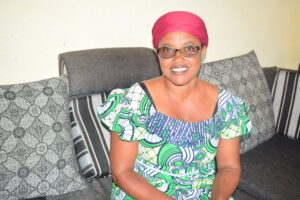
Perlina Mukamuyango: Then, I didn’t use to know that the children found refuge with the Inkotanyi. I was informed about it afterwards—after the genocide ended. While the genocide was still being carried on, I thought that they had also been murdered. I thought I was the only one in our family who was still alive. Meanwhile, I continued seeking refuge, till I joined others [who were fleeing to former Zaïre—now Democratic Republic of Congo (DRC)] and then reached Nyabikenke in the former sub-prefecture of Kiyumba. When they asked me “Where are you coming from and whose are you?”, I answered them “I am also fleeing, I am coming from Kigali, that’s where I was born.”
To my misfortune, there in Nyabikenke, I encountered a young man from our region who knew me utterly and told me “I am certainly going to kill you.” But, I told him that I was born in Musambira [now Kamonyi’s sector], vehemently denying that I was born in Gacurabwenge which was then located in the former Taba commune. I tried to convince him that I was coming from the former Musambira commune; nonetheless, he refused and asked another person to keep me so that he could go to bring a machete to kill me. Then, people immediately came rushing, saying that there was an Inyenzi [cockroach] caught. When people said Inyenzi, we failed to understand what it meant, then I comprehended that it referred to the Tutsi.
People gathered, saying that they had taken an Inyenzi and I said to myself “In fact, the Inyenzi is me.” The man had said that he would murder me, vowing that he would not offer me mercy and in my heart I said to myself “Yes, you will certainly kill me and I won’t request you for mercy, since you can’t give it to me.” While he had quit to fetch the machete, those who had assembled around me told me “Girl, go. You have not harmed that guy, if you are even a Tutsi, it doesn’t matter.”
That’s how I survived death on that day. Within some days after this incident, the Inkotanyi conquered that place where we were. Some people continued fleeing, going to Gisenyi and then Congo [DRC], but we remained there and the Inkotanyi met us and held a meeting with us, telling us that they were Inkotanyi.

The Inkotanyi were wearing military uniforms and white wellingtons and we saw that they differed from the Interahamwe and the army under [Juvénal] Habyarimana’s regime [FAR/Forces Armées Rwandaise—Rwanda Armed Forces]. The Interahamwe and the FAR used to wear military lace-boots. The wellies contributed for us to actually agree that they were Inkotanyi, since they were different from those we already knew.
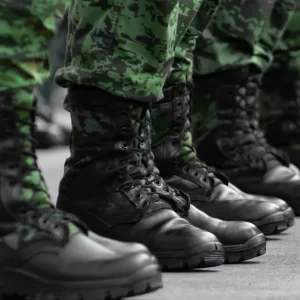
In the meeting, the Inkotanyi told us “We don’t kill people.” In the meantime, it had been always said that the Inkotanyi literally slaughtered people whom they encountered. The Inkotanyi however reassured us “We don’t kill any people; we are instead rescuing them. We advise to stop running after the killers. Return to your homes and harvest your crops, you will live; don’t worry, we won’t murder any person.” That’s how we came back.
Since I didn’t possess a place where to live, I returned to my paternal cousin’s on the hill—Kigembe. Arriving there, I found that my cousin had fled to Kibuye [which was then a prefecture and is now subdivided into Karongi District, among others; Kibuye now stands almost synonymous with Karongi District, especially in the district’s city and outskirts]. I then lived with some people in the family where she had been married. Afterwards, they told us “Depart from this rural area, so you can go to a camp where you will enjoy protection, lest the Interahamwe may come to kill you.”
Meanwhile, I had not met my brothers yet. They had been taken to Bugesera through Ruhango and Butare. They were dwelling in Bugesera, thinking that I had died while I also thought that they had been killed. It is people from Bugesera to here who informed me that they were alive and that they had seen them in Bugesera.
Jean Baptiste Ndabananiye: how many people have you lost because of the genocide?
Perlina Mukamuyango: I have lost 10 people who were directly close to me. We were 9 children in total of whom five were killed, in addition to my father, mother, my oldest sister’s two children and a fetus in her womb— only leaving us: four. Furthermore, I have lost all my maternal aunts, paternal, and maternal uncles—none of them survived.
Jean Baptiste Ndabananiye: Could you share with us your experience after the genocide?
Perlina Mukamuyango: When the genocide ended, I came back to the place which was once called our home—our home no longer existed, it was just ruins. The life was extremely harsh. I was required to go to look for those children with whom I survived. As said, my two brothers were then living in Bugesera. I had nowhere to live and no family to join. But, there was my grand-mother who had borne my mother. The killers had spared her, saying she would die of starvation. They had killed all her children and looted all her possessions including those which were in her home. So, they said “Let’s leave her alive; she will be killed by hunger.”
So, we were lucky to find that our grand-mother was still living but she was very old. So, I went to live with her in hard life in which I also had to take care of the children. Furthermore, as aged 20, I was not mature either. Despite this life, I maintained the children and was compelled to get married, because I was lacking where to live. Fortunately, my husband accepted the children. In addition to these two brothers, we finally found my young sister. We fled alone, and she fled alone; while we thought that she had also died, we found that she survived. So, they were three children whom I had to raise.
I and my husband looked them after, until they grew so that we eventually constructed them a house in the ruins. When completed, we moved them into that house where they stayed, till they tied the knot. Both of my brothers have been married; my sister has also founded her household. Two of my siblings each have three children, while the other one has one.
From hatred to healing— the power of true forgiveness and reconciliation in overcoming trauma
Jean Baptiste Ndabananiye: How were emotional wounds that you endured from this darkest experience?
Perlina Mukamuyango: My wounds were compounded by the fact that those who perpetrated genocide against my family members live together with me, because of being born and married in the same place where you have been born. I was born in this village while it is in this village that they killed my parents. Therefore, it is extremely difficult to dwell alongside people you see every day, while others tell you that these are the ones who murdered your father and mother, destroyed your house, and ate your cows.
Living with those people and looking at each other every day didn’t actually beget easy wounds. When you fell ill, you said “A sibling should take care of me during my illness, there are benefits that I could receive from them.” However, you were aware that this was impossible, whereas you are together with the person who has plunged you into this situation [who has killed your family members so that you have no one to help you] — the person you see each other in the morning, at noon and the evening.
It was extremely difficult, but again you were convinced that you could change nothing on it. Meanwhile, some of the genocide perpetrators were being jailed, some others were still moving freely as they had not been arrested and imprisoned yet, and the others had fled to Congo [DRC]. In fact, whenever a problem happened to you, you remembered that the instigators were those around you. We endured a life glutted with sadness and sorrow.
But fortunately, we were eventually engaged by an organization—CARSA [Christian Action for Reconciliation and Social Assistance]. It organized training for us, educating us on unity and reconciliation, and pardon-giving. It taught the genocide perpetrators how to genuinely ask for forgiveness from the depths of their hearts. And they taught us, the survivors, how to sincerely forgive. We came to realize that this constituted the only true path to healing our hearts, the only way to finally give our hearts rest.
Jean Baptiste Ndabananiye: whom had you found extremely difficult to forgive?
Perlina Mukamuyango—In my effort to attain the false peace, I decided to offer pardon; nonetheless, it was not forgiveness coming from the bottom of my heart. I merely said “In fact, I won’t take any action against them.” You thought “Even if the Government permitted you to kill them”, you saw that you would not kill as exactly as they murdered your people. Consequently, you said to yourself ‘Let me give them pardon’” But it was not actually forgiveness.
When CARSA intervened, we observed that the pardon wasn’t really pardon. It was after we were trained that we gave forgiveness from the bottom of our hearts. They told us “You must voluntarily and sincerely grant forgiveness, so that you feel your heart resting and the one pardoned also feels their hearts at peace.” So, CARSA accomplished a great service for us, teaching us how to verily pardon. What we had carried out before was just for us to feel the false peace, since our hearts had never experienced any rest.
When you met the person, the strong tension immediately arose inside you and you wished nothing good to them, because they had also done nothing good to you. But, after we gave the true pardon which we were taught by CARSA, we felt our hearts utterly freed and those who sincerely accepted the forgiveness we granted them also felt full liberation in their hearts.
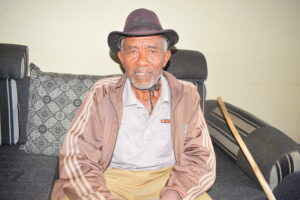
Jean Baptiste Ndabananiye: Those whom you have pardoned include this elderly man— Malachy Munyurangabo. How are your relations now?
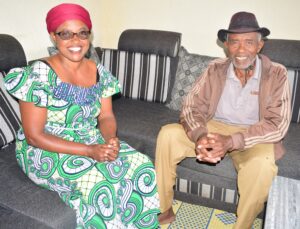
Perlina Mukamuyango: I and this old man coexist well, no problem exists between us. During the genocide, he participated in killing my father and mother, as it is they that were murdered here in this village. Before the true pardon, when I saw him, I was startled and deeply distrusted him, and he also did so. I thought “A person who has orphaned me cannot wish anything good to me.” Seeing me, he also thought that I couldn’t desire anything good to him. After he asked me for forgiveness from the depths of his heart and that I also gave it to him genuinely, we have been bearing fraternal relations.
CARSA eventually donated us a cow we jointly took care of, both of us seeking grass to feed it, among others. When it reproduced a calf, I shared milk with this elderly man. The cow helped us to improve our living conditions and played a key role in cementing our unity to become optimally strong, since when you share food with a person and give each other cows, you have actually become one so that nothing can separate you. We are neighbors, but we are like siblings.
True forgiveness- a heroic act
True forgiveness does not form a simple act—it is a heroic one. Life In Humanity is thus convinced that people like Mukamuyango, who have transcended unimaginable pain to offer sincere pardon, are not just survivors; they are heroes. They are extraordinary individuals who radiate inextinguishable inspiration to all humanity.
Such testimonies are not only profoundly moving but also immensely valuable—not just for Rwanda’s collective memory and healing, but for the world at large. In an era where violent extremism and identity-based hatred still fester in many corners of the globe, stories like Mukamuyango’s stand as vivid reminders of the consequences of division, the power of endurance, and the importance of justice. They hold timeless and infinite lessons for humanity about survival, truth-telling, and true reconciliation.
As Life In Humanity continues to shine a light on these harrowing yet vital and optimally inspiring narratives, one of our upcoming stories will also delve into Perlina and Munyurangabo’s relations and the experience of Munyurangabo. It will further explore the intertwined destinies of individuals who carry Rwanda’s painful past and enduring hope for peace into the present.
Life In Humanity also seizes this occasion to express the heartfelt recognition of organizations like CARSA. These organizations fulfill an indispensable role in rebuilding the human spirit after tragedy. By guiding individuals through the journey of true forgiveness and reconciliation, they help to transform deep wounds into bridges of unity and bright future. Their work not only restores relationships but also strengthens the very fabric of peaceful societies and development.
In this respect, Life In Humanity is wholeheartedly convinced that CARSA stands as a beacon of hope and healing, empowering individuals to embrace true forgiveness and fostering reconciliation that strengthens communities from the inside out.
Awesome https://lc.cx/xjXBQT
Thank you indeed! We are gladdened that you have found it so!