By Jean Baptiste Ndabananiye
Physical beauty has long been admired, celebrated, and even sought after in cultures across the world. It is often considered a symbol of youth, vitality, and social appeal. However, as time passes, the marks of age inevitably appear—wrinkles form, hair grays, and the body changes. Accidents or illnesses can also alter one’s physical features in an instant, reminding us of the fragile nature of external beauty.

In contrast, spiritual beauty remains untouchable, growing stronger and deeper over time. Unlike the ephemeral nature of physical attractiveness, spiritual beauty is rooted in character, wisdom, and the impact one holds on others. This article explores the limitations of physical beauty, the depth of spiritual beauty, and how we can cultivate the kind of radiance that never fades. It comprises these major sections:
- The fleeting nature of physical beauty
- The unshakable strength of spiritual beauty
- How to cultivate spiritual beauty
- Examples of spiritual beauty in the world
- Conclusion: choosing the beauty that lasts
The fleeting nature of physical beauty
“Physical beauty can be lost with marks of age or through accident. Spiritual beauty cannot be destroyed,” echoes Thought for Today, a publication featuring thoughts originally released in the Barbados Advocate established in October 1895. This paper is said to be the second most read daily newspaper in the country of Barbados.
Throughout history, physical beauty has been idealized, setting unrealistic expectations for both men and women. Society’s obsession with youth has given rise to industries dedicated to preserving appearance—cosmetic surgeries, anti-aging treatments, and an endless array of beauty products. Though people are generally interested to take care of their appearance, the reality remains that physical beauty is transient. No matter how much effort one puts into maintaining youthfulness, age will inevitably leave its mark.
Beyond aging, unforeseen accidents or health conditions drastically alter one’s appearance. A car accident, a burn, or a severe illness change a person’s face or body overnight. Those who have relied solely on their looks for self-worth often experience deep emotional distress when their physical appearance is distorted. This serves as a stark reminder that external beauty stands fragile and unreliable.
Moreover, history has shown that beauty standards are ever-changing. What was considered beautiful a century ago may not align with today’s ideals. If one’s self-esteem is anchored solely in societal standards of beauty, it becomes vulnerable to shifts in perception. True self-worth must therefore stem from something deeper and more enduring.
Corroborating examples
The Guardian ran a 26 May 2014 story headlined “Broken gargoyles: the disfigured soldiers of the first world war” in which this mega media house reports “Tens of thousands of badly wounded Australian veterans stoically participated in the earliest Anzac Day parades after the end of the first world war.

Look at the old photographs and you’ll see many of the 155,000 service men who were wounded on the various fronts, being pushed in wheelchairs by fellow veterans, or hobbling along with the aid of prosthetic limbs, crutches and walking sticks. There are the many blind men too, tap-tap-tapping their way along the main streets of the towns and cities with their white canes, clinging to the elbows of comrades.”
When individuals are disfigured or distorted by accidents or other calamities, those who readily accept their situations often find ways to adapt and continue living meaningful lives— a process that comes more naturally to those who have already developed spiritual beauty.
In contrast, those who struggle to accept their new reality may succumb to despair, retreating from the world and facing immense emotional challenges and eventually the worst outcome. This divergence highlights the resilience of the human spirit, showcasing how acceptance can lead to growth while resistance to change can result in isolation and suffering. William Kearsery is one of those saved by accepting his situation—illustrated by the photo— which was unexpected brought by the first world war.
The Guardian explains “William Kearsey became a professional wool-classer and, after a period of isolation, became heavily involved in his local community and the affairs of the RSL. He chose to live on, where others in his situation permanently retreated from the world.”
Kearsey didn’t behave like a disfigured veteran from Caulfield in Melbourne, who went back to his wife’s boarding house and engaged in heavy drinking while in his own words, “suffering from nerves”. The Guardian narrates “With his terrible appearance and drinking, he frightened the boarders and his wife expressed fears for her own life to the authorities. Eventually, and inevitably perhaps, he suicided with poison. Afterwards, in order to attain a pension, his widow struggled to convince the authorities that her husband’s suicide was war-related.
The Guardian provides another instance of a facially disfigured veteran from nearby Richmond went to his local bowling club on Anzac Day, 1954. The Guardian says that on that day he drank – as he often did, according to his wife, “because his face used to get him down”. “He drowned in the nearby river. His wife explained that he would have “drown [sic] easily because he hardly had any swallow poor fellow” (his mouth having been so distorted and reduced in size).”

Back to Kearsey, the platform-One Hundred Stories says “Doctors saved his life, but not his face. Bill suffered severe sinusitis, chronic bronchitis, pain that split his shoulder blades and headaches that reached down into his neck. Often his nights were restless; patchy sleep was broken by horrific dreams. Thunderstorms terrified him, the loud rumbles and cracks of lightening reminded him of the explosion that changed his life.”
Nevertheless, all these hardships plus some others didn’t stop him at all. One Hundred Stories clarifies “Bill was sent to England and admitted to Sidcup Hospital. Over the next eighteen months surgeons would operate on him no fewer than twenty-nine times. When Bill got back to Australia in May 1919, he set out to work the land. Flood and drought meant years without any success. He was also hampered by debilitating war wounds.
For all that, Bill Kearsey built up an impressive holding, some 15,000 hectares, stocked with cattle and sheep. Working the land became his solace, and his property was a source of immense pride. Single for much of his life, he married Miss Verdun Frances Mary Forsyth in 1951. In time they established a family, adopting a young boy named Peter.”
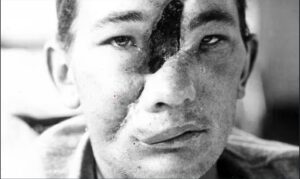
The importance of spiritual beauty is poignantly illustrated by Kearsey’s wife, who remained steadfast and resilient in the face of adversity. She unfortunately left the world before her husband who also quickly followed her. Yet, her unwavering support and advocacy for Bill demonstrate how true love and compassion uplift those who bear the scars of trauma, allowing them to forge a path toward healing and fulfillment.
One Hundred Stories reports “As Bill got older, his war injuries worsened. Verdun became his tireless advocate. Bill’s wife took issue with decisions of the repatriation authorities that she saw as arbitrary or cruel. Surely a man who had given his face and his health for his country was a ‘deserving case’?
Verdun died in 1969. Two years later Bill passed away and was buried alongside her in Inverell Cemetery. Bill Kearsey reminds us of a quiet type of courage; one not always noted in the heroic narratives of Anzac. Neither his war, nor his injury, came to define him; with remarkable resilience, he became a farmer, a husband, and a father despite all the odds.”
The unshakable strength of spiritual beauty
As already shown in the case of Kearsey and his wife, unlike physical beauty which fades with time, spiritual beauty grows richer and more profound as one cultivates inner qualities. This form of beauty is found in kindness, wisdom, compassion, integrity, patience, resilience, stoicism, and the ability to uplift others. It is an inner light that cannot be dimmed by age, circumstance, or misfortune.
More about ways in which spiritual beauty manifests
- Kindness and compassion—a heart that seeks to understand and alleviate the suffering of others radiates a beauty that is timeless. A person who is always willing to help, listen, and support others leaves a lasting impression far greater than any physical feature.
- Wisdom and integrity— as people age, they accumulate experiences and knowledge that shape their character. Those who use their wisdom to guide others with honesty and integrity develop an aura of respect and admiration that transcends physical attributes.
- Resilience and strength— life brings challenges, but those who remain strong and graceful in the face of adversity develop an undeniable beauty. Their ability to rise above difficulties and inspire others creates a lasting legacy.
- Stoicism— Stoicism is an ancient Greek philosophy that teaches the development of self-control, resilience, and rationality as a means to overcome destructive emotions and lead a virtuous life. It emphasizes the importance of accepting what we cannot change, focusing on what we can control, and cultivating an attitude of inner peace and strength in the face of adversity.
Stoics believe that true happiness comes from aligning one’s life with reason and virtue rather than seeking external validation or material wealth. Key figures in Stoicism include philosophers like Epictetus, Seneca, and Marcus Aurelius. The Cambridge Dictionary defines stoicism as the quality of experiencing pain or trouble without complaining or showing your [negative] emotions.
- Inner peace and gratitude— a person who exudes peace and gratitude naturally attracts others. Their contentment and joy become contagious, drawing people in with an energy that no external beauty can match.
Spiritual beauty is often recognized in elders who, though they may carry wrinkles and signs of aging, possess a presence that is deeply comforting and inspiring. Their beauty lies in their wisdom, their laughter, their empathy, and their ability to make those around them feel valued.
How to cultivate spiritual beauty
Developing spiritual beauty constitutes a lifelong journey, but it is one that brings far more fulfillment than the fleeting pursuit of physical perfection. The following are some key ways to nurture it.
Practice self-awareness and growth
Understanding yourself—your values, strengths, and areas for improvement—is the first step in cultivating spiritual beauty. Regular self-reflection allows you to grow and align your actions with your higher self. Journaling and introspection are some of techniques that can help you in this process.
Embrace kindness and generosity
True beauty lies in how we treat others. Acts of kindness, no matter how small, create a ripple effect. A warm smile, a helping hand, or simply being present for someone in need contributes to a beauty that never fades.
Cultivate gratitude and inner peace
Gratitude shifts our focus from what we lack to what we own, fostering contentment and joy. Those who are at peace within radiate a beauty that draws others toward them. Practices like prayer can help to nurture this inner peace.
Live with integrity and purpose
People who live authentically, staying true to their values ooze confidence and grace. When you act with integrity and align your actions with your purpose, you develop a presence that is magnetic and inspiring.
Build meaningful connections
Relationships built on love, trust, and mutual respect enhance our inner beauty. Being a supportive friend, a loving family member, or a mentor to others strengthens the qualities that make us truly beautiful.

Examples of spiritual beauty in the world
Some of the most remarkable individuals in history were not known for their physical beauty but for the depth of their spirit.
- Mother Teresa— she may not possess fit society’s conventional standards of beauty, but her kindness, compassion, and dedication to the poor made her one of the most admired figures in the world.
- Mahatma Gandhi—his frail physical appearance was overshadowed by his immense inner strength, resilience, and commitment to nonviolent resistance, transforming him into a symbol of peace and wisdom.
- Nelson Mandela— despite enduring decades of imprisonment, his forgiveness, grace, and unwavering commitment to justice made him one of the most revered leaders of all time.
- Maya Angelou— her voice, words, and spirit uplifted millions, proving that beauty is found in wisdom, expression, and the ability to inspire others.
These individuals demonstrate that true beauty is not in flawless skin or symmetrical features, but in the impact one creates on others and the legacy they leave behind.
Conclusion: choosing the beauty that lasts
While physical beauty may capture attention, it is spiritual beauty that truly captivates the soul. Time will inevitably deform our external appearance, but the kindness we show, the wisdom we share, and the love we give will remain long after our physical features fade. In a world that often prioritizes surface-level appeal, we must remind ourselves to invest in the beauty that lasts—the beauty of the heart, mind, and spirit.
Instead of chasing an unattainable standard of perfection, let us strive to cultivate the qualities that render us truly beautiful. Let us be kind, wise, resilient, and compassionate. For in the end, it is not the reflection in the mirror that defines us, but the light we bring into the world. And that is a beauty no wrinkle, scar, or passage of time can ever take away.