By Jean Baptiste Ndabananiye
Philosophy has long been perceived as a domain of abstract thought, often reserved for scholars and intellectuals. Yet, Christian Godin, a distinguished French philosopher, writer and professor known for his accessible approach to philosophy has dedicated his career to bridging this gap, rendering profound ideas comprehensible to a wider audience. As the author of La Philosophie Pour Les Nuls—a French 656-page book which simplifies philosophical complex ideas for a general audience, Godin through the book transforms complex philosophical concepts into accessible knowledge, allowing non-specialists to engage with some of the deepest questions of existence.

A former lecturer at Blaise Pascal University, he specializes in metaphysics, political philosophy, and the history of ideas, with a strong emphasis on clarity and pedagogy. In a world where philosophy is often regarded as distant from practical life, Godin’s work reaffirms its relevance, proving that deep thinking and everyday understanding are not mutually exclusive but rather complementary forces shaping human wisdom. This book contains a passage, about Thales, which holds some of four key lessons essential in life.
The passage and contextual details around Thales
Godin says “An anecdote reported by Plato tells that one day, Thales, absorbed in contemplating the sky, did not see a well at his feet and fell into it. A Thracian maid, who was nearby, burst out laughing ‘Behold these philosophers who claim to know the stars but do not even know where to place their feet!’ The story is well known.
It has been told in countless ways for twenty-six centuries. The mechanism is inevitable: when one is deeply engrossed in a task, the mind is fully concentrated on it, leaving no attention for anything else.”
The blog, Maverick Philosopher, founded by the philosopher and writer— Bill Vallicella— also echoes the above story, explaining that Thales was then examining the stars. “Thales was studying the stars and gazing into the sky, when he fell into a well, and a jolly and witty Thracian servant girl made fun of him, saying that he was crazy to know about what was up in the heavens while he could not see what was in front of him beneath his feet.”
This blog adds that Thales of Miletus proved people— who had been mocking him over a certain aspect key in people’s lives—wrong. “The story goes that some people reproached Thales for being poor, on the grounds that it showed his philosophy was useless.
But because of his knowledge of the stars, he realized there would be a bumper crop of olives in the following year. So, while it was still winter, he raised a little money and used it to secure all the olive presses in Miletus and Chios for future lease. He got them at a low rate because no one bid against him. When the olive season came, and the demand for olive presses was suddenly very heavy, he was able to sub-lease them at whatever rate he chose. He made a lot of money, thereby showing that philosophers could easily become wealthy if they wished, but that this is not something they care much about.”
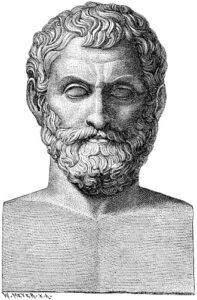
According to Britannica, Thales who arrived on the Earth around in 624 and died approximately in 545 BCE was a philosopher renowned as one of the legendary Seven Wise Men, or Sophoi, of antiquity.

Godin in the book further states “No attention without distraction. The distraction of the thinker is the reverse, not the opposite, of their attention. Reverse, as one might say of a shadow—that it is the reverse, not the opposite, of light (for there is no shadow without light).
Hegel, rather irritated by the anecdote of Thales falling into the well, remarked that while the servant girl may laugh at the philosopher, what she does not realize is that she, like all ignorant people of her kind, is already in the well. We quite literally stumble upon this symbolism: while the soul rises, the body falls. And finally, since we never truly exhaust symbolic imagery, it is truth itself, in its allegorical form, that tradition places at the bottom of the well—thus, to fall in should mean to find it.”
The four key lessons
From the above details we can draw various lessons out of which we have selected the following ones.
The price of deep thought – intellectual pursuits often demand intense focus; which can lead to neglecting immediate surroundings. Thales’ fall symbolizes how deep thinkers may become disconnected from practical matters, yet this distraction is not a flaw but a natural consequence of deep engagement.
True wisdom transcends mockery – the Thracian maid’s laughter at Thales reflects a common tendency to ridicule what is not understood. However, his ability to predict the olive harvest and prove his critics wrong demonstrates that true knowledge, even if underestimated, possesses real-world value.
The skepticism toward Thales stemmed from the assumption that a philosopher, detached from material concerns, lacked practical intelligence. His foresight, based on his study of the stars, enabled him to foresee a bountiful olive season long before others even considered it. Acting on this knowledge, he strategically secured olive presses at a low cost, taking advantage of his peers’ ignorance.
When the harvest arrived and demand surged, Thales profited handsomely, setting his own rental prices. This triumph was not merely financial but also philosophical, as it silenced those who equated wisdom with poverty. He demonstrated that philosophers could amass wealth if they desired, but their pursuits often lie beyond material gain. His success proved that intellectual curiosity, when applied wisely, bears immense practical power.
Symbolism of falling and rising – Hegel’s interpretation suggests a deeper meaning: while the body may stumble, the mind ascends in pursuit of higher truths. Falling into the well can be seen not just as a failure but as a metaphor for discovering hidden wisdom.
The need for balance – while deep absorption in thought is valuable, it should not come at the cost of practical awareness. The Thracian maid, despite her mockery, carried a valid point—completely losing sight of one’s immediate surroundings can lead to real consequences. If Thales had been seriously injured, his wisdom would not have prevented the harm.
This highlights the importance of balance: intellectual focus is crucial, but so is precaution. A thinker should strive for deep contemplation without neglecting the realities of daily life. In other words, you should look for a safe environment where to conduct your analysis or work, so that full absorption holds no way to cause you any harm.
Thales’ story—a timeless reminder
Thales’ story serves as a timeless reminder of both the power of deep concentration. Concentration is crucial for achieving great insights and breakthroughs. Thales’ story illustrates that deep focus allows us to unlock knowledge and accomplish remarkable discoveries. Instead of being distracted by fleeting concerns or external mockery, we should be focused on our pursuits with unwavering dedication.
Whether in philosophy, science, or daily life or success, true progress comes from immersing ourselves fully in what truly matters. The ability to concentrate on a goal, free from unnecessary distractions, is what separates those who make a lasting impact from those who remain on the surface. This can also be understood as alignment with one’s end goal—ensuring that every action is intentionally directed toward what we seek to achieve. Focus, alignment, and concentration are not just about thinking deeply but about consistently aligning our efforts with our ultimate vision.