By Jean Baptiste Ndabananiye
Rwanda’s workforce is in quiet crisis. While the country has introduced a national policy for occupational health and safety, and more recently, a Workplace Wellness Program, the reality across public and private institutions tells a harsher story, one of inaction, ignorance, and the growing emotional cost of doing one’s job.
Across government agencies, NGOs, mining operations, media houses, and classrooms, Rwandan employees are emotionally exhausted, physically strained, and psychologically unsupported. Despite new initiatives and international awareness days, mental health remains largely symbolic, a theme to celebrate rather than a practice to implement. And so, workers are left to suffer alone, silently, invisibly, and increasingly at risk.
Between policy and reality, a system falling short
Every October 10, Rwanda joins the world in marking World Mental Health Day. In 2024, the focus was on mental well-being in the workplace. The Rwanda Biomedical Center, RBC, published statements emphasizing that a healthy employee is more important than the work they perform, reinforcing that emotional wellness should be seen as central to workforce sustainability. But this vision has failed to materialize in most Rwandan workplaces.
In response to rising concern, the government launched the Workplace Health Program in 2023. The initiative, jointly led by the Ministry of Health, the Ministry of Public Service and Labor, MIFOTRA, the Rwanda Social Security Board, RSSB, and the Private Sector Federation, was designed to protect workers’ physical and mental health. It promised to help organizations implement stress management, nutrition education, regular check-ups, and better labor practices.

And yet, implementation remains minimal. “The program exists, but in reality, it’s at an embryonic stage,” says Dr. Jean Damascene Iyamuremye, Director of the Psychiatric Care Unit at RBC. “Most employers don’t even understand the purpose. Some don’t even know it exists.”
According to Dr. Iyamuremye, the disconnect lies in cultural and leadership mindsets that still prioritize production over people. “Many organizations focus on the work delivered, not the person delivering it. That’s why we see workers breaking down physically and emotionally.”
Rwandan employers are facing mounting evidence of the damage. Employees present with unexplained health issues, growing substance use, fatigue-related illnesses, and even suicidality. Yet in many offices, factories, and schools, these symptoms are dismissed as personal problems, rather than signs of a systemic failure.
The silent breakdown, when work becomes harm
Beneath the surface, workers across Rwanda are suffering. “I cry for stories that are not mine,” says one anonymous employee working in trauma healing for a local NGO. “We support people who’ve experienced genocide, rape, or loss. But we’re never offered support ourselves. We carry their pain like it’s ours, and it starts to destroy us from the inside.”
This condition, known as vicarious trauma, is well documented in psychological literature, particularly in professions that deal with human suffering. But in Rwanda, even mental health professionals themselves lack access to decompression sessions or regular counseling. “We’ve treated psychologists who are mentally unwell from treating others,” Dr. Iyamuremye notes. “If even trained professionals are collapsing, imagine the impact on young staffers who are emotionally unprepared.”
For others, the breakdown is more gradual but equally destructive. A non-governmental organization’s communication officer described the downward spiral that began with relentless deadlines and long nights. “I once stayed up three nights in a row trying to finish a video. My brain wouldn’t shut off. I started using beer to knock myself out. I called it my natural Phenergan.”
Another employee in media said they had to choose between mental health and survival. “I worked nonstop. I typed with one hand while eating with the other. If I refused work, I was threatened. Out of three months, I was only paid 120,000 RWF. I had to quit before I lost myself completely.”
These personal accounts are supported by alarming data from the Ministry of Public Service and Labor. Sixty percent of employees experience work-induced mental health issues. Thirty-one percent have been formally diagnosed with mental illness. Twenty-five percent have considered suicide. Only thirteen percent feel safe disclosing mental health concerns at work. Meanwhile, a mere twenty-four percent of managers have received mental health training.
Even more troubling is that nearly two-thirds of workers lie about the real reason behind their sick leave, fearing discrimination or dismissal if they reveal mental struggles.
Why support systems fail, gaps, stigma, and broken leadership
With both data and human stories aligning, the question becomes “why is so little being done ?” Experts point to a mix of structural and cultural barriers. “The biggest problem is lack of awareness,” says Dr. Iyamuremye. “Many employers genuinely don’t know how critical mental health is to long-term productivity.”

Boniface Bagabe, Occupational Safety and Health Promotion Specialist at MIFOTRA, agrees but adds that awareness alone is not enough. “There’s still systemic stigma around mental illness. Many workplaces see emotional struggles as weakness. On top of that, small and medium enterprises lack resources, and larger institutions often ignore their obligations.”
He points to poor enforcement of existing policies, including the National Occupational Safety and Health Policy and Ministerial Order No. 02/MIFOTRA/23 of 2023, as another critical gap. These frameworks exist, but few organizations are monitored for compliance. “We’re talking about a culture that overvalues discipline and undervalues emotional care,” Bagabe adds. “Overwork is romanticized. Mental illness is hidden. Leadership training in wellness is almost nonexistent.”
One anonymous source from an international NGO put it bluntly, “Our leaders don’t intend to harm us, they just don’t realize how much we’re hurting. There’s no culture of listening. That’s where the breakdown begins.”
A new model emerges, hope from the mines
Not all is bleak. One mining company, GAMICO, is setting a powerful precedent for human-centered workplace wellness.
At first glance, the setting is unexpected, a rugged, physically taxing mining operation in Kigali City. But step inside and the difference is clear. Workers start their day with a hot breakfast in a clean, well-furnished cafeteria. They receive proper safety gear. They take regular breaks. They have on-site medical care, access to free health insurance, and they are paid on time. “I’ve been here for six years,” says 27-year-old miner Prince Niyonzima. “They treat us like people, not tools. Because of this job, I built a house and bought land. I never thought mining would give me peace, but it has.”
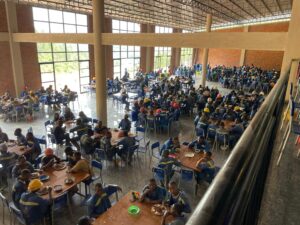
GAMICO’s example stands in sharp contrast to the typical narrative surrounding labor in Rwanda’s extractive industries, and it offers a blueprint for others. According to Niyonzima, treating workers with dignity doesn’t just improve lives, it boosts productivity and retention. “If more investors followed this model, Rwanda’s mineral production would increase significantly. Happy workers work harder.”
GAMICO’s model has inspired the national Workplace Wellness Program, which now aims to promote similar practices countrywide. The program incorporates on-site health screenings, physical activity campaigns, mental health education, nutrition guidance, better meal access, and training for managers in wellness-sensitive leadership.
Inspectors are tasked with enforcing these measures, and non-compliant companies could face sanctions. But experts warn, policies only matter if people demand them. “No journalist had ever asked us about this program before,” Dr. Iyamuremye said with visible frustration. “That tells you how far we have to go. If we want to change our workplaces, the media must help tell the truth.”
The cost of inaction and the power of compassionate leadership
The cost of neglect is measured in more than lost workdays. It is measured in lives dimmed, families strained, and potential wasted.
Dr. Rusa Bagirishya, an economist and analyst, points it out starkly “Leadership without compassion is a national betrayal. You cannot build a resilient economy on the backs of broken people.”

He cites Japan as a powerful example. After World War II, Japanese companies invested heavily in worker welfare, covering meals, education, and health. It wasn’t charity, it was strategic survival. “That’s why Japan rose from ruin to become the world’s fourth-largest economy. Trust, wellness, and dignity drive productivity,” Dr. Rusa explains.
Closer to home, business lecturer Dr. Martin Gathiru offers a provocative mantra “Make your employees unfit to work elsewhere.” He doesn’t mean under-training them, he means treating them so well they wouldn’t want to leave.
Rwanda possesses a rare opportunity. The infrastructure is there. The experts are ready. The stories have been told. But now, employers must listen and act. As one young entrepreneur warned “You can pour all the money you want into a business. But if you burn out your engine, your people, it won’t go anywhere.”
The call is clear, a human-centered workforce isn’t a luxury, it’s a necessity. The silence in Rwandan workplaces is costing too much. If change doesn’t come soon, the damage may become irreparable.