By Jean Baptiste Ndabananiye
Despite the existence of national policies designed to safeguard workers’ well-being, the issue of employee health, particularly mental health, remains critically neglected in Rwandan workplaces. Across sectors, growing distress among employees is fueled by heavy workloads, job insecurity, and lack of support systems; all contributing to burnout and severe mental health challenges. A crucial issue persists: employees are immobilized in this vicious cycle—quitting their jobs means their financial ruin, while staying signifies enduring relentless strain with no clear path to relief. In the country, 60% of employees suffer mental health issues triggered directly by their work, according to the Rwanda Biomedical Centre (RBC). This alarming figure signals not just a public health crisis—but a workplace one.

Nevertheless, the cost of overlooking employee mental health goes beyond personal suffering—it extremely undermines employers. A healthy workplace benefits workers and businesses alike. The World Health Organization— in its September 2024 story “Mental Health at Work”— points out “Globally, an estimated 12 billion working days are lost every year to depression and anxiety at a cost of US$ 1 trillion per year in lost productivity.” Dr. Rusa Bagirishya strongly urges “All employers should emulate Japanese employers.” Meanwhile, the mining business—GAMICO—is setting an unparalleled benchmark in Rwanda, as the government is beginning to take action on its own front.
To help some of our readers navigate this article in its depth and long form, the report has been shortened into this story. Why this long-form investigative story is presented in full. At Life In Humanity, we believe some truths deserve the space and structure to be fully understood. That is why we have chosen to publish this investigative story in its entirety.The subject matter—ranging from silent suffering in workplaces to promising signs of change—is too urgent, too layered, and too human to be compressed into a summary alone. Publishing the full story, without fragmentation, is our way to respect both the gravity of the issue and the intelligence of our readers. We invite you to engage with this investigation in its complete form—not only to understand the problem but to see what change could truly look like.
Furthermore, at Life In Humanity, we recognize that complex problems demand comprehensive reporting. This investigative story in its full, unabridged form ensures that all voices, evidence, and systemic insights are preserved in just one account. This stands particularly crucial for policymakers, researchers, employers, labor advocates, and development partners— stakeholders who require comprehensive context and robust findings to inform decisions, shape strategies, and inspire reforms. Instead of struggling to piece together insights from fragmented articles, these readers now access everything they need in one unified report—a tool for reflection, decision-making, and collective action.
The situation until the last year
Every year on 10 October, the world observes the World Mental Health Day, to raise awareness about mental health issues and promote efforts to support mental well-being globally. The celebration of this day last year in Rwanda concentrated on employee mental health, urging stronger action.
In connection with this day, on 15 October 2024, RBC published a story “Rwanda Celebrated World Mental Health Day 2024 Stressing on the Wellness of the Employees in the Workplace”. It reads “Mental health is often neglected as a key aspect of employees’ overall health, yet the World Health Organization points out that depression heads the list of causes of illness and disability worldwide. Normally, workplace is seen as a double-edged sword when it comes to mental health related workplace stress.
The bidirectional relationship between mental health and the workplace is crucial to understand. Even the healthiest employees can suffer physically and mentally in an unhealthy work environment. Prioritizing mental health in the workplace is essential for fostering a productive and supportive atmosphere. When employers actively address mental well-being, it results in reduced stress, lower absenteeism, and increased employee engagement.”

In this story, Dr. Jean Damascene Iyamuremye— the Director of Psychiatric Care Unit at RBC also underlined “An employer with good mental health conditions spur productivity in the institution, why [do] many of car owners prepare in advance its maintenance plan but not the same for workers[?]” He humorously added “It seems in many workplaces, employers tend to take care and [be] fully focused on the work than workers.”
Dr. Darius Gishoma, the Division Manager for Mental Health at RBC, encouraged more involvement in the promotion of mental health wellbeing. “We call upon everyone to feel sensitive and involved in boosting mental wellness awareness at workplace.”
The theme of last year’s mental health day “It is time to prioritize Mental Health in the workplace” corroborates the undeniable and colossal importance of caring for employees. Meanwhile, calls to support workers’ mental health have always been issued. But the issue endures in a critical situation.
Besides, the government of Rwanda has established mechanisms to safeguard this resource—workforce— unquestionably recognized as the most important for any organization worldwide. RBC in its already cited story says “The Government of Rwanda made tremendous strides regarding the provision of workers protection including the development of national policy on Occupation Health and Safety in the workplace and the ministerial order n°01 of 17/05/2012 determining modalities of establishing and functioning of Occupational Health and Safety [OSH] Committees that was adopted for promoting and maintaining the highest degree of physical, mental and social well-being of workers in all occupations.
The government has also put in place measures to promote the well-being of the workers, including promotion of sports activities. However, much are still needed in terms of implementation of occupational safety and health National Policy and well-being of the employees in the workplace.”
The situation now
Before embarking on the current situation, Life In Humanity first seizes this occasion to emphasize that mental health support in workplaces like in any other setting must be approached holistically—addressing both tangible needs and emotional well-being. For instance, providing staff with meals at work and fair remuneration helps to reduce daily stressors, offering a sense of stability and care that forms the foundation for mental wellness.

However, true support goes beyond physical provisions; it requires creating a culture where emotional safety, open and respectful communication, and psychological resources are accessible. Employees thrive when their basic needs are met and their inner struggles are acknowledged without stigma. A holistic approach to mental health recognizes that people are not just workers—but whole human beings with emotional, physical, and social dimensions.
This story explores the current realities of employee health in Rwanda, examining the underlying causes of workplace distress and its consequences for both individuals and institutions. It also scrutinizes the need for stronger interventions to ensure that the health policy is effectively implemented. In doing so, it features insights from various experts. Dr. Iyamuremye, one of them, begins by reinforcing the point he previously stated in the last year’s RBC story— which I and he revisit.
He says “The point you have just raised is true, I then said so. There are several organizations that prioritize the work produced over the people producing it; the reason why there exist diseases among employees. But in truth, employees are far more important than the work they perform.”
“Healthcare in general constitutes the responsibility of the state; of course, the responsibility of ensuring mental health also falls into the government’s duties, particularly through the Ministry of Health, and we conduct the healthcare of all citizens including the workforce. The government has established a program to protect workers’ health in their workplaces. It was launched in 2023, but I must note that its implementation still stands at an embryonic stage.”
He goes on, explaining the trigger that prompted the government to introduce the program. “The reason behind this program is that there were workers who were facing health problems—both physical and mental, but it wasn’t made easy for them to access services they needed for treatment.
That’s one of the major challenges we are working to address. We are urging organizations to commit themselves fully to preventing work-related illnesses, including mental health conditions, and to ensure that employees who face such issues are supported with a facilitating environment to access treatment.”
Across Rwanda’s workplaces—from media houses to mines and schools, among others—a silent crisis brews beneath the surface: unaddressed stress, unexplainable illnesses, and widespread substance use are affecting workers at alarming levels. Hidden behind office doors and factory walls, countless Rwandan employees are battling invisible ailments—stress, chronic excessive exhaustion, and addiction to substances like beer and tobacco—while several employers remain unaware of the storm.

According to Dr. Iyamuremye, these troubling signs are what compelled different authorities to launch a nationwide workplace health program, though many organizations have yet to grasp its vital importance. The full scale of the problem across sectors is still unfolding. “I can’t specify you the number of those organizations which have not comprehended the colossal importance of workforce. Saying that they are numerous is simply an estimation based on our observations.
First of all, there exist so many employers—across all sectors like media, mining, education, and others—whose workers are clearly struggling. And since this program applies to every organization where more than one employee works, the number is simply too large for me to provide a precise figure or percentage. If you ask me about the health sector, I can give you specific data because I know the statistics. Yet for the other sectors, I currently don’t have the numbers—though I can confidently maintain that there are so many organizations where employees are continuing to grapple with challenges.”
He further says “What we have done is to begin with big institutions—which govern other agencies affiliated with them. For instance, we have reached out to almost all the ministries as organs overseeing other bodies connected with them like those in the local government. Back to your question, the reason which has prompted us to undertake the program is that there prevailed problems in institutions; there occurred many problems which proved that workers were struggling. For example, we are now handling substances with psychoactive and addictive effects.

Each of the organizations employed at least one staff member who used such substances. By the substances, I mean from beer to tobacco. In numerous institutions were employees who pointed out that they were suffering from unexplainable diseases and you found that the latter ones were due to exhaustion which people call stress. Even in your employer organization, you can have identified that issue.”
Alcoholic beverages are substances with psychoactive and addictive effects. There occurs a close link between substances like beer (alcohol) and narcotic drugs, though they are classified differently under law and pharmacology. The link lies primarily in their psychoactive and addictive properties, as well as their impact on public health and the brain’s reward system.
Both are psychoactive substances. Psychoactive substances affect how the brain works, changing mood, awareness, thoughts, feelings, or behavior. Alcohol (in beer) and narcotic drugs (like opioids, heroin, morphine) both fall into this category. They all interfere with the brain’s central nervous system, though in different ways and intensities.
Both can cause addiction (substance use disorder). Regular use of alcohol or narcotics leads to dependence, where the body and mind become reliant on the substance. Addiction mechanisms—such as dopamine release, tolerance formation, and withdrawal symptoms—are similar in both cases. In both, people often need increasing amounts to feel the same effect, and stopping causes discomfort or psychological distress.

Both beget serious health and social consequences. Alcohol abuse contributes to liver disease, cancers, violence, accidents, and mental health disorders. Narcotics result in overdoses, respiratory depression, infectious diseases (in injectable forms), and severe dependency. Both are major contributors to the global burden of disease, according to the WHO and public health experts.
Both belong to the broader category of substances of abuse. While alcohol does not constitute a narcotic, it’s considered one of the most commonly abused substances worldwide—sometimes referred to as a legal drug with dangerous consequences. Alcohol (beer) and narcotic drugs are both harmful to individuals and society. They affect the brain in related ways and contribute to similar public health problems.
Boniface Bagabe works as the Occupational Safety and Health Promotion Specialist for the Ministry of Public Service and Labor—MIFOTRA. He explains how the current state of employee mental health stands in the country. “The recent research by RBC reveals the following statistics:
60% of employees experience mental health issues triggered by work. 31% of the workforce has been formally diagnosed with a mental health condition. Nearly a third of employees are absent due to mental health concerns. Two-thirds do not disclose the real reason for their absence. About 25% have contemplated suicide at some point. Only 13% feel safe disclosing mental health issues to a manager. Just 24% of managers have received mental health training.”
Factors behind the issue
Causes and gaps driving employers to ignore their workforce
Different people offer insight into factors causing organizations to overlook their workforce’s health.
Dr. Iyamuremye says “The main reason is the lack of awareness about the immense importance of caring for employees. That’s why we’ve been focusing on educating organizations about the consequences of neglecting employee health, as well as the benefits of maintaining it—just as regularly servicing a tool helps it to last longer.
We have found that a lot of employers simply didn’t use to know this, so they didn’t put workers’ health first. That’s why we are urging them to place much greater value on their staff—because employees stand more important than the work itself. We emphasize that a healthy employee performs at their full potential, driving high productivity for the employer.”

We have asked the question to Bagabe, clarifying to him that according to Dr. Iyamuremye, the reason behind several organizations’ failure to care for their employees in Rwanda is that they don’t understand the importance of doing so. We have also highlighted to him that another source has said that a major factor is that organizations’ leaders are unaware of the vital importance of employee mental health. He has answered “You’re right, leadership awareness is critical, but systemic stigma, limited infrastructure, resource constraints especially in SMEs, and cultural norms also play a role.”
As already emphasized by RBC, there has always existed a mechanism which should have always ensured employee healthcare in Rwanda. A person can ask themselves the reason or gaps which have prevented the enforcement of the mechanism. Bagabe addresses the gaps. “Despite existing frameworks like the OSH National Policy and Ministerial Order No. 02/MIFOTRA/23 of 01/08/2023, enforcement has been weak due to: limited institutional capacity and lack [of] awareness among employers about OSH and wellness obligations.”
In this story, the identities of certain individuals are withheld, as they share information that could bring them personal or professional consequences. Likewise, their employers are not named, because issues raised reflect a widespread problem affecting numerous organizations. Singling out one or a few would be unfair and unprofessional, especially since several others are involved but not specifically identified. For this reason, we will not disclose the identity of the following source— being employed by an international non-governmental organization operating in Rwanda, as they will tell sensitive information after the following one.
This worker says “I cannot argue that employers—leaders— neglect their workforce, because they don’t actually know and recognize the undeniable value of their workers. In other words, they don’t do so intentionally. Rather, it stems from their lack of awareness about the immense importance of employee health in general, and mental health in particular.”
Causes of the prevalence of the problem
Bagabe says “Beyond these figures [he gives above], the research highlights systemic contributors such as: toxic organizational culture (poor communication, weak leadership support), ambiguous roles and career uncertainty, overwork, unpaid overtime, and the ‘always on’ digital culture, and inflexible schedules, excessive time pressure, and low decision autonomy.”

The undisclosed employee explains “In fact, employee mental health is negatively affected not only by work overload, but also by the very nature of the work itself. For example, staff members involved in trauma healing and psycho-social support interventions for people are burdened too. Always listening to traumatic experiences that these people have undergone, these employees end up being infected, when they lack opportunities to process and release the emotional burden of what they hear. Over time, this leads to burnout directly resulting from the nature of their work.
This can happen especially to those working in trauma healing and others supporting people facing mental health conditions. For example, professionals helping people who have been impacted by the 1994 Genocide against the Tutsi and even those who intervene to assist individuals affected by current issues such as rape, including teenage mothers raped.”
Asked to provide us with a compelling case of an employee who has faced the issue in their own organization, they’ve responded “I can’t single out an individual, lest I may be identified, but I surely know that it occurs. Even mental health practitioners raise it. Mental health psychologists and nurses themselves often seek treatment from their peers or attend sessions to offload the emotional burden they accumulate through their work. If even trained mental health professionals are affected by their interaction with people they treat, how much more vulnerable is a professional even unaware of mental health issues, yet is constantly exposed to traumatic stories?
To give a typical example; there are young employees—born after the Genocide against the Tutsi— who are engaged in trauma healing work while they never witnessed or experienced the genocide themselves. These employees are often deeply impacted. This happens during project evaluations or visits to trauma healing clubs since we help people through clubs. When such an employee listens to a survivor recount their traumatic experiences and healing journey, they burst into tears. The employee weeps not because they are unprofessional—since they should not actually cry, but because the story is so overwhelming that it surpasses their emotional capacity, especially when it’s their first time that they’ve been directly exposed to such intense suffering.”
This undisclosed employee further explains “Suppose that an employee encounters 10 tragic stories in a single year; it will certainly affect their mental health. For instance, they can pass sleepless nights reflecting on the shocking experiences described in those stories or develop lingering emotional effects.
For example, if the people who have talked to the employee have been raped, it can cause this employee to regard all men as so cruel that they can all sexually assault females. Actually, staff members will develop mental health issues, especially if their employer organizations don’t involve them in mental health support sessions meant for assisting them to unload themselves from the emotional load that they inherit through their constant exposure to the suffering of those they assist.”
Impact of employee mistreatment

Neglecting an employee’s health—especially their mental health—produces a double-edged impact. It harms both the worker and the quality of their work, ultimately colossally undermining productivity and organizational success. Dr. Iyamuremye explains “Let’s start with when the health of an employee is protected. First of all, it is a healthy employee who is productive, and every employer needs a productive worker.
When an employee doesn’t enjoy good health— especially struggling with mental health, they don’t achieve results, since they don’t operate effectively and efficiently. When you don’t care for your employee, their work can harm the employee and they can also harm the work; especially, when their mental health isn’t maintained.”
Doctor Rusa Bagirishya is an economy expert and analyst. To underscore the disastrous effects of failing to care for your staff, this Doctor of Economic Sciences, first points out “Leadership without compassion is a national betrayal. Even the colonialists, who didn’t love us [Africans], established dispensaries—not out of affection, but to ensure their staff remained healthy and productive. A national who doesn’t care for their employees is unpatriotic and should be sued by the government, since patriotism includes loving those who live in and work in your country.
Your staff knows how much money you earn from their labor, and when you fail to reward them fairly, they notice. Organizations that neglect their workers cannot grow. If you don’t create good working conditions for your employees, you’ll reach no growth at all.”
Hunde Walter, Rwanda’s Private Sector Federation Spokesperson, also underlines the massive importance of appropriately treating personnel. “The first point I can tell you is that work is successfully conducted by an employee who oozes good health, so that both an employer and the employee have to strive to assure that there remains a good working environment enabling the worker to perform safely and then productively. It is in this respect that in 2018, the PSF and MIFOTRA forged an MOU [memorandum of understanding] meant for striving to ensure that a job creates dignity to that who occupies it.”

Dr. Rusa provides a typical example to support his statement. “I can give a compelling instance of Japan. There, every employee’s need is satisfied by their employer—meals are provided at work, and the employer covers their healthcare costs and their children’s education expenses. As a result, the employee takes their entire salary home.
That’s why Japan has developed. All employers should emulate Japanese employers. To achieve progress, you must ensure that your personnel don’t feel they’re working for you, but rather for themselves. In that way, employees feel a sense of ownership, treating the organization as part of their life. But if they serve you like slaves, growth becomes extremely difficult to realize.”
Asked whether institutions overlooking their personnel’s health certainly sustain losses, Dr. Bagirishya instantly answers “It doesn’t even require advanced knowledge to understand that such institutions undoubtedly suffer major losses. The money an employer earns is brought by their employees—because you alone can’t perform all activities. The person who enables money to flow into your company must be placed in good working conditions to remain productive.
As you have said, why do you take your car to a garage? It’s so the vehicle can function properly. In the same way, an employee drives income to you—and if they don’t enjoy good working conditions, they won’t perform well and will earn you far less. Back to Japan, despite the two bombs that they [USA] dropped on it, this nation features among the largest economies in the world. What do you think drives this? It’s because Japan’s employees work as if they were working for themselves. They are so committed and hardworking that they set the standard for dedication. They don’t perform like one working for another person.”
“You don’t need to keep a close eye on an employee, if you motivate them,” further says Dr. Bagirishya highlighting the value of trust and autonomy in the workplace. He explains that in Japan, employees are so self-driven and disciplined that they independently organize their tasks without constant oversight. This culture of responsibility not only boosts productivity but also strengthens the sense of ownership employees feel toward their work and the success of their organizations.
Investopedia in its 29 January story “The Top 25 Economies in the World” reports “Japan is the fourth-largest economy in the world.” Dr. Rusa maintains that this position is due to the way this nation’s businesses treat their employees. “Japan has risen to that level, owing to how it treats its employees and there exist other countries which have started imitating it like Vietnam. So, also our private establishments should implement the same. There, in enterprises lie facilities which operate almost like hospitals. Their philosophy is simple: your employee needs to possess good health, to perform at their best; it’s you who care for their health—not the employees themselves.”
Research Gate published research titled “Secrets of Motivation in Japanese Management” in January 2025. Its abstract reads “Japanese management is a complex system based on national culture and mentality. Their model differs from Western approaches by flexibility, adaptation and harmonious interaction within the team.
The key elements of motivation in Japanese management are: strong corporate culture, lifetime employment, merit-based promotion system, collective responsibility, and rewards that take into account a long-term perspective. Japanese management differs from Western models in its unique approach to human resource management based on trust, respect and support.”
All that substantiates Dr. Rusa’s statement that Japan’s remarkable economic success is deeply rooted in how it treats its employees—not merely as laborers, but as integral members of a collective enterprise where their health, dignity, and long-term contribution are prioritized. A detailed long-standing academic study corroborates Dr. Rusa’s statement. The study published by the University of Montana under the Scholar Works section in 1985 confirms “In fact, employees of larger Japanese firms can have surgery performed at the company hospital (30% of all large Japanese companies operate their own hospital). Most all of this comes at no direct cost to the worker.
It appears that smaller Japanese firms in the United States find the more cost effective health promotion measures to be better suited to their needs. This correlates with the findings that large enterprises in Japan spend more on health facilities and programs while small firms pay more attention to preventative health and hygiene. In general, it appears that the Japanese corporation expends more resources in nonpayroll areas than other industrialized nations (Pascale, 1978).”
About the wellness program in workplaces, Dr. Bagirishya reacts “The program should not have started in public agencies, it ought to have begun in private establishments since it’s they that are more likely to exploit their employees.” Nevertheless, the unidentified employee says “Let the program be firmly established in government organs, a focus placed upon the managers of government institutions, especially since most programs and interventions come targeting ordinary citizens and junior staff. However, these leaders are people like us— they live in society and families like us and come from the same place as us. Being a leader doesn’t insulate them. Let them not them begin with the small companies, let them first instead concentrate their efforts on the big ones.
And I don’t know why most of the programs don’t involve the leaders. For example in the field of trauma healing in which we intervene, leaders tell us ‘How do you consider us? Why don’t you provide us with the support? They’re right, since the problems that others are facing, they also encounter them since they live and come from families like the others. There are those we have trained and said ‘Did you know that I used to exclude such people from my office, and on the point of beating them, without being aware that they were struggling with mental health conditions?’ So, this justifies the awareness I have suggested.”
Though Dr. Bagirishya and the unidentified employee appear to emphasize different starting points for implementing the workplace wellness program, their views are not contradictory. Instead, they collectively underscore the program’s vital importance and the need for broad, inclusive awareness that reaches both private and public institutions—especially leaders who must occupy a lion’s share in its implementation.

These insights, especially Dr. Bagirishya’s, remind me of Dr. Martin Kimemia Gathiru. He was teaching us the course of General Management at Mounk Kenya University in the Master’s Degree of Business Administration in 2013. He told us that as an organization’s leader, you need to render all your staff unfit to work for other organizations.
At first glance, Dr. Gathiru’s statement may seem counterproductive, as it suggests creating a comfort zone that could limit employees’ ambition or adaptability. However, in reality, it reflects a strategic leadership mindset—one that retains top talent by making the organization so enriching that staff choose to grow within rather than seek opportunities elsewhere.
In other words, you have to act toward all your staff in a way which can be likened to indulging or spoiling (pampering) them with benefits and advantages through an optimally motivating environment. Dr. Kimemia’s statement emphasizes the importance of creating such a maximally rewarding, motivating, and satisfying work environment that staff would never want to leave. By “rendering them unfit to work for other organizations,” he metaphorically meant making your organization so nurturing—through benefits, recognition, and personal growth opportunities—that no other workplace feels as fulfilling.
This leadership approach fosters deep loyalty and emotional attachment, rendering employees less tempted by external offers. It does not signify disabling their potential, but rather maximizing their satisfaction and engagement. When done well, it cultivates a thriving, stable, and high-performing workforce.
Basabe highlights “Employee mistreatment and poor mental health in Rwanda’s workforce lead to significant economic and human capital losses, though precise national figures are limited.
Evidence shows high stress levels, absenteeism, presenteeism, and low disclosure rates, all of which reduce productivity and strain health and insurance systems. Mistreatment also fuels high turnover, recruitment costs, and disengagement.”
2 compelling cases illustrating the situation
The unidentified employee says “Work overload constitutes a widespread issue in several organizations, but let me confine myself to my own, instead of generalizing by saying that it occurs in numerous institutions. For example, I am the only person handling communication in my workplace. That means that it’s I that have to manage all communication issues and tasks.

It’s I that need to produce videos, write articles, and all other strategic aspects connected with communication. It’s work that should be performed by two or three professionals, since some other organizations even employ four communication practitioners—video producer, article writer, a strategist and their department head who oversees them and edits their work.”
“But in my case, I execute all that,” adds the employee. “Therefore, I am constantly inundated by urgent demands—for example, the preparation of an event while you have to create two videos which will be used in the event, the production of a press release and inviting journalists to cover the event, and coordinating all the entire communication process.
When you have been allowed enough time to organize, the workload becomes easier but they often tell you to do so at the last minute; the key reason why I’m flooded by the work, though this is often caused by circumstances beyond the organization’s control like a guest of honor’s availability. In this case, you struggle to have the work completed within two or three days, while it reasonably requires a month or at least two weeks. I thus pass two or three sleepless nights, working.”
They continue, saying “If during the day I’m busy preparing the press release and handling other tasks—because the upcoming event doesn’t pause the rest of the work—then I end up spending the whole night editing the video. This is especially demanding since the video must go through an approval process; which includes comments and revision. For a video project that involves shooting in communities, I should ideally be given two weeks—or at least one week. Filming, developing the script, editing, and going through the approval process all require time.”
As for effects on this employee, they explain “I have never gone to a healthcare institution for treatment as a result of overwhelming work yet, but I constantly encounter difficulties. For instance, there was a time when I spent three sleepless nights, working. I would go to bed at 3 or 4 a.m., while I had to report to the office as usual. Consequently, I encountered extreme exhaustion combined with the stress to meet the deadline. Of course, I delivered effectively but I was left with crushing exhaustion and stress.
In such moments, even when you finally lie down, sleep refuses to come. You just stare at the ceiling, mind racing, body exhausted. In desperation, you reach for a bottle—hoping that maybe, just maybe, it will help you to escape into sleep. So, I went to a bar and drowned in beer, expecting that it would finally knock me out and let me sink into sleep.” Laughing, the employee underlines “This happens very often. You tell yourself ‘As sleep has abandoned me, let me go to grab my natural Phenergan [beer]’. I call alcohol my natural sleep-inducing substance, when the stress won’t let me rest.”

I’ve challenged the employee that this practice is counterproductive, they’ve acknowledged it. “As you’ve said, all is due to the lack of awareness; people don’t generally comprehend the correct coping mechanism in situations like this.”
Probing further to find out whether the employee’s exhaustion eventually faded under the influence of alcohol-induced sleep, I’ve gotten a candid reply. “Do you really think drinking can fix that kind of exhaustion? It can’t. You awake in the morning and realize that you’ve only worsened it.”
Another source—young journalist entrepreneur— whom we also keep in anonymity shares their regrettable experience. “Given how employers and employees operate, it’s not easy to immediately notice that mistreatment is happening. This has become institutionalized in various establishments so that it appears normal—not mistreatment; which is why the signs of employee maltreatment are often hidden.
For example, while employees are supposed to work for a set number of hours, some organizations don’t respect that. For instance, you are forced to get out of bed before 7:00 a.m. due to a call from your employer and only return home late at night.”
Imagine working tirelessly day and night, only to face this harsh reality:“However, you’re not paid for all this overwhelming workload and overtime. When the month ends and you tell your employer ‘I need to be paid—there are expenses I must cover, like rent, buying an asset, or settling a shop debt,’ they respond ‘I don’t have the money to pay you right now’. You experience this extremely crushing pressure, whereas you’re not remunerated.”
This young entrepreneur provides an example of when and how this befell them personally. “It happened to me for a long period of time, specifically from 2019 to 2024 while I was being employee in the media industry. I was then so deprived of rest that even meals became multitasking—chewing with one hand while typing with the other.

Rest had become a luxury. I didn’t eat at a table, but over a keyboard, my mind still entangled in unfinished tasks. I was so pressed for time that food no longer signaled a break; I swallowed bites between keystrokes, my eyes never leaving the screen.”
Behind the scenes of the news you consume often lies this kind of relentless pressure.“For all breaking news, my employers compelled me to rise from bed, to write a news story about it at any hour—whether at midnight or 1:00 a.m.—whenever breaking news occurred, I had to respond. When I told them ‘I am exhausted’, they replied ‘If you don’t produce it; tomorrow, don’t come to work’.
Since you are afforded no other choice, you get up and start producing the story under the influence of your interrupted sleep. That’s why you will find a journalist has committed mistakes in their story—for example, writing ‘mind’ instead of ‘God’ because of suggestions by their machine keyboard that they have not carefully checked, due to the sleep, exhaustion and the stress under which they were writing.”
This entrepreneur adds “Since I needed a job to earn a living, I was obliged to comply—hoping that I would be paid at the end of the month. But unfortunately, I wasn’t. Even those who appeared to be paying only did so through scattered, insufficient installments—giving me 5,000 Rwandan francs today, 2,000 tomorrow—until the total amounted to 100,000 RWF.
Yet I still couldn’t meet essential needs like paying rent, because of being remunerated in the installments. I worked for three months without receiving any pay, and when they finally gave me something, they only paid me one month’s salary. Under such conditions, it’s impossible to realize any progress. Yet when they offered me the job, they had assured me I would be treated fairly and paid reliably”
To clarify , this entrepreneur recounts “One media outlet recruited me to serve as its chief editor, promising a monthly salary of 250,000 RWF. The owner relocated me from Musanze District—where I had successfully adapted to life with affordable house rental and other advantages—to the city of Rubavu District. Upon arrival, I wasn’t given any advance payment. When the first month passed, I wasn’t paid at all. Affording even basic necessities like food became extremely difficult. At the end of the second month, I received only half of the first month’s salary.
In the third month, they paid me the other half. This employer forced me to continue working and even reprimanded me, despite not even providing essential tools like internet access, which I needed to execute the job. Besides overtime, I wasn’t even rewarded. Therefore, I resigned after the third month, sensing that if I remained there, the owner and I could eventually cease to maintain the employer–employee relationship and instead become enemies hunting each other. That’s why I said to myself ‘Rather than the situation aggravating to that extent, let me learn to sacrifice and abandon this amount to them; the future is certainly bright.’ Out of 750 000RWF of three months, they only provided me with 120 000RWF.”

The entrepreneur bears a chilling warning for employers not caring for their workforce, highlighting that businesses operating in this manner are bound to collapse. “From what I’ve observed, such companies eventually cease to operate. Mistreating employees will inevitably lead your company to total failure, because those mistreated workers talk about their experience to others. This creates negative publicity against you, discouraging potential employees to join your business. In the end, it becomes nearly impossible for you to recruit new staff to replace those who have resigned.
Moreover, if people see that you work for a company but are always penniless and hungry, they will not desire to be employed there. In addition, when you get used to employing people under such pressure, it becomes your habit—and you oppress others the same way. As a result, you turn into someone too difficult for employees to work with. This is what causes even once-powerful companies to collapse—not due to a lack of money, but because of the absence of the most powerful engine: human resources. And that happens simply because of the inability to care for the staff. A point I want to emphasize is that a company treating employees like that is not lasting.”
This media entrepreneur shares some cases of companies having died of this. “This was the fate of two media organizations that once engaged me. Both businesses no longer exist. According to information I carry, all employees these companies hired eventually refused to continue working for them. They were forced to come back to me, pleading that they would improve the situation and asking me to assemble the workforce myself.
They promised they would take better care of the staff, but I refused. I was clear to them: ‘I know what you promised me before, and you didn’t honor it. So, I’m not going to fall into the trap of assembling the team and vowing promises I know won’t be kept, only for them to constantly bother me.’ As I’ve said, both of those media houses have since closed.”
GAMICO—an excellent model in employee treatment

GAMICO constitutes a Rwandan mining company. But before addressing this business, Dr. Iyamuremye and Hunde say that there are institutions that have embarked on programs to promote and institutionalize workplace health and wellness standards.
Dr. Iyamuremye further states that all the employers reached out have come to fathom the significant value of maintaining employee health. “Those we have approached now understand that this directly benefits employers, because a healthy employee remains productive for a longer period of time. It also permits organizations to reduce losses that proceed from employee poor performance and being sickly as a result of failing to comply with workplace health standards.”
“Some institutions have already started educating their staff on how to prevent mental health issues and there are organizations which have hired employees responsible for the health of workers. That’s what I can say regarding the current state of affairs.”

Hunde explains “Even before this program you have said was initiated, there exist private establishments that had already embarked on it, but voluntarily. So, I feel that the next phase is to conduct mobilization or campaign to exhort all establishments to join the program so that it may be uniformly executed in all workplaces—whereby what is being performed in one workplace is the same as what is taking place in all other workplaces.”
“For example, that’s why you will see that there are enterprises that have their employees insured for healthcare, while others don’t; some institutions providing meals for their employees at noon while others in the same field of work don’t, some give their staff members insignificant break at noon while they know that their personnel will find a restaurant at approximately 3 kilometers. You will find a business is paying fees for their employees to practice sport after work, whereas another one—here, I am saying businesses at the same level— isn’t doing it,” he says, before adding “That’s where the three institutions—MIFOTRA, RBC and PSF having jointly developed the program—asked themselves ‘Why do some institutions do so, while the others don’t?’
These institutions’ technicians suggested ‘If we produce a document which is approved by the organ in charge labor—that’s the ministry in charge, it will be an order for all employers. If some establishments already comply with the program willingly, it signifies that it is also possible in others.”
Back to GAMICO, Prince Niyonzima, aged 27 shares “I have been working for GAMICO for more than 6 years, they treat us like people, not tools. I can’t reproach GAMICO for anything. For any miner, a meal represents a vital source of strength and energy— and here, the food truly energizes us to the fullest. We alternate between a maize-flour meal and rice, both served with well-prepared vegetables and beans. Once a week, we are served meat,enjoying the sauce and gaining even more strength. Every morning, before starting to work, we take delicious porridge with sufficient sugar. The company is constructing an oven, to bake bread for us.
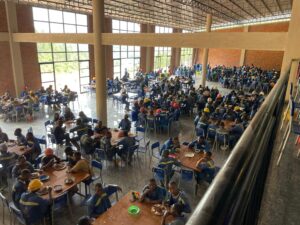
The boss himself always tastes the porridge first, to ensure it is fit for consumption. Here is how our day is arranged: at 6h20 a.m., we take the porridge in our spacious and beautiful refectory which looks more like a restaurant. By 7h30 a.m., we have gotten into mine tunnels and undertake to work. We break at 11h30 a.m., for lunch and return to work at 13h30 p.m., continuing until 15h.”
He adds “Moreover, we are furnished with all equipment needed. We are not charged the meals, we take our full salaries home. Another remarkable benefit is that GAMICO has established a medical clinic for us. When we fall ill, we are treated there at no cost. More serious cases are referred to a hospital, and the company pays our health insurance fees.
I’m married and maintain the family, own a house worth not less than 17 000 000 Rwandan francs (RWF) and a plot worth not less than 3 000 000RWF—all this thanks to GAMICO. In fact, when your employer wants you to work productively, they give you all you need and you then perform wholeheartedly and without reservation. If all investors followed GAMICO’s example, even mineral production in Rwanda could increase dramatically. With a simple investigation, you will find that GAMICO offers the best wages nationwide, while also providing all essential equipment and meals to its workers.”
A bit more on the wellness program
According to Basabe, the Workplace Wellness Program— officially launched by MIFOTRA in collaboration with the Ministry of Health, RSSB (Rwanda Social Security Board), and PSF— forms an initiative aiming to improve employee health, productivity, and retention. It includes:
- Physical Health Interventions:
- On-site screening for non-communicable diseases like hypertension and diabetes,
- Promotion of physical activity,
- Nutrition education and healthy eating campaigns, and
- Regular health check-ups.
- Mental Health Support:
- Mental health screenings and awareness campaigns,
- Counseling services and referrals,
- Integration of stress management and mindfulness practices, and
- Advocacy to reduce stigma and promote psychosocial well-being.
- Policy and Culture Change:
- Encouraging healthy workplace environments,
- Promoting work-life balance, and
- Training leaders to prioritize employee well-being.
Basabe explains that the program involves various actions that will certainly have it successfully carried out. “The program is feasible as it aligned with both national and international standards. The following are actions to be implemented by every Public and Private Institution: conduct annual capacity building of OSH committees, conduct annual workplace risk assessment to identify potential risks and ensure their prevention, establish workplace safety and health policy and its implementation plan, establishment of health corner at workplace.
Labour inspectors: empowered under Law No. 66/2018, inspectors are tasked with monitoring compliance with labour standards, including the implementation of wellness-related obligations. Quarterly Reporting: employers are required to submit regular reports on the implementation of the Workplace Wellness Program, ensuring transparency and traceability of efforts. Penalties for Non-Compliance: as stipulated in Article 23, paragraph 3 of Ministerial Order No. 001/19.20 of 17/03/2020 relating to labour inspection, failure to comply with workplace obligations may result in administrative sanctions, reinforcing accountability across sectors.” The list of those actions is not exhaustive.
A leader of an organization I served in the past often told us “Work has killed no one. You have to work very hard, you won’t die; instead, you can die, if you don’t hold a job.” Reacting to this mindset, Basabe affirms that the program has been intended to destroy such mentality. “This deeply ingrained belief reflects a toxic productivity culture that equates overwork with virtue. The workplace wellness program counters this by educating leaders on the economic cost of burnout, absenteeism, and presenteeism; encouraging employee-centered leadership and psychological safety; integrating mental health literacy into workplace training.”
Life In Humanity will come back to this program with more details exclusively about it.