By Jean Baptiste Ndabananiye
Wangiwe Joanna Kambuzi is one of five young Malawian young people who are revolutionizing the lives of countless Malawians through technologies. Kambuzi has indirectly transformed the lives of thousands of people, these just being people whom she surely knows as those indirectly changed by her social enterprise- Mzuzu Entrepreneur Hub commonly known as Mzuzu E-Hub.
Transforming a single life often launches a chain reaction. For example, by lifting just one person out of poverty, you may indirectly liberate hundreds or even thousands of others, including both people you know and those you don’t. The one person you directly assist could immediately help 10 others by, for example, providing them with jobs. Now, imagine each of those 10 people goes on to affect 10 more, and so forth.
That might be why International Finance Corporation (IFC) in its May 2024 article headlined “Going Digital: Five Young People Leading Malawi’s Tech Transformation” says “ Meet Wangiwe, Sithembile, Kelvin, Daniel and Bright. These five young people are pillars in Malawi’s growing tech community who are connected to the digital world to a degree that no generation before could have imagined. Shaped by the internet and mobile phones, they are utilizing technology to help build brighter, more prosperous futures, not just for themselves but for millions of other young people across Malawi.”
It is for this reason that Life In Humanity has felt irresistibly compelled to approach this formidable lady, for us to learn from how Africa’s citizens especially youth can employ modern technologies in order to overcome unemployment. Her responses are particularly designed to respond to this article featured in our platform. Before an exclusive interview with her, we are first going to provide a brief description of Mzuzu –E Hub and Wangiwe.
Upon opening this social enterprise’ website, you land on words that briefly explain what the enterprise exists for. “We believe that small business growth will create sustainable incomes and foster a healthy and diverse entrepreneurial environment in Malawi. Mzuzu E-Hub exists to provide the capacity building, linkages, and networks required to amplify startup and early-stage businesses for growth and success.
What We Offer
Mzuzu E-Hub implements various projects for a diverse population, focusing particularly on entrepreneurship and digital skills.” Mzuzu is the capital of North Malawi.

Kambuzi is Mzuzu E-Hub’s Founder and Managing Director. Segal Family Foundation is a philanthropic organization-founded by Barry Segal, a successful American businessman- that partners with African organizations to support locally-led solutions in health, education, and youth employment. Its website contains these words “Wangiwe is a communication practitioner and business development professional. Through her passion for youth and community development, she founded Mzuzu E-Hub.
She was recognized as one of 2019’s Meaningful Business 100 for successfully combining profit and purpose to help achieve the UN SDGs, SASA/Global Startup Awards 2019 Female Role Model of the Year Malawi, and 2018 Community Builder awardee of the Social Impact Incubator Malawi. She supported the 2019 Youth Decide Malawi Campaign as a Youth Manifesto Champion and was one of Malawi’s youth delegates at the 2019 Model African Union and the World Youth Forum. She serves as a youth advisor and mentor for the Next Generation CSO Leadership Academy under the National Democratic Institute Malawi. Wangiwe brings a pool of knowledge and expertise in organizational development from both corporate and development sectors towards enhancing socioeconomic development.”
Wangiwe is a Segal Family Foundation 2021/22 African Visionary Fellow, SEED Business Development Support Advisor on Climate Enterprising Incubation and Miller Center for Social Entrepreneurship Accelerator Cohort 24 Alumni, among others. She was additionally recognized as one of 2024 Wealth Magazine’s 100 Inspiring Women in Malawi and 2023 Africa Startup and Ecosystem Builders-ASEB Ecosystem Builder-Malawi.
She established Mzuzu E-Hub in 2017 with a purpose to build a community of entrepreneurs creating innovative solutions for their communities to foster job creation and poverty eradication. Briefly, that is Wangiwe with whom we are. But as this piece progresses, you will comprehend her and her Mzuzu E-Hub better.
Main Question I
Jean Baptiste Ndabananiye: Africa’s digital transformation journey, despite trying to advance fast in some areas, still lags by far behind the advanced world in several key aspects. As a figure who has already achieved substantial feats in the field of digital transformation/ exploitation of digital technologies to the benefit of yourself and a huge community in Malawi, if you agree that Africa possesses the potential to successfully accomplish digital transformation to the extent that it can even reach the level of the developed world, what do African governments have to do?
Wangiwe Joanna Kambuzi: Thanks a lot for having me and indeed Africa has the capability and potential to accomplish digital transformation that will see the continent operating with effective and efficient digital ecosystems.
One of the key contributors from the government is creating an enabling environment through implementation of policies that advance investments in the digital transformation agenda, infrastructure development by public and private sector-more important if public private partnerships invest in these.
One of the key challenges in terms of infrastructure is electricity access for instance in Malawi, up to 19% of the entire population has access electricity; which poses a great barrier in advancing ICT infrastructure. The more the investments towards the energy sector, the higher the opportunity towards increase of accessibility.

In most cases, what’s lacking is the political will and prioritization of diverse interventions, utilization of resources and investments through country programs and projects where by the governments have to be more intentional in fostering the digital transformation agenda and influencing the citizenry through first adoption from their end. On progression, we already see investments from diverse projects including the Digital Malawi project, Inclusive Digital Transformation project in Malawi that need to be utilized towards driving meaningful change.
Jean Baptiste Ndabananiye: What do you suggest to African citizens, especially youth? What can they learn from you?
Wangiwe Joanna Kambuzi: As African citizens especially youth, we have a huge role to play as we are a great resource in form of human capital- we should invest in contributing towards innovation developing solutions for various challenges in our communities, developing talents that can be of service to our countries or continent.
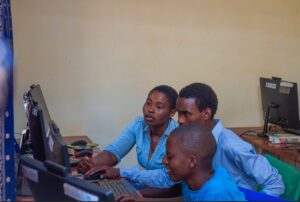
There is so much to learn from each other and one thing is not always to wait on solutions to find us rather we sit at the table where solutions are being driven- it’s one key thing I can share from my experience.
Main Question II
Jean Baptiste Ndabananiye: It is said that Africa’s digital transformation carries the capacity to reverse jobless growth in Africa. Based on your social enterprise’ s achievement of having directly helped more than 430 emerging Malawian entrepreneurs as we have read it in the article by IFC, we’d like you to confirm or reject this statement (potential of digital transformation to create jobs in Africa/ jobless growth elimination).
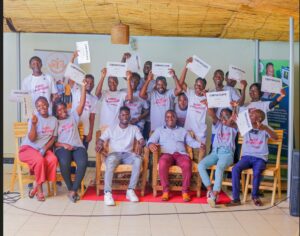
Wangiwe Joanna Kambuzi: At the Mzuzu E-Hub, we are an entrepreneurship, technology and innovation hub in Malawi fostering a thriving ecosystem that amplifies self-reliance of individuals and communities across the country by providing enterprise development support solutions including co-working and meeting facilities, business incubation, acceleration and investment support; and digital inclusion initiatives including digital skills training and job placements, awareness and sensitization, access to digital technology tools and resources; ecosystem engagement and innovation events.
It’s quite an amazing we got featured by the International Finance Corporation having partnered with the World Bank and the Malawi Government through the Public Private Partnership Commission under the Digital Malawi project in 2021 and later on Lenovo Foundation in 2023.
I would like to confirm the potential of digital transformation contributing towards improved sustainable livelihoods, as I mentioned earlier a well enabled environment with ICT infrastructure and digital transformation on the front fosters innovation which is through advancing digital skills, knowledge and literacy, entrepreneurial mindset and enhanced business practices. And who better to participate than people leveraging the opportunity towards creation of new digital innovations, online jobs/freelancing, mechanization and automation of business processes in sectors like energy, agriculture and manufacturing, financial services just to mention a few?
Jean Baptiste Ndabananiye: the 430 entrepreneurs are people who have benefitted directly from your services. However, we believe that there are other Malawians whom your services have positively affected indirectly. These can include the entrepreneurs’ employees or their other major stakeholders. How many Malawians do you think or estimate your services have positively affected indirectly?
Wangiwe Joanna Kambuzi: through our community of problem solvers/entrepreneurs, we indirectly reach up to 15,000 community members through employment opportunities, access to ICT services including community resource hubs spread across 2 cities-Lilongwe and Mzuzu and 3 districts- Rumphi, Nkhatabay and Ntcheu where we provide digital skills trainings for children, young men and women to amplify their employability and technology adoption.
Jean Baptiste Ndabananiye: What technologies and approaches do you employ to transform your customers/ stakeholders’ lives?
Wangiwe Joanna Kambuzi: Our approach adopts collaboration at the front, so as to empower fellow local organisations to adopt digital transformation in their programming and projects across various sectors.
Our main interventions at this time is establishing social innovation hubs across both rural and urban areas for ease of access to digital resources including skills and knowledge transfer, meeting facilities, internet access and enterprise development services. Some of the digital platforms we have deployed across communities include the BizLearn application for MSMEs to get access to self-paced learning (a virtual incubation platform) providing skills and knowledge for emerging entrepreneurs, can be accessed here (https://play.google.com/store/apps/details?id=com.bizlearn.bizcucation&pcampaignid=web_share).
In addition, we deployed the Kukolola WhatsApp Chatbot providing access to digital information services to emerging Agri based entrepreneurs to have access to information on emerging technologies they can utilize to enhance their productivity and compete on the market which can be accessed here +265991331031.
Main Question III
Jean Baptiste Ndabananiye: What challenges, if any, are you facing? What are their solutions?
Wangiwe Joanna Kambuzi: One key challenge is deploying technologies can be quite expensive especially infrastructure and digital literacy.
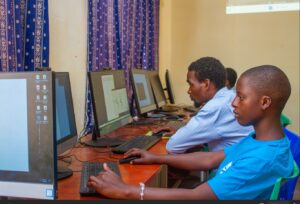
However, we are utilizing partnerships with local communities, government, development partners and corporates/private sector to reduce some of the costs by leveraging existing infrastructure or interventions and co-creating innovating solutions for specific communities as there is no one size fits all approach during the implementation. This also means pooling resources and community buy in from diverse stakeholders for long-term sustainability.
Question IV
Jean Baptiste Ndabananiye: Do you entertain plans to expand your work in Africa? If so, when, why and where do you plan to implement it? If not, why?
Wangiwe Joanna Kambuzi: Absolutely, we are currently rebranding and repositioning our work beyond Malawi and look forward to executing in the next five years of our strategy. The main reason being beyond Malawi, we are a part of the regional and continental agenda and our solutions in advancing entrepreneurship and technology adoption drive socio-economic transformation which we are proud to push forward. We will definitely share soon on which areas we will position our expansion towards and look forward to collaborating with diverse industry leaders across the region and continent.
Question V
Jean Baptiste Ndabananiye: How have your customers’ lives been changed, compared to how they stood before your intervention? Maybe for us to comprehend it better, you can give us just one example of your client whose life transformed by your intervention.
Wangiwe Joanna Kambuzi: Let me share one case study of Madalitso Makombola, an incubate under the Bizcubation Program of 2022 Cohort.

Madalitso Makombola is co-founder of the World Wide Discovery Joint – WWJD and together with his colleague Chikondi Chiumia founded this business to promote eco-tourism and fish farming in Usisya, Nkhatabay – Northern Malawi.
For the duo to effectively drive their businesses, they needed a water drone to help them curb overfishing in Lake Malawi. During their involvement in the Bizcubation Program, they underwent various capacity building training including social enterprise, financial management and business management, among others. They were in the last sixth category of entrepreneurs who pitched their businesses and funding of $1000 to purchase a water drone. Since the purchase of the drone, there has been extensive reduction in over-fishing in the area as they are able to map out fish ready for harvest and advise the community on that. And as part of also building up their eco-tourism businesses, the duo are nor operating a tourism business where they ferry tourists from main land to the lake and back as part of sightseeing.
You can get more of Madalitso’s story from a feature story that we once created https://mzuzuehub.org/blog/supporting-youth-led-ideas-in-dealing-with-unemployment.