By Jean Baptiste Ndabananiye
Beneath Rwanda’s picturesque hills lies a wealth of minerals—tin, tungsten, tantalum—resources the country hopes will drive sustainable development. Indeed, Rwanda has realized notable strides in positioning its mining sector as a pillar of economic growth and green industrialization. However, while progress stands visible on different fronts, pressing challenges affecting communities and ecosystems still need to be addressed.
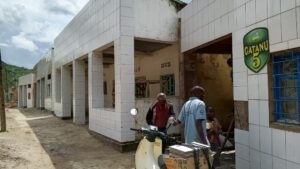
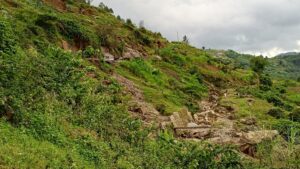
Last year, Rwanda Mining, Petroleum and Gas Board (RMB) revoked licenses from more than a dozen companies, citing serious and repeated shortcomings in areas like environmental protection and labor rights. In Ngororero District, for example, some buildings are now being dismantled due to erosion linked to mining activities—a situation this report explores further.
Such developments raise this important question: while revoking licenses forms part of the solution, where does the real obstacle lie? Some argue that financial constraints among mining establishments constitute the underlying reason. If addressed through bank loans, can it prove to be a game-changer? This article addresses this aspect, among others.
Understanding the issue
In effort to understand the situation firsthand, we are in Cyome in Gatumba Sector in Ngororero on 10 May 2025. On this day in Cyome, we should be struggling to create a way through the crowds— a vibrant market used to take place today here at Cyome. But, instead of the bustling market that once defined this day in this particular locality, we now hear only the clanging of hammers and the sound of collapsing walls. Residents are dismantling their buildings due to “mining-induced erosion.” The area is eerily quiet.
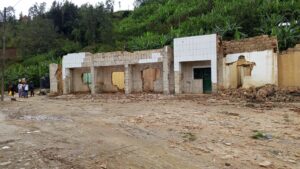
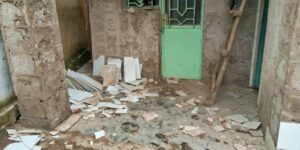
Emmanuel Ndayisaba settles in Ruvumu Village in Cyome Cell, Gatumba and is one of those negatively affected. He says “I also owned a building here in Cyome—Nyakagezi Village. Ngorero’s District Executive Committee came to encourage us to apply wall tiles to our buildings, and we received banks loans to implement it; especially since they told us that this would elevate the value of our buildings. For me to execute it, I also sold a piece of land.
But now erosion is forcing us to destroy the buildings. Though we are trying to remove the tiles, some of them are being smashed to pieces. We have suffered huge losses that some of us will be unable to repay the loans. I’ve spent 350 000RWF, but there are those who have invested far bigger amounts than me. The erosion of here is being caused by mining.”
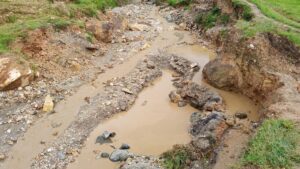
Ndayisaba adds “When the mining investor left the site, illegal miners known as ‘abanyogosi’ immediately appropriated it, extracting minerals unlawfully and causing erosion in the Serege stream—a stream that had remained free of erosion. This place once sustained the lives of everyone in the area. There used to happen a vibrant market for various goods and livestock. Anyone who used to trade their merchandise or animals here has already suffered a loss.
Today, the market has been relocated to Muhanga District, we cover a long distance to get to the market. No erosion had happened while the investor was still exploiting the mining site. This erosion has emanated from the fact that as soon as the investor stopped, abanyogosi immersed themselves in search for remaining minerals in the mineral-laden sand that the investor had piled. In their search for the minerals, they threw the sand into the stream, causing it to flood. The erosion happened in 2024.”
Béatrice Mukankundiye living in Rutabataba Village, Gatsibo Cell in Gatumba explains “The erosion washed away meat that I’d just cooked, carrots, tomatoes, and utensils like plates, spoons and forks as well as 50 kilograms of Irish potatoes since I was then running a restaurant here in Cyome. The value of what was then carried away by the erosion matches approximately 5 5000RWF.
The erosion proceeded from mining. I’ve gotten a bank loan of 500 000RWF. I have not cleared it yet, I am doing it slowly and when they ask me why I am not repaying well, I reply to them that that the business has been severely hampered. I received the loan not below 6 months ago and I could have fully settled it, if we hadn’t experienced this erosion.”
She further says “Every week, I paid 30 000RWF and I usually worked well with the bank; that was the 6th loan that I had obtained from the bank. It was already around 8 years since I’d begun working with the bank. Before the erosion, the smallest amount that I could earn from my restaurant per month was 150 000RWF; I am an old woman aged 60, but with my restaurant I could satisfy all my needs, I was even able to pay my child’s school fees from the 1st year to the final one at secondary school, spending 100 000RWF a term.”
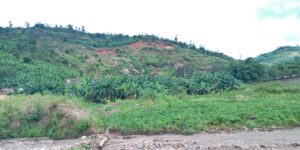
Kayibanda points out “This erosion emanates from those upper mining sites, since the erosion which floods the stream comes from the mines there above. Ah, I spent a lot of money! I expended a 1 000 000 RWF, to apply the tiles. I won’t even recover a fourth of these tiles. We propose advanced mining which is sustainable; otherwise, even the tarmacked road will be destroyed by the erosion.”

The Mayor Ngororero District, Christophe Nkusi, explains that they are taking action to address illegal mining. “In efforts to combat and prevent illegal mining, we are continuously conducting campaigns through community assemblies [held every Tuesday at the cell level] and other forums where we meet citizens. We explain to them that no person is allowed to engage in mining, unless they are authorized. We underline to them that illegal mining certainly destroys the environment. Besides, we explain to them that illegal mining causes them to conduct unprotected mining; which can claim their lives, for example a landslide can fall to them and kill them.”
Enforcement of mining standards
There are mining establishments —companies and cooperatives— whose licenses are terminated over “serious deficiencies” including failure to meet environmental and labor standards. For example, in its 3 January 2024 story headlined “Rwanda: Seven Mining Companies Lose Concessions Over ‘Serious’ Failures”, The New Times’ reported that 7 companies’ licenses were cancelled, because of the mentioned deficiencies.
“Rwanda Mining, Petroleum and Gas Board (RMB) has revoked licences of seven mining companies over ‘serious deficiencies,’ including failure to meet environmental and labour standards. The revocations announced on January 3, followed ‘repeated failures to remedy serious deficiencies highlighted in official cancellation warnings issued earlier,’ the RMB said in a statement seen by The New Times, indicating that the decision took immediate effect.”
“These companies have breached safety, environmental, and labour standards, and have not met their investment commitments,” the statement read in part, according to The New Times which added that the RMB said the mining license cancellations figured among the government’s efforts to carry out measures that support and professionalize mining operations.
In November 2023, the same source further says, the RMB cancelled 13 licences of 10 mining companies due to “serious and persistent shortcomings” related to safety, environmental and labor standards as well as investment commitments.
The newspaper—Igihe— ran a story entitled “Rwanda needs Frw26 billion to restore mining pits abandoned since colonial times” on 16 January 2025. As suggested by the headline, this media organization reported that a study showed that some of these sites were abandoned decades ago, and that others were recently neglected by private companies and individuals— including those who mined illegally or failed to comply with restoration obligations.
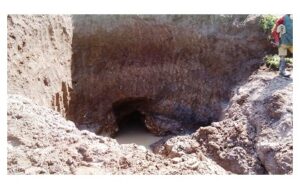
Igihe reported that those billions are those needed to rehabilitate 994 abandoned mining pits across the country. “These pits, left unrestored after mineral and quarry extraction activities, pose significant risks to public safety and the environment. Mineral extraction in Rwanda began in the 1930s under colonial rule. However, many mining sites were neglected after operations ceased, leaving behind hazardous pits that continue to threaten lives and livestock. According to Francis Kamanzi, the CEO of RMB, a recent nationwide inspection revealed that these abandoned sites include both quarries and mining pits.
The study also showed that some of these sites were abandoned decades ago, while others were recently neglected by private companies and individuals, including those who mined illegally or failed to comply with restoration obligations. Kamanzi explained that the neglected sites can be broadly categorized into four groups: those abandoned during colonial times, those exploited illegally in recent years, quarries handed over to private companies with valid permits but left unrestored, and pits neglected by licensed miners. He noted that many of these sites are located near residential areas, exacerbating the risks of injury to people and livestock.”
According to Igihe, Francis Kamanzi—the CEO of RMB— stated that individuals or companies that abandoned their sites must take responsibility and fulfill their legal obligation to restore the land to its original state. “While some progress has been made, such as the restoration of 53 sites through community efforts, a significant amount of work remains. Each site will require a thorough environmental assessment before any rehabilitation begins to ensure that restoration methods are tailored to the specific conditions of the site.”
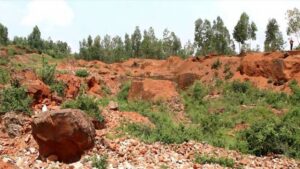
Kamanzi underscored that this process cannot be rushed, as it involves “detailed planning and coordination with various stakeholders. RMB has identified that 367 sites can be cleared using machinery, 253 will be addressed through community efforts, and 304 will be cleaned using a combination of both methods, while 70 sites do not require any restoration.”
Major cause and solution
Various sources affirm that the lack of investment funds constitutes the key reason why some mining businesses consistently fail, while others succeed by leveraging this vital resource to comply with environmental sustainability and safety mechanisms. The following are some of them.
APEDDH—Action pour l’Education et la Défense des Droits Humains— has been working in the mining sector since 2016. Alexis Kizungu serves as this organization’s executive director. He says “Mining demands extremely high investment. They first conduct exploration; then, they dig for minerals and this necessitates powerful equipment—machines, and personnel. Mining requires extremely huge amounts of money! Especially several of Rwandan mining investors’ financial means are very limited.
For them to perform well, it demands that they be provided with bank loans, yet banks don’t accept their mining sites/concessions for collateral. For mine owners to juggle with it, they give their residential houses as collateral and these houses aren’t sufficient either. There don’t exist many houses which can be valued at 500 000 000RWF; nevertheless, this sum constitutes a drop in the ocean, compared to massive investment needed in mining.”

He adds “On one side, we understand banks because they need trustable evidence that they will recover their money. We have discussed it with various mine owners and requested us to perform advocacy for them with banks but we have always told them that the fact that banks don’t grant them loans is founded. The research carried out by the mining establishments doesn’t generate information irresistibly convincing to the banks. However, with discussions with some people involved in mining in some Scandinavian countries, we have learnt that there exist some technologies which can help people to try to accurately estimate the quantities of minerals in a given place.
So, this can persuade banks to provide loans for mining investment. If this problem is solved, it can eradicate the issue of some mining establishments’ noncompliance with environment and safety standards. Possessing means, you can rectify any problem; you can pay the staff well, you can acquire modern equipment and safeguard the environment smoothly since you then own the means to fight and prevent whatever is likely to harm the environment—such as erosion. In some cases, those who fail to execute compliance do not do so intentionally, it’s due to the fact that they lack the means.”
Omar Yusuf Karambizi is president of COMIKAGI—Cooperative Miniere Kababara-Gikindo — Supervisory Committee. He also emphasizes that bank loans can help mining establishments to attain fabulous achievements— and noncompliance can become a subject of the past. “For example, our cooperative possesses six licenses, and at least per license we should own a mineral processing-plant. Each plant consumes at least a billion Rwandan francs. Such an amount can be provided by banks, and it’s not only these plants you need to possess; you must also purchase modern equipment. For instance, if you visit us, you will find that we have tried to buy an excavator. If we obtain bank loans, it will not only enable us to procure far more considerable production but also permit us comply smoothly with all that we are required.”
“For example, we have discovered that we currently extract only about 25 to 30% of minerals from mineral-laden sand. A study has confirmed this low recovery rate. However, with adequate financial means, we could increase this extraction rate to at least 80%. Eh, eh, I reassure you that we possess such a lot of minerals, the only issue being that we extract them poorly because of the lack of means! Banks cannot face any loss.

Can any bank fear to invest in mining in the Democratic Republic of Congo? I don’t think so, since people generally agree that Congo contains immense quantities of minerals. If no bank can fear to invest in mining in that country, no bank should fear to invest in our mining too, since we actually possess huge quantities of minerals too—especially since we [Rwanda and Congo] share the same geological formation, which explains why Rwanda is also rich in mineral resources. There are even Europeans who came here to COMIKAGI in the past and were amazed, but they initially suspected we don’t have minerals.”
Life In Humanity will come back to this subject relating to bank loans and mining, with a detailed interview with Karambizi, explaining how banks cannot sustain loss from giving loans to mining establishments. We will also approach other relevant mining stateholders, particularly banks, to gain deeper insight into challenges and possible solutions surrounding financial support in the mining sector.
Meanwhile, a 10 January 2024 story— by The New Times—headlined “Rwanda: Inadequate Financing Undermining Rwanda’s Mining Potential – Official” indicates that the lack of bank loans for the mining sector represents a big obstacle to this sphere. It reads “Lack of domestic financing tailored to the mining sector’s needs is making Rwanda’s mineral business highly reliant on loans from foreign companies and therefore biting into the country’s revenues because investors use a big chunk of their revenues to repay credit, lawmakers heard on Wednesday, January 10.
This was revealed during a session in which Rwanda Mines, Petroleum and Gas Board (RMB) officials appeared before the Lower House’s Committee on Political Affairs and Gender to provide responses to sector-specific issues highlighted in the Office of Ombudsman’s report for the fiscal year 2022/2023. The [former ] RMB CEO, Yamina Karitanyi, told lawmakers that majority of mining activities in Rwanda were still artisanal, indicating that such a situation creates challenges including issues related to environmental protection, in addition to losing some minerals, as a result of the use of traditional mining techniques. .All this stems from a general lack of access to finance among investors in the sector, she said, pointing out that available financial products from banks do not favourably respond to the sector’s needs.”
The then RMB Deputy Chief Executive Officer, Ivan Twagirashema, told the parliamentarians “We want to reach a level where our banking system has trust in them and provides them with finance.”
According to The New Times, there is action which will facilitate this. “While there are countries where investors offer mining concessions as collateral for bank loans, Karitanyi said, this is not possible in Rwanda because, among other reasons, investors do not have enough exploration data for their mineral reserves. She noted that collaterals that local banks accept include buildings, indicating that the maximum value of residential houses – for the relatively well-off – is about Rwf500 million, an amount that is too little for mining business.”
“What we need is an access to finance for mining purposes. If you go to banks here, you will not find a financial instrument meant for mining” she told lawmakers, pointing out that mining requires long-term and affordable loans. For her, “the mining sector should be digested in our baking sector.” She expressed the concern that even the limited financing products available on the market are short-term loans. “Mining is a long-term endeavor, it’s a long-term investment,” she said, highlighting that the government is committed to de-risking through carrying out mineral exploration research to complement what investors can do, but local banks should also develop financial products that adequately support the sector.
“What we have started doing is holding talks between entities including the Ministry of Finance and Economic Planning and banks to see how we can be able to get finance that can be used in mining. This will help us to acquire equipment which can help us to shift from artisanal mining practices to professionalisation and modernisation.”
Consequences of mining
According to Oxfam Australia, mining processes harm the surrounding environment by destroying land and biodiversity, creating toxic chemicals and causing water and air pollution. This organization furthermore states that mining also contributes to climate change by producing fossil fuels which constitute the biggest emitters of greenhouse gases.
“Surface mines create a huge amount of waste materials. Mines release harmful substances into the air and water, and can cause serious health issues if inhaled or consumed. Mines also release acidic water, which can kill marine life and make freshwater unsuitable for drinking.
Underground mining produces fewer waste materials than surface mines, but they are risky for mine workers. Mining operations that don’t respect human rights or protect the environment can cause significant harm to surrounding communities.”
Surface mines include mining operations where minerals or other resources are extracted from the Earth’s surface, as opposed to being dug out from underground. This method involves removing soil, rock, and other materials called “overburden”, to access the valuable materials beneath.
Earth.org in its 3 April 2022 story headlined “The Environmental Problems Caused by Mining” points out “The destruction of vegetation and soils when land is cleared for mining results in the release of carbon dioxide and other greenhouse gases. Another important consideration relates to the quantity of greenhouse gases released per unit mass of mined material, as some less concentrated mineral deposits require proportionally higher energy usage.
For example, mining a kilogram of diamond produces around 800,000 kg CO2e compared to a kilogram of a highly abundant mineral such as iron which produces only about 2 kg CO2e. The creation of products from mined materials uses high amounts of energy throughout the different stages of the production chain and most of this energy is currently sourced from the burning of fossil fuels.”
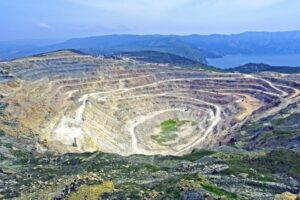
To ensure sustainable mining, Earth.org says “Reducing reliance on fossil fuels in the mining process by electrifying the technology and running it off a green energy grid is a key aim to allow mining to continue along a more sustainable path. Automation of many of the stages of mining is also another vital change that will not only improve safety but also increase efficiency and cut energy costs.”
Research Gate has released a June 2024 publication titled “Biodiversity Loss Due to Mining Activities”. It reads “The mining sector, despite its significant role in the climate and biodiversity crises, has not garnered substantial attention in global discussions on these matters. COP15 [UN Biodiversity Conference in 2022] presents an additional chance to integrate biodiversity and forests into standard practices within the mining sector. In 2019, a UN report highlighted a global biodiversity crisis characterized by an alarming pace of animal and plant extinctions, putting one million species at risk of vanishing.
“Surprisingly, the biodiversity crisis doesn’t garner the same level of media and political focus as the climate crisis, despite the imperative to address both simultaneously. Preserving habitats such as forests serves a dual purpose: safeguarding species diversity while also serving as a solution to mitigate greenhouse gas emissions.
Forests act as vital carbon sinks, absorbing and storing atmospheric carbon as biomass. Mining activities, essential for meeting global resource demands, have become a pervasive threat to biodiversity, leading to widespread ecological disruption and biodiversity loss.”
Mining and the environment across the world
Oxfam Australia reports “The mining industry is responsible for 4%-7% of global greenhouse gas emissions and has a responsibility to commit to a reduction in emissions throughout its entire supply chain. This includes moving away from fossil fuels and supporting renewable energy and new technologies. The mining sector, governments, investors and communities need to work together to agree on clear standards that promote environmental sustainability, along with social and economic development.
To reduce the social and environmental impacts of mining, companies and governments must abide by regulations that protect air, water and land resources, respect basic human rights, follow socially responsible practices, and engage in appropriate consultations with local communities. Mining activities must be transparent and companies must be accountable to the communities impacted by their operations. They must publicly disclose the impacts of projects and the revenue governments earn from them.”
Meanwhile UNDP—United Nations Development Program— says “We know that degrading ecosystems could trigger a downward spiral of US$2.7 trillion in global Gross Domestic Product by 2030. Despite ongoing efforts, biodiversity is deteriorating worldwide, and this decline is projected to worsen with business-as-usual. The loss of biodiversity comes at a great cost for human well-being and the global economy.”
SpringerLink forms an online collection of more than 1,200 peer-reviewed journals and 25 book series published by Springer addressing a variety of topics in sciences, social sciences, and humanities. This platform contains a publication entitled “Implementation of Circular Economy Between Mining and Construction Sectors: A Promising Route to Achieve Sustainable Development Goals.” This publication appeared on 5 January 2024 on this channel.
Its abstract reads “The mining sector is the largest solid waste producer in the world. Mining, mineral processing, and metallurgical activities generate more than 100 billion tons of waste per year in several forms.” Exactly echoing the point, Pan African Resources says “Across the world, mining produces over 100 billion tonnes of waste each year in the form of rocks and tailings.
If not handled and managed correctly this can pose a significant environmental and social risk, through harmful dust and gas emissions and water leaching. In the most severe cases, failing to adequately deal with waste can have catastrophic consequences, as happened in Brazil recently with the failure and collapse of two tailings dams in 2019 and 2015.”
International Council on Mining and Metals—ICMM— explains that responsible mining constitutes a foundational element of a sustainable future. It says “Mining is essential for modern life, providing the raw materials necessary for infrastructure, technology, and clean energy innovations. To achieve net-zero emissions by 2050, the World Economic Forum estimates that 3 billion tons of metal will be required—equivalent to the weight of 300,000 Eiffel Towers. Mining plays a crucial role in fulfilling this need.
However, this necessity doesn’t grant the industry a license to operate without accountability. On the contrary, it imposes a responsibility to ensure that mining activities do not jeopardise the long-term health and wellbeing of people or the planet for short-term gains. Mining has the potential to significantly impact ecosystems, communities, and economies.”
ICMM adds “Responsible mining mitigates these impacts, fostering trust among stakeholders and aligning operations with global objectives such as climate action, biodiversity conservation, and equitable development. Without these safeguards, the societal benefits of mining may be overshadowed by its costs, undermining its role as a driver of sustainable progress. Only through ethical and sustainable practices can mining contribute positively to society and the global transition to a low-carbon economy.”
ICMM defines responsible mining as practices prioritizing environmental stewardship, social responsibility, and ethical governance throughout the entire mining lifecycle. “This includes avoiding, minimising and mitigating environmental impacts, respecting human rights, ensuring worker safety, engaging with communities, and fostering long-term social and economic development.”