By Jean Baptiste Ndabananiye
Russia and China have reviled the US and Israeli attacks on Iran, according to Al Jazeera, Moscow declaring that it had observed no proof that Tehran was producing nuclear weapons. Beijing requests for an immediate halt to the joint attacks. Meanwhile, Russian State Media have excoriated the US/Israel ‘war crimes’, according to The Moscow Times. Vladimir Solovyov alerts that the US will apply the same tactic against Russia.
The world is divided. There are those who castigate this war on Iran, which has already metastasized, and those who support it. Those who criticize it say that the US and Israel should not have launched it while those who endorse it affirm that the US and Israel are right. While we won’t provide many details around the war, we are now interested in the question: will these countries comply with the Russia and China call?
Enigma- why Iran was attacked amid negotiations

People’s Republic of China.
In its 4 March 2026 story headlined “Russia, China raise diplomatic voices against US-Israeli attacks on Iran”, Al Jazeera reports “China’s foreign minister tells Israel to end attacks; Russian FM Lavrov says no sign Tehran seeking nuclear bomb. Chinese Minister of Foreign Affairs Wang Yi told his Israeli counterpart, Gideon Saar, on Tuesday that the attack on Iran came as negotiations between Washington and Tehran had ‘made significant progress, including addressing Israel’s security concerns’, China’s Foreign Ministry said in a statement.”
“Regrettably, this process has been interrupted by military action. China opposes any military strikes launched by Israel and the US against Iran,” Wang told the Israeli foreign minister during a phone call, as stated by the ministry. “China calls for an immediate cessation of military operations to prevent the further escalation and loss of control of the conflict. Force cannot truly solve problems; instead, it will bring new problems and serious long-term consequences,” Wang said.
Solovyov is one of Russia’s strongest state television presenters and a vocal supporter of the Kremlin. According to The Moscow Times, in his primetime weekly news show, he said that the U.S. exploited the negotiations as a part of its military strategy-instead of availing herself of the negotiations as genuine talks to end the problem. He charged Washington with capitalizing upon diplomacy as cover for military action and cautioned that similar tactics could be employed one day against Russia.
“Their [Russian state television hosts] rhetoric casts the conflict as further proof of U.S. destabilization abroad, as well as a cautionary lesson for Moscow as it navigates strained ties with Washington and seeks leverage in talks over Ukraine,” says The Moscow Times.
In his own words, Solovyov- addressing the U.S.-Iranian nuclear talks in the weeks leading up to Washington’s strikes- pointed out “It’s now clear to us that the negotiation process appears to be no more than part of their military operation, a redeployment against a peaceful opponent. This technique will be used against us. Russia never has to do this.”
On the Rossia 1 talk show “60 Minutes”, according to The Moscow Times, the co-host Yevgeny Popov- a state television presenter and lawmaker from the ruling United Russia party, termed U.S. President Donald Trump’s actions an “immersion of the Middle East in chaos.” “Not since Pearl Harbor has the U.S. experienced such powerful and painful attacks on its military infrastructure,” Popov wrote in a Telegram post after reported Iranian counterattacks. He further said “The United States can no longer guarantee anyone’s security. Even its own. Iran has written this fact in stone. Those who are powerful do what they want. It’s simply the law of the jungle.”
As for the negotiations, he concurs perfectly with Solovyov. “If they enter negotiations, it means they are preparing for your murder. The man with the red tie [Trump] told us about their four-day military operation and now sings about four weeks. Their calculation was for something totally different.”
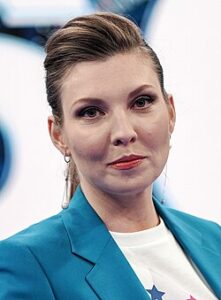
The Moscow Times reports “Olga Skabeyeva, Popov’s co-host on ‘60 Minutes’ and one of the most recognizable faces on Russian state television, slammed the White House’s publication of a montage of the Iran strikes set to the song ‘Macarena,’ calling it a display of the Trump administration’s ‘perverse sense of humor’. She claimed that U.S.-made ATACMS missiles were being used for ‘chaotic strikes on civilians,’ pointing to an American strike that reportedly hit a school in Tehran and killed up to 168 people.”
In her words, she said “International agencies confirmed the footage but otherwise the civilized world did not notice the mass murder of children.”
The Moscow Times adds “Moscow has so far sought to avoid open confrontation with Washington since Trump’s return to the presidency in January 2025 in hopes of securing a favorable peace deal in the Ukraine war. President Vladimir Putin has largely kept quiet on the strikes on Iran.”
Up to now, Putin just condemned what he described as the ‘assassination’ of Iran’s supreme leader. He also proposed to mediate between Tehran and the Gulf states as the conflict spilling into the wider region.
“Please accept my deepest condolences in connection with the assassination of the supreme leader of the Islamic Republic of Iran … committed in cynical violation of all norms of human morality and international law,” Putin said in a message to the Iranian President Masoud Pezeshkian published by the Kremlin, according to The Moscow Times in its 1 March 2026 story entitled “Putin Expresses Condolences to Iran’s President Over Khamenei ‘Cynical Assassination‘”
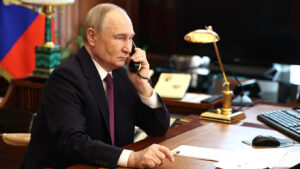
“In our country, Ayatollah Khamenei will be remembered as an outstanding statesman who made a tremendous personal contribution to the development of friendly Russian-Iranian relations.”
Russia’s Foreign Ministry on Sunday said Khamenei’s death as well as other top Iranian officials was “met with outrage and deep regret in Moscow.” Russia “resolutely and consistently condemns the practice of political assassinations and the ‘hunting’ of leaders of sovereign states,” the ministry added.
It called for “an immediate de-escalation, a cessation of hostilities, and a return to the political and diplomatic process.”
Russia’s Permanent Representative to the UN Vasily Nebenzya slammed the strikes as a “genuine betrayal of diplomacy” and rejected Western arguments that Iran was seeking to possess nuclear weapons as “completely unfounded.” “Despite its willingness to engage in the diplomatic process, Tehran is once again being stabbed in the back,” Nebenzya said at an emergency UN Security Council session Saturday.
The Moscow Times says that senior Russian diplomats have warned that the U.S.-Israeli strikes on Iran would plunge the region into the brink of a nuclear mishap and heighten tensions beyond the region.
Will the call be respected?
Based on statements such as “Those who are powerful do what they want. It’s simply the law of the jungle,” and the observation that Vladimir Putin has largely remained restrained in his reaction to the strikes, Life In Humanity can cautiously infer that the call by Russia and China may ultimately go unheeded.
In international politics, appeals for restraint often carry moral weight but limited coercive power. As long as the principal actors in the conflict — the United States and Israel — believe that their strategic objectives remain attainable through continued military action, a voluntary cessation of strikes appears unlikely. Historically, major powers seldom halt military campaigns solely because rivals or critics demand it. The powers stop primarily when their goals are achieved, when the costs become unbearable, or when military counter-pressure from equally powerful actors alters the balance. They even cease to carry their campaigns on when they encounter unexpected issues which immediately compel them to stop.
For this reason, diplomatic condemnation alone may not suffice to change the course of events. Unless other influential powers decide to exert stronger political, economic, or military pressure, the trajectory of the conflict will largely depend on the calculations of the belligerents themselves.
In practical terms, this means that Iran may ultimately have to determine its own response — whether through military resistance, diplomatic maneuvering, or strategic restraint — while the wider international community weighs how far it is willing to intervene in order to prevent further escalation.
What becomes clear, however, is that in moments of geopolitical confrontation, calls for peace compete with the harsh realities of power. Russia herself faced such rhetoric — and, in addition, weapons and financial assistance for Ukraine— when she launched the invasion of Ukraine, yet the war did not immediately cease. The international community issued condemnations, sanctions were imposed, and military support flowed to Kyiv, but the conflict endured because each side believed that its objectives were still attainable or that withdrawal would carry greater strategic costs.
This pattern illustrates a recurring truth in international affairs: appeals to morality or diplomacy, though significant, rarely prevail when nations perceive vital interests to be at stake. States act primarily according to calculations of security, influence, and survival. Consequently, as long as the principal actors in the current confrontation — the United States, Israel, and Iran — continue to assess the conflict through the prism of strategic advantage, external calls for restraint from powers such as China or Russia may generate limited immediate effect to no effect at all.
In this sense, the unfolding crisis reflects a broader reality of world politics: diplomacy can urge restraint, but power ultimately shapes outcomes. Until the calculations of the belligerents themselves change — whether through mounting costs, shifting alliances, or unforeseen developments — the path toward de-escalation is likely to remain uncertain and fragile.