By Jean Baptiste Ndabananiye
A silent revolution is sweeping across agriculture, promising to reshape food security in countries where erratic weather, limited resources, and financial constraints have long hindered progress. A certain study proposes a bold vision—leveraging artificial intelligence to transform irrigation systems, optimize yield forecasts, and empower farmers with useful predictive insights.
Can the fusion of deep learning and traditional agricultural wisdom rewrite the future of farming, turning innovation into the key to abundance even in the most challenging environments? This article consists of these parts:
- Details around the study
- Can deep learning be successfully used in agriculture?
- What benefits is it generating where it is being used?
- Are AI tools totally fine?
- Conclusion
Details around the study
Science Direct accepted a paper titled “Deep learning, irrigation enhancement and agricultural economics for ensuring food security in emerging countries” on 11 June 2024 and rendered it public online on 28 June 2024. This paper constitutes a joint work of five authors from International School of Finance and Technology, Tashkent, Uzbekistan; RUDB University, Moscow, Russia; Armenian State University of Economics, Yerevan, Armenia; and University of Messina, Italy.
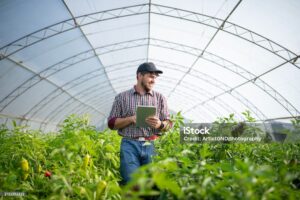
The paper reads “Undoubtedly, deep learning can help address global hunger by implementing it in agriculture in countries with low investment attractiveness and limited opportunities for financing digital innovations. By examining the international experiences of agriculture and food security in emerging countries, we propose deep learning technology to enhance climate resilience and adaptability in agriculture and provide a foundation for implementing advanced management techniques for productivity and yield forecasting based on deep learning.” For more on hunger read The global food crisis: factors aggravating hunger and agricultural practices, plus the solution.
Deep learning is a subset of machine learning that involves training artificial neural networks to recognize patterns and make decisions. It mimics the way the human brain processes information by using multiple layers of interconnected nodes (neurons) to analyze and extract features from large amounts of data. This type of artificial intelligence teaches computers to learn from large amounts of data, like how humans learn from experience. It uses layers of algorithms (called neural networks) to recognize patterns and formulate decisions, helping in tasks like image recognition, language translation, and predicting outcomes.
The paper says “Developing smart irrigation systems and other breakthrough technologies can help increase food security by reducing dependence on unpredictable weather conditions.
A systemic overview of the leading technologies and scenario analysis of the provision of food security based on agriculture digitalization demonstrates the most optimal scenario and the selection of the most perspective technologies. This article hypothesizes that applying deep learning technologies to organic agriculture can strengthen food security. Furthermore, we explore the promising benefits of restoring ancient irrigation systems to elevate productivity levels.”
Can deep learning be successfully used in agriculture?
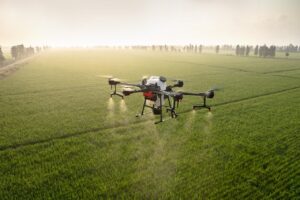
Deep learning can be successfully used in agriculture, transforming the way farming is conducted. By analyzing vast amounts of data, AI-powered models can help farmers to make informed decisions that improve productivity and sustainability. For example, deep learning can detect plant diseases early through image recognition, allowing timely intervention. It also enhances precision irrigation by analyzing weather patterns and soil moisture levels, optimizing water usage.
Automated drones equipped with AI can monitor large fields, identifying problem areas in crops with high accuracy. Additionally, deep learning aids in predicting crop yields, helping farmers to plan for market demand and reduce waste.
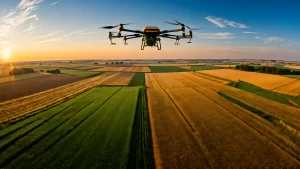
AI-driven systems can also classify soil quality, providing recommendations for fertilizer application. In livestock farming, deep learning monitors animal health by analyzing movement and feeding patterns.
Smart farming equipment, integrated with AI, can automate tasks such as planting, weeding, and harvesting. Deep learning models can also assist in climate adaptation, identifying crops best suited for changing environmental conditions. Farmers in developing countries can benefit from mobile AI applications that offer real-time agricultural advice.
However, challenges such as high costs, limited internet access, and data privacy concerns must be addressed. Governments and agricultural organizations need to invest in infrastructure and training for AI adoption. When combined with traditional farming knowledge, deep learning can create a balanced and efficient agricultural system. By leveraging AI technology, global food security can be improved while reducing environmental impact. As more farmers adopt deep learning solutions, agriculture will become more resilient and sustainable.
What benefits is it generating where it is being used?
To respond to this question, we are going to avail ourselves of a story headlined “High tech, high yields? The Kenyan farmers deploying AI to increase productivity” published by The Guardian on 30 September 2024. “AI apps are increasingly popular among small-scale farmers seeking to improve the quality and quantity of their crop.”
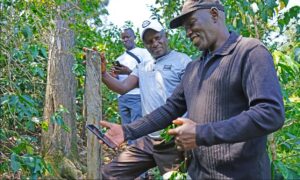
The Guardian reports Sammy Selim accompanied by a younger farmer named Kennedy Kirui strode through some dense, shiny green bushes on the slopes of his coffee farm in Sorwot village in Kericho, Kenya. It adds that they paused at each corner to send the farm’s coordinates to a WhatsApp conversation.
“The conversation was with Virtual Agronomist, a tool that uses artificial intelligence to provide fertiliser application advice using chat prompts. The chatbot asked some further questions before producing a report saying that Selim should target a yield of 7.9 tonnes and use three types of fertiliser in specific quantities to achieve that goal. ”
“My God!” Selim said upon obtaining the report. He had planned to employ much more fertilizer than Virtual Agronomist was advising. “I could have wasted money.”
In Kericho and other regions of Kenya, AI-powered tools have turned increasingly prevalent among small-scale farmers seeking to upgrade the quality and quantity of their produce, according to The Guardian. “Pests, diseases and a lack of technical knowhow mean farmers have become accustomed to suffering crop losses on a large scale.
They used to rely on advice from agricultural extension officers – professionals deployed by local governments to provide educational services to farmers – but their numbers have declined in recent years due to inadequate funding.”
The Guardian says that Selim began utilizing Virtual Agronomist on his 0.4-hectare (1-acre) farm in 2022, with the help of another farmer who then possessed a smartphone. “Following its recommendations, his farm produced 7.3 tonnes of coffee, his highest yield ever. He’s optimistic that the new recommendations will work too.” “Technology helps,” he said.
Before adopting Virtual Agronomist, The Guardian adds, Selim would simply apply fertilizers using what he called “general farmer’s knowledge”, employing different types at different times of the year without knowing the soil health. “The farm’s productivity was low. In one season, he managed to produce only 2.3 tonnes of coffee. At other times, he’d take samples of his soil for testing at labs far from Sorwot, but the results would take months to come back and sometimes they wouldn’t arrive at all.”
“A big challenge for farmers is not knowing exactly what their soil needs,” Florah Maritim— factory manager at Sorwot Coffee Farmers Cooperative Society which buys coffee from local farmers— told The Guardian. This mega-media house adds that the story remains similar for farmers attempting to identify pests and diseases that have attacked their crops.
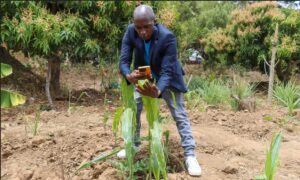
The Guardian provides an instance of Musau Mutisya in Kwa Mwaura village in Machakos county. He explained he used to rely on his own knowledge to detect pests and diseases, but that he was sometimes mistaken. “On a recent sunny morning on his 0.6-hectare (1.5-acre) farm, he stood next to a maize plant, pointing his phone’s camera at a ragged, torn leaf using PlantVillage, an AI-powered app for diagnosing pests and diseases. A voice assistant instructed him on where to hold the phone, identified the pest as the fall armyworm, then gave him advice on how to control it.”
He said “We were doing guesswork in the past. You’ll end up using more money treating what you don’t know.”
Both tools function by training AI models on images and data. Researchers at PlantVillage have fed their model thousands of images of healthy and diseased crops to help it learn how to determine pests. For Virtual Agronomist researchers trained a model to predict PH and other soil properties using continent-wide satellite data.
Are AI tools totally fine?
Despite the promise, always according to The Guardian, some scientists furnish a warning around dependence on AI tools for agriculture. Angeline Wairegi, who has researched the use of the technology in agriculture in East Africa, highlighted that most AI training datasets exclude indigenous knowledge, “meaning the information they provide can exclude successful localised practices.”
“Heavy reliance on AI tools to set farming practices may result in the erosion of long-held, and tested, indigenous agricultural practices,” said Wairegi, founder and research director of Athene Research Group.
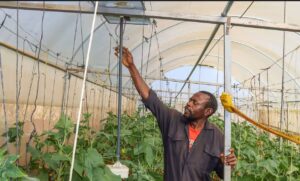
However, as explained by The Guardian, for farmers like Boniface Nzivo in Mua village in Machakos county, AI represents a game changer. He employs a system termed FarmShield to monitor temperature, humidity and soil moisture and recommend him on when to water his cucumbers – aspects with which he used to struggle.
“I don’t waste time trying to figure out how much water to use,” he said while inside a greenhouse for growing the plant, which needs consistent water supply. “It’s a great technology.”
Brookings in its 16 May 2024 story “How AI can inclusively transform agri-food systems in Africa” also affirms “Advances in artificial intelligence (AI) will be the most significant contributor to the transformation of agri-food systems in Africa. OpenAI’s ChatGPT application exemplifies the rapid pace of advancement in AI capabilities in the last year alone.
AI and other automation technologies are presenting game-changing opportunities for the continent’s smallholder farmers, particularly when delivered through low-tech delivery channels, in-person intermediary networks, and through partnerships with value chain stakeholders to subsidize costs.”
Meanwhile, Research Gate published “Review Paper: Disadvantages of Artificial Intelligence in Agriculture” in April 2024. This paper highlights that in spite of its promise, AI implementation in agriculture also raises concerns that necessitate careful examination. It addresses economic, social, and ethical disadvantages, some of which are the following ones.
The paper reads “High initial investment. Implementing AI technologies like robotics, sensors and data analytics platforms can be expensive, making it inaccessible for small and medium-sized farms. This can exacerbate existing inequalities in the agricultural sector. Farmers with limited access to technology and digital literacy skills risk being left behind in the AI revolution. AI-driven intensification of agriculture could have negative environmental consequences, such as increased use of pesticides and fertilizers, leading to soil degradation and biodiversity loss.”
This paper also points out the issue of loss of traditional knowledge. “Overreliance on AI could lead to the erosion of traditional farming knowledge and practices accumulated over generations.”
Conclusion
As the silent revolution in agriculture unfolds, it becomes clear that the integration of deep learning and smart irrigation systems is not merely a technological advancement but a potential lifeline for farmers in emerging economies. By harnessing the power of artificial intelligence, farmers can gain invaluable insights that enhance productivity, sustainability, and resilience against the unpredictable challenges posed by climate change and resource scarcity.
However, while the benefits of AI are profound, it is crucial to approach this transformation with a balanced perspective. The erosion of traditional agricultural knowledge poses a significant risk; therefore, it is essential to foster a collaborative environment where modern technology and indigenous practices coexist. By combining the strengths of deep learning with the wisdom of seasoned farmers, we can create a more robust agricultural framework that respects and preserves local knowledge.
The future of farming lies in this synergy—a partnership between innovation and tradition that can unlock new levels of food security and sustainability. As we continue to explore the potential of AI in agriculture, let us remain vigilant in ensuring that these advancements uplift all farmers, empowering them to thrive in even the most challenging environments. In doing so, we can pave the way for a food-secure future where abundance triumphs over scarcity, fostering prosperity for generations to come.
Hmm it looks like your site ate my first comment (it was super long) so I guess I’ll just sum it up what I had written and say, I’m thoroughly enjoying your blog. I as well am an aspiring blog writer but I’m still new to the whole thing. Do you have any points for beginner blog writers? I’d genuinely appreciate it.
Dear Theodore, thank you so much for your kind words about Life In Humanity! I truly appreciate your engagement, and it’s great to hear that you’re enjoying the blog. Also, congratulations on being the first to comment on this article!
Since you’re an aspiring blogger, my key advice is to stay committed to quality and consistency. Ensure that your work is well-researched, clear, accurate, engaging, and newsworthy. Keep in mind that newsworthiness varies— it is influenced by location, culture, and audience interests. A story that is significant in one country or community may not hold the same level of importance elsewhere. However, always strive to offer something original and unique to your audience.
Focus on writing stories that matter, stories that resonate with your audience and provide them with valuable insights. Additionally, never stop learning—study high quality blogs, read widely, and refine your storytelling skills. Building an audience takes time, so be patient and use social media effectively to amplify your reach.
Another crucial aspect is to answer the key journalistic questions: Who, What, Where, When, Why, and How. The Why, What if, and How questions are especially crucial in writing, as they help you to dig deeper and produce more insightful content. I recommend people—journalists, writers and communicators— to ensure that their every sentence is gap-free: to achieve it, you respond to these questions. For example, if China’s president has stated that China has to strengthen the role of education in advancing science, technology and talent development; don’t just report the statement. Instead, explore why he said it, when and where it was stated, and how this vision will be implemented.
Curiosity constitutes a crucial factor behind all discoveries, inventions and innovations which have occurred and will materialize in the future. Curiosity sparks great content as well. Curiosity is a driving force behind great content. The best writers and journalists are those who ask the right questions and explore hidden angles. If you aspire to become a great blogger, train yourself to think critically and ask deeper questions: Why? What if? How? What are the potential hidden issues?
If you still experience any other specific questions or need guidance on any aspect, feel free to ask!
Wishing you success in your blogging journey!
Best,
Jean Baptiste Ndabananiye.
I like what you guys are up also. Such intelligent work and reporting! Carry on the excellent works guys I’ve incorporated you guys to my blogroll. I think it will improve the value of my web site :).
I have learn a few just right stuff here. Definitely value bookmarking for revisiting. I surprise how much attempt you place to make this type of great informative web site.