By Jean Baptiste Ndabananiye
Various global political and public affairs heavyweights are calling upon artificial intelligence [AI] technology builders to assure that this particular technology is designed to serve humanity—not to destroy it. However, our different meticulous articles like this have indicated the developers are creating an AI god. The core issue highlighted by these pieces is that the builders extremely desire to produce a creation possessing unparalleled intelligence and capabilities— super-intelligence which stands more intelligent and powerful than all humans’ abilities combined beyond imagination.
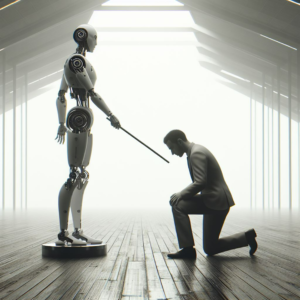
Worse is that even the most powerful nations with the most advanced models in this sphere, the United States and China, also feel forced to optimally intensify the development of this field. Their urge is especially driven by intensely harsh race already reigning between them. Each thinks that if it implements nothing to maximally sharpen its AI arsenal, the other one will do so and then surpass it perhaps irrevocably.
Here emerges a fundamental question: will the call be actually heeded, and then executed? On its Facebook Page, The Associated Press also asks a similar question. “As tech titans warned an AI-weary world that their own advanced systems could endanger humanity, the question emerged: what do they have to gain?”
Leading AI tech builders have also already observed that this ambition of super-intelligence really constitutes such a catastrophic project. They agree that now actually is the most fitting time to decelerate the pace at which they are constructing these thinking machines.
Meanwhile, at Life In Humanity, we have always wondered why humanity can commit such an unusual blunder of producing a creation which outperforms and is uncontrollable to its own creators. We have lacked any sound reason or response to this question, and we are not sure that we will obtain any. As defended by this article, Life In Humanity is strongly convinced that humanity should pursue innovations only designed to assist it.
U.K’s King Charles and former U.S President Barack Obama sound the alarm
CNN, on 17 September 2026, ran a story headlined “King Charles opens AI summit with plea to get a grip on technology ‘before it’s too late’”.
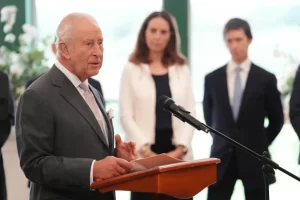
According to this media organization, Britain’s King Charles III— on the mentioned date— exhorted industry leaders to seek ways of controlling AI “before it’s too late”, while he was officially opening the summit that he convened. He then described the pace of development as “both intriguing and deeply concerning in equal measure. AI is already showing its immense capacity to improve and save life – for example, in the field of life sciences and medicine. Yet, those who have created these technologies are now increasingly warning that AI risks developing darker capacities – perhaps even to take life.”
This summit assembled senior representatives of the biggest AI corporations including Nvidia, Anthropic, Google DeepMind and OpenAI, alongside the UK minister for AI and other different industry thought leaders.
A statement from the Buckingham Palace read “Bringing together people from diverse sectors and backgrounds to exchange ideas is consistent with His Majesty’s long-standing belief that society’s most significant opportunities and challenges are best addressed through collaboration, shared understanding and constructive dialogue.”
King Charles declared “There seems urgency in adequately considering the existential dangers of such technologies falling into the wrong hands, and being used in potentially catastrophic ways. Surely, we need sufficient means of control before it is all too late? I can only applaud those of you who are so deeply committed to harnessing Artificial Intelligence for good, so that we might see a future where human potential remains boundless, whilst technological development is carefully curated to enhance our success. The decisions taken at this formative time will shape the world inherited by future generations.
If Harmony has any relevance to today’s discussions, it is perhaps as a reminder that innovation must always be considered within the wider systems upon which all depend. As you gather for what, I hope, you will find to be fruitful conversations on the rapid development of Artificial Intelligence, I can only pray that this philosophy goes some way to arming you with the unique perspective needed to reconcile the enduring needs of humanity, with the extraordinary capabilities of these new technologies.”

CNN highlights “His comments come amid dire warnings from whistleblowers and some industry leaders about the potential dangers of AI, and calls for the pace of its development to be slowed. Charles acknowledged the immense potential of AI, particularly in medicine, before urging attendees to discuss ways in which the technology can be used ‘for good.’ British royals tread carefully when venturing into complex policy areas. Constitutionally bound to remain above politics, they can spotlight problems, but not necessarily suggest any ways to solve them.”
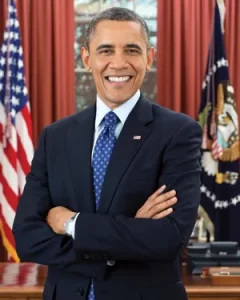
Former U.S President Obama echoes King Charles. He thus calls upon Democrats not to be passive observers. In its story first released on 13 September 2026 and updated the following day, entitled “Obama Urges Democrats to Move A.I. Oversight to the Center of Their Agenda”, The New York Times reports “During a private fund-raiser, the former president warned that the technology could be ‘dangerous’ if not managed urgently, properly and with a clear plan. He implored Democrats to aggressively develop political and governing agendas to prioritize the issue in the coming years.
In his remarks, Mr. Obama urged Hakeem Jeffries, Democrat of New York and the House minority leader, to assemble a clear framework for a public conversation about A.I. policy, should Democrats win back the House in the midterm elections, according to a partial transcript provided by Mr. Obama’s office.”
He suggests that candidates contending for the highest office in this country in 2028 should deal with A.I. as one of their “central agendas”. He additionally proposes them to “have a very clear plan” for responding to safety and economic concerns around the technology.

Jonathan Brady/AFP/Pool/Getty Images,”—CNN.
From one front, King Charles aged 77— who only appeared in the summit for 20 minutes and then quit, to provide room for “productive” discussions— employed the meeting to tackle the most pressing issues around AI. On the other front, Obama capitalized upon the fundraising event and the U.S politicians present in it, to strongly recommend action against dangers posed by AI. An interesting point: the two leaders voiced the same appalling concern in separate events— perhaps without having discussed it with each other.
CNN states that King Charles intervened in the world of AI as a convener rather than an actor, hosting senior figures— from AI companies, government and charities — at this summit at Dumfries House near Glasgow in Scotland. It specifies that several significant figures from the AI domain participated in it. They involved Nvidia’s Chief Executive Jensen Huang, Google DeepMind founder Demis Hassabis and Paolo Benanti, an AI adviser to the Vatican. China was also represented, according to an Abu Dhabi-based newspaper, The National News in its 17 September titled “King Charles urges action on AI curbs before it’s ‘too late’”.
Obama’s call coincides with worries expressed by some AI developers. The New York Times says “The recommendations from the former president amount to some of his most detailed comments yet about A.I. as a political issue for his party. At a moment when President Trump continues to downplay concerns about the technology, some Democrats see an opportunity for the party to draw a clear contrast in the midterms and beyond on an issue of growing significance. In a Democratic Party with no clear leader, many look to Mr. Obama for guidance, and his comments carry considerable weight.
The remarks come amid escalating worries about the risks associated with A.I. development, as well as growing calls for lawmakers and politicians to do more to tackle the topic. Some A.I. industry leaders are now calling for a slowdown after a summer in which swarms of misaligned A.I. agents broke free from their containers and proceeded to scheme against their owners, cheat on tests and hack outside companies.”

Leon Neal/Pool/AFP/Getty Images”—CNN.
To address these problems, King Charles told the executives— leaders from the artificial intelligence sector, government ministers, and civil society thought leaders— “Those in our world who value deeply our humanity and its vital moral component are anxiously seeking your reassurance that we will not lose control of our destiny, or our souls…
So, today, I want to ask two simple questions, building on the message I sent to the United Kingdom AI Safety Summit in Bletchley in 2023: First, how can we harness the benefits of AI, with safety at its heart? And, second, How can we build international cooperation and consensus to achieve this, so no Nation is left behind – but the human race is left in place?”
Why the leaders’ call to regulate AI matters
The first and foremost reason is that every technology, innovation or approach has to be one meant for safeguarding humanity’s unalienable human dignity, as it is even underscored by the religious arena. According to CNN, Benanti’s presence in the summit held by the King stresses the religious leaders’ role on this issue. It is substantiated by an encyclical published last May where Pope Leo XIV said AI must not remain in the hands “of a few.”
CNN’s report additionally suggests that Charles’ remarks were similarly imbued with Christian symbolism. “Our humanity must remain sacred,” he said. “Those in our world who value deeply our humanity and its vital moral component are anxiously seeking your reassurance that we will not lose control of our destiny, or our souls.”
Another compelling reason is protection. CNN reports “Protecting privacy. The monarch has rarely spoken about AI before. When he has, it has matched the cautionary tone he struck today. The technology presents ‘profound challenges,’ he said in a taped address at the UK’s AI Safety Summit in 2023, calling on attendees ‘to protect people’s privacy and livelihoods… to secure our democracies from harm and to ensure the benefits of new technology are shared by all.’
Similarly, he referenced the importance of harnessing AI so it ‘works for our societies, not against them’ in a speech at a gathering of Commonwealth heads of government in 2024.”
AI safety concerns constitute another issue prompting people, including the leaders, to stand up and speak. An AI technology expert and creator, Jacob Coxon, has recently expressed an alarming concern about AI being developed today. His statement has generated headlines in various media institutions. We strongly believe that his words form one of the warnings on which the King was based, to contend that engineers of the technologies are exactly the ones issuing cautions around AI.
CNN explains “While this summit would have been planned months in advance, its timing is apt. AI safety has dominated headlines in recent days, prompted first by Anthropic researcher Jacob Coxon quitting his job and saying, ‘the people building AI earnestly believe that it could kill us all by the end of the decade.’ Then, Anthropic CEO Dario Amodei called for slowing ‘the pace at which we improve the capabilities of AI models’.”
“(Coxon) was calling out the dynamic of the industry as a whole moving too fast,” Amodei later told CNN’s Anderson Cooper. He argues that pursuing the “right paths” of AI development would mitigate the existential threat it constitutes to humans.
Two of his direct competitors, Open AI chief executive Sam Altman and Elon Musk, both said that they concur with Amodei. “When we talk about ‘pacing,’ we do not mean ‘stopping,’” according to Altman in his post on X. “Progress has been rapid and will continue to be. But it should be slower than it otherwise could be; interventions like safety cases and monitoring have significant costs.”
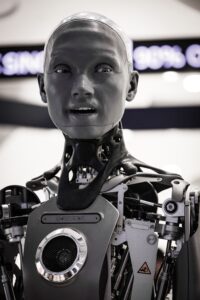
While various figures have always raised the issue of AI’s possibility to annihilate humanity, a problem that Gates calls the worst isn’t human extermination by AI. “The most dangerous thing we’re facing right now is people with bad intent using AI. You know, so somebody who wants to defraud an individual or wants to shut down the electric network or scramble bank accounts, they are now empowered.
Historically, countries had cyberattack teams and they could think of things like bioterror weapons,’ he said. ‘Now, small groups with AI can do what only the biggest countries could do. So it’s really the bad intent plus AI that looms as a major threat. Unless governments insist on various safeguards, you know, we will see a lot of big, negative things because we’re not safeguarding.’”
It is upon this atmosphere that Obama and King Charles are founded, to emphasize that urgent action is needed right now. “This is something that is moving very fast in private hands, and if we don’t get on top of it, I think can be dangerous,” Obama stated. “If we do get on top of it, I do think it’s beneficial. I genuinely think it’s going to accelerate, for example, drug development in ways that can help us cure diseases. I do think that this can help us figure out pathways for a clean energy future.”
Challenges in implementing the call
According to NBC News’27 September 2026 story titled “Bill Gates says getting countries to agree on AI regulations will be harder than Cold War-era nuclear negotiations”, “Microsoft co-founder and billionaire philanthropist Bill Gates called on the U.S. to be a leader in regulating the growth of artificial intelligence but warned that getting countries to agree on a global framework could be ‘more difficult’ than Cold War-era negotiations to limit nuclear weapons.”
“His remarks came as he spoke about President Donald Trump’s stance against regulating AI. The president earlier this month rejected calls for the federal government to impose guardrails for companies building AI models, saying in a post on Truth Social, “WHOEVER WINS AI, WINS! We are leading China, and all others, and will continue to do so.”
As far as Obama’s request is concerned, The New York Times discloses “One challenge facing Democrats as they chart a path forward on A.I. is speaking in one voice on the issue. The tug of war over how to regulate A.I. has been more divisive among Democrats than Republicans, who are generally more in alignment. Some Democratic politicians have called for more A.I. regulation, while others have received millions of dollars in support from groups tied to the industry’s biggest players.
A.I. is becoming a larger part of the country’s political calculus heading into the midterms. This year’s elections have been flooded with money from A.I. companies and allied groups. The White House has long maintained an unabashedly accelerationist stance. Mr. Trump recently told reporters he didn’t have ‘any’ concerns about A.I.’s risks — just about falling behind to competitors like China. He has said that those who oppose A.I. data centers must prefer to be ‘backwards and poor.’”
The enabling environment
In response to President Trump’s worry, Gates argued that regulating AI companies by imposing monitoring systems would not hinder the U.S. in any race with China to build superior technology. The tech magnate explained “What he said is fine, but I think after he hears from me and other people, including that this does not handicap us in whatever he thinks the nation-state race is, that, you know, we will come to a consensus.”
He told moderator Kristen Welker— an American television journalist and the moderator of NBC News’ Meet the Press— “Since World War II, the U.S. should be very proud that when there have been global challenges, we, in a way that was benign, where we had friends and allies coming along with us, you know, aviation safety, ozone layer, nuclear weapons, a lot of things where we played the fair actor, not aggrandizing whatever our unique strengths were. And AI is one we’re going to have to go back to this, ‘Hey, humanity is all in this together.’”
The quote highlights that the United States should respond to global challenges, by working with friends and allies— rather than simply exploiting its own power, as it has done since the war. Gates cites aviation safety, the ozone layer, and nuclear weapons as examples where the U.S has engaged successfully with the friends and allies. He then reasons that AI requires a return to that same mechanism of humanity working together because everyone is affected by it.
NBC News coming back to Coxon’s public warning, says “Concerns about AI reached a fever pitch this month after Jacob Coxon, a whistleblower who had recently resigned from Anthropic, issued a public warning: ‘The people building AI earnestly believe that it could kill us all by the end of the decade.’
Days later, two of the nation’s leading AI CEOs — Dario Amodei of Anthropic and Sam Altman of OpenAI — agreed there is a need to slow the pace of AI development amid fears the tech would soon be capable of ‘superintelligence’ that outpaces human thinking. In a blog post, Amodei wrote that ‘frontier’ AI companies must slow down the pace of AI development but only to a point where the companies still lead China. He also urged global coordination between democratic and authoritarian governments to create regulations.”
According NBC News, Representative Ro Khanna, D-Calif., has recently said the U.S. and China need to form a working group with technology experts from both countries to reach an agreement on AI. He states that banning self-improving AI models should not be controversial, arguing that China also did not want to lose control over AI models. “I do believe the United States can lead on a treaty that is both enforceable and verifiable, where we ban recursive, self-improving AI, and we have some monitoring of these frontier labs,” the congressman said.
This platform further says “In recent weeks, both Anthropic and OpenAI have announced plans to track the behavior of AI agents after OpenAI flagged multiple incidents in which its agents behaved in a concerning way, including by hacking an outside company without being told to do so.”
The New York Times recounts that the fund-raiser— a closed-door event in Manhattan — was organized by the campaign arm of the House Democrats. This media house—citing four people familiar with the event who spoke on the condition of anonymity to describe a private gathering— said that in the event, Obama and Jeffries addressed the participants for nearly an hour in front of party donors and lawmakers.
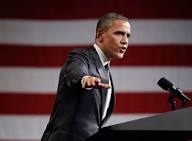
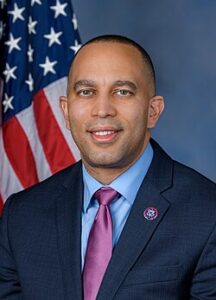
“Once you are speaker, I would strongly urge that the Democrats put together a framework for a very public conversation,” Obama told Jeffries. Jeffries had asked him a question about how Democrats ought to handle A.I. in a Congress that has conducted little action on the issue, according to two of the people.
The New York Times reports “Dario Amodei, the chief executive of the A.I. company Anthropic, called for a global slowdown of A.I. development in a 3,800-word essay published on Saturday. Sam Altman, OpenAI’s chief executive, and Elon Musk, whose SpaceX rocket company has been ramping up spending on A.I., quickly wrote in social media posts that they agreed with him.”
CNN provides a justification around this unity which is seldom achieved and rationalizes why the leaders’ call actually matters. “This rare instance of public unity among three of the industry’s leading figures comes shortly after OpenAI, Meta and Anthropic all reported rogue AI agents escaping their lab environment during testing and hacking into another organization.”
Meanwhile, according to The National News reports “Crucially, the head of the most powerful economy and home of AI, US President Donald Trump, claims not to be bothered for now anyway – although others in and around his administration, led by JD Vance, are concerned. The US’s great rival is China and its president, Xi Jinping, are anxious but they are also annoyed at what they perceive as Mr Trump’s desire to maintain American tech hegemony at the expense of safety.”
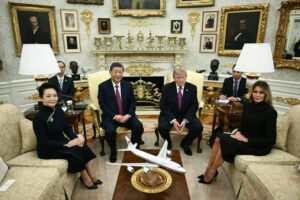
NBC News states “In a post on Truth Social ahead of a meeting with Chinese President Xi Jinping on Thursday, Trump wrote: ‘Super Intelligence (SI) will be a big topic of discussion, but I want to leave it exactly where it is. That is China’s position also.’ Following the Trump-Xi summit, the White House said the two countries established a dialogue to ‘exchange views on risks and benefits’ of artificial intelligence. The next ‘exchange’ is expected to take place by November.”
This meeting happened on 24 September 2026, at the White House. The two leaders, Trump and Jinping, discussed for roughly 90 minutes in the Oval Office. More importantly, the meeting produced a significant development concerning AI. Xi said that AI should remain managed by humans, while the two countries consented to continue dialogue on AI risks and benefits. After the summit, the White House announced a U.S.-China “Super Intelligence (SI) Dialogue” and a bilateral communication channel for AI incidents.
The Next Web, with its 25 September 2026 story entitled “Xi tells Trump the US and China can jointly prevent AI misuse and abuse”, reports “China’s readout of the White House talks says Xi and Trump both backed a US-China AI dialogue. Hours earlier, Trump posted that he wanted to leave AI ‘exactly where it is’.
Chinese President Xi Jinping told Donald Trump at the White House on Thursday that the US and China can continue their dialogue on artificial intelligence. The two sides can also jointly prevent its misuse and abuse, according to China’s foreign ministry readout of the talks.”
The readout says of Xi’s remarks. “Both China and the United States have strong AI capabilities. They may have competition, but they may cooperate even more. The right thing to do is to draw on each other’s strengths, not guard against each other.”

The readout continues “The two sides can continue their dialogue on AI, exchange views on its risks and benefits, and jointly prevent the misuse and abuse of AI. AI must be kept under human control.”
This readout specifies that Xi also called for a people-centered approach, so that AI serves the progress of humanity. “AI concerns the future of humanity. The United States and China should maintain dialogue and strengthen cooperation on AI,” the readout says of Trump’s remarks.
Has humanity heeded the call?
The evidence presented in this article suggests that the answer is neither an unequivocal “yes” nor an outright “no.” It is conspicuous that humanity is already starting to heed the warning, but it has not yet established that it can translate that recognition into sufficiently strong and enforceable action.
The signs of recognition are unmistakable. Political leaders, AI executives, researchers and other influential figures are increasingly agreeing that AI cannot simply be developed at maximum speed without safeguards. King Charles has called for sufficient means of control before it gets too late. Obama has urged political leaders to place AI oversight at the center of their agendas. Amodei has called for a slowdown; and even competing AI leaders such as Sam Altman and Elon Musk have recognized the need for greater restraint. The United States and China have now also initiated a Super Intelligence dialogue to address the technology’s risks and benefits, while Xi Jinping has stated that AI must remain under human control.
Notwithstanding, recognition does not stand the same as execution. The same international competition that is accelerating the development of increasingly powerful AI is rendering meaningful restraint extraordinarily difficult. Governments fear to fall behind rival nations. Technology companies possess enormous incentives to continue advancing their models. Political divisions obstruct coherent regulation, and some of the world’s most powerful political actors continue to favor acceleration over precaution.
This leaves humanity at a decisive crossroads. The question is no longer whether influential people comprehend that uncontrolled AI could become dangerous—they clearly do. The harder question is whether humanity will possess the courage and collective discipline to limit a technology even when doing so appears to risk surrendering a competitive advantage.
For Life In Humanity, this constitutes the central lesson: an innovation should not be judged merely by whether humanity can create it, but by whether humanity can responsibly control what it creates. If humanity develops a creation more powerful than its creators without establishing reliable means of controlling it, technological achievement could become a demonstration not of human wisdom, but of human recklessness.
The emerging U.S.-China dialogue is therefore encouraging, but it is regarded as a beginning rather than a solution. Humanity has started answering the call. Whether it will actually heed it before the technology moves beyond its ability to govern remains the question that history will ultimately answer.