By Jean Baptiste Ndabananiye
The survivors of the atomic bombings of Hiroshima and Nagasaki bear harrowing yet profoundly wise testimonies—lessons the global community, especially its leaders, should heed with the utmost seriousness. Their accounts serve as powerful warnings, urging humanity to prevent nuclear war at all costs. Life In Humanity brings forward a series of testimonies, originally collected by Time Magazine, from survivors of Nagasaki. Although the exact interview date remains unclear, the stories stay timeless in their relevance and urgency. In today’s tense global atmosphere, where the threat of nuclear conflict looms larger than ever, the testimonies of Hiroshima and Nagasaki survivors represent more than just stories—they constitute warnings that echo through history.
Their experiences hold urgent lessons for world leaders, as humanity stands on the brink of repeating catastrophic mistakes. As the geopolitical climate shifts toward dangerous escalation, with nations posturing and the specter of nuclear war growing ever closer, the survivors’ voices remind us of the unimaginable devastation such weapons inflict. Life In Humanity revisits a powerful series of testimonies from Nagasaki survivors whose haunting recollections serve as timeless calls for restraint. Though these interviews might have been conducted decades ago, the lessons are more pressing now, in an era teetering on the edge of potential nuclear calamity. Their harrowing experiences aren’t just part of the past—they are a blueprint for the future we must avoid at all costs. As tensions rise, we must listen to their warnings, uniting across borders to prevent the unspeakable destruction they lived through from becoming a reality once again. All the photos featured below belong to Time Magazine through its photographer Haruka Sakaguchi.
Yasujiro Tanaka’s story
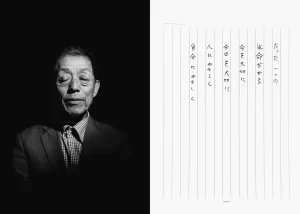
He was aged 75, when interviewed. He was at the distance of 3.4 kilometers (km) from the hypocenter of the explosion. He started, saying “You are only given One life, so cherish this moment, Cherish this day, Be kind to others, Be kind to yourself.” The following is his testimony.
“I was three years old at the time of the bombing. I don’t remember much, but I do recall that my surroundings turned blindingly white, like a million camera flashes going off at once. Then, pitch darkness. I was buried alive under the house, I’ve been told. When my uncle finally found me and pulled my tiny three year old body out from under the debris, I was unconscious. My face was misshapen. He was certain that I was dead. Thankfully, I survived.”
This explosion of the only one instrument of mass destruction has gotten negative consequences upon him, his mother and sister. “But since that day, mysterious scabs began to form all over my body. I lost hearing in my left ear, probably due to the air blast. More than a decade after the bombing, my mother began to notice glass shards growing out of her skin – debris from the day of the bombing, presumably.
My younger sister suffers from chronic muscle cramps to this day, on top of kidney issues that has her on dialysis three times a week. ‘What did I do to the Americans?’ she would often say, ‘Why did they do this to me?’ I have seen a lot of pain in my long years, but truthfully, I have lived a good life. As a firsthand witness to this atrocity, my only desire is to live a full life, hopefully in a world where people are kind to each other, and to themselves.”
Inosuke Hayasaki, 86, at 1.1 km
Hayasaka began with these words “I am very thankful for the opportunity to meet with you and speak with you about world peace and the implications of the atom bomb. I, Hayasaki, have been deeply indebted to the Heiwasuishinkyokai for arranging this meeting, amongst many other things. You have traveled far from the US – how long and arduous your journey must have been. Seventy two years have passed since the bombing – alas, young people of this generation have forgotten the tragedies of war and many pay no mind to the Peace Bell of Nagasaki. Perhaps this is for the better, an indication that the current generation revels in peace. Still, whenever I see people of my own generation join their hands before the Peace Bell, my thoughts go out to them.
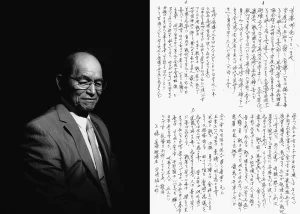
May the citizens of Nagasaki never forget the day when 74,000 people were instantaneously turned into dust. Currently, it seems Americans have a stronger desire for peace than us Japanese. During the war, we were told that the greatest honor was to die for our country and be laid to rest at the Yasukuni Shrine. We were told that we should not cry but rejoice when family members died in the war effort. We could not utter a single word of defiance to these cruel and merciless demands; we had no freedoms. In addition, the entire country was starving – not a single treat or needle to be seen at the department store. A young child may beg his mother for a snack but she could do nothing – can you imagine how tormenting that is to a mother?”
Testimony
“The injured were sprawled out over the railroad tracks, scorched and black. When I walked by, they moaned in agony. ‘Water… water…’ I heard a man in passing announce that giving water to the burn victims would kill them. I was torn. I knew that these people had hours, if not minutes, to live. These burn victims – they were no longer of this world. ‘Water… water…’ I decided to look for a water source. Luckily, I found a futon nearby engulfed in flames. I tore a piece of it off, dipped it in the rice paddy nearby, and wrang it over the burn victims’ mouths.
There were about 40 of them. I went back and forth, from the rice paddy to the railroad tracks. They drank the muddy water eagerly. Among them was my dear friend Yamada. ‘Yama- da! Yamada!’ I exclaimed, giddy to see a familiar face. I placed my hand on his chest. His skin slid right off, exposing his flesh. I was mortified. ‘Water…’ he murmured. I wrang the water over his mouth. Five minutes later, he was dead.”
Hayasaki regretted providing the water for the dying souls. “In fact, most of the people I tended to were dead. I cannot help but think that I killed those burn victims. What if I hadn’t given them water? Would many of them have lived? I think about this everyday.”
He also deplored the behavior of the then Japanese military elite class. “We would not be where we are today if it weren’t for the countless lives that were lost due to the bombing, and the many survivors who have lived in pain and struggle since. We cannot shatter this momentum of peace – it is priceless.
Hundreds of thousands of soldiers died under the insurmountable greed of the Japanese military elite class. We cannot forget those young soldiers who silently longed for their parents, yearned for their wives and children as they passed away amidst the chaos of war. American soldiers have faced similar hardships. We must cherish peace, even if it leaves us poor. The smile pales when peace is taken from us.”
He raised the point that people possess little chance to emerge victorious during today’s wars, while recognizing certain things. “Wars of today no longer yield winners and losers – we all become losers, as our habitats become inhabitable. We must remember that our happiness today is built upon the hopes and dreams of those that passed before us. Japan is a phenomenal country – however, we must be cognizant of the fact that we waged war on the US, and received aid from them afterwards.
We must be cognizant of the pain that we inflicted upon our neighbors during the war. Favors and good deeds are often forgotten, but trauma and misdeeds are passed on from one generation to the other – such is the way the world works. The ability to live in peace is a country’s most prized commodity. I pray that Japan continues to be a shining example of peace and harmony. I pray that this message resonates with young people all over the globe.”
Shigeko Matsumoto, 77, at 800 meters from the ground zero.
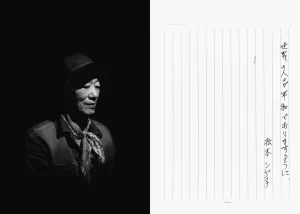
“I pray that every human being finds peace,” he first said before narrating his testimony as follows. “There were no air raid alarms on the morning of August 9, 1945. We had been hiding out in the local bomb shelter for several days, but one by one, people started to head home. My siblings and I played in front of the bomb shelter entrance, waiting to be picked up by our grandfather. Then, at 11:02am, the sky turned bright white. My siblings and I were knocked off our feet and violently slammed back into the bomb shelter.
We had no idea what had happened. As we sat there shell-shocked and confused, heavily injured burn victims came stumbling into the bomb shelter en masse. Their skin had peeled off their bodies and faces and hung limply down on the ground, in ribbons. Their hair was burnt down to a few measly centimeters from the scalp. Many of the victims collapsed as soon as they reached the bomb shelter entrance, forming a massive pile of contorted bodies. The stench and heat were unbearable.”
He said that he and his siblings were caught in the situation for three days. “Finally, my grandfather found us and we made our way back to our home. I will never forget the hellscape that awaited us. Half burnt bodies lay stiff on the ground, eye balls gleaming from their sockets.
Cattle lay dead along the side of the road, their abdomens grotesquely large and swollen. Thousands of bodies bopped up and down the river, bloated and purplish from soaking up the water. ‘Wait! Wait!’ I pleaded, as my grandfather treaded a couple paces ahead of me. I was terrified of being left behind.”
Yoshiro Yamawaki, 83, at 2.2 km
“The atom bomb killed victims three times,’ a college professor once said. “Indeed, the nuclear blast has three components – heat, pressure wave, and radiation – and was unprecedented in its ability to kill en masse.
The bomb, which detonated 500m above ground level, created a bolide 200-250m in diameter and implicated tens of thousands of homes and families underneath. The pressure wave created a draft up to 70m/sec – twice that of a typhoon – which instantly destroyed homes 2km in radius from the hypo- center. The radiation continues to affect survivors to this day, who struggle with cancer and other debilitating diseases.”
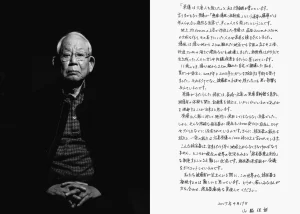
Yamawaki pointed out that consequences of the bomb had not only manifested themselves on them as the direct victims but also their descendants. “I was 11 years old when the bomb was dropped, 2km from where I lived. In recent years, I have been diagnosed with stomach cancer, and have undergone surgery in 2008 and 2010. The atomic bomb has also implicated our children and grandchildren. One can understand the horrors of nuclear warfare by visiting the atomic bomb museums in Hiroshima and Nagasaki, listening to first-hand accounts of hi- bakusha survivors, and reading archival documents from that period.
Nuclear weapons should, under no circumstances, be used against humans. However, nuclear powers such as the US and Russia own stockpiles of well over 15,000 nuclear weapons. Not only that, technological advances have given way to a new kind of bomb that can deliver a blast over 1,000 times that of the Hiroshima bombing. Weapons of this capacity must be abolished from the earth. However, in our current political climate we struggle to come to a consensus, and have yet to implement a ban on nuclear weapons. This is largely because nuclear powers are boycotting the agreement.”
Yamawaki indicated that he didn’t nevertheless trust that the nuclear weapons would be eliminated in this generation, though hoping that the abolition could happen in future generations. “I have resigned to the fact that nuclear weapons will not be abolished during the lifetime of us first generation hibakusha survivors. I pray that younger generations will come together to work toward a world free of nuclear weapons.”
Hibakusha is a Japanese term that translates to “explosion-affected people” or “bomb-affected people.” It specifically refers to the survivors of the atomic bombings of Hiroshima and Nagasaki during World War II. Hibakusha includes those who were physically present at the time of the bombings, and individuals who were exposed to the radiation and its effects later on.
Testimony
“One incident I will never forget is cremating my father. My brothers and I gently laid his blackened, swollen body atop a burnt beam in front of the factory where we found him dead and set him alight. His ankles jutted out awkwardly as the rest of his body was engulfed in flames. When we returned the next morning to collect his ashes, we discovered that his body had been partially cremated. Only his wrists, ankles, and part of his gut were burnt properly.
The rest of his body lay raw and decomposed. I could not bear to see my father like this. ‘We have to leave him here,’ I urged my brothers. Finally, my oldest brother gave in, suggesting that we take a piece of his skull – based on a common practice in Japanese funerals in which family members pass around a tiny piece of the skull with chopsticks after cremation – and leave him be.”
During this funeral ritual, they were too shocked by what occurred to their father’s remains. “As soon as our chopsticks touched the surface, however, the skull cracked open like plaster and his half cremated brain spilled out. My brothers and I screamed and ran away, leaving our father behind. We abandoned him, in the worst state possible.”
Masakatsu Obata, 99, at 1.5 km
“I often think that humans go into war to satisfy their greed. If we rid ourselves of greed and help each other instead, I believe that we will be able to coexist without war. I hope to live on with everyone else, informed by this logic. This is just a thought of mine – each person has differing thoughts and ideologies, which is what makes things challenging.”
Testimony
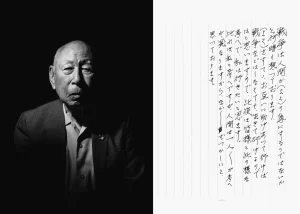
“I was working at the Mitsubishi factory on the morning of August 9. An alert warning went off. ‘I wonder if there will be another air raid today,’ a coworker pondered. Just then, the alert warning turned into an air raid warning. I decided to stay inside the factory. The air raid warning eventually subsided.
It must have been around 11. I started to look forward to the baked potato that I had brought for lunch that day, when suddenly, I was surrounded by a blinding light. I immediately dropped on my stomach. The slated roof and walls of the factory crumbled and fell on top of my bare back. ‘I’m going to die,’ I thought. I longed for my wife and daughter, who was only several months old. I rose to my feet some moments later. The roof had been completely blown off our building. I peered up at the sky.”
Obata added that the walls and houses around the factory were also demolished, “revealing a dead open space. The factory motor had stopped running. It was eerily quiet. I immediately headed to a nearby air raid shelter. There, I encountered a coworker who had been exposed to the bomb outside of the factory. His face and body were swollen, about one and a half times the size.
His skin was melted off, exposing his raw flesh. He was helping out a group of young students at the air raid shelter. ‘Do I look alright?’ he asked me. I didn’t have the heart to answer. ‘You look quite swollen,’ were the only words I could muster. The coworker died three days later, or so I’ve heard.”
Kumiko Arakawa, 92, at 2.9 km
When Time Magazine approached, Ms. Arakawa bore very little recollection of how she survived the bombing, having lost her parents and four siblings to the atomic bomb attack. When asked to write a message for future generations, she replied, “Nani
mo omoitsukanai (I can’t think of anything).”
Her testimony
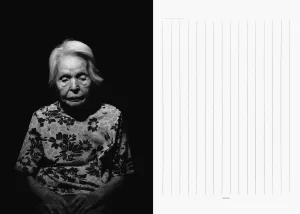
“I was 20 years old when the bomb was dropped. I lived in Sakamotomachi – 500m from the hypocenter – with my parents and eight siblings. As the war situation intensified, my three youngest sisters were sent off to the outskirts and my younger brother headed to Saga to serve in the military. I worked at the prefectural office. As of April of 1945, our branch temporarily relocated to a local school campus 2.9km away from the hypocenter because our main office was beside a wood building (author’s note: flammable in case of an air strike). On the morning of August 9, several friends and I went up to the rooftop to look out over the city after a brief air raid.
As I peered up, I saw something long and thin fall from the sky. At that moment, the sky turned bright and my friends and I ducked into a nearby stairwell. After a while, when the commotion subsided, we headed to the park for safety. Upon hearing that Sakamotoma- chi was inaccessible due to fires, I decided to stay with a friend in Oura. As I headed back home the next day, an acquaintance informed me that my parents were at an air raid shelter nearby.”
After the information, she went to see her parents and siblings whom she found in a situation that she narrated as follows. “I found both of them (her parents) suffering severe burns. They died, two days later. My older sister was killed by the initial blast, at home. My two younger sisters were injured heavily and died within a day of the bombing. My other sister was found dead at the foyer of our house. There are countless tombstones all over Nagasaki with a name inscription but no ikotsu (cremated bone remains). I take solace in the fact that all six members of my family have ikotsu and rest together peacefully.
At age 20, I was suddenly required to support my surviving family members. I have no recollection of how I put my younger sisters through school, who we relied on, how we survived. Some people have asked me what I saw on my way home the day after the bombing, on August 10 – ‘surely you saw many dead bodies,’ they would say – but I don’t recall seeing a single corpse. It sounds strange, I’m sure – but it is the truth. I am now 92 years old. I pray everyday that my grandchildren and great-grandchildren spend their entire lives knowing only peace.”