By Jean Baptiste Ndabananiye
“Try to never feel that you are competing against anyone; it is better to have the feeling that you are helping all,” — Thought for Today, having originally appeared in the Barbados Advocate. Nevertheless, business management bluntly teaches to remain harshly competitive. The world —from our parents and direct environment to formal education— also teaches us to be so. In a nutshell, we live in a world where the dominant narrative glorifies winners, celebrates personal triumph, and reinforces the idea of success as an individual’s ability to outshine others.

Yet, the quiet wisdom captured in the above quote proposes a radically different worldview—one rooted in solidarity rather than rivalry, in contribution rather than conquest. This article explores the tension between cooperation and competition, analyzing both perspectives before offering a reconciliatory framework for those seeking meaning, impact, and growth in a rapidly changing world.
The gentle strength of helping
To live with the mindset of helping rather than competing is often dismissed as naive or impractical. But closer examination reveals that this constitutes one of the highest expressions of intelligence and emotional maturity.
A principle grounded in humanity
From early childhood, humans are wired for empathy. Neuroscientific studies have shown that mirror neurons fire in our brains when we observe another person experiencing joy or pain. As shown by history, in the past, tribes that collaborated thrived better than those fractured by internal rivalry. Helping others is not a soft alternative to competing; it constitutes part of our biological blueprint.
When one stops viewing others as rivals to outperform and begins to see them as fellow travelers on the same path and challenges of life, life develops a new dimension—less stressful, more purposeful. Helping others fosters trust, expands networks, and creates environments where collective growth becomes possible.
The fulfillment of contribution

While competition may offer short-term victories, helping creates long-term fulfillment. Numerous psychological studies confirm that acts of service enhance happiness and personal well-being. From a philosophical perspective, the Stoics, religions, and even modern thinkers like Viktor Frankl argue that true meaning arises from being useful to others, not from dominating them.
If success is redefined not as “being ahead of others” but as “improving things for others” then helping becomes a more noble pursuit than competition. The thought from Thought for Today does not propose weakness, but rather a profound inner strength—one that frees us from envy, comparison, and the endless treadmill of competition.
Cooperative advantage— a silent force of innovation
In academia, in science, in peacebuilding, and in social entrepreneurship, some of humanity’s greatest advances have come from collaborative efforts. The open-source software movement, Wikipedia, humanitarian missions—these are prime examples of what happens when helping becomes a shared ethic.
Even from a strategic standpoint, cooperation allows pooling of knowledge, skills, and resources. When organizations and individuals prioritize the success of all, they often discover greater sustainability, deeper impact, and more resilient relationships.
Gentle strength in helping – optimal lessons from Edison and Ford
The extraordinary friendship between the late Thomas Edison and Henry Ford offers a profound lesson in the gentle strength of helping others. When a young and unknown Ford introduced his experimental gasoline-powered car in 1896, Edison, already a renowned inventor, responded not with jealousy but with encouragement—igniting Ford’s confidence and journey to automotive greatness.
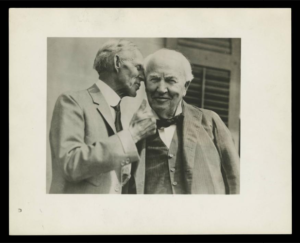
This world-renowned figure—chose to wholeheartedly support rather than feel threatened. With the simple words “Young man, that’s the thing! You have it!”, Edison sparked a lifetime of innovation in Ford. This single moment of affirmation blossomed into a lifelong friendship deeply established in mutual respect, mentorship, and support.
Years later, when Edison’s laboratory was consumed by fire and that insurance couldn’t cover the loss, Ford—then a titan of industry—responded not with detachment, extending a hand of gratitude, with a check for $750,000 to help his mentor rebuild. This act transmitted Edison an extremely strong and unforgettable message of unwavering support. Their friendship continued through old age, even marked by playful wheelchair races—symbols of a bond deeper than business.
Rather than being rivals, they preferred collaboration, proving that real success is not about dominating others, but about raising them up. Their story teaches us that mentorship and solidarity outshine envy and ego. The light that Edison provided for Ford was returned with gratitude, creating a ripple effect of mutual greatness.
In a world increasingly shaped by competition, Edison and Ford remind us: your candle doesn’t burn dimmer by lighting another—it shines brighter. Helping is not weakness; it is a force that builds legacies and revolutionizes lives. For more on the late Edison and Ford, read this article.
The harsh reality of competition
The world and business speak differently. Despite the emotional and ethical allure of helping others, the reality we live in often contradicts it. Capitalist economies, formal education systems, and modern management theories operate under a different principle: compete or perish.
Business management— efficiency through competition

Business management, especially in its classical and neoliberal forms, has long endorsed competition as a driver of excellence. Competitive strategies are not merely suggestions—they are imperatives. Michael Porter’s five forces model, for example, builds entirely around understanding and outmaneuvering competitors. Companies that fail to compete effectively are outpaced, outpriced, or rendered irrelevant.
The logic is straightforward: resources are finite, markets are saturated, and consumers are choosy. In such an environment, helping everyone equally seems idealistic. Businesses survive by differentiating themselves, not by aiding competitors.
Moreover, competition is seen as a crucible where innovation is born. The race to outperform others fuels creativity, drives productivity, and forces adaptability. Without this tension, the argument goes, mediocrity would prevail.
The cultural imprint of comparison
From primary school to adulthood, we are conditioned to compare ourselves to others. Top scores, rankings, performance metrics, promotions—these are not cooperative models; they are competitive systems. We are taught that others’ failure can be an advantage, and that being second forms the first step toward irrelevance.
This mindset isn’t just taught—it is rewarded. The person who “wins” often receives glory, recognition, compensation. As a result, helping others becomes secondary, and sometimes even viewed as self-sabotage.
In many sectors, offering assistance to others—especially competitors—is treated as weakness or betrayal. Business management tells us: know your edge, protect your secrets, and exploit your advantage. In this world, empathy is a luxury; results are the goal.
The risk of being left behind
Helping without caution can also expose one to exploitation. While one party gives generously, another may extract relentlessly. In competitive systems, power dynamics often favor those who look after their own interests first. In such an environment, believing in helping all can appear naive, even dangerous.
The tough truth is: the world does not always reward the helpful. It rewards the effective, the efficient, the profitable. And sometimes, competition delivers that better than cooperation does.
Harmonizing the two
Evolving from competition to compassionate strategy. While these two worldviews seem opposed, they are not irreconcilable. The most intelligent path lies not in choosing one over the other but in harmonizing the two—adopting a helping mindset while understanding the competitive landscape.
Beyond binary thinking
True wisdom requires escaping binary choices. The modern world is complex, and successful individuals and organizations are those who can blend empathy with strategy. Helping does not mean handing over all advantages; it means operating with integrity and contributing to shared value while pursuing personal goals.
Competition can be internal—striving to outdo your past self. And helping can be strategic—building strong alliances, nurturing customer loyalty, and fostering innovation through open collaboration. In this sense, competition and helping are not mutually exclusive but mutually enhancing.

Coopetition— competing with, not against
A new term gaining traction in business circles is coopetition—a hybrid of cooperation and competition. The Cambridge Dictionary defines it the act of working together with a person or company who is your business competitor in a way that benefits both of you. Rival firms sometimes collaborate on pre-competitive aspects (like infrastructure, research, or regulation) while continuing to compete in core areas. This model honors both self-interest and collective advancement.
On an individual level, this can translate to healthy rivalry where parties push each other to be better—without malice, envy, or sabotage. One can admire a peer’s achievement and even aspire to exceed it, while still cheering for their success.
This is where the spirit of the Thought for Today shines: feeling like you’re helping others doesn’t mean suppressing your ambition. It means elevating others with you, not at the expense of them.
Thought for Today also teaches us to lead with purpose
The future of leadership is shifting from dominance to impact. In a world increasingly facing shared crises—climate change, inequality, mental health—leaders are being called to serve, not just to win.
Organizations that embrace purpose-driven leadership tend to outperform those solely driven by profit. Stakeholders now value sustainability, ethics, and community. Helping, once dismissed as weakness, is now seen as a strategic asset.
The new paradigm doesn’t ask you to stop being excellent. It asks you to be excellent and generous. To win and lift others. To reach the top not by climbing over people, but by building ladders alongside them.
Competing to help, helping to grow
The advice to never feel like you’re competing but instead helping all is not a romantic detour from reality—it is a call to a higher intelligence. While business and life do present competitive pressures, the most sustainable path forward is neither unthinking rivalry nor blind generosity, but a conscious integration of the two.

Help where you can. Compete with your best self. Build success on contribution, not comparison. Because the highest form of success is not beating others—it’s being of value to others.
When a new competitor enters your field, don’t let jealousy cloud your vision—let strategy lead. As Dr. Martin Kimemia Gathiru of Mount Kenya University once taught us in our MBA General Management class, “A brilliant general is the one who conquers a country, but without bombing and destroying the cities.” He followed this with a timeless warning: “Don’t destroy the infrastructure or reputation of your competitor.” The goal of true leadership is to rise above, not by weakening others, but by strengthening your own value proposition. Attacking a competitor’s foundation may seem tempting, but it constitutes a short-sighted move that erodes your own credibility. Choose instead to innovate, grow, and win with integrity—because real victory lies in building, not breaking. And in doing so, you not only rise—you elevate the world around you.
Why destructive competition backfires: MAD in business and life
You should not compete destructively, since when your competitor discovers it, they will certainly also work to destroy, culminating in Mutually Assured Destruction—MAD, a popular concept in nuclear weapons—arms of massive destruction.
Destructive competition is not just unethical—it’s irrational. When one works actively to ruin a competitor’s infrastructure or reputation, retaliation becomes inevitable. Like in global politics, this leads to a cycle where both parties escalate harm until neither can win. This mirrors the doctrine of MAD, a principle in nuclear strategy where both opponents possess the power to destroy each other—so total conflict guarantees total loss. In business and life, the same principle applies: if your competitor feels threatened enough, they will likely strike back just as fiercely. In the end, both fall—not due to market forces, but due to misplaced ego and unnecessary aggression.