By Jean Baptiste Ndabananiye
Thirty-two years after the 1994 Genocide against the Tutsi, Rwanda and the world once again stand at the intersection of memory and moral responsibility. As voices of leadership—from Paul Kagame to António Guterres and Mahmoud Ali Youssouf—reverberate across Kigali and beyond, the 32nd commemoration does not just constitute a solemn tribute to more than one million lives lost, but a renewed global recognition of failure, resilience, and the urgent duty to act.
Kwibuka is more than remembrance; it forms a confrontation with history and a warning to the present. It calls on humanity to reject indifference, resist the resurgence of hate, and uphold the promise of “never again” not as rhetoric, but as policy, vigilance, and collective courage.
Yet beyond official statements lies a deeper truth: the enduring strength of survivors who transformed unimaginable suffering into incredible pathways of reconciliation and unity. Their stories—of loss, forgiveness, and rebuilding—embody the living testimony that remembrance is not passive. It is an active force that shapes nations, heals communities, and challenges the world to protect human dignity wherever it is threatened
The leaders’ messages
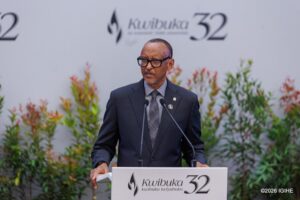
Officially launching the 32nd Commemoration of the 1994 Genocide against the Tutsi on 7 April 2026, the Chief of State of Rwanda, Kagame, stated “Today, we gather again in remembrance. To everyone present and watching online, thank you for joining us on this important day. We deeply appreciate the friends who join us every year in person or in spirit without fail. I thank this survivor who has just spoken. These testimonies keep memory alive for all of us and those who will follow us.
Kwibuka carries profound meaning for our nation. It is how we confront and overcome the divisions that nearly destroyed us. This day empowers us all. We draw on the strength of survivors who provide the reservoir of humanity that feeds our nation’s soul. To all survivors, know that you are not alone. We stand with you always.”
On the same date, the Chairperson of the AU Commission-Youssouf- also indicated that the commemoration of the 1994 Genocide against the Tutsi bears a deeper meaning. He said “We remember over one million lives lost to hatred, indifference, & inaction. #Kwibuka is not only a moment of mourning, but also a call to truth, responsibility, & vigilance.

Africa affirms: never again will organised hatred be allowed to become a political project. We must confront rising threats; hate speech, division, & polarisation, with unity, courage, & action. Remembrance obliges us to act, to prevent, & to defend human dignity everywhere. Africa stands firm for peace, justice, & the protection of all.”
The UN Secretary General, Guterres, also joined the Rwandans in the 32nd commemoration of the Genocide. He admitted the international community’s inaction toward the Genocide, while underlining that the protection of humans has to be ensured. He declared “Thirty-two years ago, Rwanda endured one of the darkest chapters in human history. In just 100 days, more than a million people were murdered. Entire families were brutally erased.
On the International Day of Reflection on the 1994 Genocide Against the Tutsi in Rwanda, we mourn the victims and honour their stolen dignity. We pay tribute to the survivors, whose resilience shows the strength of the human spirit. And we recall, with humility and shame, the international community’s failure to heed warnings and take immediate lifesaving action.”
He added “It’s not enough to remember the dead. We must learn from past failures and protect the living – by rejecting hatred, inflammatory rhetoric and incitement to violence; by investing in the social fabric to deepen community resilience; and by strengthening institutions that help prevent mass atrocities. I call on all countries to become parties to the Genocide Convention without delay – and to implement it fully.
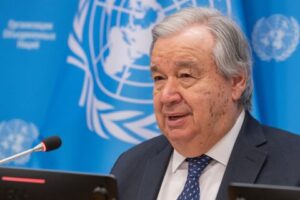
The United Nations stands with the people of Rwanda. And we stand with all those, everywhere, who refuse to surrender our future to fear, division, or silence. Let this day reaffirm our commitment to remember, to listen, and to act. With history as our guide, and the prevention of genocide as our goal.”
The President Kagame emphasized that genocide would never occur again in Rwanda. Acknowledging the role of the Rwandans, he said “Everything we have achieved was only possible because all Rwandans decided to join hands in common purpose. We honor the role played by every Rwandan in our country’s rebirth. After the Genocide, Rwandans chose to rebuild the country together. With that came a promise to never let the politics of genocide take root ever again. I tell you ‘Genocide cannot happen here again. It won’t happen’.
Even with those noises, you hear in the region, of people gathering from Europe, from wherever, meeting in Kinshasa; all that is just noise, it cannot amount to anything that will happen here of that kind again. It cannot happen. And I am not saying this just as a person. I am saying it because I know every Rwandan- young and old- is as determined and is saying so like I am saying now to you.”
More on the resilience and humanity already mentioned
Perlina Mukamuyango
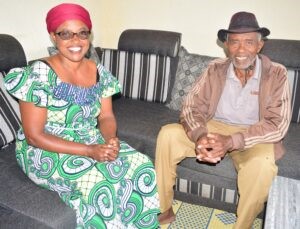
Mukamuyango in Gihinga Cell, Gacurabwenge Sector in Kamonyi District, Rwanda’s South recounts her harrowing survival during the 1994 Genocide Against the Tutsi. She fled from hill to hill as her family members—including her parents and several siblings—were brutally killed. Amid extreme suffering, she and her older sister refused to abandon their 12-year-old brother, choosing instead to face death together, a decision that reflects profound compassion and courage.
During the genocide, death often felt like a release from unimaginable suffering, but after its end, the weight of loss and grief was fully eventually managed. Despite losing several relatives and enduring a life of unspeakable hardship, Mukamuyango rebuilt her life. She reunited with siblings who survived and raised them. Through reconciliation programs, she was able to move from deep pain to genuine forgiveness, even forming excellent peaceful relations with those who killed her family members. It actually embodies the power of healing, unity and remarkable example of resilience.
“Given the unimaginable horrors we were enduring, when someone died, you didn’t feel sadness. You thought ‘At least they are resting from this overwhelming situation’,” Perlina Mukamuyango has said. a genocide survivor and a genocide perpetrator, Malachy Munyurangabo, who participated in killing her parents in the 1994 Genocide against the Tutsi. For more on her, click on “Rather than abandon him, we shall die together”: Perlina Mukamuyango’s harrowing survival in the Genocide and her healing.
Jean Giraneza
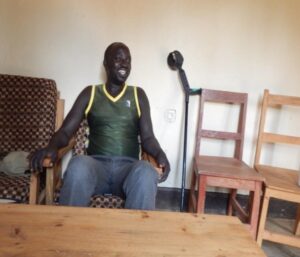
Giraneza is a Rwandan who has survived the 1994 Genocide against the Tutsi. His testimony- like that of Mukamuyango as well as Genocide survivors in general- stands timeless and boundless that it resonates deeply not only in Rwanda but also globally. He is a fond of two spheres essential for his life. “I most like working hard and living at peace with others. I do whatever it can cost for me to live peacefully with everyone. I’m devoted to working hard because I don’t wish myself and my family to be beggars or burden to the Government; I strive for my household to enjoy wellbeing,” he told me in 2017 in an interview with him.
Giraneza, married, was then living in Batima Cell, Rweru Sector in Bugesera District in Eastern Rwanda, and had 4 children. I don’t currently have any updates on him, since I have lost his telephone number. I have not even managed to find a person to provide me his number.
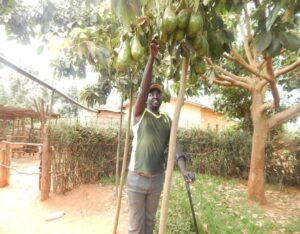
Giraneza is a professional farmer of tomatoes, beans, and maize, among other crops. “Ah! I can’t say I am a fond of working hard, if I produce food stuffs to consume at home only; I also provide food products for the market,” he said.
Giraneza was brutally attacked during the Genocide. He spent six years in a coma at Kigali Kanombe Hospital in Kigali City, Rwanda’s capital. He must now rely on the cane to walk, as you see it in the photo. After being nearly paralyzed, Giraneza awoke to notice that groups of Hutu people killed most of his family. “I vowed to kill each and every Hutu who would enter my house. I bought a machete and had it excellently sharpened because I hated all Hutus. I’d decided to kill any Hutu who could enter my house,” he said, before specifying that the Genocide claimed the life of his mother and around 40 siblings because his father had 10 wives.
Giraneza’s father was killed in 1992 for the mere reason that he was a Tutsi. Giraneza estimates that more than 100 people, very close to him in relationship, were massacred in the Genocide.
Giraneza pointed out that the Genocide left disastrous effects. All of his family possessions were plundered; the houses were destroyed. “I have found myself without anything left; except land, of course, which they couldn’t destroy. I was forced to start from zero. If the Genocide had not happened, I believe I could now be a PhD holder because I was resolved to study but I have only finished the primary education level.”
Prison Fellowship Rwanda [PFR]’s untiring work to convince Giraneza
Giraneza never intended to forgive the Hutu—let alone marry one. But the fate created other plans. Giraneza finally changed his mind because of the non-governmental organization’s interventions having inspired him to undertake the pathway to forgiveness. Meanwhile, it came to pass that he left Kigali City for his native locality; which also materialized with difficulty. “My fellow Genocide survivors who had been healed by reconciliation joined me in Kigali and asked me to return to our native community. They also told me that I would be provided with a house but I replied to them that I would not accept a house constructed by Hutus who exterminated my family.
In efforts to bolster unity and reconciliation, the organization had brought Genocide survivors and perpetrators together; they then constructed houses together so that when they were completed, every Genocide survivor and perpetrator were given houses and lived together. Arriving there, I found that this had actually cemented unity and reconciliation among them, but I couldn’t care about it because of an insuperably heavy burden which I was carrying,” he said.
In fact, the aftermath of the Genocide caused unbearable grief and pain to him. “I used to suffer too extremely to stand it,” he said. “I attempted to commit suicide twice, but failed; I thought I deserved to die because life was nothing for me then. I harbored too much heavy sorrow, suffering, insecurity, hatred and drives of revenge. I hardly slept.”

Giraneza said that it demanded a lot of efforts, for the organization to persuade him to embark on the pathway. “The executive director of the organization, Prison Fellowship Rwanda, came to me for the first time and I vehemently rejected his proposal to be reconciled, and I vowed to never pardon Hutus. He wasn’t discouraged, he came back for the second time and I reiterated my vow that I would never forgive Hutus.”
Giraneza added that several more interventions of the organization’s leader eventually prompted him to agree to start the journey of unity and reconciliation which he had regarded as impossible for him to do. As soon as he just accepted to begin the journey, he felt an extraordinary sensation within him so that he thought that he’d already gotten into the paradise. “When I consented to reconcile with those who had perpetrated wrongdoings against me, I felt a too heavy burden be removed from my head to the ground and I got delighted beyond imagination; which reinforced my determination to be perfectly reconciled.”
He was thus resolved to embark on the journey, since the sensation allowed him to realize that possessing so much animosity and revenge was just an unbearable burden on his shoulders.
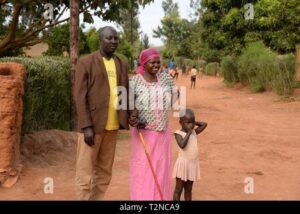
No longer did he want to allow his hateful feelings to prevent him from enjoying life. That’s when he allowed his heart to open and the unthinkable fact happened—he fell in love with his enemy, a Hutu. “My wife is a Hutu daughter of a Genocide perpetrator who killed my people and plundered our possessions during the Genocide,” he explained. “We love each other extremely.” Remarkably, Giraneza has shifted his vows of hate to vows of love so that he and his wife have built an unbreakable bridge which has welded their community members into one.
Search For Common Ground [SFCG] project cemented PFR’s work
To reinforce the unity and reconciliation process, an international peace-building organization-SFCG- intervened with the project to strengthen the work of grass-roots based initiatives. The project involved a radio broadcast and financial support to promote solidarity and forgiveness. Twuzuzanye/Igiticyumuvu Association constitutes one of the initiatives which received the support in 2013 to perform unity and reconciliation activities. The latter ones were meant for reconnecting shattered ties and reestablish peace.
Giraneza was then president of the association. But we don’t know who leads it now, and as already pointed out, we could have obtained updates, if we had succeeded in talking to him. ‘Twuzuzanye’ literally means ‘Let’s complement one another; ‘Igiticyumuvu’ is a kind of an indigenous tree with large branches under which people can sit to discuss.
The project has greatly buttressed the work of the other non-governmental organization, contributing enormously for Giraneza to become who he is proud to be today. “I’m a man determined to work to satisfy the needs of my household because a poor family is easily plunged and induced into conflict and violence and I am also dedicated to ensuring that I am living peacefully together with others. When I face a conflict with any person, I don’t rest until I take a step to initiate a dialogue to peacefully resolve it even if it were the person who was the instigator.”
Requesting him to tell me further information demonstrating that he’s really a man committed to peaceful coexistence, he told me “Some time ago I conflicted with a woman and I made the first step to join her in order to peacefully settle the conflict and we managed to peacefully handle it.”
The woman is Louise Uwamungu. I asked her to verify Giraneza’s claim. “Human beings can’t actually be totally free from conflict; in the past a person provoked me against Giraneza but I didn’t approach him. It is he that has taken the first step for us to talk about the problem and we’ve peacefully resolved it.”
Giraneza praises those projects executed by both organizations. “They have been significantly useful for us! We’ve succeeded in reaching all of the six cells composing our Sector, Rweru; before, we were confined to our Cell, Batima; we have created Unity and Reconciliation Groups currently dedicated to strengthening unity and reconciliation in each cell.”
He contended that they could not have reached the position they then held in terms of unity and reconciliation, if the organizations had not intervened. “For example before, The Hutu scarcely joined and supported us in the commemoration of the Genocide against the Tutsi but they now participate willingly at 100%.”
“The Hutu contribute willingly for us to bury our people’s bodies in dignity; some contributing cash for funeral expenses and the others giving their cars- free of charge, to drive people to the Genocide Memorial Site.”
The Tutsi and Hutu’s participation in commemoration activities of the Genocide against Tutsis represents a very strong sign of togetherness/ true reconciliation.
Benefits of unity and reconciliation
As the case of Giraneza showcases it, when you have been affected by a horrendous crime, you cannot be healed, unless you are genuinely reconciled with those who have committed it against you. Not healed, you can rarely reap benefits from physical, mental, emotional, spiritual, occupational, environmental, financial, social, and even intellectual health.
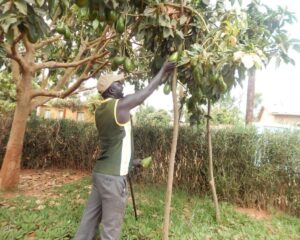
Before Giraneza was healed, he wasn’t interested to work and in fact nothing pleased or fascinated him. He even suffered from a chronic headache. You have learnt that he attempted to commit suicide but failed. Yet, he affirmed to me that he was completely healthy and determined to work with all his energy.
Pardon-giving in such a situation is intensely difficult, but it stands as the only remedy for you to get healed and carry normal life on. There are Genocide survivors who decided to pardon all people who had perpetrated crimes against them, though the perpetrators had not asked for the pardon yet. These Genocide survivors have since enjoyed amazing lives.
One of them is a woman who was miraculously healed of a cancer just because of forgiving all the Hutu who had killed her family members. I heard this narrative, in church, from her husband who was sharing the testimony with those who were praying. I don’t actually remember the man’s name and don’t know his wife, but vividly recall the story as if I listened to it yesterday. A doctor informed her that she couldn’t be cured, that she was instead waiting for a few days to die.
Since then, she started meeting the Hutu in all prisons where they were jailed in Rwanda. She cooked food which she handed to them, but the purpose was for her to reconcile with them. At the beginning, the prisoners distrusted her so that they even thought that the food contained poison. But in the end, they trusted her. She got to every prison, in the country, which accommodated all people who had killed her relatives.
The cancer had been caused by the fact that some Genocide perpetrators cut her in the head, employing machetes which they had just used to cut meat of the Tutsis’ livestock, while slaughtering it. “The livestock’s blood retained on the machetes was mixed with your blood, while they were cutting you; which has begotten the cancer”. That’s what a physician told the mother, adding “Other doctors have refused to reveal you the truth, so that you may not be intensely desperate. But I have decided not to act like them, you’re suffering from cancer and you’re close to passing away. I know that you’re a true Christian, so go and prepare to quit this world, and you will die very soon, unless you experience a miracle from God.”
In the end, the story of Jean Giraneza stands as one of the most profound illustrations of what Kwibuka truly demands of humanity—not only remembrance, but transformation. From a man consumed by grief, hatred, and a desire for revenge, to one who has picked reconciliation, love, and community leadership; his journey was not accidental. It was rendered possible through sustained, courageous interventions by initiatives especially PFR which refused to abandon the possibility of healing even when it appeared impossible. By bringing survivors and perpetrators together, fostering dialogue, and supporting grassroots structures like Twuzuzanye, these initiatives did more than rebuild houses—they rebuilt trust, dignity, and the very fabric of society.
Giraneza’s life today offers a living proof that reconciliation is not weakness, but strength; not forgetting, but overcoming. His transformation demonstrates that peace is not declared in speeches alone, but constructed patiently within hearts, communities, and everyday actions. As Rwanda marks the 32nd commemoration of the 1994 Genocide against the Tutsi, his story reminds not only Rwanda but the whole world that preventing future atrocities requires more than memory—it requires investment in the human capacity to change, to forgive, to coexist and to prevent.
Kwibuka, therefore, not only involves looking back. It entails choosing, again and again, the difficult path of unity over division, dialogue over silence, humanity over hatred, and action over inaction. The unfinished duty to preclude genocide lies precisely here: in ensuring that stories like Giraneza and Mukamuyango’s are not only remembered as testimonies of extraordinary resilience which inspire reflection and conscience, but also the foundation upon which a more just and peaceful world is built.