By Jean Baptiste Ndabananiye
Agathe Hagenimana ‘s lifelong struggle with severe and unusual physical disabilities, social stigma which she and her family have faced, and daily challenges which she endures should not just be viewed through the lenses of hardship. Her life exemplifies resilience and determination in the face of adversity. Consequently, her story including high levels of adaptation to life serves as an inspiring example for not only others facing similar difficulties, but also any other person grappling with any other life hurdle. Her narrative particularly emphasizes the importance of support and inclusion for people with disabilities.
Humanity& Inclusion (HI) highlights “1.3 billion people around the world live with some form of disability, making up around 16% of the global population. The vast majority of people with disabilities live in developing countries. According to the World Report on Disability , the number of people with disabilities is increasing. Despite being ‘the world’s biggest minority’, people with disabilities are often forgotten. They regularly face discrimination and exclusion from water and sanitation, healthcare, education, work, and community life. And even though people [with disabilities] are among the poorest and most vulnerable, their needs are often overlooked by governments and by international organizations. Efforts to reduce poverty can only be effective if we include people with disabilities!”
HI is an international non-governmental organization with a strong presence in the United States, among other countries. This organization having originated from the merger of two organizations- Handicap International founded in France in 1982 and Humanity & Inclusion which emerged in 2017. It works alongside people with disabilities and individuals living in situations of poverty and exclusion, conflict and disaster. This article addresses these major points:
- Hageimana’s story
- Stigma around Hagenimana and her mother- Primitiva Kubwimana
- Hagenimana provides a testament that humans possess potential beyond what they imagine
- Rising number of people with disabilities in the world
Hagenimana’s story
Before starting her story, Life In Humanity first gives credit to Kigali Today-its Kinyarwanda version- as the source of a part of this story.
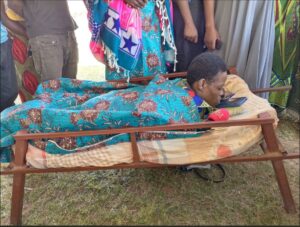
Hagenimana is a 37-year-old lady living in Kabacuzi Sector in Muhanga District, Rwanda’s South. She has never sat and stood. It signifies that she has spent all her 37 years lying down on her metallic bed, because she has never been able to sit or stand due to her physical disabilities. She explains “Since I was born, I have never sat down or gone anywhere. I don’t have a wheelchair because I can’t sit; I always lie down. My mother does everything for me, and I am very grateful to her because she is the reason I am still alive.”
Hagenimana sustains disabilities affecting her legs, arms and spinal bones; which obliges her to remain lying on her belly. She is looked after by her mother, helping her in her personal hygiene, clothing, and feeding.
For her to go anywhere such as to church, she is transported in her special metallic bed. For instance, it is in this way that she was brought to the International Day of a Rural Women ceremony on 15 October 2024 in Kabacuzi where she joined others. This event was special for her, saying that it was the first event she had ever attended since birth; which delighted her.
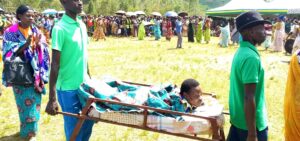
Hagenimana astonishes people. Her ability to use her mouth, tongue, and teeth for various tasks is not commonplace. It is the first time that Life In Humanity has learnt this. She produces decoration crafts namely Rwandan traditional grass mats. Despite having disabilities in nearly all her limbs, she skillfully uses modern smartphones and portable push-button phones with her mouth, tongue, and teeth to dial numbers, perform calls, and send messages.
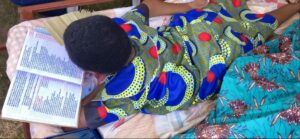
Another surprising skill is that she writes neatly in a notebook with a pen held in her mouth, while she has never gone to school. Furthermore, she knows how to weave the extraordinary mats, also employing her mouth, tongue, and teeth.
You can hardly believe what you’re told, learning her literacy journey
On 18 October 2023 Life In Humanity felt compelled to telephone Hagenimana, to learn more about her pressing assistance needs since she had told Kigali Today that she would welcome any assistance. In this interaction with her, she eventually passed her phone to her mother-Kubwimana, so that we might talk. She then said “Nobody taught her to write and read.
In May 2002, her very young siblings who had not started primary education yet placed a bible close to her and she then saw the name ‘Jesus’. She immediately started reading and writing so that since then she has been reading and writing. It is since then that she has been doing the tasks. Before then, I fed her but since 2002 she has been eating by herself. She was born in 1987.” We really failed to believe it and asked Hagenimana who confirmed it. She said “It is true, it happened like that. Nobody has taught me to write and write”
Life In Humanity still feels compelled to thoroughly address this subject, crosschecking it with some other people knowing this case. The reason behind Hagenimana’s miracle around her writing and reading, as given by Hagenimana and her mother, is actually inconceivable.
However, we do believe in miracles, the reason why Life In Humanity comprises a beat exclusively addressing spirituality, miracles being a component of this field of spirituality. If there are people who are miraculously healed of incurable diseases, as we find it in this article , you cannot dare to question or deny Hagenimana and her mother’s assertion. Besides information in the latter article, Brenda Michaels is another irresistible example proving the justifiability of their assertion.
Her cancer-ignited struggles, which eventually ended, have prompted her to author the book “ The Gift of Cancer: A Miraculous Journey to Healing” jointly with Marsha Mercant. Founded by Jeff Bezos in 1994, one of the world’s largest online retailers and technology companies- Amazon offers the book. Amazon states the book appeared on 14 October 2014.

The summary description of the book on Amazon reads “For fourteen years, Brenda Michaels battled cancer. Then one day she surrendered to the experience and found the gift in her disease. The Gift of Cancer: A Miraculous Journey to Healing speaks to anyone on a journey of wellbeing, whether suffering from a life-threatening disease or merely desiring to live a better, more fulfilling life.
After Brenda’s third cancer diagnosis and being told she had a year to live, she boldly stepped away from the accepted medical model, said ‘no’ to chemotherapy, and chose alternative treatment. This unorthodox path, the connection of mind, body, and spirit, which many experts now believe is the key to true healing, ultimately saved Brenda’s life and put her in control of her own destiny. Her story reveals the immense healing power available within each of us.With each obstacle Brenda encounters, we see the indefatigable courage and fortitude she demonstrates in facing her demons both inside and out.”
The summary underlines that Michaels’ uplifting memoir encourages us to listen to our inner voice, trust our intuition, and consider the true source of healing. “When we are willing to look deep within and take responsibility for our choices, we have the power to alter the course of our lives in miraculous and unexpected ways.”
In the book’s introduction, Michaels herself says “At age twenty-six I was given an unusual gift: cancer. I don’t say this to make light of what appeared to be an early death sentence. Cancer devastated my life. My marriage was ripped apart and our meager finances were drained away faster than we could have imagined. Over the course of fourteen years, cancer claimed my entire reproductive system, both my breasts, and left me with a prognosis of one year to live. That was twenty-four years ago. While cancer ushered in one of the most difficult periods of my life, it also ignited one of the most profound. Having cancer left me stranded in a place where no doctor had the capacity to save me.
But it led me to the truth of who I am and the realization that only I possessed the power to save myself. Forced to examine my life in new and challenging ways by the dramatic changes generated by my cancer diagnoses, I came to the understanding that if you are inclined to look for the silver lining amongst the dark clouds you will find it. I learned that in the storm of crisis that is the healing process, there is enormous opportunity for growth and change. Those dark clouds of adversity have the power to strengthen, bring clarity and reveal to us the miracles that lie beyond our limited beliefs. I now appreciate the importance of embracing that adversity as the gift it is. I finally know that those challenging experiences are a crucial piece of the puzzle that can serve our growth and transformation. Arriving at that knowledge was not easy.”
Michaels contends that life will consistently illuminate what is needed to nudge us toward the growth necessary for our highest good. “And in perfect harmony with each life plan, every experience comes forth at the perfect moment to teach us something profound about ourselves. When we accept our challenges and move through the lessons inherent in them, we discover the healing energy is available to us, offering the hope of wholeness and an amazing future alive with possibility.”
Michaels is an amazing case and we will produce an exclusive article about her and her book. Back to Hagenimana, for you to watch how she executes the tasks, click on this link to access a story uploaded on YouTube in Kinyarwanda by Kigali Today, and don’t worry, if you don’t understand this language. The narration contains information that you have already gotten in this article, it is just for you to see how she performs the tasks.
Using the mouth and teeth to perform tasks, as Hagenima does while weaving mats, can lead to an increased risk of dirt-related diseases. This practice may expose individuals to bacteria, parasites, and other pathogens present in the materials being used or the environment. We were curious to know this aspect about her and she answered “I have not faced any problem yet and I began employing a phone in 2013. I don’t know whether I will experience it maybe in the future or not, but I don’t have any problem at all.” Life In Humanity will approach a doctor about this particular question.
Stigma around Hagenimana and her mother
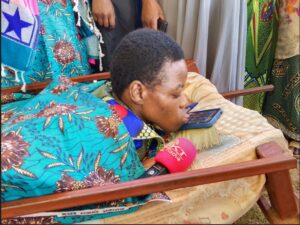
Despite stigma that Hagenimana’s mother- Kubwimana- has experienced, she says that she has never abandoned or complained about the disabilities of her daughter who is also her firstborn child. The fact that she has been born with nearly all her limbs affected by disability caused some people to claim that she had born a ‘strange child.’
She says “People used to insult me, calling me someone who has birthed a monster, but now my daughter is a blessing that has connected me with many people. She is my companion at home, all my children have gotten married. I urge parents, with children born with disabilities, to take care of them and not lock them indoors because they are also human beings.”
She adds that it is her children, born without disabilities, who have helped her to overcome the shame ignited by the stigma and humiliation.
Hagenimana, who remains bedridden, says that any assistance she could receive would be helpful. As already mentioned, this point of assistance prompted Life In Humanity to call Hagenimana on 18 October 2023, to know her pressing assistance needs. Asked, she instantaneously responded “I don’t have a wheelchair, if I were provided with it, it could assist me. But since I don’t sit, I need a special wheelchair in which I can lie, so that a person can push it to take me where I want to go.”
We also approached her mother on the phone about potential assistance that she thinks can help her daughter, replying “Since she weaves amazing Rwandan traditional grass mats; if she obtained a market for these mats, it could be a great solution. There are people who come here; spotting the mats, they are stunned by their beauty because you would think that it is a machine that produces them, while she employs her mouth and teeth. People actually fail to comprehend it.
These people take them, giving her something voluntarily. No other person can create those mats, there are those who have tried to imitate them but they have failed, because you cannot weave them with fingers.”
Hagenimana also affirms that her mats are admired, but she says that she cannot satisfy a market, since she uses her mouth and teeth. “People like my mats so much because they are beautiful. One mat takes me three days, and I can weave for around three weeks; afterwards, I rest, since I’m so tired that I move to other tasks including reading and writing. Therefore, I cannot be able to handle a market.”
Her mother says that she conducts every endeavor to maintain her daughter, though with difficulty so that she adds that if she got support, it would enable her to take of her daughter smoothly. “For example, If I were assisted to practice trade, it could be easy for me to satisfy her needs. In the past they (government) gave me a cow under the Gira Inka ‘Have a Cow Program’ and it reproduced so that I even provided its calf to another vulnerable person in the community as per the program.
Unfortunately, a calf that the cow produced for the second time died and the cow’s health deteriorated so badly that I sold it for a bull. When the bull grew, I sold it and bought another one which was still young. That’s how I manage—purchasing a young bull and selling it when it matures. In addition, I rent land from people to grow crops. That’s how I survive, so any assistance would be crucial for us.”
The National Union of Disability Organizations in Rwanda (NUDOR) constitutes an umbrella organization working to reflect the needs and interests of its member organizations and persons with disabilities in Rwanda. Its interventions are designed to assure that the rights of persons with disabilities are respected at all levels and their needs are fully addressed, with an emphasis on empowerment. Life In Humanity plans to approach NUDOR about Hagenimana’s case.
Rising number of people with disabilities in the world
HI clarifies why the number is growing. “This is because populations are aging (older people have a higher risk of disability) and because of the global increase in chronic health conditions associated with disability, such as diabetes, cardiovascular diseases and mental illness. Other environmental factors, such as road accidents, natural disasters and conflicts also contribute to the increase in disability.”
It adds “Disability is both a cause and a consequence of poverty: poor people are more likely to become, and people with disabilities are among the poorest of the poor. This relationship can be seen as a vicious circle, with poverty leading to disability and disability worsening poverty”.
According to HI, the main links between poverty and disability include hazardous living conditions, absence or inaccessibility of medical care or rehabilitation, limited access to education and employment, and social exclusion. “Dangerous and unhealthy living conditions such as inadequate housing, water and sanitation, and unsafe transportation and work conditions. People with disabilities are confronted with extra costs related to disability such as personal assistance, healthcare or assistive devices. These additional costs increase their risk of being poorer than others.
People with disabilities are more likely to be unemployed and are generally paid less when they are employed. People with disabilities often do not have access to public spaces because of physical barriers, and often cannot participate in political decision-making, meaning that their voices are not heard and their needs are overlooked.”
This organization also raises the issue of double discrimination where it points out that disability encompasses a great variety of situations and that people with disabilities do not constitute a homogeneous group. “There are significant inequalities, and poor people, women, and old people are more likely to experience disability than others. For example, women and girls with disabilities experience double discrimination on account of their gender and their disability, and are also particularly vulnerable to violence and abuse.
School enrolment rates also differ among disabilities: children with physical disabilities generally fare better than those with intellectual or sensory disabilities. Those most excluded from the labor market are often those with mental health issues or learning disabilities. People with more severe disabilities often experience greater disadvantage.”
H&I affirms its commitment to fighting injustice, ensuring that people with disabilities can live in dignity.
Hagenimana provides a testament that humans possess potential beyond what they imagine
Hagenimana’s life forms a powerful testament to the untapped potential that dwells within all individuals. Her achievements, despite the unbelievable limitations of her body, illustrate that human capabilities can far exceed what people typically believe to be possible. Hagenimana’s remarkable story demonstrates that when humans employ their full potential, they can achieve extraordinary outcomes, regardless of life limitations that they face. One of our next articles will detail this point.
Life is a struggle, Thanks for the article.
You are right.
WONDERFUL Post.thanks for share..more wait .. …
I’m still learning from you, while I’m trying to achieve my goals. I absolutely love reading everything that is posted on your site.Keep the information coming. I loved it!
Thank you so much indeed.
Someone essentially help to make seriously articles I would state. This is the very first time I frequented your website page and thus far? I amazed with the research you made to make this particular publish extraordinary. Excellent job!
Thank you so much for your kind words! We’re truly glad that you have found the articles valuable, and I appreciate you taking the time to visit the site. I hope you’ll keep coming back — there’s much more.