By Jean Baptiste Ndabananiye

There was a village called Kibalya long ago, when the world still kept secrets in shadows and forests whispered to those who listened. In that village lived two brothers whose lives were further apart—one drowned in gold, the other in hardship. Gahigi, the elder, was a man whose house pressed against the mountainside— its back wall formed by the living rock itself, as if the mountain had decided to shelter it, enabling it to perch like a delicate ornament upon the rock’s vast face. He was a man whose meals shimmered in silver bowls, and whose herds rolled like waves across the hills. But his wealth was matched only by his insatiable greed.

Mugisha, the younger, owned little more than the patched clothes on his back and the straw mat on which he lay down. Yet his heart was rich in patience, his hands worn from honest work. He asked for nothing from his brother, for Gahigi believed that “what a man does not earn, he does not deserve.”
One morning, Mugisha wandered into the forest for firewood—and discovered a secret that no man was meant to see: a jagged rock that could open its heart to those who spoke the right words. That discovery would bring him fortune. What happened to his older brother?
The secret in the forest
Once upon a time, in the village of Kibalya, there lived two brothers whose lives were as completely different as possible. The elder, Gahigi, was draped in wealth like a crown. His home was built of carved stone, his food served in bowls of silver, and his herds stretched beyond the horizon. But with every coin he gained, his heart grew colder, greedier, and more unkind.
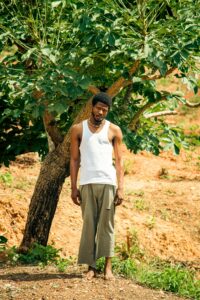
His younger brother, Mugisha, lived just a short walk away—but worlds apart in comfort. He wore patched clothes, slept on mats woven from straw, and worked tirelessly just to eat one meal a day. Despite their shared blood, Gahigi never offered his brother so much as a cup of water. He claimed “What a man does not earn, he does not deserve.”
One morning, Mugisha went into the forest to collect firewood. As he wandered among the tall acacia trees, he stumbled upon something peculiar—a massive rock, jagged and dark, sitting like a throne among the thorns. He ducked behind a bush when he heard voices—low and dangerous.
Forty-one bandits emerged, each burdened with sacks that clinked with the sound of metal. Their leader, a tall man with a jagged scar across his face, stood before the rock and their chief declared “Fortunate rock, open!”
To Mugisha’s awe, the rock rumbled and split in two. The bandits filed inside, and the leader followed. “Shut again,” the Chief Bandit said. And the rock obeyed. After a while, the same voice called “Fortunate and incredible rock, open again!”
The stone yawned apart once more, and the thieves emerged—lighter in load, heavier in secrecy. “Shut again.” The stone sealed.
When they vanished into the forest, Mugisha crept toward the rock. With a shaking voice, he mimicked the Chief. “Fortunate rock, open.” The stone opened. Inside was a chamber glowing with gold—coins, jewelry, goblets, and gemstones in piles taller than a man. Mugisha stood in awe. He filled three sacks, whispered “Shut again,” and returned home, breathless and grateful.
He told his wife, Amina, everything. Her eyes widened with both wonder and worry. “No one must know,” he told his wife. “Not even my brother. Especially not my brother.”

They needed to weigh the gold, so Mugisha asked her to borrow Gahigi’s weighing machine. When Amina arrived at Gahigi’s mansion, he narrowed his eyes. “What could you possibly need to weigh?” he asked.
Amina stumbled over her words. “Oh, just… some grain from the market.” Gahigi pretended to nod, but before handing over the weighing scale, he slyly smeared honey on its bottom. When Amina returned the weighing machine, Gahigi found a gold coin stuck to the honey. His eyes gleamed with suspicion—and greed.
Greed meets its end
Gahigi stormed into Mugisha’s hut the next morning, fire in his eyes. “Tell me where you got the gold. I know you. You’ve never owned more than a chicken. Where did you steal it from?”
Mugisha trembled but tried to remain firm. “It’s nothing. Just some luck. Please don’t ask further.” But Gahigi pressed and pestered, hour after hour, until Mugisha’s resolve cracked like a dry twig. He told him everything.
Gahigi galloped into the forest with three donkeys and a greedy grin. He found the rock easily and stood before it, barely able to contain himself. “Fortunate rock, open!” The rock opened. He stepped into and whispered “Shut again.” The rock closed, surrounding him with gold. Inside, he laughed like a madman, grabbing all he could. But when the time arrive for him to leave, he stopped short. He couldn’t remember the exact words and said “Magic rock, open. Rock, open sesame?” But, nothing worked.

He screamed, cursed, pounded the rock. But it remained shut. When the thieves returned, they found him crawling in the corner. “Who are you?” the Chief growled. “I—I didn’t mean to—please—I was just…” But the thieves knew. And thieves do not forgive. Gahigi’s story ended there, beneath stone and silence. They instantaneously sent him to death.
Back in Kibalya, the Chief Bandit sensed that someone else had plundered their secret vault. Their Chief sent one man, a scout, to search the village for any who had become suddenly rich.
It wasn’t hard to find Mugisha. Though still humble, he owned a new roof, clothes, livestock and some other astounding possessions. The scout marked the house with a red cross in the night.
But Amina, ever sharp-eyed, saw the strange symbol as soon as the thief quit the village. Suspecting danger, she took red paint and marked every home in the village with the same cross.
That night, the bandits returned—forty-one of them—creeping like shadows. But when they saw every house was marked, they fumed with confusion and disappeared into the darkness, failing to accomplish their plan.
The boiling justice
Weeks passed, but the Chief Bandit remained unsatisfied. He couldn’t rest while the thief lived free. So he devised a plan more cunning than blades. He filled forty huge oil vessels with his men—one man per barrel. The forty-first vessel held real oil which the Chief Bandit employed to trick Mugisha. Dressed as a merchant, the Chief Bandit arrived at Mugisha’s gate at dusk.

“I am a humble trader,” he said. “I’ve heard you buy oil. And I beg your shelter for one night.” Mugisha, generous as always, welcomed him in. “Place your barrels inside the house. You’ll be given food, drink, and a place to sleep.”
Amina, however, was suspicious. That night, as she passed near the barrels, she heard breathing from within. She returned to the kitchen, quietly boiled oil in a very huge pot, and poured it—jar by jar—into the vessels. Not a single thief escaped. They were cooked in silence, especially since they refused to yell.
The Chief, unaware that his men were dead, planned to strike at midnight. But Amina had acted faster. Around midnight, he rose from his bed, intent on ordering the thieves to attack Mugisha’s family. But when he reached them, he found every one of them dead. The sight froze his blood, and terror gripped him so fiercely that he immediately fled Kibalya, vowing never again to dare such a deed. As for Mugisha and Amina, their names became legend.
They cared for Gahigi’s widow and children, offering them a home and kindness the late rich man never gave. The villagers, inspired by the tale, began valuing heart over gold, and generosity over pride.
The fortunate rock was never seen again. Some say it vanished. Others say it waits, deep in the forest, for a voice humble enough to call it.
Moral of the tale
Greed chokes its master, but kindness multiplies itself. Wealth gained through heartlessness turns to ruin, while fortune shared becomes legacy.
This story also teaches that before venturing into any business or opportunity, you must first explore and understand it thoroughly—rushing in blindly invites misfortune. In Gahigi’s case, his downfall came not only from his greed but also from his failure to truly understand the opportunity before him. He rushed into the rock’s chamber without taking the time to learn its secrets—such as the exact words that opened it—because he was blinded by the glitter of gold. If he had observed patiently, studied the process, and prepared himself, he could have avoided his tragic end. The same holds true in real life: entering a business, investment, or venture without knowing its workings is like walking into a locked room without checking if you possess the key. Impulse can open the door to fortune, but ignorance will close it faster than any lock.
And above all, strive to shun greed, for it clouds judgment, breeds carelessness, and, as with Gahigi, often writes the final line of one’s downfall. Greed shuts the door to trust, replacing cooperation with suspicion and selfishness. Had Gahigi not been driven by his insatiable and unreasonable greed for wealth, his relationship with Mugisha would have been characterized by brotherly support rather than rivalry. His brother could have felt safe enough to share the secret from the beginning—perhaps even inviting him to the rock. Together, they could have approached the opportunity wisely, with planning and shared responsibility, avoiding the fatal mistakes born of haste, secrecy, and greed. But greed blinds a man to the value of alliances, leaving him to chase fortune alone into the shadows and tragic end.
If you are facing unspeakably severe hardships, don’t panic—as Mugisha unexpectedly discovered fortune through patience, courage, and careful observation, it will also remind you that opportunities often arrive in forms you least expect, and with wisdom and generosity, even the harshest circumstances can transform themselves into a lasting legacy. Though this is a tale, similar realities happen in the real world. Take Sylvester Stallone, for example: facing extreme challenges early in life, including speech difficulties and repeated career rejections, he persevered with patience and ingenuity, eventually tranforming his adversity into lasting and extraordinary success. Hardship, when met with wisdom and resilience, can open doors we never imagined. In both stories, wisdom, resilience, and determination transform hardship into opportunity. For more about him, read Don’t Despair—success is within reach: the Sylvester Stallone Story.