By Jean Baptiste Ndabananiye
Success is often portrayed like a straight-line path—one that involves careful planning, disciplined execution, and unbroken progress. Yet, history and real-life experiences tell a different story: failure does not constitute an obstacle to success; it is the very thing that speeds success up. While failure is frequently seen as a setback, it actually accelerates learning, resilience, and innovation more than immediate success ever could. This article is structured into these sections:
- The myth of immediate success
- Failure as an accelerator for a learning process to overcome it
- Building resilience through failure
- Innovation thrives on failure
- Overcoming the fear of failure
- Conclusion: embrace failure as a shortcut
The myth of immediate success
Society tends to glorify overnight success stories, but they are often misleading. Behind every so-called instant success lie years of trials and errors, except in certain cases where there are people who are helped to instantly rise. The myth of effortless success discourages people from embracing failure as an essential part of growth.

In reality, the greatest innovators and leaders have failed multiple times before achieving breakthrough success. The late Thomas Edison, when asked about his thousands of failed attempts at inventing the lightbulb, famously responded “I have not failed. I’ve just found 10,000 ways that won’t work.” His failures weren’t roadblocks; they constituted stepping stones that allowed him to refine his work until he finally succeeded.
Failure as an accelerator for a learning process to overcome it
When you fail, you receive immediate feedback. Success can be deceptive—it may validate methods that are not necessarily the best. But failure forces deep reflection, improvement, and adaptability.
Take the startup world, for example. Many of the most successful entrepreneurs have launched failed ventures before hitting their big break. Each failure teaches valuable lessons about market needs, business models, and leadership. Jeff Bezos, before founding Amazon, held multiple failed business ideas. Instead of seeing those failures as wasted time, he used them as experiments that built his knowledge and refined his strategies.
CNBC in its October 3, 2021 story says “Bezos has long encouraged his teams to take big risks and embrace failures. Amazon’s own founding story is an example: at age 30, Bezos quit his Wall Street investment banking job to launch the online bookstore because he felt unfulfilled.”
The University of Michigan narrates “On July 5, 1994, Amazon was officially founded under the name ‘Cadabra” (as in abracadabra) by young Princeton graduate Jeff Bezos within a garage space in his rental home in Bellevue, Washington. However, after just a few months, Bezos switched the name to Amazon Inc because of Cadabra’s unappealing similarity to the word “cadaver” (A&E Television Networks, 2015). Roughly a year later, the Amazon website was officially published as an online bookseller delivering to all 50 US states and 45 countries from that same garage space.

Like many other companies in their first couple of years of production, Amazon saw losses. However, one of the most significant signs that the company was on the path to success came in the transition of quarter three (July 1st – September 30th) to quarter four (October 1st – December 31st) in 1996. Within that time span, Amazon’s revenues rose from $4.2 million to $8.5 million while seeing a $100,000 decrease in losses from each quarter (Wilhelm, 2019). Although they were still seeing roughly $2.2 million in total losses during this quarter, this was a positive sign as they were able to more than double their revenue while decreasing those losses.”
Failure works as a real-world teacher, offering lessons that theoretical learning can never match. When you experience failure, you are forced to develop problem-solving skills, rethink your approach, and uncover hidden opportunities that success alone might not reveal.
Bezos in 2019 told his employees “We need big failures if we’re going to move the needle — billion-dollar scale failures. And if we’re not, we’re not swinging hard enough.” After registering success in the gaming arena, he tweeted “After many failures and setbacks in gaming, we have a success. So proud of the team for the persistence. View setbacks as helpful obstacles that drive learning. Whatever your goals are, don’t give up no matter how hard it gets.”
Building resilience through failure
One of the greatest advantages of failure is that it builds resilience. Resilience is the ability to endure hardship, adapt to change, and continue pushing forward despite adversities. People who experience failure early in their journey develop the emotional and mental toughness required for long-term success.
Consider athletes. Many of the world’s greatest sports legends have suffered painful defeats before reaching the top. Michael Jordan, widely regarded as one of the greatest basketball players of all time, was cut from his high school basketball team. Instead of abandoning the sport, he used the failure as fuel to work harder. His resilience led him to become an National Basketball Association (NBA) icon.
Jordan has said “The key to success is failure. I’ve missed more than 9,000 shots in my career. I’ve lost almost 300 games. Twenty-six times, I’ve been trusted to take the game winning shot and missed. I’ve failed over and over and over again in my life. And that is why I succeed.

Failure makes me work even harder. I’ve never been afraid to fail. I know fear is an obstacle for some people, but it is an illusion to me. Failure always made me try harder next time. If you do the work, you get rewarded. There are no shortcuts in life. Once I made a decision, I never thought about it again. Always turn a negative situation into a positive situation. If you quit once, it becomes a habit. Never quit! I never looked at the consequences of missing a big shot … when you think about the consequences, you always think of negative results.”
Similarly, authors like J.K. Rowling faced repeated rejection before their works became bestsellers. Rowling’s “Harry Potter” manuscript was rejected by 12 publishers before being accepted. Had she surrendered after her first few failures, the world would have never experienced one of the most beloved literary series of all time.
Innovation thrives on failure
Failure lies at the heart of innovation. The most groundbreaking discoveries, from space exploration to medical breakthroughs, have emanated from trial and error. Scientists and inventors rely on experimentation, which inherently includes failure, to refine their ideas.
Take SpaceX, for example. Elon Musk’s company endured multiple failed rocket launches before successfully developing reusable rockets. Each failure provided critical data that enabled engineers to polish designs and correct mistakes. Today, SpaceX is revolutionizing space travel, and none of it would have been possible without the lessons learned from failure.
Failure does not stand as the opposite of innovation—it forms the foundation of it. Every major technological advancement, from the invention of the telephone to the development of artificial intelligence, has been shaped by countless failed attempts that led to breakthrough success.
Overcoming the fear of failure
Despite its benefits, countless people still fear failure. The fear of failure can be paralyzing, preventing people from taking risks that could generate incredible success. This fear often stems from societal pressure, perfectionism, or a lack of confidence.
To overcome this fear, it is crucial to reframe failure as a necessary and valuable experience. Instead of viewing failure as a personal flaw, it should be seen as a ladder toward growth. The following are some of ways to embrace failure and then advance.

Adopt a growth mindset—the Psychologist Carol Dweck’s research on growth mindset versus fixed mindset shows that people who see abilities as developable rather than fixed are more likely to succeed. If you view failure as an opportunity to learn, you’ll be more willing to confront challenges. The Harvard Business School in its 10 March 2022 story “Growth Mindset vs. Fixed Mindset: What’s the Difference?” reports “According to Dweck, challenging situations can be catastrophic for those with fixed mindsets because of the implication that if they don’t already have the skills or intelligence to complete a task, there’s no chance of improvement.
When you have a growth mindset, you believe you can gain the knowledge and skills necessary to succeed, which makes every challenge a learning opportunity. Given the numerous challenges entrepreneurs face, a growth mindset can be a powerful tool as you work toward your venture’s success.”
“Do you have to be a creative genius to succeed?” asks Harvard Business School Professor William Sahlman in the online course Entrepreneurship Essentials. Do you have to be young, or technical, or a college dropout, or risk-seeking to become an entrepreneur? I don’t think so. Every person can find opportunities, attract necessary resources, and build teams to bring successful products and services to customers.”
The Harvard Business School adds that this mindset—that ability and intelligence can be attained through effort—is called a growth mindset, and serves an invaluable asset in the startup world. “In one of Dweck’s studies, her team analyzed students’ brain activity while reviewing mistakes they made on a test.
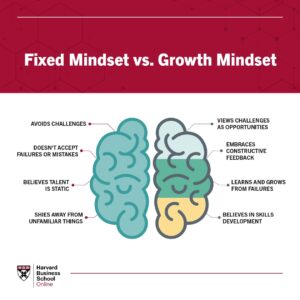
Those with a fixed mindset showed no brain activity when reviewing the mistakes, whereas the brains of those with a growth mindset showed processing activity as mistakes were being reviewed. A fixed mindset can physically prevent you from learning from mistakes, while a growth mindset can empower you to perceive mistakes as learning opportunities.”
Analyze your failures—instead of dwelling on failure emotionally, dissect it rationally. What went wrong? What lessons can you take away? What adjustments can you conduct for next time?
Take calculated risks— risk-taking is essential for growth. Instead of avoiding failure, approach challenges strategically, knowing that setbacks are part of the process. Here, act like one of the tycoons of this planet—Warren Buffet—who once stated “Don’t put all your eggs in one basket.” This quote embodies the concept of calculated risk.
Surround yourself with resilient people— having, around you, people who have faced and overcome failure can provide encouragement and insight. Many successful individuals openly share their failures, showing that they are part of the journey.
Conclusion: embrace failure as a shortcut
Failure is not a dead end; it acts as a shortcut to success. It accelerates learning, builds resilience, and fosters innovation in ways that instant success never could. History has shown time and again that those who adopt failure as a learning tool are the ones who ultimately achieve the greatest success.
By changing our perception of failure and using it as a bridge to success, we can unlock our full potential. Rather than fearing failure, we should welcome it—because each failure brings us one step closer to our ultimate success.
Somebody necessarily lend a hand to make critically articles I might state. This is the first time I frequented your web page and up to now? I amazed with the research you made to make this actual publish incredible. Excellent process!