By Jean Baptiste Ndabananiye
As Rwanda continues to grapple with the far-reaching impacts of climate change, Gicumbi District has emerged as a remarkable case study in resilience. Once ranked among the most climate-affected regions in the country—with over 150 hectares of tea lost to floods and a steep decline in agricultural productivity—Gicumbi stood at a crossroads. Today, thanks to the Green Gicumbi Project, it stands as a symbol of transformation.
In a country where climate-related disasters have claimed lives and livelihoods, this six-year initiative is nearing completion, offering a rare glimpse into how locally driven solutions can reverse environmental decline and spark community-led progress. But the question remains: can Gicumbi’s success be replicated elsewhere—and can its story inspire a new chapter of climate resilience for Rwanda and beyond?
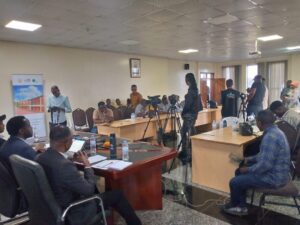
“Rwanda is one of countries threatened by climate change. For around 12 years, it has been affected by excessive flooding which has reduced agricultural productivity. For example, since approximately 2012, 150 hectares of tea crop land have been lost to flooding in the Murindi wetland. Research indicated that in 2018 Gicumbi district was the second most affected by the impacts of climate change,” Jean Marie Vianey Kagenza, Green Gicumbi Project Manager, told journalists at a press conference held today in Gicumbi district’s office.
To illustrate how the situation in Gicumbi has improved thanks to the project —addressing the challenges which the district faced in the 2018s—Gicumbi District Mayor Emmanuel Nzabonimpa stated “In these recent times, no one has died due to climate-related disasters, no houses have been swept away, and no crops have been destroyed, unlike in the period before the project.”
In this piece which opens the door to this story, we have asked ourselves “Green Gicumbi Project nears completion— a beacon of community-led climate resilience in Rwanda? Does the Green Gicumbi Project offer a valuable case study in how localized initiatives can address global environmental challenges?”
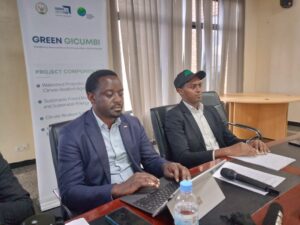
Though we have not conducted conversations with the direct beneficiaries ourselves yet, the two officials at the press conference demonstrated that the project holds the potential to serve not only as a valuable resource for Rwanda but also as a model for global climate resilience. “We receive foreigners who come to learn from this project, and if you get to the field, you will notice a lot of things on your own,” Nzabonimpa said.
Echoing him, Kagenza said “There are a lot of lessons which have helped the government, through the Ministry of the Environment, to create several other projects. This year we have received visitors from Nigeria, Ivory Coast, Malawi, Kenya, Uganda and Tanzania—all of them coming to learn from this project. Yet, we have also gained valuable lessons from others.”
Nzabonimpa added “I wish this project to be replicated in other sectors of Gicumbi since it was just implemented in 9 ones, we suggest that all 21 sectors benefit from this intervention. I also wish other districts like Gakenke to benefit from this project as well. Owing to the project, the production of maize in the district his risen by 20%, bean production has increased by 28%, and Irish potato production has gone up by 20%.”
Crucial questions with regard to this project do not end here. Will this model be scaled up across Rwanda’s remaining districts? What are the voices and experiences of the beneficiaries themselves? How sustainable are these gains without continued external support? And crucially, can this initiative influence policy at the national and continental levels?
These are some of the questions we will continue to explore in future reporting. As we follow this story, Life In Humanity remains committed to investigating the lessons, limitations, and legacy of community-led climate resilience efforts. Because in a rapidly warming world, stories like Gicumbi’s are not just worth telling—they are essential to shaping the future.