By Jean Baptiste Ndabananiye
As the world is grappling with intensifying climate threats, Rwanda’s Gicumbi District has drawn national attention for its six-year climate resilience initiative—the Green Gicumbi Project—now approaching its phase-out stage. But as the project winds down, a key question emerges: Can it truly serve as a model for community-led climate resilience?
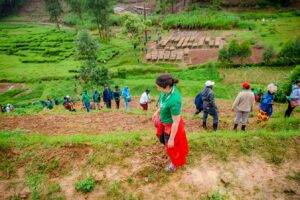
This week, from 2 to 6 June 2025, journalists from across the country are joining a media tour organized by the Green Gicumbi Project as it reaches the final phase of its five-year implementation. The initiative, rooted in Rwanda’s Northern Province, has garnered attention for its practical approaches to climate adaptation and community transformation.
The tour begins with a press briefing on Monday, 2 June, at the project’s headquarters in Gicumbi, bringing together project managers, district officials, and development partners. It offers media professionals a rare chance to ask key questions about the project’s legacy, challenges, lessons learned, and the sustainability of its gains.
Throughout the tour, journalists will engage directly with the people behind the statistics—smallholder farmers practicing climate-smart agriculture, households benefiting from rehabilitated watersheds, and communities reviving degraded forests. Their testimonies will shed light on whether the project’s impact runs deep enough to endure beyond donor support.
For Life In Humanity, the Green Gicumbi Project provides fertile ground for exploring the intersection between grassroots innovation and global climate priorities. The central question—does the Green Gicumbi Project constitute a true beacon of community-led climate resilience?—deserves more than a simple yes or no. It calls for an examination of the structures in place to sustain momentum, the ownership of initiatives by local communities, and the replicability of its successes in other regions.
The project’s closing chapter is also an opening: an invitation to reflect on what works, what still needs work, and how localized, inclusive climate action can shape the path forward not just for Rwanda, but for a warming world.
This week’s tour doesn’t represent a conclusion—it instead forms a turning point. Stories that will be gathered will help to determine whether Gicumbi’s hills echo a message of hope strong enough to inspire long-term, people-powered environmental resilience.
At the core of this media engagement is a mission: to document and share compelling stories of change—directly from the people whose lives have been transformed by the project’s multifaceted interventions.
But more than numbers and reports, what makes this coverage meaningful is the chance to meet and listen to the project’s beneficiaries—farmers adopting climate-smart agriculture, families benefiting from hillside irrigation, and communities revitalizing degraded ecosystems through sustainable forestry.
Local actions, global lessons
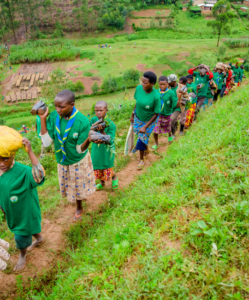
As the climate crisis accelerates, global leaders increasingly recognize the importance of community-led adaptation strategies. Does the Green Gicumbi Project, based in Rwanda’s northern highlands, offer a valuable case study in how localized initiatives can address global environmental challenges? Around the world, rural communities often face the worst effects of climate change despite contributing the least to it. From the Sahel to South Asia, soil erosion, water scarcity, and extreme weather are disrupting lives and livelihoods.
Green Gicumbi Project’s work—restoring degraded forests, promoting climate-smart agriculture, and protecting watersheds—mirrors broader global efforts under frameworks like the UN’s Climate Adaptation agenda. This tour will enable us to observe whether when communities are empowered with the right tools and ownership, climate resilience becomes both achievable and sustainable. Globally, billions are invested in top-down climate solutions, yet grassroots models like Green Gicumbi may hold the key to long-term success.
Its participatory approach aligns with growing calls for locally-led adaptation (LLA), as championed by global networks like the Global Commission on Adaptation. By placing citizens at the center of transformation, the project offers lessons that transcend borders and resonate in climate-vulnerable regions worldwide.
A microcosm of global climate resilience
What is unfolding in Rwanda’s Gicumbi District is part of a much larger story—the urgent global search for sustainable and inclusive climate solutions. In many parts of the world, the climate discourse remains dominated by policy talks and carbon targets, while community realities receive less attention. Green Gicumbi flips this script by showing how resilience is built from the ground up.
As droughts, floods, and shifting weather patterns challenge food systems globally, smallholder farmers—like those in Gicumbi—are on the frontlines. Their success in adapting to these conditions holds insights for similar communities in Asia, Latin America, and the Pacific. Moreover, Green Gicumbi Project echoes the goals of the Paris Agreement and the Sustainable Development Goals, particularly on climate action, life on land, and no poverty.
It also provides a living example of the “think globally, act locally” philosophy, proving that solutions tailored to local ecosystems can ripple out globally. As the world prepares for COP30 and debates finance, technology, and equity, though it is the tour which will prove it, we believe that case studies like Gicumbi’s are crucial for grounding high-level dialogue in real-world impact. If extended thoughtfully, the Gicumbi experience could inform a generation of climate resilience efforts in vulnerable regions worldwide.