By Jean Baptiste Ndabananiye
Every day, in countless interrogation rooms and hidden detention centers across the globe, people scream in indescribable pain. Their torturers carry out orders with methodical precision. The human rights organization B’Tselem has released a devastating report titled “Welcome to Hell”. Built on testimonies from 55 Palestinian detainees, the report exposes what amounts to the deliberate transformation of Israeli military and civilian detention facilities into “de facto torture camps” following the outbreak of war on 7 October 2023.

These facilities—some hastily repurposed into makeshift holding centers—are said to have become sites of relentless unspeakable physical and psychological abuse. The detainees, including women, were often held without charge, reportedly subjected to beatings, humiliation, mauling by dogs, and complete isolation from the outside world. In one chilling case, a detainee was reportedly beaten to death for merely asking if a ceasefire was declared. In another, a woman described being hurled into a pit, threatened with being buried alive, and later transported alongside other abused detainees in states of despair before being locked in an overcrowded, traumatized cell.
B’Tselem’s report unmistakably clarifies that these were not isolated incidents or the result of chaos in the fog of war. They were systematic, organized, and executed as a matter of policy, according to the organization. The title “Welcome to Hell” does not stand metaphorical or as an exaggeration—it reflects the lived experiences of the Palestinians who, though released without charge, were irreparably scarred by what they endured. Fouad Hassan, 45, from Qusrah in Nablus District in his testimony recounted “We were taken to Megido. When we got off the bus, a soldier said to us ‘Welcome to hell.”
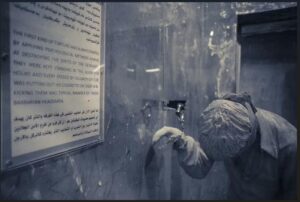
This harrowing documentation has compelled us to confront uncomfortable questions: who are the people carrying out these acts? What systems embolden and shape them into instruments of such terror—in other words, how have they become capable of such horror and how do institutions manufacture such cruelty? Can this cruelty be ever dismantled? Horrors, endured by torture victims, related in this article are so deeply heartbreaking that we, too, were emotionally affected while documenting them — especially as portrayed in the accompanying images.
Who are these people?
Before addressing this point, we are going to understand what torture truly means and how it manifests itself in practice. “Torture is when somebody in an official capacity inflicts severe mental or physical pain or suffering on somebody else for a specific purpose. Sometimes authorities torture a person to extract a confession for a crime, or to get information from them. Sometimes torture is simply used as a punishment that spreads fear in society.
Torture methods vary. They can be of a physical nature, like beatings and electric shocks. It can be of a sexual nature, like rape or sexual humiliation. Or they can be of a psychological nature, like sleep deprivation or prolonged solitary confinement. Torture can never be justified. It is barbaric and inhumane, and replaces the rule of law with terror. No one is safe when governments allow its use,” explains Amnesty International in its undated story “Torture”. The Center for Victims of Torture emphasizes “Freedom from torture is a fundamental human right.”
Torturers are human beings—like any other people such as you, but— who have been trained to become and remain heartless and then dehumanize their victims. This training is far from ordinary—torture practices are burned into their consciousness, deeply embedding cruelty into their very being— brutality is instilled deep within their souls. Intense indoctrination effort is exerted to condition them to never feel—or be infected by—others’ suffering.
Those who resist or question this brutal profession are themselves subjected to torture, as a way to instill in them firsthand how they are expected to treat their future victims. To better understand the mindset and transformation of torturers, we will consult various sources—beginning with The Conversation.
The Conversation released a story “How someone becomes a torturer” on 7 September 2021. “Every day, thousands of people are tortured in police stations, security offices and prisons around the world. Human rights organizations protest torture and advocate for survivors, but neither they nor the public knows much about the torturers themselves.
Where do torturers come from? How can they do such terrible things? And most important, is there a way to stop torture by stopping the people who do it? Answering these questions is difficult because torture, or the infliction of severe mental and physical suffering by government authorities, is illegal under international law. Torturers do their work in secret, and few have ever agreed to talk to journalists or researchers,” are the words which open this account.
The story was written by Christopher Justin Einolf—an Associate Professor of Sociology at Northern Illinois University.
Behind the veil of tyranny, chilling confessions emerged as 14 of Saddam Hussein’s former torturers laid bare the twisted logic behind their cruelty—raw, unfiltered accounts preserved in a human rights archive. Several of them hating their career, these men revealed how and why they chose to torture, and how they constructed justifications that shielded them from guilt. “As part of the Iraq History Project, an oral history project conducted by DePaul University’s Human Rights Law Institute after Saddam Hussein’s fall, 14 of Saddam’s former torturers were interviewed about what they did and why they did it. Their stories went into a human rights repository, and I analyzed them as part of a recent research project.
While some earlier research found that torturers were psychologically normal people forced to engage in acts against their will, my research shows how recruits voluntarily engaged in torture and how they justified their actions to themselves.”
Einolf continues, explaining who turns into a torturer. “Most of the men who were interviewed expressed regret about what they had done. Some of them attributed their choice of careers to traumatic childhoods where they endured violence from abusive, alcoholic fathers.
One explained that he hated his father so much and ‘had a strong desire to take revenge on him.’ In search of something that ‘made me of value and position,’ he applied for a job with the security forces. When his application was accepted, he welcomed the ‘happy news,’ as he ‘was going to have power over people like my dominant father.’”
On the question “how they are recruited”, according to the Assistant Professor Einolf, all of the torturers in the study entered Saddam’s security forces out of their own free will. He adds that they sometimes exploited family connections or paid bribes to procure the prestigious and well-paid job of security officer. “They thought they would become investigators, tasked with the job of finding and arresting enemies of the state.
They were shocked when they were assigned the job of torturer, where they would have to torture dissidents while interrogating them and force them to confess to political crimes. Unable to ask for a transfer, the recruits faced a stark choice: lose their job or become a torturer. Many who stayed did so because they were poor and needed the money.”
To elucidate the issue of poverty as a reason forcing some people to join this profession, the professor says “One recalled telling his mother that he had gotten a great job with the security forces and assured her that he would take care of her and she would no longer have to live in poverty.” When he found out he was assigned the job of torturer, according to the Assistant Professor Einolf, he said he “was not able to say anything because of my fear of losing the job, and because of my fear of going back to my mother and disappointing her after all the promises I had made.”
Systems emboldening and shaping torturers

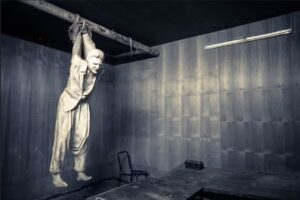
The Assistant Professor—Einolf, specifically responding to the question of how they are trained—points out “Novice torturers received practical instruction in how to torture, sometimes in classrooms and always on the job under the supervision of experienced torturers. They learned how to most effectively cause pain by beating people with cables, using electric shock, beating the soles of the feet and suspending victims by their arms from the ceiling.
Recruits were urged to do away with their natural feelings of empathy and compassion. One recruit recalled being told he had to be ‘a destroying monster’, ‘tough-hearted’ and “having no mercy for others,’ and he had to stop being ‘a human being with a heart of friendliness or mercy.’ Another was told ‘never to show any mercy to those who would want to harm the country or the President Saddam Hussein, who was like the father of our house.”
Einolf explains that torturers are tightly inspected. “The Iraqi torturers worked under orders and were sometimes ordered to do specific acts of torture. Their superiors placed security cameras in the torture rooms to make sure they obeyed. Two of the torturers say they suffered torture themselves when they refused to harm a victim.
When they did their jobs well, they were rewarded with praise and promotions. After getting one important prisoner to confess, one recalled, ‘all the officers were proud of me for my satisfactory performance, and all my colleagues at the directorate started to regard me as an important person’.”
Justifications of their bestial acts
The Assistant Professor, Einolf, explains that torturers convinced themselves that they were saving the country and that their victims deserved punishments which they received. He clarifies that after his first day of training, one asked a colleague “What sins did those persons who were tortured in front of me commit?”
The colleague answered “Their sins are huge and cannot be forgiven! Their sins are that they want to topple the regime, disturbing our government and dispersing chaos, terrorism, looting and killing. Don’t you ever believe that any one of those is a victim! We are the victims of them.”
The recruit “spent that night thinking of how I would be able to hold the cable and beat those people with it. … However, I remembered his words and that those people were just traitors and criminals, and I thought to myself ‘Yes! They deserve all that torture, as they are trying to betray the country, and so they have to get what they deserve!’”
The Israeli torture apparatus being addressed these days
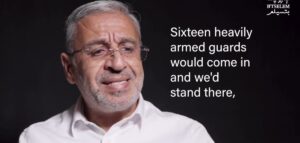
“The Israeli Prison System as a Network of Torture Camps. ‘Welcome to Hell’ is a report on the abuse and inhuman treatment of Palestinians held in Israeli custody since 7 October 2023. B’Tselem collected testimonies from 55 Palestinians held during that time and released, almost all with no charges.
Their testimonies reveal the outcomes of the rushed transformation of more than a dozen Israeli prison facilities, military and civilian, into a network of camps dedicated to the abuse of inmates as a matter of policy. Facilities in which every inmate is deliberately subjected to harsh, relentless pain and suffering operate as de-facto torture camps.” Those are B’ Tselem’s words. B’Tselem is the Israeli Information Center for Human Rights in the Occupied Territories and we will come back to this organization at the end of this piece.
We have selected a few quotes of those reporting that they have sustained unspeakable mistreatment in Israel, to describe the magnitude, methods, and psychological impact of the abuse they endured—giving voice to the often-silenced victims of state-sanctioned cruelty.
“I’m married and live with my wife and our four kids, who are between the ages of six and 17. I work as a real estate lawyer and have a private office in Haifa. They (Israeli guards) knew I was a lawyer and wanted to humiliate me. On 4 November 2023, around 11:00 A.M., I was at my office. Three people in civilian clothes came into my office and sat down.
They tied my hands with zip ties and led me outside. They led me into my home with my hands tied. My wife asked them to untie them so my young kids wouldn’t see me like that, but they refused. After the raid on my home, they took me to the police station in Shfaram, where they put metal cuffs on my hands and feet. Then they took me to Megiddo Prison, which I’ve called Abu Ghraib ever since, because of the severe torture I underwent there,” said Attn. Sari Huriyyah, 53, a father of four told B’Tselem on 29 May 2024.
“First, the guard demanded that I undress. I did and stayed in my underwear. He ordered me to take off my underwear as well. I tried to convince him that there was no need, and said I was 53 years old and an Israeli citizen. I thought that might help, but the guard threatened to beat me. I gave in, feeling I had no choice. There was a window in the cell, through which we heard detainees crying and shouting while guards beat them. The guards yelled out demands that they bark like dogs. We heard some of the detainees actually bark after they were hit. The guards laughed, of course. It was really hard to hear and see.”
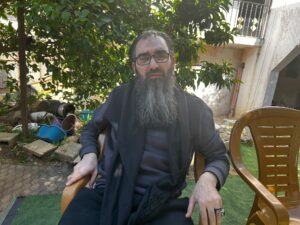
On 18 April 2024, Thaer Halahleh aged 45 and a father of four told B’Tselem “During that period, I lost 35 kilos because the food was so poor in quality and quantity. I remember the rice the guards would bring us. It felt like it was just soaked in hot water without being cooked at all.
We had to eat it, and anyway each prisoner was given only one or two spoonfuls per meal. That was a major change, because before the war, we cooked our own food and had as much as we wanted. We were also forbidden to go outside to the yard, unlike before. For 191 days, I didn’t see the sun. They also prohibited haircuts and communal prayer. We weren’t even allowed to hold the ‘Eid al-Fitr prayer on 10 April 2024.”
On 7 April 2024, Muhammad Srur, 34—a father of two, said “They set dogs on us, beat us badly and hurled insults at us. They took me and another detainee to a room where they sat us in front of a computer to participate in a live court hearing. Before the hearing began, we were attacked and beaten hard with metal batons all over our bodies for more than 30 minutes. At the court hearing there were judges, prosecutors, a translator and a lawyer.
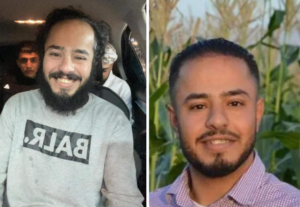
When the lawyer saw me on the computer with my face red, swollen and bruised, he asked what happened to me. I told him what happened before the hearing and he asked me to tell the judge. I did get the chance to speak at the hearing and I told the judge what happened. He asked me if I had been taken in for a medical check and if a doctor had treated me. I said no. He recommended taking me to a doctor. During the hearing, I found out I’d been issued an administrative detention order for six months. Because of my health condition, and because of the severe beating and abuse, it was shortened to five months.”
On 29 November 2023, Muhammad Nazzal aged 18 said “The guards turned very violent after the war broke out. One day, I heard shouts from the inmates in the next cell. Later, I found out that one of them asked a guard if there was a ceasefire or any sort of solution because we weren’t getting any news from the outside, and in response to that question, they beat him to death. The guards simply left him there for half an hour after the assault. His name was Thaer Abu ‘Asab.”
BBC published a similar piece titled “Chemical burns, assaults, electric shocks – Gazans tell BBC of torture in Israeli detention” on 7 July 2025. It reports “We have conducted in-depth interviews with five released detainees, all of whom were arrested in Gaza in the months after Hamas and other groups killed about 1,200 people in Israel and took 251 hostage.
The men say they were accused of having links with Hamas and questioned over the location of hostages and tunnels, but were not found to be involved in the 7 October 2023 attacks – a condition Israel had set for anyone released under the recent ceasefire deal. Some of those freed under the deal were serving sentences for other serious crimes, including the killing of Israelis, but that was not the case for our interviewees.”
BBC explains that the five Palestinians interviewed in depth were returned earlier this year under the ceasefire deal with Hamas. “They were among about 1,900 Palestinian prisoners and detainees exchanged for 33 Israeli hostages, eight dead and 25 living, some of whom have described being abused, starved and threatened by their Hamas captors.”
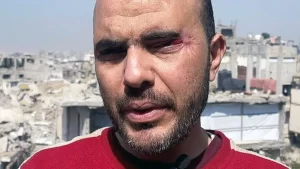
One of the five interviewees is Mohammad Abu Tawileh, a 36-year-old mechanic. According to BBC, soldiers mixed chemicals used for cleaning into a pot and dunked his head in them, the interrogators then punched him, and he fell to the rubble-strewn floor, injuring his eye. He told this media organization “They used an air freshener with a lighter to set my back on fire.
I thrashed around like an animal in an attempt to put the fire out. It spread from my neck down to my legs. Then, they repeatedly hit me with the bottoms of their rifles, and had sticks with them, which they used to hit and poke me on my sides.”
He adds that they then continued pouring acid on him. “I spent around a day and a half being washed with [it]. They poured it on my head, and it dripped down my body while I was sitting on the chair.”
BBC points out “These, in turn, align with testimony given by others to Israeli human rights group B’Tselem and the United Nations, which in July detailed reports from returning detainees that they had been stripped naked, deprived of food, sleep and water, subjected to electric shocks and burned with cigarettes, and had dogs set on them.”
Can torture be eliminated?
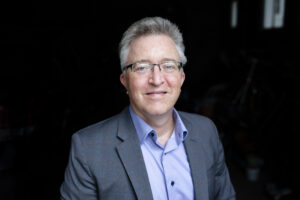
The Assistant Professor, Einolf, says “How can torture be prevented? Studying torturers is strange and disturbing, and understanding their actions may seem like excusing them. But studying torturers is important: Only by understanding how and why they do it can people begin to prevent torture. Like a doctor who studies cancer in order to cure it, social scientists must study torture in order to help human rights groups and governments prevent it.”
Penal Reform International (PRI) is a non-governmental organization working globally to boost criminal justice systems upholding human rights for all and do no harm. In its undated piece headlined “Preventive monitoring”, this organization reports “Torture and ill-treatment usually occur in isolated places – such as prisons. By their very nature they are cut off from the rest of the world and those who practise torture feel confident that they are outside the reach of effective monitoring and accountable to no one.
Preventing torture and ill-treatment requires that places of detention are transparent and subject to regular external scrutiny. Enabling prisoners to have contact with the outside world, for example through family visits and meetings with lawyers, is not just a human right in itself. It plays a crucial role in helping to prevent torture or ill-treatment from occurring and from going undetected and unpunished.”
PRI defends regular, unannounced visits to places of detention as mechanisms to contribute to the prevention of abuse. “The possibility that a visit could be made at any time, unannounced, increases the likelihood that abuse will be detected.
It therefore discourages prison guards and police officers from engaging in torture or other forms of ill-treatment. Visiting mechanisms should identify risk factors that contribute to torture and ill-treatment, and they should reveal and identify systemic deficiencies. If addressed, this can prevent future cases of abuse.”
PRI adds that when justice lacks tools to uncover truth, desperation can turn it into a fatal weapon—unlawful methods to force concessions instead of relying on evidence. “The quality and capacity of criminal investigations also play a crucial role. Where forensic capacity to investigate offences is lacking, under pressure to solve crime, law enforcement bodies are more likely to resort to confessions obtained through torture or ill-treatment.”
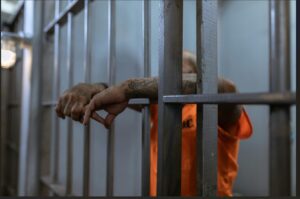
“In detention, systematic or humiliating searches, the use of instruments of restraint, disciplinary sanctions, the absence of decent healthcare and basic material conditions can all constitute torture or ill-treatment.”
B’Tselem strives for a future in which human rights, liberty and equality are guaranteed to all people, Palestinian and Jewish alike, dwelling between the Jordan River and the Mediterranean Sea. “Such a future will only be possible when the Israeli occupation and apartheid regime end. That is the future we are working towards,” it says.
B’Tselem, in Hebrew literally means “in the image of”. The name chosen for the organization by the late Member of Knesset Yossi Sarid, according to this organization, is an allusion to Genesis 1:27: “And God created humankind in His image. In the image of God did He create them.” B’ Tselem underlines “The name expresses the universal and Jewish moral edict to respect and uphold the human rights of all people.”
B’Tselem was established in 1989 by a group of prominent Israeli academics, lawyers, journalists, and members of the Knesset (Israeli parliament). The founding was motivated by concern over human rights violations during the First Intifada (Palestinian uprising).
The founders—Israeli—of B’Tselem believed that documenting and exposing human rights violations in the occupied Palestinian territories was essential for Israel’s democratic character.
B’Tselem operates independently and is widely known for its meticulous documentation and reports on abuses by Israeli authorities and settlers, as well as by Palestinian actors when relevant. Its mission is to promote human rights, combat the occupation, and foster accountability.
B’Tselem says “Since B’Tselem’s inception in 1989, we have been documenting, researching and publishing statistics, testimonies, video footage, position papers and reports on human rights violations committed by Israel in the Occupied Territories. The initial mandate we took upon ourselves focused on the occupation regime in the West Bank (including East Jerusalem) and in the Gaza Strip.
However, over the years, it has become clear that the concept of two parallel regimes operating between the Mediterranean Sea and Jordan River – a permanent democracy west of the Green Line and a temporary military occupation to the east of it – is divorced from reality. The entire area that Israel controls is ruled by a single apartheid regime, governing the lives of all people living in it and operating according to one organizing principle: establishing and perpetuating the control of one group of people – Jews – over another – Palestinians – through laws, practices and state violence.”
It further states “In more than 30 years of work, B’Tselem has earned a place of honor in the local and international human rights community, and has received various awards, including the Carter-Menil Award for Human Rights (1989, jointly with Al-Haq); the Danish PL Foundation Human Rights Award (2011, jointly with Al-Haq); the Stockholm Human Rights Award (2014); and the Human Rights Award of the French Republic (2018, jointly with Al-Haq). B’Tselem’s video project has also received various awards, including the British One World Media Award (2009) and the Israeli Documentary Filmmakers Forum Award (2012).
The essence of the apartheid regime in place between the Jordan River and the Mediterranean Sea is to promote and perpetuate the supremacy of one group over another. B’Tselem works to change this reality, recognizing that this is the only way to realize a future in which human rights, liberty and equality are guaranteed to all human beings living here, Palestinians and Jews alike.”
Other different sources recommend to support whistleblowers and defectors and educate security forces on rights and trauma. These sources specifically recommend to encourage torturers to break silence and defect and dissuade them from continuing to reframe their torture actions as the right duty, patriotism, or divine mission.
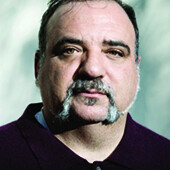
Darius Rejali, professor emeritus of political science at Reed College, is a nationally recognized expert on government torture and interrogation, as reported by the college. “Iranian-born, Rejali has spent his scholarly career reflecting on violence, and, specifically, reflecting on the causes, consequences, and meaning of modern torture in our world. His work spans concerns in political science, philosophy, sociology, anthropology, history, and critical social theory”.
Rejali is best known for his influential book “Torture and Democracy (Princeton University Press, 2007)”. This groundbreaking book earned the 2009 Raphael Lemkin Award from the Institute for the Study of Genocide. It was also awarded as the Best Book of 2008 by the Human Rights Section of the American Political Science Association.
Princeton University, in its undated story titled “Torture and democracy” says “This is the most comprehensive, and most comprehensively chilling, study of modern torture yet written. Darius Rejali, one of the world’s leading experts on torture, takes the reader from the late nineteenth century to the aftermath of Abu Ghraib, from slavery and the electric chair to electrotorture in American inner cities, and from French and British colonial prison cells and the Spanish-American War to the fields of Vietnam, the wars of the Middle East, and the new democracies of Latin America and Europe.”
“As Rejali traces the development and application of one torture technique after another in these settings, he reaches startling conclusions. As the twentieth century progressed, he argues, democracies not only tortured, but set the international pace for torture. Dictatorships may have tortured more, and more indiscriminately, but the United States, Britain, and France pioneered and exported techniques that have become the lingua franca of modern torture: methods that leave no marks.”
Always quoting Rejali, this university emphasizes that under the watchful eyes of reporters and human rights activists, low-level authorities in the world’s oldest democracies were the first to grasp an important truth. Scarring a victim was not just brutality—it constituted an open advertisement of iniquity and an invitation to scandal.
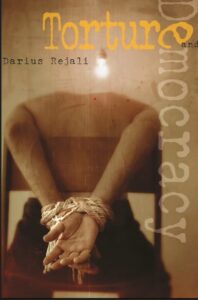
“Long before the CIA even existed, police and soldiers turned instead to ‘clean’ techniques, such as torture by electricity, ice, water, noise, drugs, and stress positions. As democracy and human rights spread after World War II, so too did these methods.”
Amnesty International reports “Under international law, torture and other forms of ill-treatment are always illegal. They have been outlawed internationally for decades. To take just a couple of examples, 172 countries have adhered to the International Covenant on Civil and Political Rights, which prohibits torture and other forms of ill-treatment, and 165 countries are parties to the UN Convention against Torture which Amnesty International campaigned hard to create.
But many states have failed to criminalize torture as a specific offence under their national laws, and governments around the world continue to defy international law by torturing people. Between January 2009 and May 2013, Amnesty International received reports of torture in 141 countries, from every region of the world.”
While Life In Humanity has not obtained reliable global data on the full scale of torture, there exists a fact that can assist us to understand the problem. The fact that over a million refugees living in one country—as many as 44%—are torture survivors reveals the staggering, often hidden, magnitude of this human rights crisis.
“Up to 1.3 million refugees living in the U.S. have survived torture. This is as high as 44 percent of all refugees in the U.S. Your neighbor could be a survivor,” reports the Center for Victims of Torture with its 8 November 2024 story entitled “Facts about torture”.
In light of all this, can torture really cease?
The evidence paints a grim picture: torture persists on every continent, in autocracies and democracies alike, in war zones and behind prison walls. It is hidden by silence, justified by fear, and sustained by systems that fail to hold perpetrators accountable. Yet, the world has not been silent.
From human rights watchdogs to independent scholars like Darius Rejali, from organizations like PRI and B’Tselem to survivors who bravely testify, the global community has steadily built the knowledge, tools, and moral imperative to fight back. Rejali reminds us that understanding torturers is the key to stopping them—just as a doctor studies cancer to cure it. PRI emphasizes monitoring, transparency, and accountability as essential weapons in the prevention arsenal. Amnesty International underscores the global legal consensus: torture is never legal.
And there is hope. Laws have been passed. Whistleblowers have spoken. Survivors have rebuilt. Even in countries with widespread abuse, citizens and institutions have begun pushing for reform. The road to eradication is long, but not impossible. Torture may be an ancient crime, but it is not an unstoppable one.
So, can torture really cease? Yes—if people stop treating it as inevitable. If humans resist indifference, protect truth-tellers, empower investigators, and shine light into the darkest cells, we can push torture further into the margins of history—and eventually, out of practice entirely.
Torture can be defeated—history proves it
Those who believe torture is too deeply entrenched to be uprooted ignore the compelling lessons of history. Across time, humanity has confronted and dismantled systems once seen as unavoidable. Consider slavery: for centuries, it stood legal, normalized, and woven into the fabric of global economies. It was defended by law, religion, and profit. But relentless pressure from abolitionists, resistance by the enslaved, and growing moral awareness eventually rendered it not only illegal but unthinkable in most of the modern world. If slavery—an institution once more globally accepted than torture—could be abolished, then so can torture.
Take also the gruesome torture devices of medieval Europe—racks, Iron Maidens, and whips—once instruments of state justice. These were eventually outlawed not merely because they caused pain, but because society evolved in its understanding of human dignity. What was once routine is now remembered only as a barbaric stain in our past. Similarly, judicial corporal punishments like flogging and branding, once widely used in formal justice systems, have been abolished in most democracies, replaced by legal frameworks rooted in respect for human rights.
And reflect upon apartheid in South Africa. It formed a state system engineered to dehumanize and segregate—brutal, normalized, and fiercely defended. But through organized resistance, international solidarity, and courageous leadership, it collapsed. Apartheid’s fall proves that even state-sponsored cruelty can be undone—when people demand justice.
All of these systems—slavery, state torture devices, corporal punishment, apartheid—were once considered permanent. They were defended by law, tradition, and fear. But none of them survived the determined march of human conscience. Torture, too, is not immune to this moral momentum. The path to ending it lies in the same formula that ended these evils: unrelenting exposure, legal accountability, cultural rejection, and collective moral resolve. Yet achieving this demands the same fierce dedication, strategic resistance, and unwavering courage that fueled the long, painful struggles against slavery, medieval torture, corporal punishment, and apartheid.